
We’ve seen quite a bit of famous children’s authors here lately – Kenneth Grahame and Lewis Carroll in particular. But it would be remiss not to mention another this month – because last week saw the centenary of the publication of A.A. Milne’s Winnie-the-Pooh.
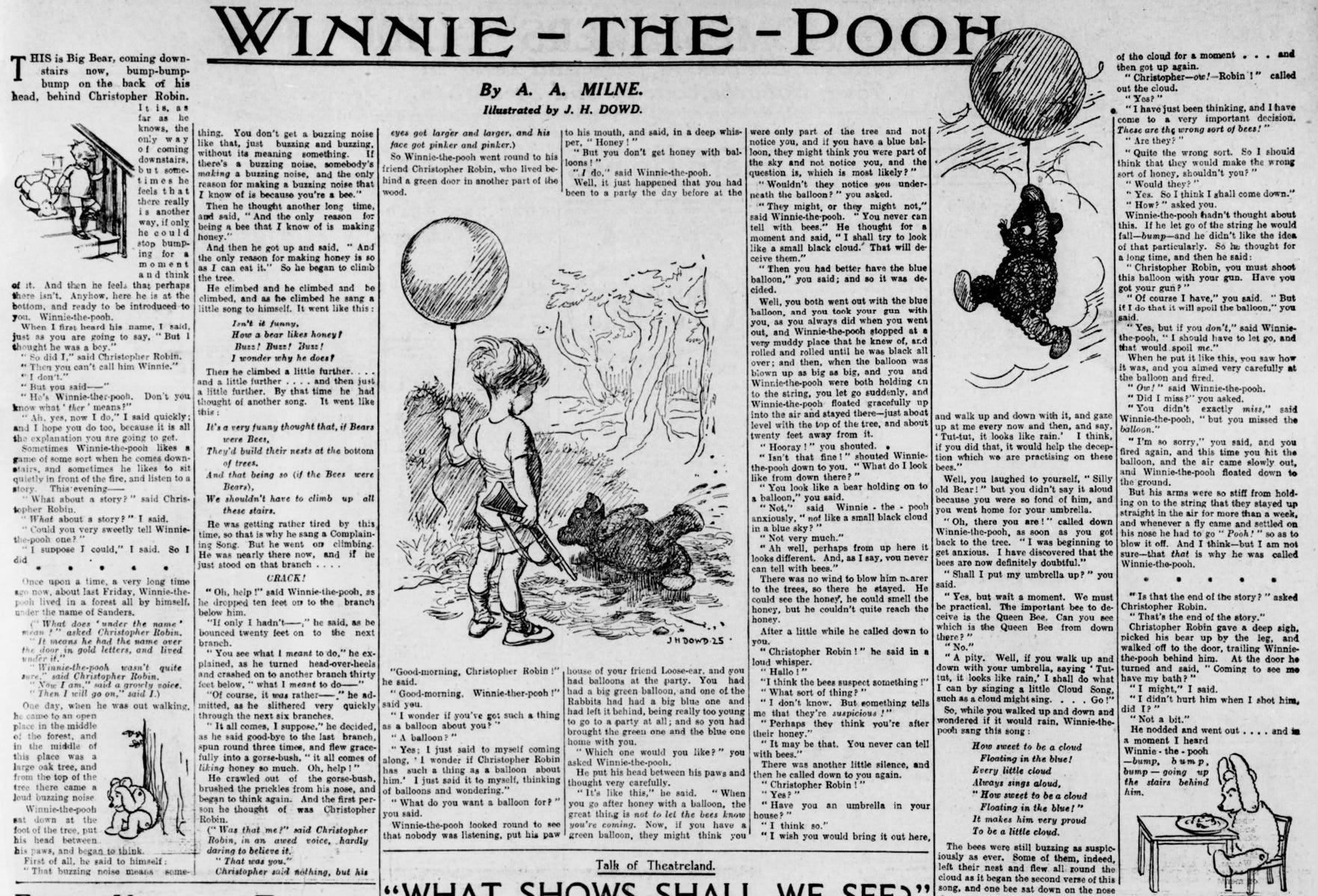
It wasn’t technically Pooh’s first rodeo, so to speak – the character was originally called Edward Bear and appeared thus in Milne’s poem ‘Teddy Bear’ in Punch in February 1924, included in Milne’s collection of children’s verse, When We Were Very Young, later that year. And his first appearance as Winnie-the-Pooh was actually in a story written for the Evening News in London on Christmas Eve 1925 (you can see it pictured below).1
Plenty has been written in the past about A.A. Milne (1882–1956) and indeed what his son Christopher Robin Milne called “that love-hate relationship with my fictional namesake”2 – but in this short piece I’m not going to go into all that. I was curious to know what the initial reception of this classic work was – and it’s rather lovely to find that it was hugely positive.
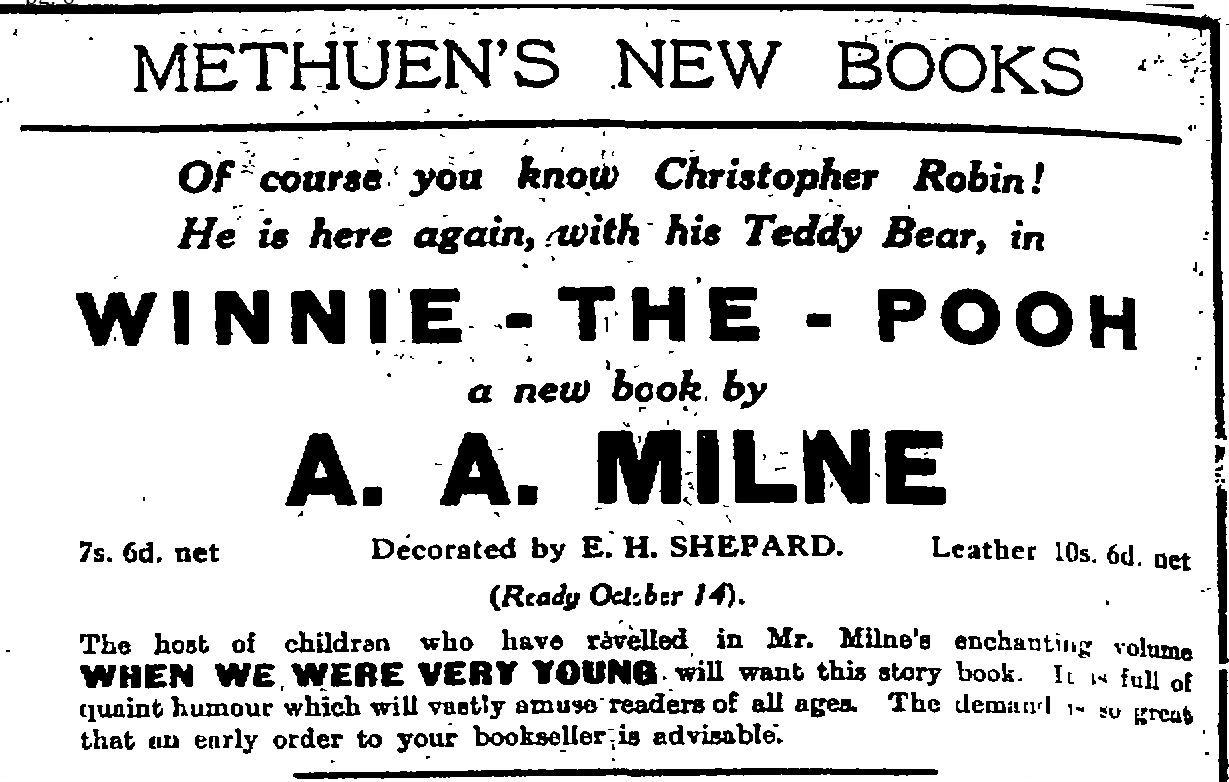
Certainly the first dedicated Pooh volume (it would be followed by the verse of Now We Are Six, 1927, and more stories in The House at Pooh Corner, 1928) was much-heralded. My combing through newspaper archives reveals that there were radio broadcasts of Pooh stories throughout 1926, well before the book was published.3 And the book itself was announced in advance, as any decent publisher would have been expected to do:
The earliest ‘review’ I could find was two days after the publication of Winnie-the-Pooh, a brief note in the Daily Mail:
This charming successor to “When We were Very Young will probably have as wide an appeal… Children and grown-up people will probably find equal pleasure in this latest work of Mr. Milne.
Writers in the US were particularly quick off the mark. Here’s what librarian and children’s book specialist Marcia Dalphin had to say on 17th October, just three days after publication, in the New York Herald Tribune:
Out of a sedate looking little green and gold book steps Winnie-the-Pooh, bashful and a bit out of breath (because of Stoutness), to make his bow to a waiting world…Mr. Milne says that the nicest people when they go to the Zoo go straight to the animal they love the most and stay there. So, though Rabbit comes into the story, and Eeyore, the gloomy donkey, and Owl and Roo and the other nursery animals, not forgetting Piglet… still it is Pooh who is the hero of the story, dear, comfortable, furry, silly old Pooh, the Bear of Very Little Brain, with weakness for honey.
Writers for children have done stories about bears often enough, but it has remained for Milne to discover to us in “Winnie-the-Pooh” the essential wistfulness of these great lumbering, blundering creatures. Others have shown their clumsiness, their heavy, halting intelligence, their occasional flashes of sly humor, their greediness. Pooh has all these; but he has something else as well—a disarming humility in the presence of his quicker-witted fellows, a longing for approval, a desire to be correct (did he not take Stoutness Exercises in front of the glass?), a—well, there’s no word for it but wistfulness—that goes straight to your heart…
As you read the conviction grows on you that Mr. Milne has done it again. There are not so very many books that, sitting reading all alone, you find yourself laughing aloud over. This is one of them. Here is nonsense in the best tradition; entirely plausible on the surface, as true nonsense always is, with good sense at its core, and the high seriousness about it that children and other wise people love. The illusion is perfect. You never forget that these are nursery animals, and that you exist as a reader only because you are allowed to see them through the eyes of a child.
And another early fan of Pooh was Harry Este Dounce, the chief reviewer for The New Yorker, a publication which itself only started in 1925. On 23rd October 1926, he wrote a review of a new biography of George Washington and immediately followed with this:
But the Book of the Week, and the book which should have come first, only lots of benighted executives won’t appreciate it, is a modest affair no thicker than your thumb, in a faintly plaided jacket, on which is a picture of a Little Shaver lying on his stomach, a corpulent yellow teddy-bear with a honey-pot before him, and a perky, although diminutive, toy pig.
It used to be a vice of feeble book-men like ourself to predict that every book they liked “will live.” We never did it. We’re going to, now, and would stake untold gold on our judgment.
Not to keep you in suspense, the pig’s Piglet, whom you have not met but the bear is Mr. Edward, whose being fat wasn’t “to be wondered at,” and who was consoled about his tubbiness on seeing a handsome King afflicted similarly—and if you don’t know him, why, heaven help you. Naturally, the Shaver is one Christopher Robin Milne…
The other characters are Rabbit, who is clever; Eeyore, who is doleful and a donkey—and is immense; Kanga, who is excessively maternal, and Roo, the baby in her pocket; Owl, who, like this department, dispenses long words in lieu of wisdom; and Christopher Robin in person… The book is as good as “When We Were Very Young”; if anything, better!
By 26th October, the Dundee Courier was gushing comparisons with our writer from last week:
No one tells stories quite like Mr Milne, for no one ever finds such stories to tell. The only one who ever did was a very learned Oxford don, an old bachelor who lived in old-fashioned rooms in college, and who, when he wasn’t doing sums that no one else could do, wrote the queerest and funniest nonsense, which he made into a book called “Alice in Wonderland”.
And I’ll finish this brief survey with the words of Edward Shanks – a WW1 war poet and early science fiction novelist4 – who wrote a joint review of Winnie-the-Pooh and Kenneth Grahame’s The Wind in the Willows (of which Milne was a huge admirer, and his most successful play was his adaptation, Toad of Toad Hall) for the Saturday Review on 30th October. Shanks focuses in particular on how the most enduring children’s classics appeal just as much to adults:
A good way to make a new book for children successful is to suggest that, once it is in the house, grown-ups and children will contend for the possession of it: a better way is so to write your book as to ensure that they will. Has any children’s book ever become a durable classic without this double appeal? I doubt it. The adult gets more out of Hans Andersen and Lewis Carroll than the child, and it is in the adult’s memory and enjoyment that these books are carried on from one generation of children to another.
The fact that this is so makes one from time to time a little self-suspicious. When we applaud Mr. Milne’s books and others like them, when we press them on our children, are we not perhaps indulging in a very hypocritical and sophisticated naivety? Is it really possible that the children can honestly enjoy what we ourselves enjoy so much?5
But when he tries “experimenting on the nursery”, his listeners clearly enjoy it – albeit with the pictures being of help. He is wary of predicting “immortality for Mr. Milne’s pleasant confection” – but of course we now know he could have done. Happy birthday, Pooh!
Hey, let’s end on a controversial question! If you could only keep one of these, which would it be?
What’s notable here is the illustrations were not by E.H. Shepard (famous for illustrating the published book) but originally by J.H. Dowd – and the images of Pooh being bumped down the stairs and being carried away by a balloon that Shepard later drew are very similar. Dowd was commissioned again by the Evening News to illustrate ‘The House at Pooh Corner’ in December 1926.
Shepard worked closely with Milne and is said to have used his son’s toy bear Growler as the chief model. And in fact it turns out that Shepard illustrated the original Punch story – so he did get there first after all. By November 1926, Shepard’s Pooh pictures were being exhibited at the Sporting Gallery in London’s Covent Garden.
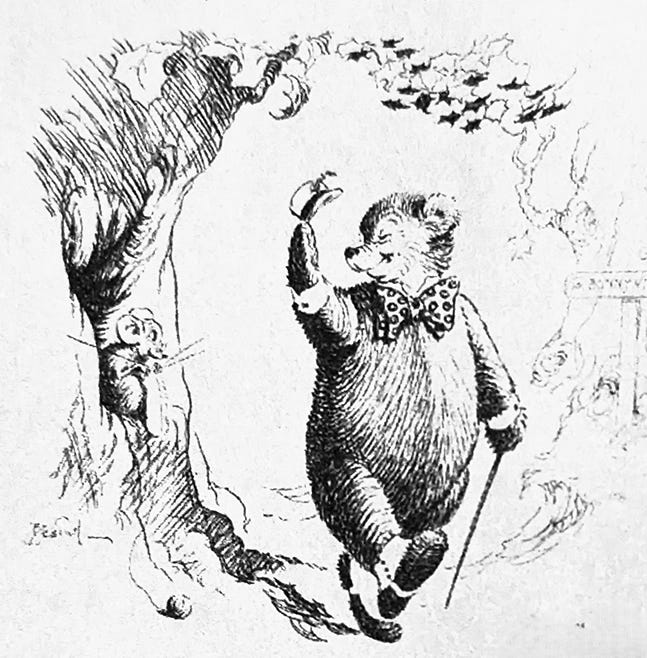
Another illustrator actually got in there between them, too – in February 1925, Alfred E. Bestall illustrated ‘Teddy Bear’s First Story’ in Eve: The Lady’s Pictorial. He would go on to make his own ursine success as writer and illustrator of Rupert Bear stories for over 30 years. This was his rather different version of Milne’s bear:
There’s even a 2018 Ewan McGregor film exploring it, Christopher Robin.
‘Winnie-the-Pooh goes visiting’ back in February, for example, ‘Winnie-the-Pooh finds a tail’ in July and ‘Winnie-the-Pooh goes hunting’ in August.
He wrote the 1920 post-apocalyptic novel The People of the Ruins, imagining a physicist awaking 150 years in the future into a neo-medieval society after being in suspended animation. Sounds fun!
Of The Wind in the Willows, he notes: “Here, if ever there was one, is a book with the double appeal, but rarely have the two been blended with equal confidence and intricacy.”