
In my previous piece I explored the history of how Alice’s Adventures in Wonderland came to be written. Clearly the title character was based upon a real person, Alice Liddell, but I was both surprised and pleased to learn that a number of the other people and creatures to participate in this tale (and Through the Looking-Glass, and What Alice Found There)1 were also, to greater and lesser extents, inspired by individuals that Carroll had encountered, and this week I will be telling you about some of their stories.
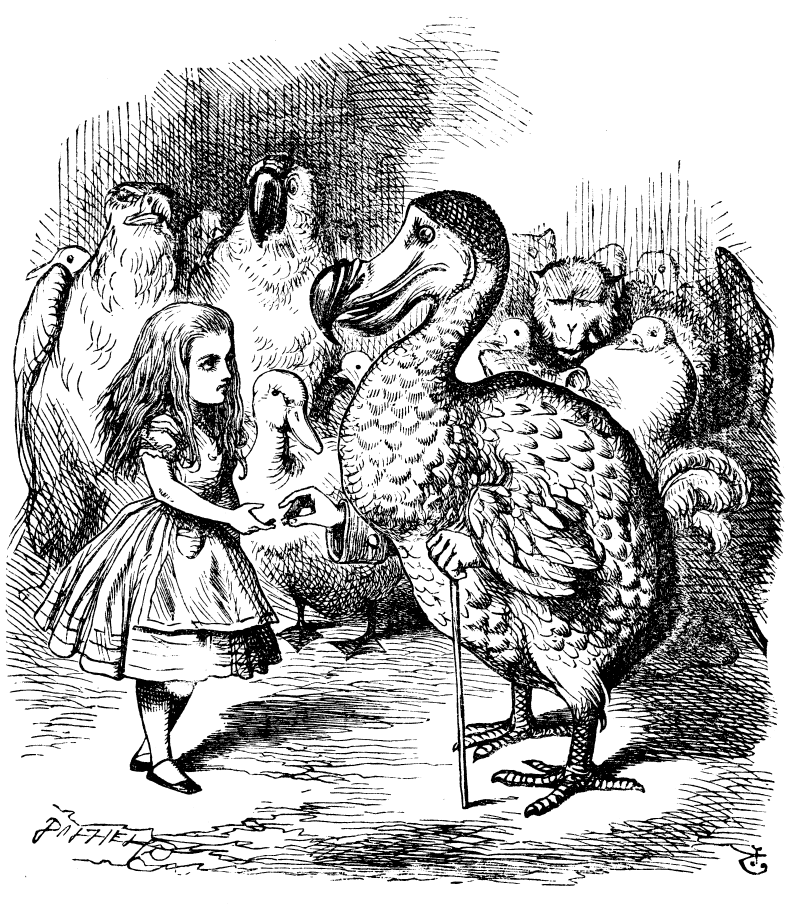
In the second chapter of Alice we find our protagonist escaping from the pool of tears in the company of four birds:
It was high time to go, for the pool was getting quite full of birds and animals that had fallen into it. There was a Duck and a Dodo, a Lory and an Eaglet, and several other curious creatures. Alice led the way, and the whole party swam to the shore.
This odd group have various adventures before going their separate ways, and we can figure out exactly who they are from a passage that was included in the original hand-written manuscript but not in the published book:
She sat for some while sorrowful and silent, but she was not long before she recovered her spirits, and began talking to herself again as usual: ‘I do wish some of them had stayed a little longer! and I was getting to be such friends with them—really the Lory and I were almost like sisters! and so was that dear little Eaglet! And then the Duck and the Dodo! How nicely the Duck sang to us as we came along through the water: and if the Dodo hadn’t known the way to that nice little cottage, I don’t know when we should have got dry again.
The four were her companions on that first boat trip up to Godstow where Carroll began telling the tale. Lory was her sister, Lorina (‘Ina’) and Eaglet her sister Edith. The Dodo2 was Lewis himself, most likely named in a manner to gently poke fun at his own stammer – in saying his real surname he would sometimes stutter “Do…do…Dodgson”. And finally, as readers of my previous piece will have already worked out, the Duck was Robinson Duckworth.3 Lest there be any doubt, Carroll inscribed the copy of Alice he gave to Duckworth “From the Dodo to the Duck”.
Besides Alice herself, arguably the most famous character in the books is the Mad Hatter. It seems likely that the author was inspired, at least in part, by the wonderfully named Theophilus Carter (1824–1904), a furniture dealer and cabinet maker who ran his own business on Oxford High Street. Generally described as an “eccentric” he was well known for standing in the doorway of his shop with a black top hat pushed back on his head and seemingly was known to locals as “The Mad Hatter”.
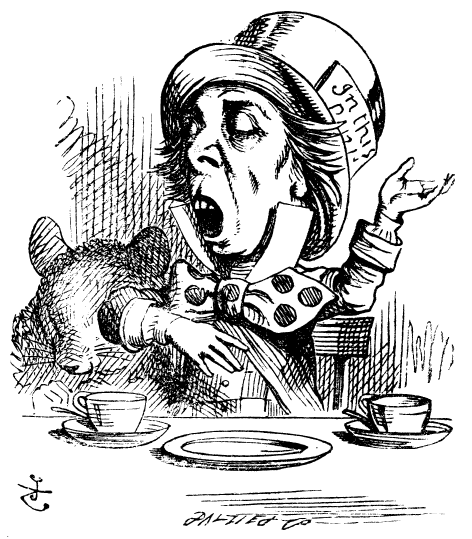
It is possible that before plying this trade he had worked as a servant in Christ Church College, and waited at Carroll’s table, but there is really no credible evidence to substantiate this. Writing to The Times in 1935 the Reverend W. Gordon Baillie claimed that Carroll brought Sir John Tenniel to Oxford to get a look at the man in order to base his illustrations for the book upon him:
Your correspondent, Mr. H.W. Greene, thinks that Theophilus Carter was unaware that he figured in “Through the Looking Glass” [sic] But all Oxford called him “The Mad Hatter,” and surely his friends, or enemies, must have chaffed him about it. He would stand at the door of his furniture shop in the High, sometimes in an apron, always with a top-hat at the back of his head, which, with a well-developed nose and a somewhat receding chin, made him an easy target for the caricaturist. The story went that Mr. Dodgson (“Lewis Carroll”), thinking T. C. had imposed upon him, took this revenge. In justice to the man’s memory, I may say that I possess a carved oak armchair which I bought from him, second-hand, 50 years ago. It is as good as ever, and the price was very moderate.
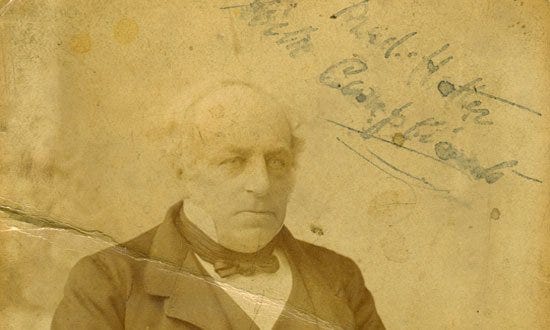
Next, let’s have a look at the Cheshire Cat. In my ignorance, before starting to research this piece, I had assumed that the notion of a grinning Cheshire cat had been purely the invention of Carroll. But no! The phrase had been around for decades before he used it, as shown by this entry in Francis Grose’s 1788 book A Classical Dictionary of the Vulgar Tongue:
CHESHIRE CAT. He grins like a Cheshire cat; said of any one who shews his teeth and gums in laughing
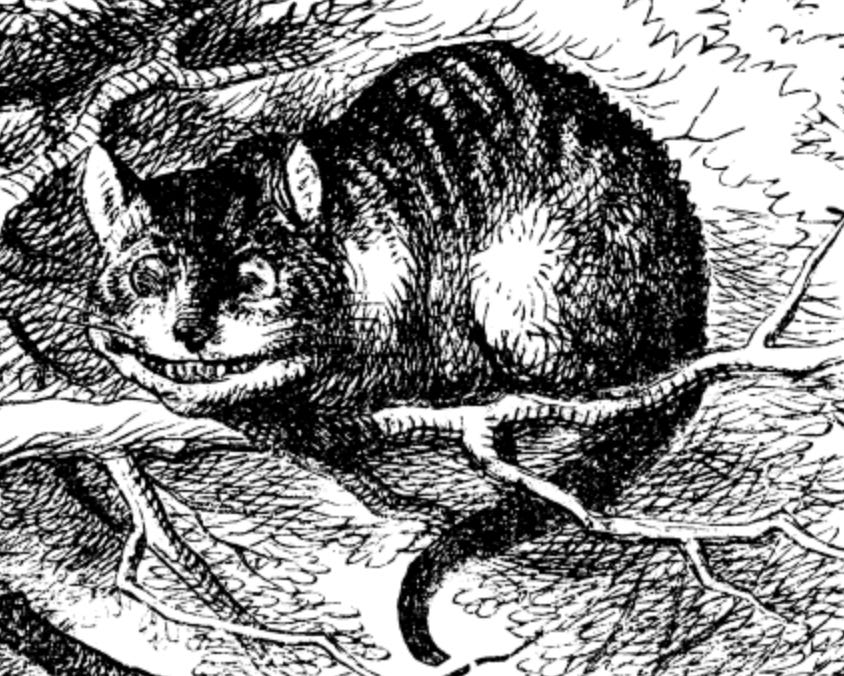
Back to Alice’s cat. One possible candidate is Dr Edward Bouverie Pusey (1800–1882) who in 1828, became Regius Professor of Hebrew at Oxford, with a canonry at Christ Church, so would have been well known to Carroll and the Liddell family alike. He became one of the key figures in the Oxford Movement (which strove to maintain the Church of England’s continuity with the early church with a strong focus upon its sacramental life) alongside John Henry Newman and John Keble. So significant was his influence that the movement’s adherents were called ‘Puseyites’. Why might he have been the inspiration for the toothsome feline? Well, the evidence is pretty tenuous I have to say, but it is essentially based upon Alice referring to him as “puss”.
The Cat only grinned when it saw Alice. It looked good-natured, she thought: still it had very long claws and a great many teeth, so she felt that it ought to be treated with respect.
“Cheshire Puss,” she began, rather timidly, as she did not at all know whether it would like the name: however, it only grinned a little wider.
Let’s move onto somewhat firmer ground. In Alice the Mock Turtle tells us about his old drawling [sic] master, the conger-eel:
“There was an old conger-eel, that used to come once a week: he taught us Drawling, Stretching, and Fainting in Coils.”
“What was that like?” said Alice.
“Well, I can’t show you myself,” the Mock Turtle said: “I’m too stiff. And the Gryphon never learnt it.”
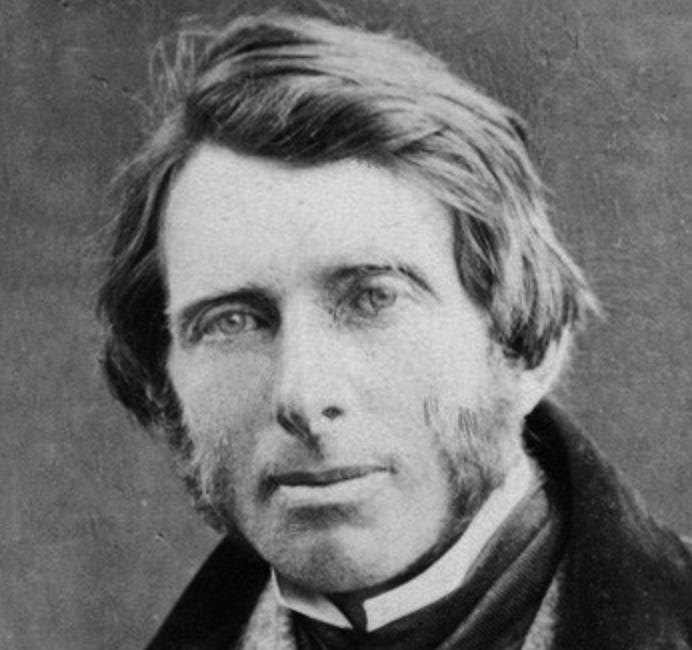
This alluded-to fish is based on none other than the great John Ruskin (1819–1900) who taught the Liddell children “drawing, sketching, and painting in oils”. He later also taught them woodcarving, a skill in which they gained great proficiency, the evidence for which can be seen to this day in the form of ‘Alice’s Door’ in St Friedeswide’s Church in Oxford. We have an account of Alice’s experience of being taught by Ruskin from this account by her son, published in 1932:
When much older, they went to the School of Art for drawing. This school was later taken over by Mr. Ruskin, who taught my mother to sketch. On one occasion he was telling her she had done a drawing very badly. ‘I’m sorry,’ said Alice. ‘Don’t be sorry, Alice, but don’t do it again,’ was Mr. Ruskin’s reply.
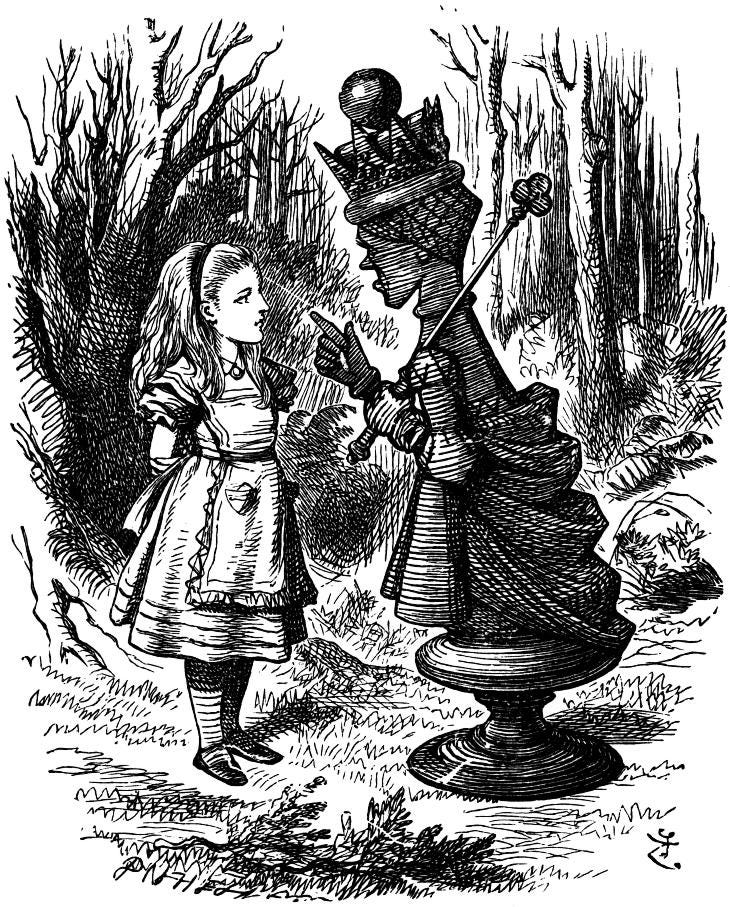
Not to be confused with the Queen of Hearts, there is another Alice royal, the Red Queen from Looking Glass. A clue to whom she might have been based upon can be gained from Carroll’s description of her:
The Red Queen I pictured as a Fury, but of another type; her passion must be cold and calm – she must be formal and strict, yet not unkindly; pedantic to the 10th degree, the concentrated essence of all governesses!
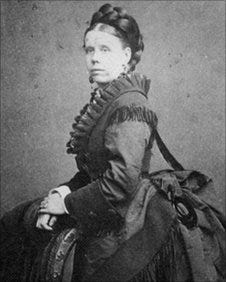
It seems probable that she was based upon Mary Prickett,4 later Mary Foster (1832–1920), the governess to the Liddell children.
Mary was born on the 3rd of January 1832 on Oxford’s Cowley Road, making her almost exactly Carroll’s contemporary. Her father, James Prickett, had worked as a wine merchant before becoming butler5 at Trinity College and she became governess to the Liddell children in 1855, aged 23. They met for the first time on the 3rd of November 1856, as he recorded:
Met Miss Prickett, the governess at the Deanery, walking with Ina, and settled that I would come over on Wednesday morning if it is fine. I also asked her to try and secure some of the Aclands coming over to be taken: there are five or six of them, and Southey says they are a beautiful family: I have only seen the eldest, Willie.
Little more than six months later, on the 17th May 1857, rumours had started to fly:
Took Harry Liddell to chapel, and afterwards walked back with the children to the Deanery. I find to my great surprise that my notice of them is construed by some men into attentions to the governess, Miss Prickett. I had a long talk with Joyce about it in the evening, and though for my own part I should give little importance to the existence of so groundless a rumour, it would be inconsiderate to the governess to give any further occasion for remarks of the sort. For this reason I shall avoid taking any public notice of the children in future, unless any occasion should arise when such an interpretation is impossible.
He did not, of course, end up cutting himself off from the children, otherwise Alice would not have been written,6 and Prickett remained in the service of the Liddell family until 1871. That year she married Charles Foster, a prosperous widower 24 years older than herself. He had been a substantial Oxford draper and was at that time a wine merchant. The couple went on to run the Mitre Hotel on Oxford High Street (which survives to this day as, err, an Italian restaurant) and did very well for themselves. Interestingly, Mary’s sister had already married Charles’s son, which meant that she was her sister’s step-mother-in-law, something that doubtless would have amused Carroll.
Speaking of the Queen of Hearts, did she have an inspiration from Carroll’s life? Sadly, probably not, though there has been some suggestion that Alice’s mother, Lorina ‘Ina’ Liddell could have been in his mind when he created her. It seems that she was a fairly formidable woman, and some say that she dominated her husband, the Dean of Christ Church, at least socially, much like the Queen dominated the King in the book. Indeed this verse about the couple circulated around Oxford at the time:
I am the Dean, this Mrs Liddell:
She plays the first, and I the second fiddle.
She is the Broad: I am the High:
We are the University.
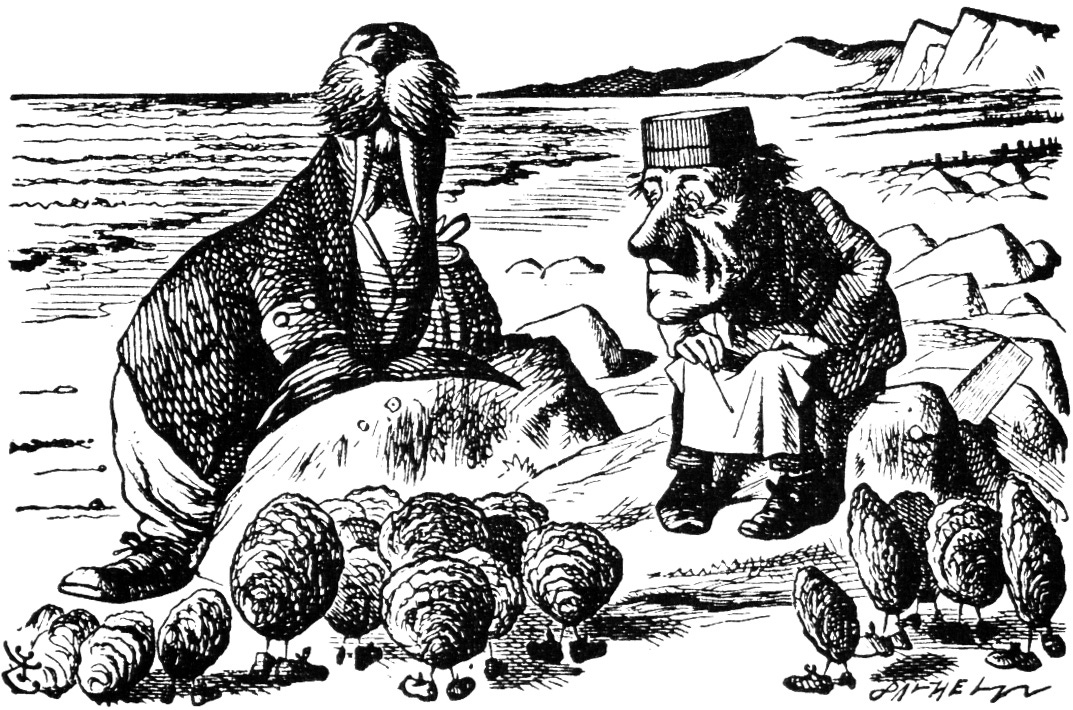
I led the piece with a picture of the Walrus and the Carpenter. Were they, perchance, based upon real people? Almost certainly not. And we can be pretty sure about this because the carpenter nearly wasn’t a carpenter! Carroll recalls that the illustrator, John Tenniel:
…remonstrated against the walrus and the carpenter as a hopeless combination, and begged to have the ‘Carpenter’ abolished—I remember offering ‘baronet’ and ‘butterfly’7… but he finally chose ‘Carpenter’.
Tenniel did, however have some impact upon the poem. Originally it went:
The Walrus and the Carpenter
Were walking hand in hand;
They wept like anything to see
Such quantities of sand
But the final, published version was:
The Walrus and the Carpenter
Were walking close at hand;
They wept like anything to see
Such quantities of sand
Why the change? Flippers. Tenniel, it seems, couldn’t figure out a way for a flipper-wielding beast to hold hands with the Carpenter!
Better known as Alice through the Looking Glass.
Do I think it weird that the Dodo has human hands in the illustration? Yes. Yes I do.
Duckworth went on, among other things, to become the tutor to Queen Victoria’s youngest son, Prince Leopold, and also officiated at the funeral of Charles Darwin. Quite wonderfully his memorial window in Westminster Abbey includes a duck: you can see it here.
Her nickname was ‘Pricks’, which seems unlikely to be appropriate today.
An interesting note in the terms of class and status at the time. Although he worked as a college servant, he also had domestic servants in his own home.
Though, as noted in my last piece, it is possible that similar chatter caused his schism with the Liddell family in 1863.
I think that either of these would have been way worse choices, but at the same time it is fascinating to see how Carroll was happy to tweak his text if need be.