
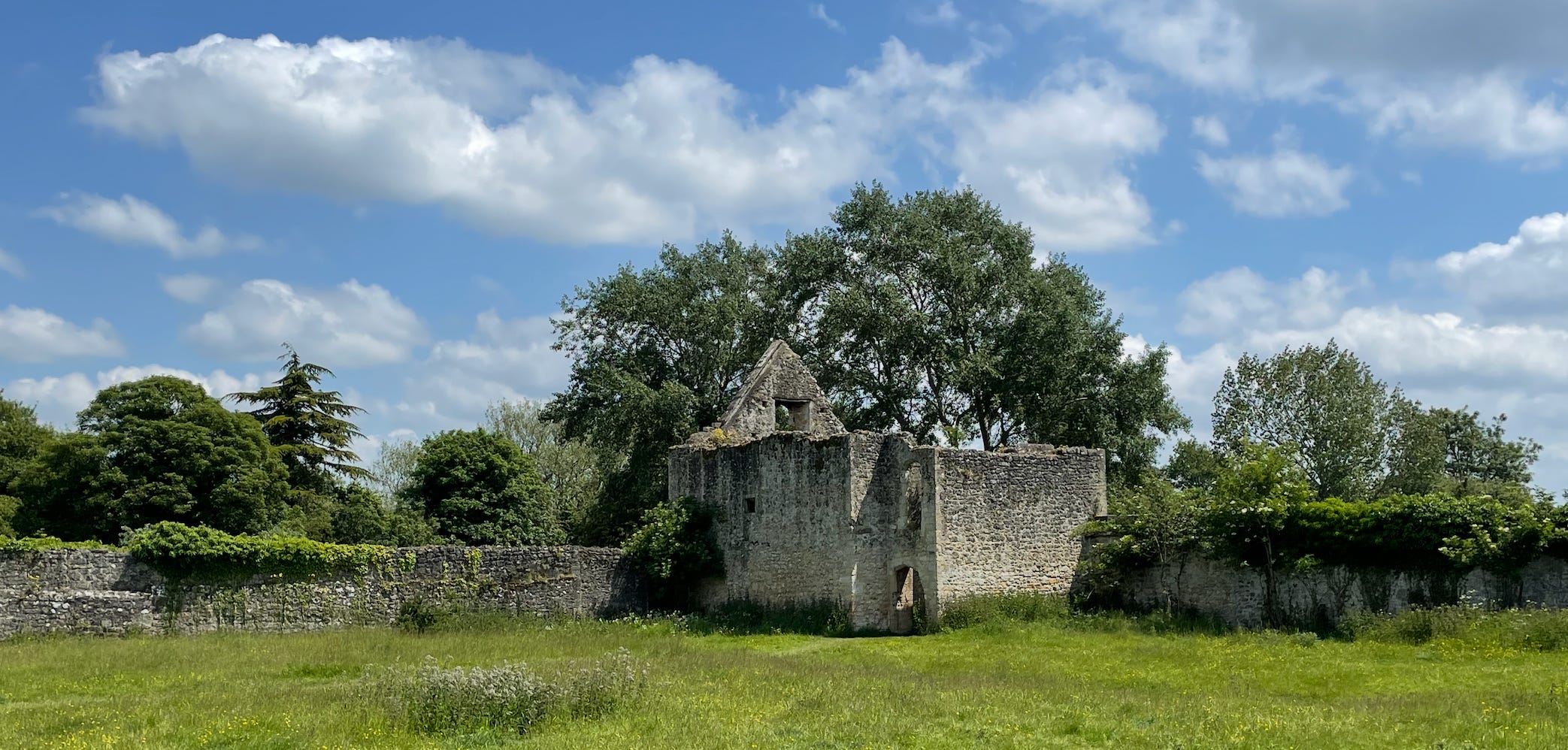
As regular readers of these pieces will know, I live in Oxford, a few yards from the River Thames. One of my favourite regular walks is to stroll around three miles up to the ruins of Godstow Abbey. It is a place that has so fascinated me that I once wrote a meticulously researched, but wholly bogus, mythology1 about it as part of a wildly complex treasure hunt. I only ever intended this to be read by people taking part in the hunt, but it subsequently escaped into the wild. Oops! The place has a far greater claim to literary fame, however, because it played a key roles in the creation of one of the greatest works of children’s literature, Alice’s Adventures in Wonderland (aka “Alice in Wonderland”) and today I’ll be delving into the origins of this classic book.

Let’s begin with the story of its author, Lewis Carroll, or to give him his real name, Charles Lutwidge Dodgson. He didn’t wish to be published under his real name to keep it separate from his professional life, and came up with four options, two that were anagrams of his name and two that played with the Latin-based transformations of his forenames:
Edgar Cuthwellis
Edgar U. C. Westhill
Louis Carroll
Lewis Carroll
He shared these with Edmund Yates, the editor of The Train magazine, in February 1856, and Yates, obviously, selected the fourth. Personally I find it fascinating that Alice could have been written by one “Edgar Cuthwellis”!2
Dodgson was born on 27 January 1832 in Daresbury, Cheshire, the third of eleven children and the eldest son. His father, also Charles Dodgson, was an Anglican clergyman who had distinguished himself at Oxford in mathematics and classics. His mother, Frances Jane Lutwidge, came from the same extended family, being a first cousin of her husband. In 1843 the family moved to Croft-on-Tees where Charles senior became a rector and life in the large household provided young Charles with the perfect outlet for the imagination that would populate his later works. He created illustrated family magazines, entertainments, and comic verses, all filled with complex wordplay.
School life was, alas, more challenging for him. Dodgson suffered from a stammer that would plague him until his death. Sometimes this involved silent blocks, when he could not get a word out. His friend May Barber later recalled him suddenly stopping in the middle of telling a story, with his mouth open but no sound emerging. He attended Richmond School, before going up to Rugby in 1846, an experience he disliked intensely later, writing: “I cannot say that I look back upon my life at a Public School with any sensations of pleasure.”
In January 1851 he went up to Christ Church College, Oxford, to study mathematics, and its buildings would be his home for the rest of his life. He gained a first-class degree in maths in 1854 and began working as a lecturer there in around 1856, a role he would continue in until 1881. He was ordained as a deacon in 1861, and preached numerous sermons, but never actually became a priest.
1856 was a hugely significant year for the 24-year-old for three reasons. First, he took up photography, a complex and cumbersome process at the time, and over the next 25 years would produce over 3,000 pictures – all of which he developed and printed himself – which demonstrated great skill in portraiture. Then in March he had his first work published under the name “Lewis Carroll” in The Train. It was a serious, melancholic, poem titled “Solitude”, very different in tone to his more famous works. Here is a taste of it:
I love the stillness of the wood:
I love the music of the rill:
I love to couch in pensive mood
Upon some silent hill.Scarce heard, beneath yon arching trees,
The silver-crested ripples pass;
And, like a mimic brook, the breeze
Whispers among the grass.Here from the world I win release,
Nor scorn of men, nor footstep rude,
Break in to mar the holy peace
Of this great solitude.
Finally, and most significantly, on the 25th of April he met the three daughters of his friend Henry Liddell, the Dean of Christ Church, for the first time. This is how he recorded the day in his journal:
Went over with Southey3 in the afternoon to the Deanery, to try and take a photograph of the Cathedral: both attempts proved failures. The three little girls were in the garden most of the time, and we became excellent friends: we tried to group them in the foreground of the picture, but they were not patient sitters. I mark this day with a white stone.4
The girls were Lorina Charlotte Liddell, known as “Ina”, who was six, going on seven; Edith Mary Liddell, just a toddler, around two years old; and most famously of all, Alice Pleasance Liddell, who would turn four nine days later.
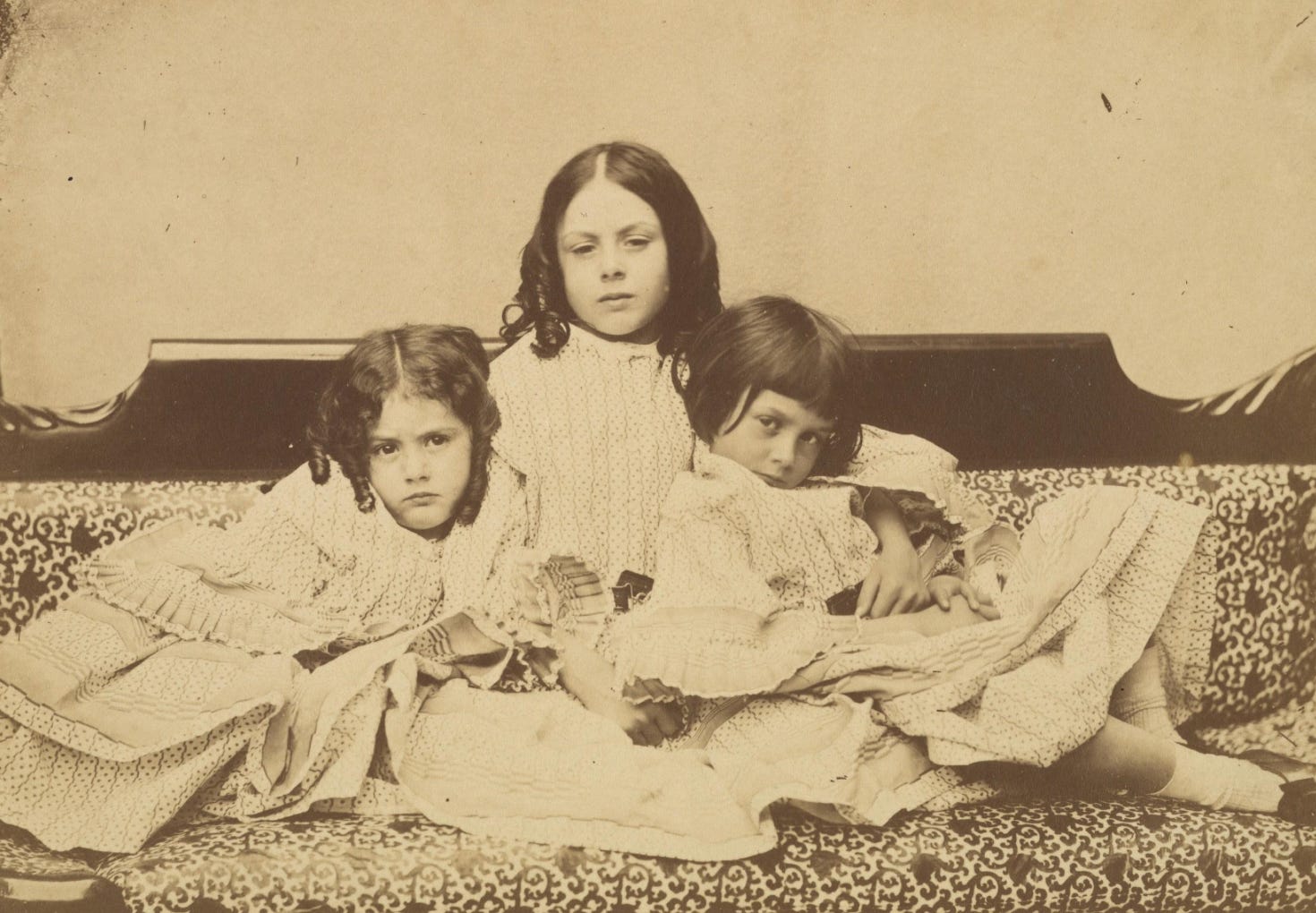
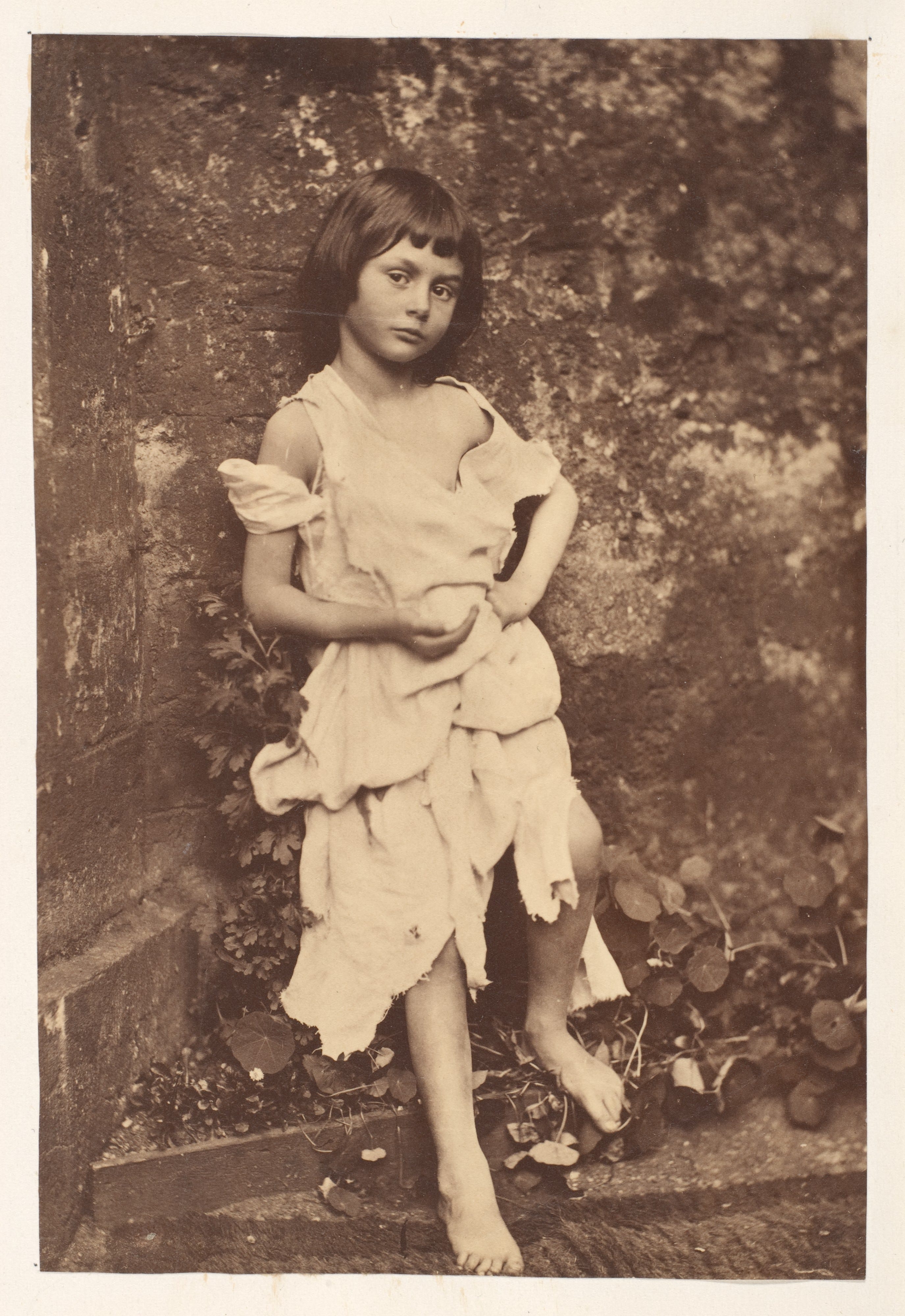
In the years that followed Dodgson would go out on excursions with the children, inventing stories and games to pass the time, and he would also photograph them. Some of these pictures were formal portraits, others were vignettes or character studies, such as this one of the six-year-old Alice as “The Beggar Maid” taken in 1858.5
Some of their days out involved taking a rowing boat down the Thames (probably hired from Salter’s Steamers, a company that still exists to this day!) but on a couple of occasions they ventured upstream, possibly because it meant that the journey home was running with the current, rather than fighting against it. It was on a walk, rather than a row, upstream that Dodgson first encountered Godstow Abbey, and we know precisely when this happened because he recorded it in his journal entry of the 19th May 1857:
Walked with Skeffington6 to Godstow, where, oddly enough, I do not remember ever being before.
He obviously liked the place because he chose it as the destination for an upstream row some five years later on the 4th of July 1862. In the boat were Ina, Alice, and Edith (then 13, 10, and 8 respectively) along with 27-year-old Reverend Robinson Duckworth (1834–1911) an academic, priest, and friend of Dodgson’s who sometimes joined such trips. It was a glorious summer’s day, as described by Dodgson recalling it in 1887:
Stand forth, then, from the shadowy past, ‘Alice,’ the child of my dreams! Full many a year has slipped away, since that ‘golden afternoon’ that gave thee birth, but I can call it up almost as clearly as if it were yesterday—the cloudless blue above, the watery mirror below, the boat drifting idly on its way, the tinkle of the drops that fell from the oars, as they waved so sleepily to and fro, and (the one bright gleam of life in all the slumberous scene) the three eager faces, hungry for news of fairy-land, and who would not be said ‘nay’ to: from whose lips “tell us a story, please,” had all the stern immutability of Fate!
Alice too had similar memories:
Nearly all of Alice’s Adventures Underground was told on that blazing summer afternoon with the heat haze shimmering over the meadows where the party landed to shelter for a while in the shadow cast by the haycocks near Godstow. I think the stories he told us that afternoon must have been better than usual, because I have such a distinct recollection of the expedition, and also, on the next day I started to pester him to write down the story for me, which I had never done before. It was due to my ‘going on, going on’ and importunity that, after saying he would think about it, he eventually gave the hesitating promise which started him writing it down at all.
Except… the meticulous weather records taken by the Radcliffe Observatory in Oxford tell us that the temperature that day got no higher than 20 degrees Celsius (68˚F) and that it was overcast7 with rain showers!
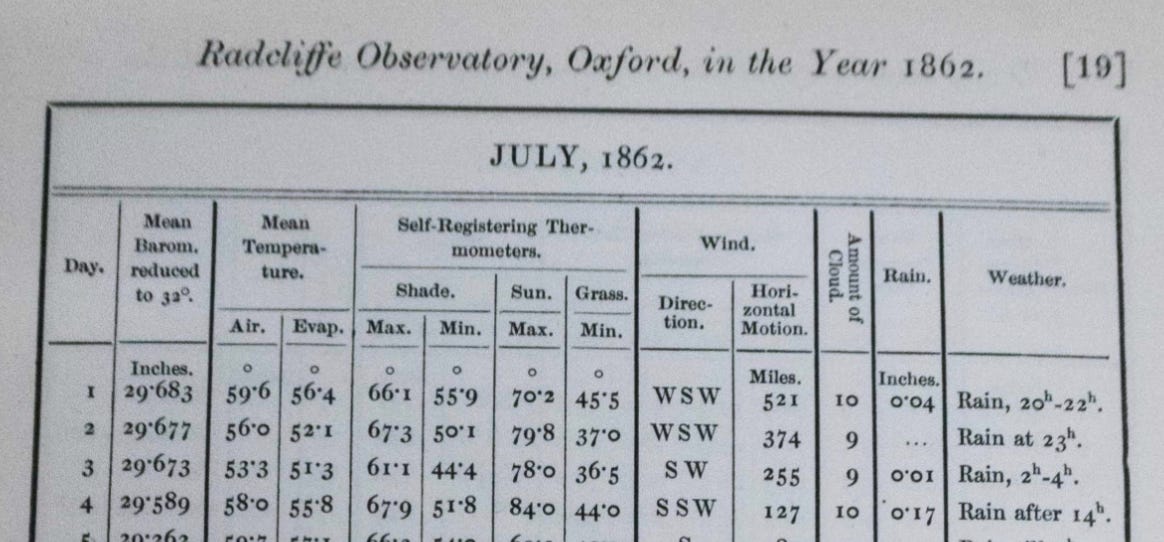
The weather is important, as it seems likely that it would made the girls more sullen and restive, and Dodgson therefore had to lean more heavily on his storytelling to keep them entertained. His journal entry for that day gives little clue that this day was the origin of a masterpiece:
Duckworth and I made an expedition up the river to Godstow with the three Liddells: we had tea on the bank there,8 and did not reach Ch. Ch.9 again till quarter past eight.
A later note, written on the opposite page, dated 10th of February 1863, does however speak to its significance:
On which occasion I told them the fairy-tale of “Alice’s Adventures Under Ground”,10 which I undertook to write for Alice, and which is now finished (as to the text) though the pictures are not yet nearly done.
Duckworth later recounted both the creation of the story, and that it was such a hit that Alice demanded that it be written down:
I rowed stroke and he rowed bow in the famous Long Vacation voyage to Godstow, when the three Miss Liddells were our passengers, and the story was actually composed and spoken over my shoulder for the benefit of Alice Liddell, who was acting as ‘cox’ of our gig. I remember turning round and saying, ‘Dodgson, is this an extempore romance of yours?’ And he replied, ‘Yes, I’m inventing as we go along.’ I also well remember how, when we had conducted the three children back to the Deanery, Alice said, as she bade us good-night, ‘Oh, Mr. Dodgson, I wish you would write out Alice’s adventures for me.’ He said he would try, and he afterwards told me that he sat up nearly the whole night, committing to a MS. book his recollections of the drolleries with which he had enlivened the afternoon. He added illustrations of his own and presented the volume, which used often to be seen on the drawing-room table at the Deanery.
It clearly required several trips for the complete story to be told, as a little over a month after the original expedition, on the 6th of August 1862, he recorded this:
In the afternoon Harcourt11 and I took the three Liddells up to Godstow12 where we had tea: we tried the game of “the Ural Mountains”13 on the way, but it did not prove very successful, and I had to go on with my interminable14 fairy-tale of “Alice’s Adventures”. We got back soon after 8.
A very enjoyable expedition, the last, I should think, to which Ina is likely to be allowed to come.15
It took Dodgson more than two years to hand-write and illustrate the first copy of Alice, sending it to its protagonist on the 26th of November 1864, with the dedication “A Christmas Gift to a Dear Child in Memory of a Summer Day.” He noted in his journal:
Text (of Alice’s Adventures Under Ground) finished before Feb. 10, 1863. Pictures in M. S. finished Sept. 13 (Tu.), 1864. M. S. finally sent to Alice, Nov. 26, 1864.
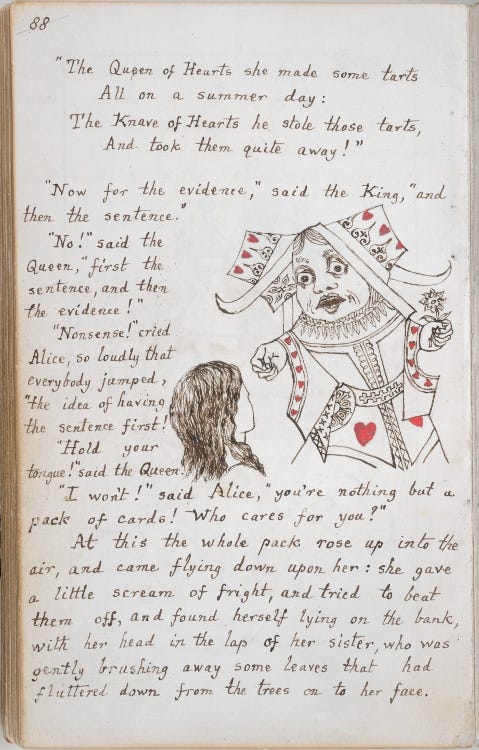
An expanded version, now titled Alice’s Adventures in Wonderland, with illustrations by John Tenniel, was printed for Macmillan in June of 1865, but the quality of the reproductions of the images was so poor that they were all returned. A reprint took place, and the book was finally published in November of the same year.
By this time, however, relations between the Liddells and Dodgson had cooled somewhat. On the 25th of June 1863 he had a day out with the girls, notably returning without any other adult chaperone. He considered it to have been a wonderful day:
About 10 o’clock Alice and Edith came over to my rooms to fetch me over to arrange about an expedition to Nuneham. It ended in our going down at 3, a party of ten. We had our tea under the trees at Nuneham, after which the rest drove home in the carriage — while Ina, Alice, Edith and I (mirabile dictu!)16 walked down to Abingdon-road station, and so home by railway: a pleasant expedition, with a very pleasant conclusion.
The next entry, for the 27th of June has Dodgson writing to Mrs Liddell requesting to photograph the children again, but it is only a snippet – the following page has been cut out of the journal. Clearly something very significant happened, as he writes in his entry for the 19th of December “It is nearly six months (June 25th) since I have seen anything of them, to speak of.” The following May saw him asking to be allowed another trip with the children, only to be rebuffed:
During these last few days I have applied in vain for leave to take the children on the river, i.e. Alice, Edith, and Rhoda: but Mrs. Liddell will not let any come in future — rather superfluous caution.17
Whole books18 have been dedicated to the various theories about what might have happened. A lot of speculation surrounds the fact that Dodgson liked to take pictures of young children, particularly girls, and in some cases (perhaps around 30 known) these girls were naked. Now you might think “Oh, it was the Victorian era, things were different then, that was quite normal” but Dodgson had to request explicit permission of the parents to take such pictures. In this letter, dated 28th of June 1876, he asks just that of the mother of nine-year-old Gertrude Chataway:19
If you should decide on sending over Gertrude and not coming yourself, would you kindly let me know what is the minimum amount of dress in which you are willing to have her taken? With that information, [I] will then be guided by her likings in the matter: children differ very much—with some that I know (Londoners chiefly) I would not venture to propose even taking off their shoes: but with a child like your Gertrude, as simple-minded as Eve in the garden of Eden, I should see no objection (provided she liked it herself) to photographing her in Eve’s original dress. And I think, if you were here and could see the photographs I have done of children in that primitive costume, that you would agree that it is quite possible to make such a picture that you might frame it and hang it up in your drawing-room.
But, much as I should myself like to have such a picture of her, if you at all object, or if she has changed her mind since I saw her (she was quite willing to be taken so, last September), of course I give it up, though I do not, once in a hundred cases, get so well-formed a subject for art.
Personally I am inclined to think that his interest in his subjects was artistic, rather than prurient. The Liddells had the picture of Alice as a beggar proudly framed on their wall, and, as mentioned above, the original copy of Alice was left for all to see years later. It seems pretty unlikely that had they suspected him of having an unhealthy interest in their child that they would have done so. But. But. But. In 1930 her sister Ina spoke to the biographer Florence Becker Lennon and, well, quite what she said is unclear, but we can get a sense of it from letters20 she subsequently sent to Alice:
I don’t suppose you remember when Mr Dodgson ceased coming to the Deanery?…I said [to Lennon] his manner became too affectionate to you as you grew older, and that Mother spoke to him about it, and that offended him so he ceased coming to visit us again – as one had to give some reason for all [social] intercourse ceasing. I don’t think you could have been more than 9 or 1021 on account of my age! I must put it a bit differently for Mrs. B.’s book.
Though in the preceding letter to Alice she wrote:
On thinking by myself, I think she tried to see if Mr Dodgson ever wanted to marry you!! She said he had such a sad face, and she thought he must have had a love affair…and it did not occur to me at the time what she perhaps was driving at!… I had no idea it was to be put in her book as from me!! However, thank goodness I am to see and correct it.
She also wrote, in the context of her conversation with Lennon, “I tremble at what I had said.” Was this discomfiture due to the revelation of some long-concealed secret? Or was it rather that she had, under pressure from a biographer, nearly seventy years after the events, come up with a spurious reason for “all intercourse ceasing”? I don’t have a dog in this fight; I am totally fine with separating the art from the artist. But I think that taking this as evidence that Dodgson had a sexual interest in Alice is placing oneself on shaky ground.
So what then really happened? We can get an idea from a note written by one of Dodgson’s nieces (which dates from around 1930) that details what was on some of the missing journal pages.
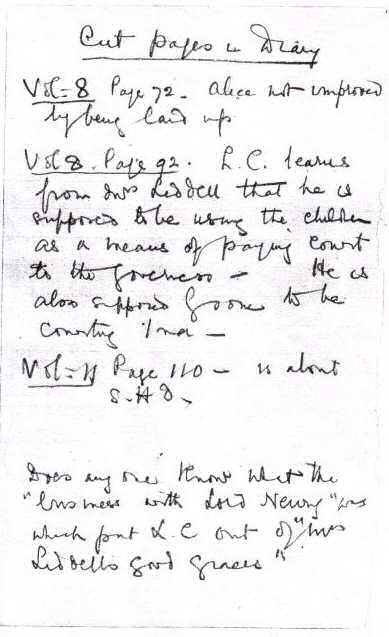
The key passage reads:
LC learns from Mrs Liddell that he is supposed to be using the children as a means of paying court to the governess — He is also supposed [by some?] to be courting Ina.
And the note at the bottom gives us a hint of possibly another explaination:
Does any one know what the “business with Lord Newry”22 was which put LC out of “Mrs Liddell’s good graces”?
The rumour that Dodgson had been romantically interest in the children’s governess, Mary Prickett,23 was not a new one, back in 1857 he mentions it in his journal entry for the 17th May 1857 (and then later adds a note making reference to the truncated June 27th 1863 entry):
Took Harry Liddell24 to chapel, and afterwards walked back with the children to the Deanery. I find to my great surprise that my notice of them is construed by some men into attentions to the governess, Miss Prickett.
I had a long talk with Joyce about it in the evening, and though for my own part I should give little importance to the existence of so groundless a rumour, it would be inconsiderate to the governess to give any further occasion for remarks of the sort. For this reason I shall avoid taking any public notice of the children in future, unless any occasion should arise when such an interpretation is impossible. (See June 27, 1863).
It is likely that we never know what really went on, and everyone has a theory. To me it seems unlikely that a resurfacing of old rumours about the governess could have caused such a schism. Perhaps he was seen alone on the train home with the girls, most notably the now fourteen-year-old Ina, and concerns were raised about the inappropriateness of this behaviour. Then there is the “business with Lord Newry” which seems most likely to have been a spat about the 1862 college ball, but possibly reflected a romantic interest that Newry might have had in Ina. Whatever the cause the relationship was not wholly severed, but it was significantly weakened. The idyllic days out ceased. Alice would go on to sit to be photographed by him again when she was eighteen, and a decade later loaned him the original Alice manuscript so that a facsimile edition could be produced.
Dodgson continued to have a brilliant career as a mathematician, and published many more works of what he would likely have termed “fairy-tale”. His enthusiasm for making up new stories for children on the fly remained undiminished also, as we can see from this letter written by one Mrs Bennie, wife of the rector of Glenfield:25
Next morning nurse took out our two little twin daughters in front of the sea. I went out a short time afterwards, looked for them, and found them seated with my friend [Dodgson] of the table d'hôte between them, and they were listening to him, open-mouthed, and in the greatest state of enjoyment, with his knee covered with minute toys. I, seeing their great delight, motioned to him to go on; this he did for some time. A most charming story he told them about sea-urchins and Ammonites. When it was over, I said, "You must be the author of ‘Alice’s Adventures.’” He laughed, but looked astonished, and said, “My dear Madam, my name is Dodgson, and ‘Alice’s Adventures’ was written by Lewis Carroll.” I replied, “Then you must have borrowed the name, for only he could have told a story as you have just done.” After a little sparring he admitted the fact, and I went home and proudly told my sister and brother how my genius had turned out a greater one than I expected. They assured me I must be mistaken, and that, as I had suggested it to him, he had taken advantage of the idea, and said he was what I wanted him to be. A few days after some friends came to Whitby who knew his aunts, and confirmed the truth of his statement, and thus I made the acquaintance of one whose friendship has been the source of great pleasure for nearly thirty years.
Dodgson never married, and died at his sister’s home in Guildford of pneumonia at the age of 65. But what of Alice? As she matured she displayed an interest in, and aptitude for, art. The John Ruskin taught her both drawing and woodcarving, and in December 1871, aged nineteen, she embarked on a European tour with her sisters, sketching the places they visited. In the 1870s she also posed for Julia Margaret Cameron, including portraits as figures from classical mythology.
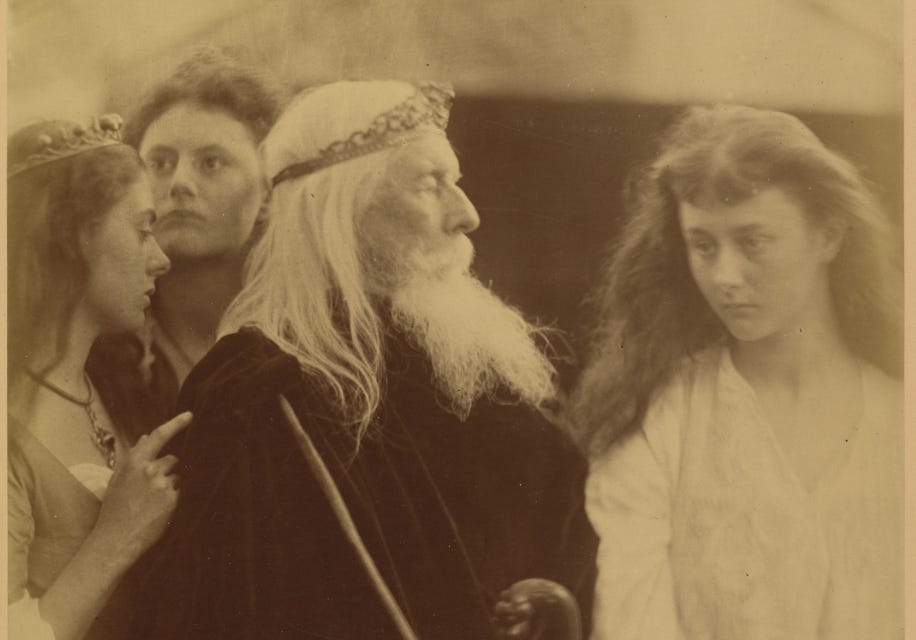
In 1880, at the age of 28, she married the wealthy landowner and cricketer Reginald Hargreaves, and they went on to have three sons, Alan Knyveton,26 Leopold Reginald, and Caryl Liddell.
After the death of her husband in 1926 financial pressures forced her to sell the original manuscript of Alice that Dodgson had given her more than sixty years earlier. Towards the end of her life she found, much to her astonishment, fame. This was due in no small part to the fact that most people had no idea that Alice was based upon a real person. In 1932, she travelled to New York27 for the centenary of Carroll’s birth where Columbia University awarded her an honorary Doctor of Letters on 2nd May. Two days later, on her eightieth birthday, she was the guest of honour at a celebration attended by approximately 2,000 people.
In her acceptance speech for her doctorate she said:
I feel very greatly the signal honor which you have conferred upon me. I shall remember it and prize it all my life. I love to think that, however unworthy I am, perhaps Mr. Dodgson—Lewis Carroll—knows, and rejoices with me in this honor.
She goes on to lament how many stories were lost because “he [Dodgson] never wrote anything down.” Incredibly, you can hear a very crackly recording of her speech here. This is the voice of Alice in Wonderland. On a personal note, I have to say that having been writing these pieces for a few years now it is the most amazing thing I have ever found!
Her relationship with her namesake was somewhat equivocal though, as she wrote to her son, late in life:
But oh my dear I am tired of being Alice in Wonderland.
She died in 1934, at the age of 82 and while she was clearly the inspiration for the most famous character in the works of Lewis Carroll, she wasn’t the only one. In my next piece I will be exploring some of the others. I should also add that if you have enjoyed this, I cannot recommend the book Alice in Waterland by Mark Davies highly enough.
A clear giveaway that it is fake is that the name of the alleged author of the piece is the same as Alice Liddell’s real-life husband.
I know that the text would have been the same, but I find it that name somewhat discombobulating! Lewis Carroll is obviously the best of the bunch – clearly Yates knew his business.
Reginald Southey (1835-1899) a doctor friend of Dodgson’s and a keen amateur photographer who was instrumental in introducing Charles to the art.
Dodgson would “mark days with a white stone” to indicate particularly special times, which he referred to as “white stone days”. He did so because the Romans associated white stones with favourable outcomes and black stones with unfavourable ones.
Don’t worry, we’ll come onto the appropriateness, or not, of his photography later on…
His brother, Skeffington Hume Dodgson (1836-1919) who also studied at Christ Church and became a vicar in Herefordshire. And yes, his first name was really “Skeffington”. No, I didn’t believe it either, but it is true!
As you can see on the record the amount of cloud for the day was the maximum “10”.
Note this contradicts Alice’s account of sheltering under hayricks. Were it a more miserable day then it makes sense that they would just picnic right by the boat.
Christ Church.
The original title of the book.
Augustus George Vernon Harcourt (1834–1919), usually called Vernon Harcourt, was an English chemist and a friend, and colleague of Charles Dodgson at Christ Church, Oxford.
I find it interesting that it was another trip to Godstow where the tale was continued and can’t help but think that it had become associated with the place in the minds of the children.
“The Ural Mountains” was a Victorian parlour game of improvised accusation and cross-examination: players invented an absurd story, then tried to catch the opposing team contradicting itself. It was invented by Henry Sidgwick, the Cambridge philosopher.
Wait, what?
It seems that she is somehow “ageing-out” of these trips, and that as she matures her parents don’t want her participating in them. Again, this will be explored more in a bit.
“wonderful to relate”.
I think that this phrase is probably the key the whole mystery. I read it as Mrs Liddell being concerned about Dodgson being seen out with the girls (something which he believes is irrational) so the issue is one of external perception, rather than that something tangible actually happened.
And a frankly somewhat dodgy documentary.
In 1876 he dedicated The Hunting of the Snark to her, its opening poem incorporates her name as a double acrostic. She could well be thought of as “the other Alice” but that might be the subject of another piece.
Full disclosure, the original sources for this are pay-walled so I am taking them from secondary reporting.
There is an article in the Smithsonian Magazine which says that Ina stated that she, rather than Alice, was nine or ten. They got it wrong. Am I pointing this out to be a bit smug that I noticed their error? Clearly yes.
Francis Charles Needham, 3rd Earl of Kilmorey (1842-1915).
More on her next time!
Brother to the girls.
Date of the letter unknown, most likely some time in the 1860s post-publication of Alice.
Yes, again, really his name.
This trip is the core of the 1985 film Dreamchild, written by Dennis Potter. It is at least 35 years since I last saw it, but I seem to remember that it was pretty good.