
Last time I told the story of the Secretary of the Bank of England being threatened at gunpoint by the troubled George Frederick Robinson, and I ended with a teaser about the Secretary’s other life. If you’ve heard the story before, you’ll know who he was – and it’s time to turn the spotlight more on him. His name was Kenneth Grahame.
Kenneth was born in Edinburgh in 1859. As I mentioned, his early life was touched with tragedy, with the death of his mother when he was only five and then estrangement from his father. But his schooldays were among his happiest, at the newly opened St Edward’s in Oxford, then right in the centre of the city (it would later move northward to the edge of town where it is today). There he won prizes, both sporting and academic, and became head boy.
(In 1913 he would be invited to write a piece for the school’s golden jubilee journal, which would be a charming short essay about the joys of solitary walking. I was recently invited to write an introduction to and annotate a new edition of this, and it’s now available to order in the U.S. from the wonderful Fiddler’s Green stable.1)
After school, denied a university education, he became a clerk as we saw last time, eventually promoted to the second most senior role at the Bank of England. But banking did not by any means take up all his time. In the late 1880s – in his thirties – he began writing short stories and essays for magazines.
These did well, and he was encouraged by the poet and editor William Ernest Henley2 to send a collection of his writings to a publisher. These were published in 1893 as Pagan Papers. This was quickly successful, aided no doubt by illustrations from the go-to artist of Decadence, Aubrey Beardsley. The book was soon followed by The Golden Age (1895) and Dream Days (1898). Across these books Grahame demonstrated a vision of childhood – intensely imaginative and at odds with the dull cares of adults, but also distinct from Victorian schmaltziness by recognising childhood can contain fear and disappointment – and of a quiet mysticism. All the while, of course, developing his own more staid career in the bank.
But becoming a parent himself is what led to his most famous work: The Wind in the Willows.
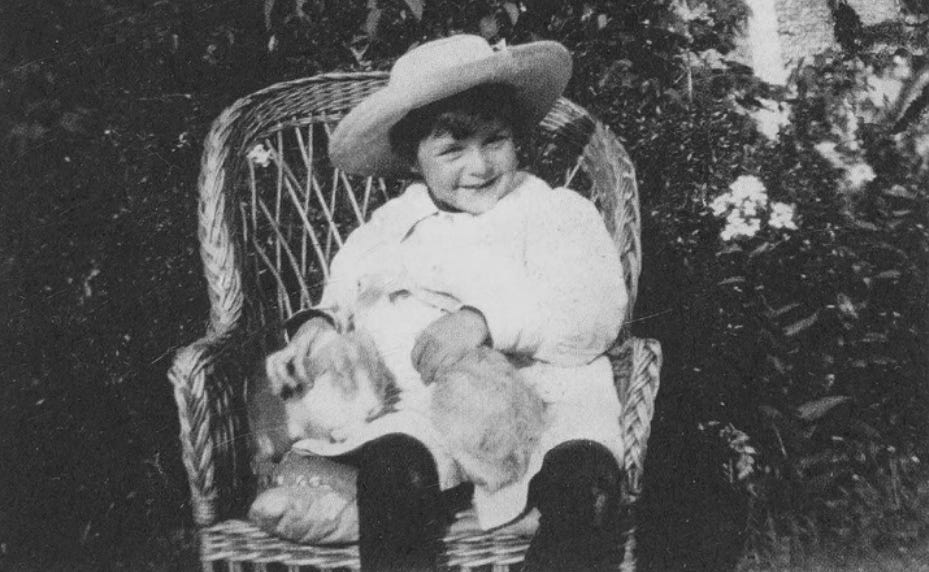
In 1897, Kenneth met aspiring writer (with one novella under her belt) Elspeth ‘Elsie’ Thomson.3 By all accounts, their marriage – they got hitched in 1899 – was an awkward one (and Kenneth’s sister Helen had tried to talk him out of it). She was loudly talkative and outgoing; he was solitary, stuffy and reserved. Many of their letters to one another were written in a weird baby language quite cringe-worthy to read today.4 But when they had a baby of their own, Alastair, born prematurely on 12 May 1900, he would become the focus of all attention.
Poor Alastair – soon known as Mouse – was born blind in one eye and with a squint in the other. Kenneth’s chief biographer Peter Green, observed rather bluntly: “He was a sickly, physically handicapped, sensitive but not over-bright child: and throughout his life he had to struggle with the image of himself which his mother created and steadfastly believed. Elspeth managed to convince herself—and did her best to convince everyone else—that Alastair was, in every respect, whether physical or mental, not only normal but brilliant. The boy’s whole life became a struggle to live up to the impossible ideal she set him…”
Alastair is hard to get a handle on, really – both peculiar (Green notes, “he used to lie dreamily in the middle of the road when motor-cars were approaching”) and precocious. In January 1905 (when Alastair was not quite four), Kenneth shared this anecdote about his son with a friend:
The other day when the doctor arrived he cocked his eye at his nurses whom he knew to be modest and shamefaced women beyond the ordinary, & began cheerily: ‘Hullo doctor! Are your bowels open to-day?’ One of the women stupidly begged him not refer to such things—‘it wasn’t nice’. This gave him the opening he wished for. ‘Not nice?’ he said furiously, ‘then what does he say it to me for? I didn’t begin it, he said it first!’
Stories of his personality abound: on one occasion he tried to break the bathroom door down because he wanted to speak to his bathing father; on others, he was known for kicking and hurting girls who were his contemporaries. There would be hints of Alastair in the infamous Toad.
By the time Mouse was four, Kenneth was inventing bedtime stories for him – with characters featuring “moles, giraffes and water-rats”.5 His public writing career had meanwhile largely dried up, a combination perhaps of the time-sink of parenthood and a residual shock from the Robinson incident at the bank.6
But all was not lost. In May 1907, Kenneth started to formalise those bedtime stories in the form of letters to his son. (He and Elise had taken off on holiday without him, and they were read to Alastair by a governess.) They initially began addressed to ‘My Dearest Mouse’ – but in a strange twist, from July seven-year-old Alastair insisted he should be addressed in them as ‘Robinson’, the name of course of Kenneth’s gun-wielding antagonist at the bank. Was this childish parroting of a name he had heard, a need to hurt his father for his absence from home or a more general note of spitefulness? (Mouse, for his part, would sometimes sign off as “thine bad boy”.) There’s a lot going on in these family dynamics, and it’s not my place to psychoanalyse.7
Urged on by Elsie, in 1908 Kenneth wrote these stories up, expanding them into a full-length book, initially intended to be published as The Wind in the Reeds (the name was changed for being too close to The Wind Among the Reeds by W.B. Yeats. The book struggled at first to find a publisher, and owed its success to Scribners in America more than Methuen in Britain. And, in fact, this might have been thanks to US President Theodore Roosevelt. He was already a fan of Kenneth’s works, and the author sent him a typescript of this new one, which Roosevelt said Scribners should publish!
In the same year, Grahame left from the Bank of England at last, though on health grounds. He would spend much of his retirement on walks around the River Thames, where his famous characters messed about in boats, or up on the ancient Ridgeway not far away. He would not write any more books.
As for Alastair, alas, life was not to go well. After happy times at school in Dorset, he was less so at Rugby School, Eton and then Christ Church, Oxford. In 1920, just five days before his 20th birthday, his body was found on a railway line near Oxford – the verdict was accidental death, but there were suspicions he had taken his own life.
After his death, Kenneth and Elsie would spend some years in Italy. J.L.G. Crookston, holidaymaker who encountered the author there on a walk, would reminisce in 1957:
He was a remarkable-looking man, striding across hill and dale, his Inverness cape swirling around him, his hair all swept up by the wind. On and on he went, solitary, absorbed in his own thoughts, until he vanished in the distance. I think he was deeply grieved over the loss of his son and I hesitated to intrude on his self-imposed isolation.
Kenneth and Alastair are now both buried at Holywell Cemetery in Oxford. Elsie, meanwhile, lived 14 more years after Kenneth’s death in 1932, and for all her frustrations with him in life, she would be the strongest advocate of him and his works.
As a final word from Kenneth Grahame himself, let’s finish on a lighter note. In 1919, a Professor Hill at the University of London was motivated to write to the author asking who had looked after Mole End, and fed Mole’s goldfish, while Mole was away on his adventures with Ratty. Grahame replied from his home in rural Blewbury as follows:
DEAR SIR,
The very natural inquiries contained in your kind letter which reached me this morning are probably best answered by a simple reference to the hopelessly careless and slipshod methods of the author whose work you are criticizing. But it may perhaps be pointed out in his defence, that Mole, though unmarried and evidently in rather poor circumstances, as incomes go nowadays, could probably have afforded some outside assistance say twice a week or so, indeed, living as he did, it would be almost a necessity. He probably then had a char-mouse in for a few hours and her dinner on certain days, and the animal would have cleaned up his whitewashing mess in a perfunctory sort of way: then, finding that her weekly pittance was no longer forthcoming, quite naturally and properly would have taken her services elsewhere, though from kindness of heart she might have continued to give an occasional eye to the goldfish.
In support of his theory, I would ask you to observe that our author practises a sort of “character economy” which has the appearance of being deliberate. The presence of certain characters may be indicated in or required by the story, but if the author has no immediate use for them, he simply ignores their existence. Take this very question of domestic service—however narrow poor Mole’s means may have been, it is evident that Rat was comfortably off—indeed I strongly suspect him of a butler-valet and cook-housekeeper. Toad Hall, again, must have been simply crawling with idle servants eating their heads off.
But the author doesn’t happen to want them, so for him they simply don’t exist. He doesn’t say they are not there; he just leaves them alone. To take another instance—the wretched fellow, ignorant as he is, must have known perfectly well that the locomotive on which Toad escaped required the services of a stoker as well as an engine-driver, but he didn’t happen to want a stoker, so he simply ignored him.
I think you will find that this same character-economy runs through all the classic old fairy-tales and our author probably thought that he was sinning (if sinning at all) in very good company. The modern method leaves so little to the imagination of the reader that it describes with insistent particularity the appearance of the taxi-driver who did not say “Thank you” to the heroine when she gave him 3d. above the legal fare from South Audley Street to Waterloo. Our author would have treated a taxi exactly as he would treat a Magic Carpet (which indeed is just what it is) and would not have given the taxi a driver at all. And this is right, for not one passenger in a hundred is ever conscious of the presence of a driver at all. They only see at the end a paw thrust out into which they drop something, and the taxi vanishes with a snort. Probably Magic Carpets had drivers too, but the authors of old saw that they were unessential to their stories, and ignored them.
Yours very truly,
KENNETH GRAHAME
Henley’s own story is something I’ll look into next time…
She too was born in Edinburgh, in 1862. Her father Robert invented both the pneumatic tyre and the refillable fountain pen. But not at the same time.
For example, before they were married and when she was ill, he wrote to her: “Ope youre makin steddy progress & beginnin ter think of oppin outer your nest & avin a short fly round.” There’s a lot more where that came from.
What happened to the giraffes?
He was also reluctant to become a slave to writing for the public, describing himself as “a spring, not a pump”, and was said to have hated writing at this point.
Though one last note on this subject: by 1911, at school in Dorset, he had a nickname for his father. In a letter to Elsie, he wrote: “your humble servant is glad to hear… that Inferiority is doing some work at last!”
Beautiful, thank you. I wish we had both the time and space for such characters today, but life presses on frenetically, and to our detriment.
A delight!