
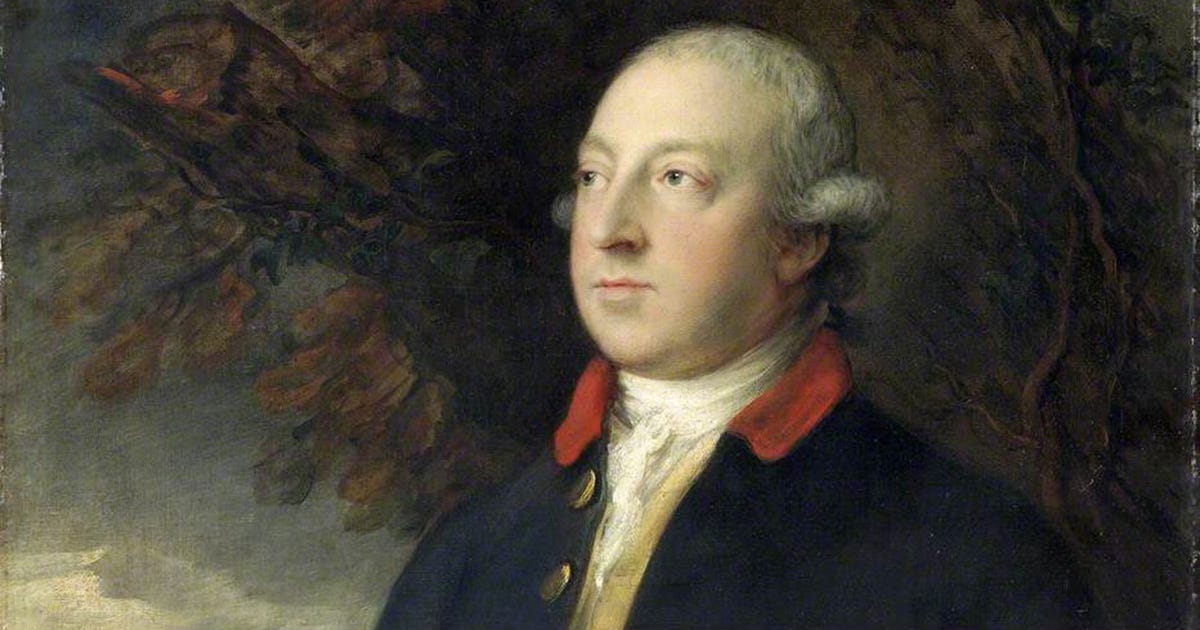
Last week saw the 250th anniversary of the birth of Britain’s perhaps most renowned landscape painter, John Constable,1 an occasion being fanfared across his native Suffolk with three exhibitions. But last week also saw another anniversary of someone immersed in his own landscapes as well as many others – someone who you might well have never heard of. That someone was Thomas Pennant, born 300 years ago on 14th June 1726. While far from the first British travel writer,2 I’d say he should at least be seen as a major founder of the genre.
Pennant spent his entire life residing at his family’s estate, Downing Hall near Whitford,3 not far from the north coast of Wales. That estate had been built by his great-great-grandfather John in 1627. Many of Pennant’s writings related to natural history – his first love was ornithology, then palaeontology, later broadening to zoology in general, his British Zoology (1776) being a particular landmark.
I say ‘entire life’ – but although Downing Hall was always his home, he spent much of his life travelling across Britain (and Europe), and it is his accounts of his tours which have particularly ensured his name passed down to posterity.
His first known trip was as an undergraduate, from Oxford to Cornwall in around 1746–7. In 1754, he went to Ireland, where he kept a short journal but this was never published. We can blame the craic, for in his words: “Such was the conviviality of the country, that my journal proved as maigre as my entertainment was gras, so it never was a dish fit to be offered to the public.”4 And in 1765, he undertook a Grand Tour of northern Europe – this was written up but not published until 1948 As A Tour of the Continent, 1765.
But it was his 1769 tour of Scotland which made his name when it was published two years later, and it is still in print to this day. His account was a popular success, and in fact was the inspiration for our old friend Samuel Johnson touring Scotland with James Boswell. Johnson was rare to praise people, but said of Pennant: “He’s the best traveller I ever read; he observes things more than anyone else does.”
And here’s Pennant’s own modest description of his own methodology in a letter to George Ashby: “I beg to be considered not as a Topographer but as a curious traveller willing to collect all that a traveller may be supposed to do in his voyage; I am the first that attempted travels at home, therefore earnestly wish for accuracy.”5
Pennant sets off from Chester and heads east to begin with. He gives us an interesting mixture of personal opinions, historical details from his research, notes on industry and social commentary. For example…
The road from this place to Macclesfield is thro’ a flat, rich, but unpleasant country. That town is in a very flourishing state; is possessed of a great manufacture of mohair and twist buttons; has between twenty and thirty silk mills, and a very considerable copper smelting house, and brass work…
After leaving this town, the country almost instantly changes and becomes very mountainous and barren, at least on the surface; but the bowels compensate for the external sterility, by yielding sufficient quantity of coal for the use of the neighboring parts of Chesbire…
The celebrated warm bath of Buxton is seated in a bottom, amidst these hills, in a most cheerless spot, and would be little frequented, did not Hygeia often reside here, and dispense to her votaries the chief blessings of life, ease and health. With joy and gratitude I this moment reflect on the efficacious qualities of the waters; I recollect with rapture the return of spirits, the flight of pain, and re-animation of my long, long crippled rheumatic limbs. But how unfortunate is it, that what Providence designed for the general good, should be rendered only a partial one, and denied to all, except the opulent; or I may say to the (comparatively) few that can get admittance into the house where these waters are imprisoned?
He continues all the way to the east coast and follows that northward to Scotland.6 Eventually, after taking in Edinburgh, he heads through Perth to Aberdeenshire, north as far as Caithness and then back down towards Glasgow via Fort William. Here’s another extract, where Pennant describes the Highlanders and their entertainments:
The manners of the native Highlanders may justly be expressed in these words: indolent to a high degree, unless roused to war, or to any animating amusement; or I may say, from experience, to lend any disinterested assistance to the distressed traveller, either in directing him on his way, or affording their aid in passing the dangerous torrents of the Highlands: hospitable to the highest degree, and full of generosity:7 are much affected with the civility of strangers, and have in themselves a natural politeness and address, which often flows from the meanest when least expected… [They] are excessively inquisitive after your business, your name, and other particulars of little consequence to them: most curious after the politicks of the world, and when they can procure an old newspaper, will listen to it with all the avidity of Shakespear’s blacksmith. Have much pride, and consequently are impatient of affronts, and revengeful of injuries…
Most of the ancient sports of the Highlanders, such as archery, hunting, fowling and fishing, are now disused: those retained are, throwing the putting-stone, or stone of strength, as they call it, which occasions an emulation who can throw a weighty one the farthest. Throwing the penny-stone, which answer to our quoits. The shinty, or the striking of a ball of wood or of hair: this game is played between two parties in a large plain, and furnished with clubs; whichever side strikes it first to their own goal wins the match.
The amusements by their fire-sides were, the telling of tales, the wildest and most extravagant imaginable: musick was another: in former times, the harp was the favorite instrument, covered with leather and strung with wire, but at present is quite lost. Bag-pipes are supposed to have been introduced by the Danes… the oldest are played with the mouth, the loudest and most earpiercing of any wind musick; the other, played with the fingers only, are of Irish origin; the first suited the genius of this warlike people, roused their courage to battle, alarmed them when secure, and collected them when scattered. This instrument is become scarce since the abolition of the power of the chieftains, and the more industrious turn of the common people.
Many more tours would follow:
1772: To Scotland again, from Chester through the Lake District, Dumfries and Glasgow, then beyond, published in 1774 as A Tour in Scotland, and Voyage to the Hebrides 1772.
1773: Mopping up more of Cumbria and Yorkshire, published posthumously in 1801 as A Tour from Downing to Alston Moor. There was also a 1777 follow-up, again published by his son David after Thomas’s death.
1773–76: Three journeys across his native Wales, published in various forms and gathered together in an omnibus edition of 1784.
1774: Northamptonshire and then the Isle of Man (only fragments of details survive).
1776: He later recalled visits to Warwickshire, Buckinghamshire, Nottinghamshire and Lincolnshire in this year, recalling a moment of jeopardy:
At Buckingham I narrowly escaped a death suited to an antiquary; I visited the old church at 8 o’clock in the morning of March the 26th. It fell before 6 in the afternoon, and I escaped being buried in its ruins.”
1777: Kent – London to Canterbury, Sandwich, Deal and Dover.
1780s: Published as The Journey from Chester to London in 1782, bringing together details from different trips, because every time he visited the capital, he tried to take a different route to maximise his experiences (“digressing to the right or to the left, as the places which merit notice happened to lie”)! He also published Of London in 1790.
1787: a tour of the West Country, unpublished. Also, journeys from London to Dover and thence to the Isle of Wight, with his son David, and published posthumously in 1801.
As if all that wasn’t enough (when was he ever actually at the home where he spent his ‘entire life’?), he also penned Outlines of the Globe, 18 volumes (some published, some not) of “imaginary tours… to climes more suited to my years, more genial than that to the frozen north”. All this plus numerous works of natural history and contributions to the Society of Antiquaries and the Royal Society,8 as well as a multitude of letters to luminaries of the day such as Carl Linnaeus, Gilbert White and Joseph Banks. When he died in 1798, at the age of 72, he must have been exhausted!
Pennant’s life was not untouched by tragedy – his first wife, Elizabeth Falconer, died in 1764 when his son David was still a baby; and in 1794 he lost a daughter by his second wife, Ann Mostyn. An injury to his knee in the same year “confined him long to his room” (as another writer on North Wales, William Bingley, recorded) “but he recovered from it in a wonderful manner”. And the impression I have is that he was a charming optimist.
Five years before he died, he wrote a brief autobiographical account, published whimsically as The Literary Life of the Late Thomas Pennant, Esq and mostly focusing on the history of his written works and what led to them. He begins: “The title page announces the termination of my authorial existence, which took place on March 1st, 1791.” He means the date of his last publication (Account of London) – though of course he kept going anyway. “May I remain possessed with the same passions till the great Exorcist lays me for ever,” he wrote. And a little later on:
My body may have abated of its wonted vigour; but my mind still retains its powers, its longing after improvements, its wish to receive new lights through chinks which time hath made.
And this is how his Literary Life ends, reflecting on his imaginary tours from his desk:
Happy is the age that could thus beguile its fleeting hours, without injury to any one, and, with the addition of years, continue to rise in its pursuits. But more interesting, and still more exalted subjects, must employ my future span.
What better way to approach the autumn of life?
Though I for one am on Team Turner.
We’ve previously met Celia Fiennes 50 years earlier, for example.
Amusingly, Pennant noted in a local history he wrote in 1796 that “Above three hundred yards from my house, on the opposite side of a dingle, stands another Downing, the seat of my worthy neighbor and friend Thomas Thomas… Before Mr. Thomas’s arrival, a fierce feud raged between the two houses, as usual in days of yore.” He goes on to describe how the residents of the other Downing would block the stream used by his family’s estate. A case of one-updowningship, perhaps? (Pennant’s Downing was demolished in 1953, though some outbuildings survive.)
You can read more about his Irish trip, and much else about Pennant, at the Curious Travellers website. There’s also a Thomas Pennant society, Cymdeithas Thomas Pennant, which organised 300th anniversary celebrations in his home town last weekend.
He also wrote of this tour: “I had the hardiness to venture on a journey to the remotest part of North Britain, a country almost as little known to its southern brethren as Kamtschatka.” And of his journeys in general: “I never lost an opportunity of enlarging my knowledge of topography.”
This is a relief, as I’m taking my own tour of the Highlands this summer.
In 1750, for example, he wrote in about a local earthquake in Wales – “I, who was in bed, was frequently moved up and down; and the bed, having casters, was removed some small space from its proper situation.”