
This week’s little stories from contemporary historical sources (and an announcement)…
Good riddance? 1661
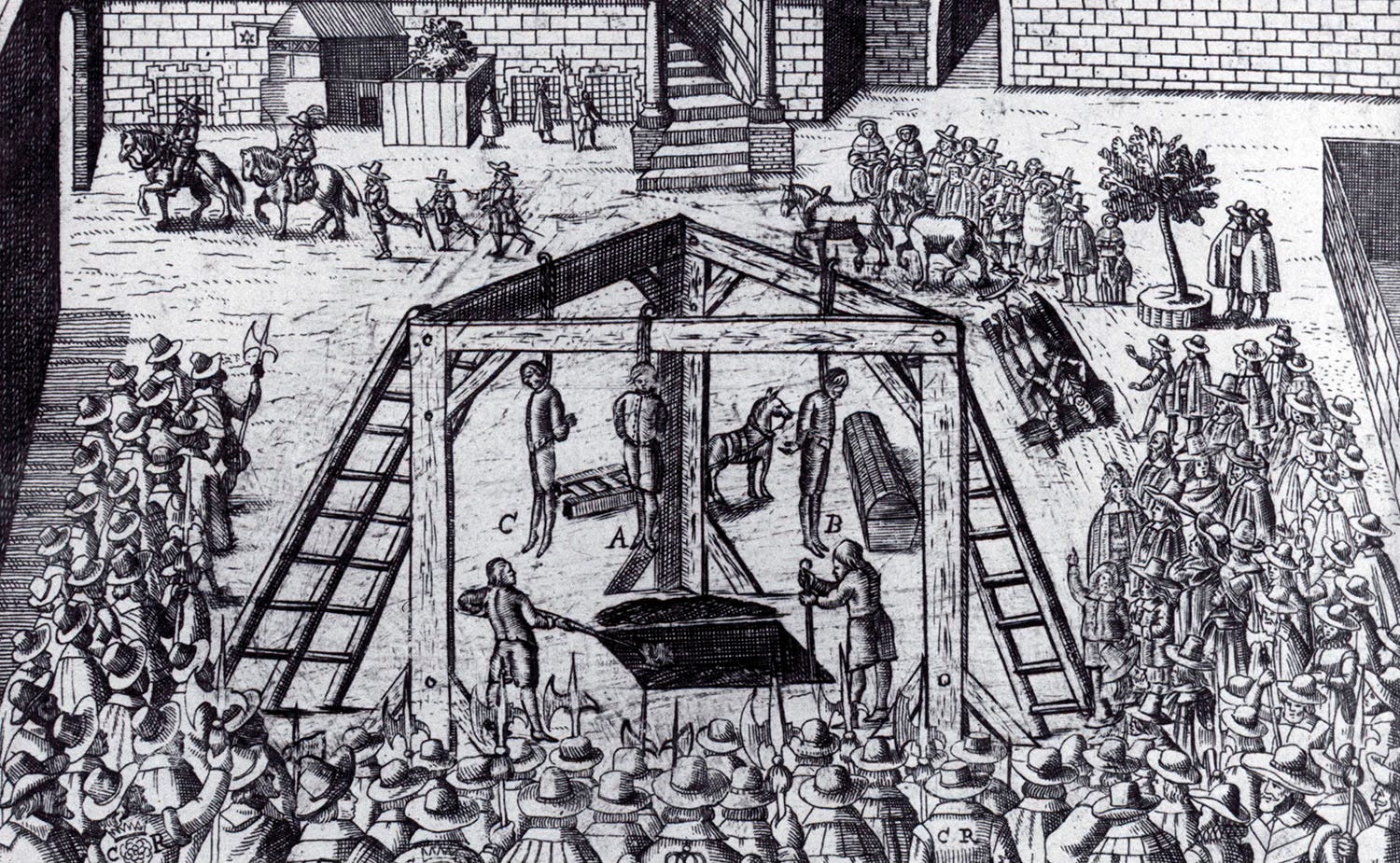
The Restoration of Britain’s monarchy in 1660 did not simply bring Charles II back to the throne; it reopened old wounds from the Civil Wars. None cut deeper than the execution of Charles I in 1649 – which happened on 30th January, in fact.1 Eleven years later, on the anniversary of that regicide, the restored regime staged an extraordinary act of symbolic vengeance: the posthumous execution of Oliver Cromwell, who had died peacefully in 1658. His corpse – exhumed, dragged to Tyburn, hanged, beheaded and displayed – was meant to rewrite memory itself: to show that even death did not absolve a regicide.
Londoners did not experience this as an abstract political lesson, but as a macabre public spectacle. Surprising, the diary of Samuel Pepys, who was generally present at all the big occasions in that era, does not directly cover this event, but he does say that his wife and a friend “are lately come back again from being abroad, and seeing of Cromwell, Ireton, and Bradshaw hanged and buried at Tyburn”. However, the editors of Pepys’s diary2 also quote a contemporary news journal, Thomas Rugge’s ‘Diurnal’, also known as Mercurius Politicus Redivivus:
This morning the carcasses of Cromwell, Ireton, and Bradshaw (which the day before had been brought from the Red Lion Inn, Holborn), were drawn upon a sledge to Tyburn, and then taken out of their coffins, and in their shrouds hanged by the neck, until the going down of the sun. They were then cut down, their heads taken off, and their bodies buried in a grave made under the gallows. The coffin in which was the body of Cromwell was a very rich thing, very full of gilded hinges and nails.
And for a more energised account, we need to turn to our old friend John Evelyn, 17th-century Britain’s other great diarist:
This day (Oh, the stupendous and inscrutable judgments of God!) were the carcasses of those arch-rebels, Cromwell, Bradshawe (the judge who condemned his Majesty), and Ireton (son-in-law to the Usurper), dragged out of their superb tombs in Westminster among the Kings, to Tyburn, and hanged on the gallows there from nine in the morning till six at night, and then buried under that fatal and ignominious monument in a deep pit; thousands of people who had seen them in all their pride being spectators. Look back at October 22, 1658 [the entry where Evelyn describes Cromwell’s funeral] and be astonished! and fear God and honor the King; but meddle not with them who are given to change!
Cromwell’s head remained on a spike above Westminster Hall for decades,3 a permanent warning embedded into London’s skyline. (We met Cromwell in better times a few months ago.)
Not quite goodbye, 1835
30th January is also a significant date in the life of another polarising figure in politics, this time in the United States. Andrew Jackson was a war hero turned populist president, he inspired fierce loyalty – and equally fierce hatred. On 30th January, as Jackson exited the US Capitol after a funeral service for a congressman, a house painter named Richard Lawrence stepped forward and fired a pistol at point-blank range. It misfired. Lawrence drew a second pistol. It misfired too. What followed was chaos, disbelief and one of the strangest scenes in presidential history: an elderly president beating his would-be assassin with a cane.
Private letters written in the days immediately after the attempt show how shocking the event felt to contemporaries, who had never imagined a president could be attacked so directly. For example, three days after the event, an eyewitness we only know as ‘H’ wrote the following to his wife:4
Nothing more of consequence is known of the man who attempted the President’s life… His name is Lawrence – a painter by trade and an Englishman by birth. His father died in this city where this fellow has long resided. The Opposition contend earnestly that he is insane. I have seen nothing as yet to make me believe it. The pistols were well laded – and it is impossible to account upon any known principles for their not going off.
I believe a special Providence saved the old Hero’s life. He (the Genl) behaved most gallantly upon the occasion, & if he had not been jerked back by his friend, would probably have knocked the 2nd pistol out of the fellow’s hand by striking his arm with a cane, – & would then have laid him out by another blow over the head!!! They say he was a foot taller than usual! He was the coolest man on the ground & can tell more about it than anyone else. He says after this he will lock arms with no man. Then his hands & arms will be free.
When his friends crowded close around him he said stand back gentlemen, I shall be stabbed by some unseen hand! Few men would have thought of it – but the precaution was very proper. An Assassin would run his arm thus between two men in a crowd and stab him – and no one see who did it. It is a great blessing to the Country that he did not fall. The excitement would have been fearful indeed!
Lawrence was tried and found not guilty by reason of insanity, becoming the first person in US history acquitted on that basis in a presidential assassination attempt. Jackson emerged bloodied but triumphant, reinforcing his image as indestructible. More quietly, the event reshaped thinking about presidential security and criminal insanity. The misfiring pistols – later blamed on damp weather – gave the episode an almost supernatural quality for contemporaries, many of whom believed Jackson had been spared by providence. Lawrence remained in insane asylums until his death in 1861.5
Farewell, 1901
When Queen Victoria died on 22nd January 1901, she had ruled for more than 63 years. Britain did not simply lose a monarch; it lost a living symbol of an age. Her funeral, held on 2nd February, was unlike any before it. At Victoria’s own instruction, it was to be a military funeral, not a black-draped state pageant.
For ordinary Londoners, the funeral was experienced from the pavement: hours of waiting, vast crowds and a silence broken only by marching boots. One of the most vivid contemporary records comes from a young woman’s diary, written the same day. The diarist in question is Katharine (Kate) Frye (1878–1959), an interesting character in her own right – a year after the events described below, she went to acting school, wrote plays of her own and went on to become a suffragist.6 Here’s what she had to say about Victoria’s funeral, having seen the crowds at Hyde Park and then walked to a grocery store in Edgware Road owned by her father, where she took up a viewpoint for several hours:
Miles and miles of soldiers – a regal soldier’s funeral truly and the most impressive one possible. We could see them coming half the length of the Edgware Road – from the Marble Arch and they looked like some long long wave. The brass helmets then the banners. I never took my eyes off the coffin whilst it was in sight – as if I couldn’t let our Queen go. Before the body had gone a band playing Chopin’s Funeral March and now ever will the scene come back to me when I hear those sad strains – that to me is the only Funeral March.
Some of the uniforms were magnificent – but the German Emperor had a Field Marshall’s uniform as had the King. I do love the Emperor’s face – he is so striking – I am glad to have seen him. The King looked round our way – so I saw him well – he looked very pale and puffy but nicer than I expected.
A similar account was given by 14-year-old Hester Fraser Tytler in a letter to her father a few days later:7
The road was lined each side with one row of soldiers, each touching the other, just 24 inches was allowed for each man, & behind them was a row of policemen, leaving a narrow passage in between, up which we often saw the ambulance men. The crowd was all as black as it could be just now, but when the procession came & they took off hats it looked all white faces so closely were they packed… The Duke of Norfolk was by himself a little in front on a very fidgety horse… Then came the King & the Kaiser & all the other Royalties, but I only made out the little Duke of Saxe Coburg, the Kings of Portugal & Greece & the Crown Prince of Germany. Then the closed carriages of the Princesses & the King of the Belgians & at the very end an enormous number of the different suites. We thought it was never going to end. The procession began to pass us at 11:30 & the end disappeared soon after 12:30. We waited a few minutes & then walked along Piccadilly to see the decorations which were all in white or purple. Every lamp post had a huge laurel wreath hung on it…
And thus the Victorian era was over.
Farewell… for now, 2026
And while we’re on a valedictory note, I’m hanging up my hat here at Histories – at least for now. After five years of writing articles here – more than 200 of them! – first every week, then every fortnight, I’m taking a sabbatical to work on a few other projects. My excellent friend and colleague Paul will still be here with a new ‘A history of…’ piece every two weeks – and both of us will occasionally write extra features in the gaps when we have something extra to share. Thanks for reading!
Meanwhile, if you’re into landscape, archaeology and folklore (mostly British, but not exclusively), I also edit a little magazine called Northern Earth on these subjects, which has a related free monthly newsletter:

But I haven’t covered it here because we’ve already had one monarch going to his execution only two weeks ago.
Until at least 1684 – then its whereabouts are unknown until 1710, after which various museums and collectors played hot potato with it until it was buried at Cromwell’s old Cambridge college, Sidney Sussex, in 1960.
One theory for his actions is that he had been exposed to toxic chemicals in paint. His story is a sad one: a couple of years before the assassination attempt, he was having delusions, including that he believed himself to be Richard III and was owed money by the British government – this led on to him believing that Andrew Jackson’s opposition to a national bank was preventing Lawrence from getting the money.
Her lifelong diary keeping is a major source for the day-to-day work of the suffrage movement. Her diaries were edited as Campaigning for the Vote by Elizabeth Crawford, who also wrote a biography of Frye. Elizabeth’s website is here.
The letter is preserved by the Highland Archive Service.
Thanks for all the hard work! I’ve really enjoyed the tidbits.
Thanks & Blessings to you for your continuing good works and good health! I appreciate your good work! Thanks again!