
This week’s little stories from contemporary historical sources…
Arrival, 1788
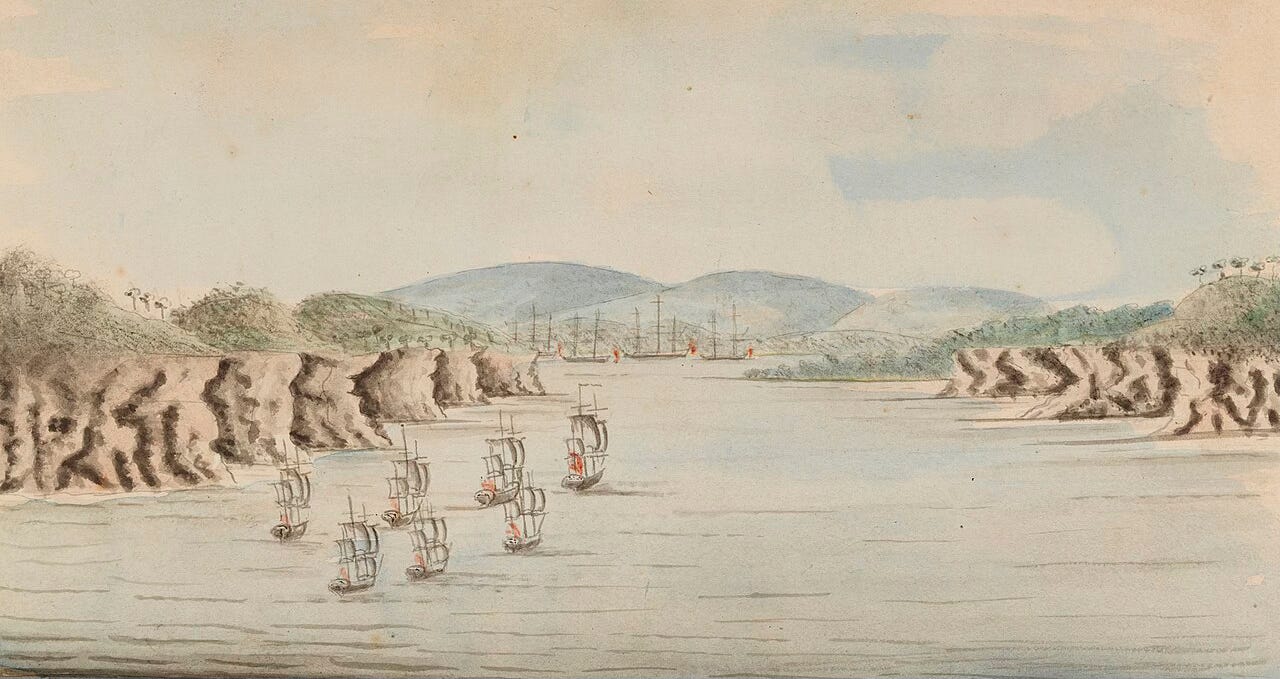
In 1787 the British government sent the ‘First Fleet’ – 11 ships carrying around 736 convicts plus marines and officials – to establish a penal colony on the far side of the world. The official destination was Botany Bay, charted by James Cook in 1770.1 Ships of the fleet arrived between 18 and 20 January 1788. One of the marine officers, Watkin Tench, later published A Narrative of the Expedition to Botany Bay (1789), based on his contemporary journal. It contains one of the most vivid on-the-spot descriptions of the First Fleet’s arrival and the decision, a few days later, to abandon Botany Bay for Port Jackson. Here’s his description of their arrival:
In running along shore, we cast many an anxious eye towards the land, on which so much of our future destiny depended. Our distance, joined to the haziness of the atmosphere, prevented us, however, from being able to discover much. With our best glasses we could see nothing but hills of a moderate height, cloathed with trees, to which some little patches of white sandstone gave the appearance of being covered with snow. Many fires were observed on the hills in the evening…
The wind was now fair, the sky serene, though a little hazy, and the temperature of the air delightfully pleasant: joy sparkled in every countenance, and congratulations issued from every mouth. Ithaca itself was scarcely more longed for by Ulysses, than Botany Bay by the adventurers who had traversed so many thousand miles to take possession of it.
“Heavily in clouds came on the day” which ushered in our arrival. To us it was “a great, an important day,” though I hope the foundation, not the fall, of an empire will be dated from it.
On the morning of the 20th, by ten o’clock, the whole of the fleet had cast anchor in Botany Bay, where, to our mutual satisfaction, we found the Governor, and the first division of transports. On inquiry, we heard, that the ‘Supply’ had arrived on the 18th, and the transports only the preceding day.
Tench ends his mostly upbeat account of their arrival with an interesting dig at the government:
Thus, after a passage of exactly thirty-six weeks from Portsmouth, we happily effected our arduous undertaking, with such a train of unexampled blessings as hardly ever attended a fleet in a like predicament. Of two hundred and twelve marines we lost only one; and of seven hundred and seventy-five convicts, put on board in England, but twenty-four perished in our route. To what cause are we to attribute this unhoped for success? I wish I could answer to the liberal manner in which Government supplied the expedition. But when the reader is told, that some of the necessary articles allowed to ships on a common passage to West Indies, were withheld from us; that portable soup, wheat, and pickled vegetables were not allowed; and that an inadequate quantity of essence of malt was the only antiscorbutic supplied,2 his surprise will redouble at the result of the voyage. For it must be remembered, that the people thus sent out were not a ship’s company starting with every advantage of health and good living, which a state of freedom produces; but the major part a miserable set of convicts, emaciated from confinement, and in want of cloaths, and almost every convenience to render so long a passage tolerable. I beg leave, however, to say, that the provisions served on board were good, and of a much superior quality to those usually supplied by contract: they were furnished by Mr. Richards, junior, of Walworth, Surrey.3
Tench goes on to describe the bay itself, the surf and reefs, and first encounters with Aboriginal people coming out in canoes. He is struck both by the apparent infertility of much of the soil around Botany Bay and by the skill of the local people with their spears and canoes. A few days later, he records Governor Phillip’s decision to explore Port Jackson to the north, and his return with news of “the finest harbour in the world” – which led to the move to what became Sydney Cove. From that decision flowed the growth of a vast settler colony and, ultimately, the modern state of Australia.
‘We are arrived’, 1793
Just five years after those Antipodean events and back in Europe, the French Revolution had dismantled the old monarchy. Louis XVI had been tried by the National Convention on charges including conspiracy against liberty and foreign intrigue. On 20 January the Convention condemned him to death; the next morning, 21 January, he was taken from the Temple prison to the guillotine in the Place de la Révolution. His confessor, the Abbé Henry Essex Edgeworth, accompanied him throughout the last night and final morning and later published a poignant narrative of these hours:
The King, finding himself seated in the carriage, where he could neither speak to me nor be spoken to without witness, kept a profound silence… The gendarmes, without speaking, seemed astonished and confounded at the tranquil piety of their monarch, to whom they doubtless never had before approached so near.
The procession lasted almost two hours; the streets were lined with citizens, all armed, some with pikes and some with guns, and the carriage was surrounded by a body of troops, formed of the most desperate people of Paris. As another precaution, they had placed before the horses a number of drums, intended to drown any noise or murmur in favour of the King; but how could they be heard? Nobody appeared either at the doors or windows, and in the street nothing was to be seen, but armed citizens – citizens, all rushing towards the commission of a crime, which perhaps they detested in their hearts.
The carriage proceeded thus in silence to the Place de Louis XV, and stopped in the middle of a large space that had been left round the scaffold: this space was surrounded with cannon, and beyond, an armed multitude extended as far as the eye could reach. As soon as the King perceived that the carriage stopped, he turned and whispered to me, ‘We are arrived, if I mistake not.’…
As soon as the King had left the carriage, three guards surrounded him, and would have taken off his clothes, but he repulsed them with haughtiness – he undressed himself, untied his neckcloth, opened his shirt, and arranged it himself. The guards, whom the determined countenance of the King had for a moment disconcerted, seemed to recover their audacity. They surrounded him again, and would have seized his hands. ‘What are you attempting?’ said the King, drawing back his hands. ‘To bind you,’ answered the wretches. ‘To bind me,’ said the King, with an indignant air. ‘No! I shall never consent to that: do what you have been ordered, but you shall never bind me…’
The path leading to the scaffold was extremely rough and difficult to pass; the King was obliged to lean on my arm, and from the slowness with which he proceeded, I feared for a moment that his courage might fail; but what was my astonishment, when arrived at the last step, I felt that he suddenly let go my arm, and I saw him cross with a firm foot the breadth of the whole scaffold; silence, by his look alone, fifteen or twenty drums that were placed opposite to me; and in a voice so loud, that it must have been heard it the Pont Tournant, I heard him pronounce distinctly these memorable words: ‘I die innocent of all the crimes laid to my charge; I Pardon those who have occasioned my death; and I pray to God that the blood you are going to shed may never be visited on France.’
He was proceeding, when a man on horseback, in the national uniform, and with a ferocious cry, ordered the drums to beat. Many voices were at the same time heard encouraging the executioners. They seemed reanimated themselves, in seizing with violence the most virtuous of Kings, they dragged him under the axe of the guillotine, which with one stroke severed his head from his body. All this passed in a moment. The youngest of the guards, who seemed about eighteen, immediately seized the head, and showed it to the people as he walked round the scaffold; he accompanied this monstrous ceremony with the most atrocious and indecent gestures. At first an awful silence prevailed; at length some cries of ‘Vive la Republique!’ were heard. By degrees the voices multiplied and in less than ten minutes this cry, a thousand times repeated became the universal shout of the multitude, and every hat was in the air.
So it goes. Within months, the Revolution slid into the radical phase known as the Terror, in which thousands were executed as ‘enemies of the people’, including Queen Marie-Antoinette and, later, many of the revolutionaries themselves.
Arrival, 1912
By January 1912, Robert Falcon Scott’s British Antarctic Expedition had been on the polar plateau for weeks, man-hauling sledges in brutal cold and thin air. They knew that Roald Amundsen’s Norwegian team was somewhere on the continent, racing them to be first to the South Pole. On 17 January, Scott’s polar party – Scott, Wilson, Bowers, Oates and Evans – finally reached their goal, only to find that Amundsen had beaten them there by about a month. Scott recorded the moment in his sledging diary, which survives and is now held (and fully transcribed) by the Scott Polar Research Institute. Here’s what he wrote:
Camp 69. T. -22º at start. Night -21º. The Pole. Yes, but under very different circumstances from those expected. We have had a horrible day – add to our disappointment a head wind 4 to 5, with a temperature -22º, and companions labouring on with cold feet and hands.
We started at 7.30, none of us having slept much after the shock of our discovery. We followed the Norwegian sledge tracks for some way; as far as we make out there are only two men. In about three miles we passed two small cairns. Then the weather overcast, and the tracks being increasingly drifted up and obviously going too far to the west, we decided to make straight for the Pole according to our calculations… We have been descending again, I think, but there looks to be a rise ahead; otherwise there is very little that is different from the awful monotony of past days. Great God! this is an awful place and terrible enough for us to have laboured to it without the reward of priority. Well, it is something to have got here, and the wind may be our friend to-morrow.
Scott’s party took photographs at the Pole, collected a few geological specimens as planned, and then turned north for the 800-mile return journey – now with morale shattered. (“Now for the run home and a desperate struggle. I wonder if we can do it,” he wrote.) The return was devastated by extreme cold, storms, injuries and scurvy. Evans died in February; Oates walked out into a blizzard in March; Scott, Wilson and Bowers died in their tent later that month, only 11 miles from a supply depot. Their bodies and diaries were found by a search party in November 1912. So it goes.
While we’re on January dates, it was on 17 January 1773 that Captain Cook set out on the first expedition to sail south of the Antarctic Circle, and on 18 January 1778 that he became the first known European to discover what he called the Sandwich Islands – Hawaii, of course. I wish my Januaries could be so productive.
There was a legend that a mystic or Louis himself had an apparition that he needed to Consecrate his kingdom to The Immaculate Heart of Mary which he failed to do....These anarchists tend to destroy their own for power. Robespierre went to the block too! We also have that famous painting: "The Death of Marat"....................Thanks for your fine work!
Was Australia a benevolent conquest, then?
Yes, French's six verbs whose past take être. Dont arriver. What a fantastic narration: on y est, lorsqu'il dit qu'on y est.
The scene is the French grammarian's example of how French and English differ in one particular respect, whilst both adhering to an undeniable logic: tout le monde se lève le chapeau: https://endlesschain.substack.com/p/every-little-counts.
I've considered Scott and Oates here: https://endlesschain.substack.com/p/i-am-just-going-outside-and-may-be. The South Pole may be an awful place, but the North Pole may yet be even awfuller.
Again, a super essay, thanks.