
Here’s the concluding part of my little three-part series while Paul has been away from his desk.
This week we begin at an ending – which would become a strange new beginning:
His head reposed on my bosom. It was an imperceptible dying. He became gradually colder, and his muscular powers were deprived of action. After he had ceased to speak, he smiled, and grasped my hand. He looked at me affectionately, and closed his eyes. There was no struggle,—no suffering,—life faded into death—as the twilight blends the day with darkness.
Those are the words of John Bowring (1792–1872), who we met recently as the interviewer of arsonist Jonathan Martin. He was a man of many parts: acquaintance of Charles Dickens, Lord Byron and many other luminaries of the age; herring merchant, wine trader and journalist; governor of Hong Kong; polyglot, hymn-writer and industrialist; and survivor of a shipwreck. And the man whose death he describes up close is the philosopher Jeremy Bentham.
The two men were first introduced by Edward Blaquiere – an Irishman with Huguenot roots, officer under Nelson, fan of progressive politics and another friend of Byron – in August 1820. At this point Bentham was 72 and Bowring 27. Bowring rapidly became Bentham’s disciple, and the two men would remain intimate (“He and I are son and father”, wrote the unmarried Bentham) for the last decade of Bentham’s life. In 1823 Bentham founded the political and philosophical journal The Westminster Review, soon appointing Bowring its editor and his own literary executor.1
Here’s how Bowring described his hero:
Though closely resembling Franklin, his face expresses a profounder wisdom and a more marked benevolence than the bust of the American printer. Mingled with a serene contemplative cast, there is something of playful humour in the countenance. The high forehead is wrinkled, but is without sternness, and is contemplative but complacent. The neatly-combed long white hair hangs over the neck, but moves at every breath…
But look, interesting as Bentham’s life was – yes, he was the ground-breaking philosopher of utilitarianism;2 yes, he was a pioneer of animal rights;3 and yes, he did have a pet cat which he liked to call ‘The Reverend Sir John Langbourne D.D.’4 – we’re really here to talk about his death and ‘afterlife’. Some of you will no doubt know about this, but many won’t, and it’s a story worth the telling.
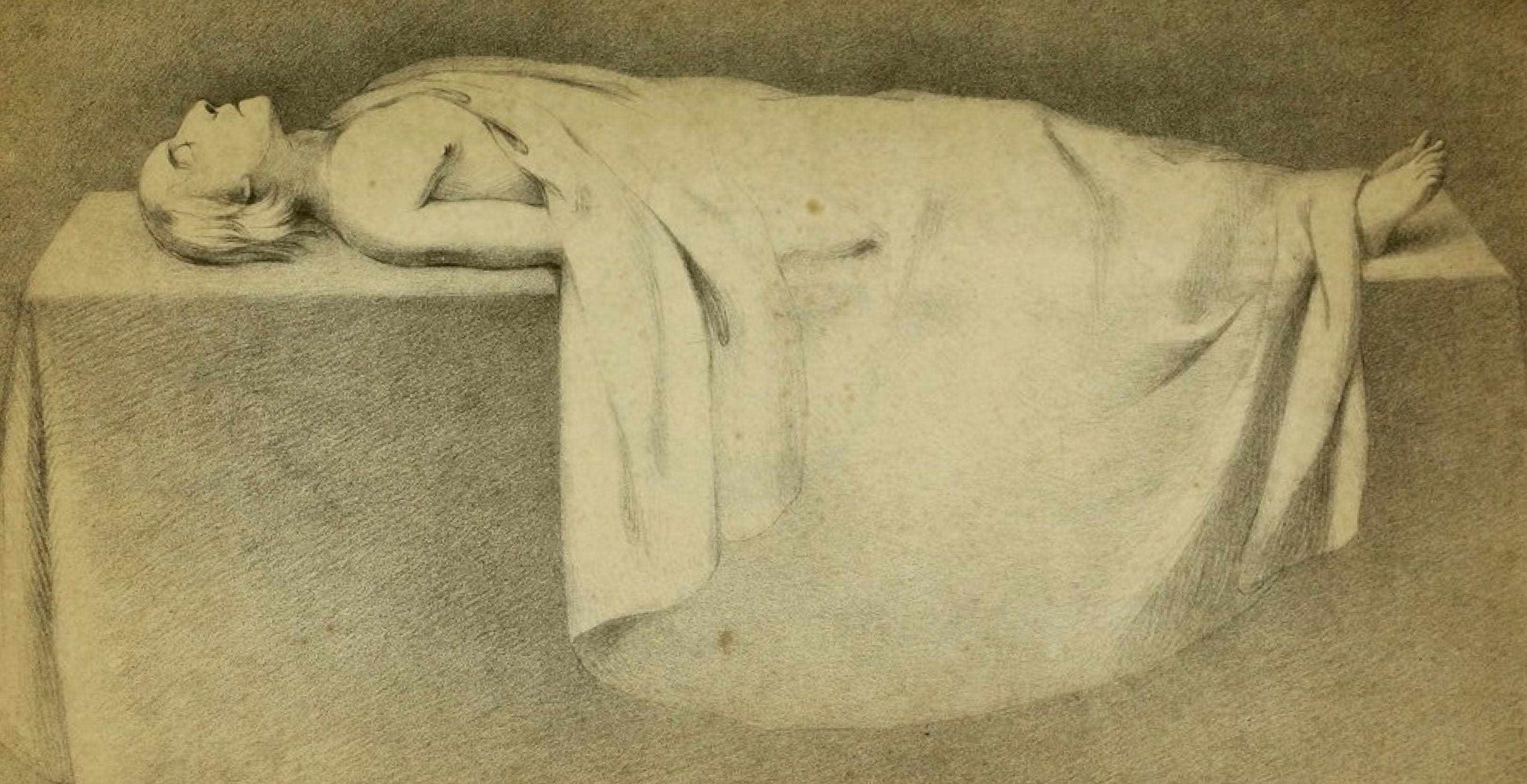
Even back in 1769, when he was only 21, Bentham had made a will which left his body to a doctor friend so it could be dissected for science. In 1824, his friend Thomas Southwood Smith, a physician and public health campaigner, wrote an article in the Westminster Review on ‘Use of the Dead to the Living’5 which prompted Bentham to ponder a future public dissection of his own body (after his death, obviously). Bowring noted that Bentham was also…
…full of the notion of having his head preserved in the style of the New Zealanders… Experiments are to be made, and Armstrong is to get a human head from Grainger, the anatomist, which is to be slowly dried in a stove in Bentham’s house.6
Sometime in 1831, Bentham wrote his own paper: ‘Auto-Icon or, Farther Uses of the Dead to the Living’, expanding on all this.7 By ‘Auto-Icon’ he meant “a man who is his own image”. He was definitely very keen on these:
Our churches are ready-provided receptacles for Auto-Icons,—provided for all classes,—for rich and poor. There would no longer be needed monuments of stone or marble,—there would be no danger to health from the accumulating of corpses,—and the use of churchyards would gradually be done away.
There’s a lot more in this vein. Sounds like a recipe for the zombie apocalypse!
On 30th May 1832 – just a week before he died – Bentham wrote the final version of his will, and fully committed to the idea. In it we read…
I appoint John Bowring Doctor of Laws who for these twelve years or thereabouts has been my most intimate and confidential friend my Executor…
my body I give to my dear friend Doctor Southwood Smith to be disposed of in manner hereinafter mentioned and I direct that as soon as it appears to any one that my life is at an end my executor or any other person by whom on the opening of this paper the contents thereof shall have been observed shall send an express with information of my decease to Doctor Southwood Smith requesting [him] to repair to the place where my body is lying and after ascertaining by appropriate experiment that no life remains it is my request that he will take my body under his charge and take the requisite and appropriate measures for the disposal & preservation of the several parts of my bodily frame in the manner expressed in the paper annexed to this my will and at the top of which I have written ‘Auto Icon’—the Skeleton he will cause to be put together in such manner as that the whole figure may be seated in a chair usually occupied by me when living in the attitude in which I am sitting when engaged in thought in the course of the time employed in writing.
I direct that the body thus prepared shall be transferred to my executor – he will cause the Skeleton to be clad in one of the Suits of Black occasionally worn by me – the body so clothed together with the Chair and the Staff in my later years borne by me he will take charge of and for containing the whole apparatus he will cause to be prepared an appropriate box or case and will cause to be engraved in Conspicuous Characters on a plate to be affixed thereon and also on the labels on the Glass cases in which the preparations of the soft parts of my body shall be contained as for example as in the manner used in the case of wine decanters my name at length with the letters ob: [i.e. ‘obiit’, Latin for ‘he died’] followed by the day of my decease.
If it should so happen that my personal friends and other disciples should be disposed to meet together on some day or days of the year for the purpose of Commemorating the founder of the Greatest happiness System of Morals and legislation my [executor] will from time to time cause to be conveyed to the room in which they meet the said box or case with the contents there to be stationed in some part of the room as to the assembled company shall seem meet…8
His will also lists several people9 to whom a ring and a lock of his hair should be given, including Bowring. A note entitled ‘Auto-Icon’ – written a few weeks earlier – was indeed annexed to this, giving further details such as “the body is to be used as the means of illustrating a series of lectures to which scientific & literary men are to be invited”.
Three days after Bentham’s death, at the Webb Street School of Anatomy and Medicine in London, Southwood Smith gave a lecture (more a eulogy, really) to a packed room of 300 people “delivered over the remains of Jeremy Bentham, Esq.”, the text of which was soon published:
There lie before us the mortal remains of one of the most illustrious men of our country and of our age. And that body, once animated by the master-spirit that now animates it no more, why is it here? Why, instead of being committed to the tomb, is it in this school of science?
Rather pleasingly, this was interrupted by a violent thunderstorm. The Dictionary of National Biography provides us with the grisly details that followed: “Following dissection, the skeleton was wired together, and the head was preserved by placing it under an air pump over sulphuric acid and simply drawing off the fluids.”
Unfortunately his “face had lost all expression and was deemed unsuitable for display”. A wax replacement head was then made and attached via an iron spike. It had some of Bentham’s real hair stuck onto it, and the skeleton was padded out with straw before being clothed and seated in a glass and mahogany case pretty much as Bentham had directed.
The Auto-Icon’s whereabouts go a bit vague for a while. It stayed in Southwood Smith’s possession for some time, primarily at his consulting rooms in Finsbury Square. One of Charles Dickens’ biographers, Una Pope-Hennessy, noted “everyone who dined with the doctor had to face this memento mori. Dickens used to dine with him…”.
But when Southwood Smith offered it to University College London (UCL) around 1850, it seems to have been at 36 Percy Street, the home of his lover, the artist Margaret Gillies. Let’s hope Bentham’s corpse didn’t have to witness any… shenanigans.
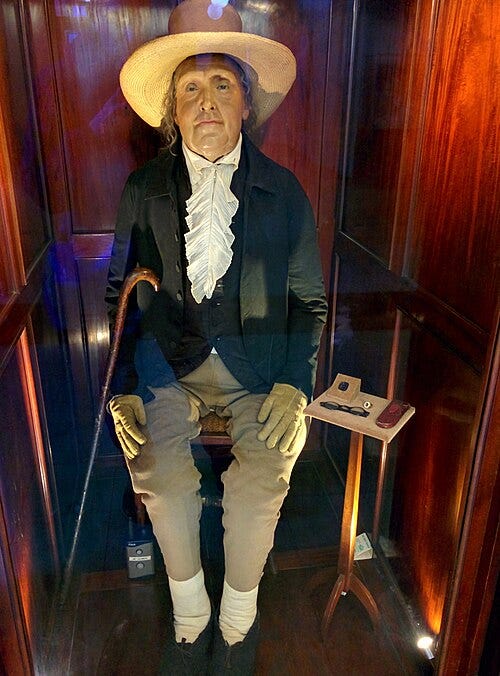
The Auto-Icon was tucked away in UCL for many years.10 During the Second World War it was sent to Stanstead Bury in Hertfordshire for safe keeping, and then placed in UCL’s South Cloister, where it remained until 2020 (though it went on a trip to Germany in 2002).
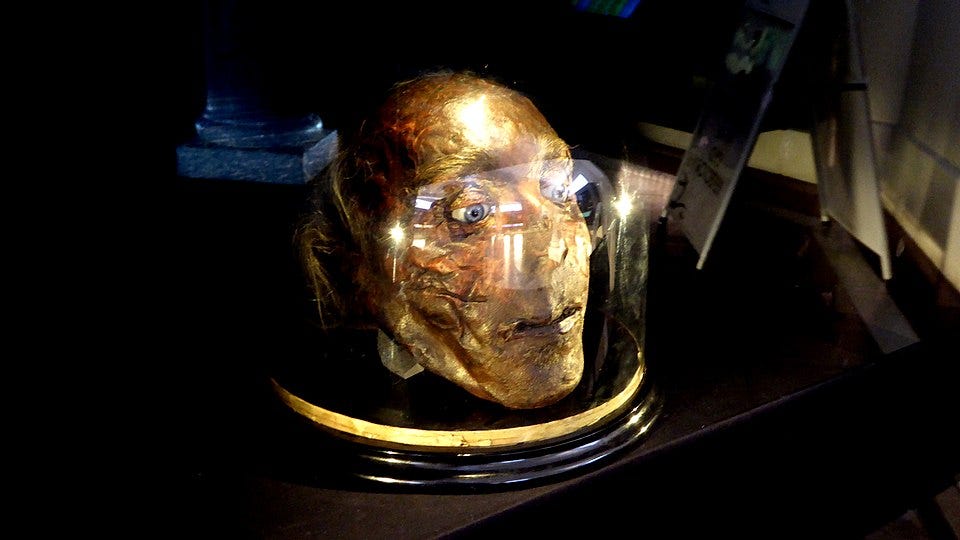
His shrunken real head was placed at the feet of the Auto-Icon, then later in a box on top of the main case. The head was briefly stolen (and ransomed) by students in 1975.11 I’m not sure when it moved but the head is now in a safe at London’s Institute of Archaeology, though it did reappear at UCL for an exhibition in 2017:12
After 2020, the Auto-Icon was put in a shiny new glass box to replace the old wooden one, and it sits there today at the main entrance of the UCL Student Centre in Gordon Square.
PS
Strangely enough, John Bowring was – possibly – involved with the body of another great figure of the 19th century. In his autobiographical recollections, he notes of Byron, “After his death, his body was consigned to me in a puncheon of rum, which came from Missolonghi, whence it was transferred to a leaden coffin…” (though elsewhere he said it was brandy).
I say ‘possibly’ because another account says it was packed in a case and sent to Byron’s executors, John Hobhouse and John Hanson, then exhibited for a while at Sir Edward Knatchbull’s house in Great George Street, which 1824 newspaper accounts confirm.13 But surely Bowring would know, wouldn’t he? And we can trust these narrations of his that we’ve been following…
…can’t we?
Not without controversy in both cases. Bentham’s other disciple, John Stuart Mill, despised Bowring, and would later write, “I never attached sufficient value to anything Bowring could say about Bentham.” Bowring produced the first collected edition of Bentham’s works in 11 volumes between 1838 and 1843, and it was described in the snarky Edinburgh Review as “incomplete, incorrect and ill-arranged”.
We can ultimately blame him for the trolley problem.
“…a full-grown horse or dog, is beyond comparison a more rational, as well as a more conversable animal, than an infant of a day or a week or even a month, old… The question is not, Can they reason? nor, Can they talk? but, Can they suffer?”
Originally just ‘Langbourne’. He also named his walking stick ‘Dapple’ (though one account by Bowring says it was ‘Dobbin’). And while we’re enjoying these details, he apparently called his walks round his garden “anteprandial circumgyration”.
William Empson, the literary critic who had written the snarky review of Bowring’s edition of Bentham’s works, wrote of Bentham “entertaining his visitors by taking out of his pocket the [glass] eyes which were to adorn it”.
An earlier version of his will from 1824 had suggested his body could be brought to a club with his friends and placed “at one end of the table, after the manner in which, at a public meeting, a chairman is commonly seated”. This is perhaps the source of the rumour to this day that his corpse attends all UCL council meetings as ‘present, but not voting’ – it doesn’t usually, but, well, it did in 1976, and again in 2013. Unboxed.
Actually, 27 of them! The editors of vol. 13 of The Correspondence of Jeremy Bentham (UCL, 2024) have even traced as many of these as they can. Meanwhile, if you want to see a bit of Bentham’s skin with some writing on it… look here.
Southwood Smith observed in 1857, “The authorities seem to be afraid or ashamed to own their possession.”
There are rumours of other occasions when it has gone AWOL too – one claiming it was found in a luggage locker at Aberdeen station, though I can find no evidence for this and I feel this rumour… lacks body.
There’s also a death mask of Bentham and various copies scattered around the world. Or possibly actually a life mask.
“The muscular form and outline of bodily strength for which the late Lord Byron was remarkable, were perfectly visible after his decease…”