
Regular readers of Histories will have perhaps noticed that I’m slightly obsessed with Charles Dickens. He seems to follow me around. (We’ve met him in America, we’ve had a one-to-one, we’ve marvelled at his big nose, we’ve seen him witness an execution.) Today’s story isn’t actually about him at all, but he led me to it.
Last year, I went even deeper down the Dickensian rabbit hole for a long essay about the strange confluences between his life and that of the murderous artist Richard Dadd. (The essay was published in the always enjoyable Undefinable Boundary journal, available here.)1
Part of my research for that involved my trying to establish if and when Dickens had ever visited the famous Bethlem hospital for the insane (also known as Bedlam), and whether he could have met Dadd in person. That story is told in my essay – but my delvings led me to an intriguing article published in Dickens’s journal All the Year Round in December 1866, based around an interview with another famous Bedlam inmate, the arsonist Jonathan Martin.
Let’s backtrack a bit.
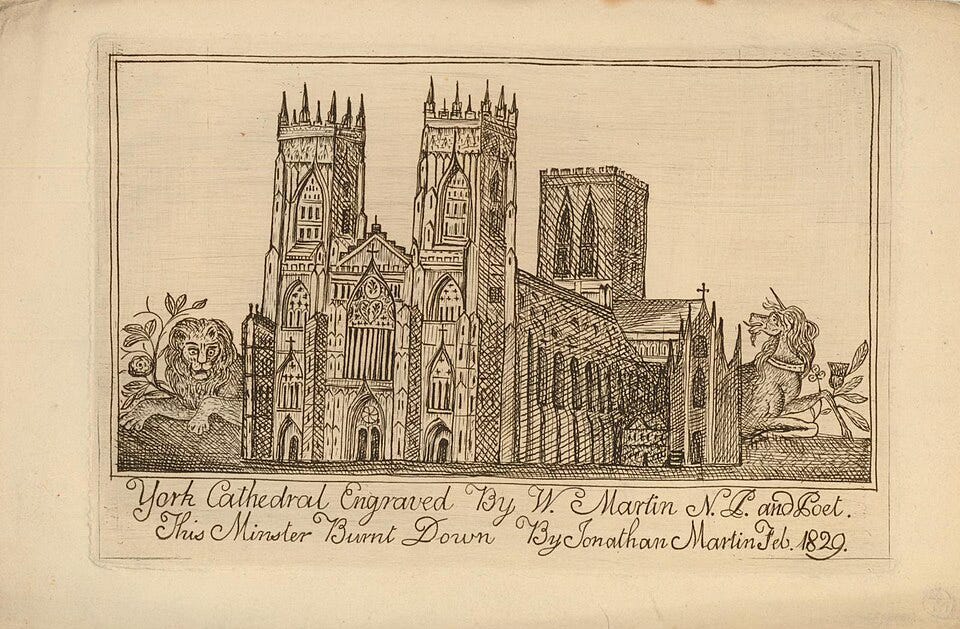
Jonathan Martin was born in Northumberland in 1782, one of 13 children (only five surviving until adulthood). Like Richard Dadd, Jonathan was artistically talented, although he was somewhat overshadowed by his brothers John and William – John went on to become a very successful artist, William an inventor and philosopher. Jonathan’s life was more troubled from early on – as a child he had a speech impediment from being tongue-tied, and he witnessed his sister being murdered by a neighbour, who threw her down some stairs. After employment on his uncle’s farm and then at a tannery, he went to London in his early twenties, where he was seized by a press gang for the navy. This led to six tough years on board HMS Hercules.
Alongside these troubles, Jonathan was influenced by his aunt’s fiery Protestantism. In the navy he was renowned for his religious extremism (he also began having violent dreams), and in his thirties he became a Wesleyan preacher known for disrupting traditional church services.
All this came to a head in 1817 when Jonathan – now married and with a son of his own – threatened to kill the Bishop of Oxford. This saw him tried and committed to an asylum. There followed a series of escapes and committals. Meanwhile he had also returned to painting, and a witness at one of his trials described his works as “extraordinary marks of uninstructed talent, mixed with frenzy and wildness”. Jonathan even dictated his own autobiography, published in multiple editions between 1826 and 1830, and packed with lively incidents from his wayward life.
In 1828, he married his second wife2 – 20 years younger than him – and they moved to York. This was where his erratic life (preacher, tanner, writer) reached its climax. His focus became the magnificent York Minster, where he began by hanging threatening placards on the railings. On 1st February 1829, things escalated on a sudden whim – hiding inside the Minster, he was angered by a buzzing noise from the organ and late at night he set fire to woodwork in the choir area. It would take two days for the fire to be fully put out, by which time most of the woodwork inside, the bishop’s throne, the pulpit – and the offending organ – were destroyed. The Dictionary of National Biography notes: “It was one of the most spectacular consequences of arson in modern British history.”3
It didn’t take long for him to be caught, especially given that he had put his name and address on those placards. He was tried at York Castle – amid resulting media fame and the publication of an account of the trial – and initially declared guilty by the jury but then the judge reversed it to not guilty on the grounds of insanity. He was then sent to Bethlem, where he stayed until he died in May 1838. So it goes. Like Dadd (but decades earlier), he continued to draw and paint during his confinement – one notable work being a picture of London being destroyed.
So now we march forward to 1866 again, where an anonymous writer in Dickens’s journal has penned a piece under the title ‘Jonathan Martin’. They set the scene with Jonathan’s religious obsession: “Not a shadow of doubt troubled Jonathan’s mind as to his right to denounce, and his mission to punish, ecclesiastical wickedness. If ever there were a reasoning lunatic, it was he.” Here’s part of the interview relating to Jonathan’s original fixation on the Bishop of Oxford:
All that I am about to record I received from the lips of Jonathan Martin. His mode of expression was vehement, his language rude and unpolished—I think it had the Northumbrian twang—he was dogmatical and peremptory, as if he spoke with authority; indeed, if there were anything of which he was truly convinced, it was that he was a special instrument appointed by God to do great works—works too great to be committed to any but the most highly privileged exponents of the Divine will. He once said to me in prison, “Is there any one, from the king on his throne to the lowest of the people, who is not thinking of and speaking of Jonathan Martin; and would this be so, unless Jonathan Martin had to do what can be done by nobody but myself?” …
One of the earliest and most remarkable observations of Jonathan’s intellect was the reasoning unreason… with which he persuaded himself that for the purpose of promoting church reform he was called upon to murder a bishop. He told me that a succession of heavenly visitors had appeared to him at night, and communicated a mandate from God the Father that he should destroy some right reverend prelate. He had no personal resentments to indulge, and therefore his conscience freed him from the charge of malice prepense. He had been offended by the intrusive and imposing character of the cathedral, as it towers over the Lincolnshire flats, and determined that the bishop of that see should be the first example of the Divine judgment.
“I was asleep,” he said, “when an angel appeared to me—a smiling angel—he had a bow in his hand, a quiver with arrows on his back. He looked kindly and tenderly towards me, and having said, ‘Jonathan! shoot the bishop!’ he disappeared. I was a good deal perplexed and embarrassed. I did not like the suggestion. I thought I might be deceived. I did nothing, and I said nothing to anybody, but I still felt that the angel had been instructed to point out my duty to me… when I fell asleep at night, after much restlessness and many tossings and turnings on my bed, the angel again appeared, but he did not smile—he looked melancholy and disappointed. I fancied he had come to reproach me for my hesitations and doubts. He shook his head mournfully; he held his bow in his left hand, took an arrow from his quiver, and, in a voice that had more in it of sorrow than of anger, said, ‘Jonathan! Jonathan! Shoot the bishop!’ and then quitted my presence…
“I took out a pistol which I had in my room, and loaded it; but I resolved upon nothing then. I passed another miserable day…
“On the third night, however, the angel’s visitation took quite another character. There was no smile of satisfaction, there was no expression of sorrow; but the angel appeared with terrible frowns on his countenance, and looked at me with indignant anger and displeasure… ‘Jonathan! Shoot the bishop!’ was again repeated, and the angel, amidst a crash which seemed to shake my bed and make the whole building totter to its foundations, vanished out of my sight. This seemed so manifest and irresistible an announcement from above, that most of my scruples were removed, and I then confided to my wife that it was my purpose to obey the Lord’s commands…”
“But, Jonathan,” said I, interrupting him here, “you are familiar with the Scriptures. You know the commandments. Did you not find this: ‘Thou shalt do no murder’?”
“Yes! I did, and that commandment somewhat perplexed me. Was it not given by Moses? But don’t you know, and does not everybody know, that more is to be learnt from men’s works than from their words? And I studied the history of Moses, attending less to what he said than to what he did. And did he not slay the Egyptian? And was not this my warrant for slaying the bishop?”
The interviewer then relates how Jonathan’s wife alerted a magistrate, hence her husband’s arrest and imprisonment. His escape is worth noting in passing:
He was placed in a cell with a brick floor, which had been lately scrubbed with pumice-stone, a fragment of which had been scraped down to a sharp edge, and was left in one of the corners. The door was strongly bolted and locked; the windows had iron frames; even the funnel of the chimney was protected by bars of iron. Yet with that small unnoticed piece of pumice-stone Jonathan managed to cut through the bars placed across the chimney,4 and with the dexterity of a sweep made his way up to the top, whence he descended to the ground… He knelt down outside the jail, thanked God for his deliverance, confirmed in his conviction that he was a special instrument in the hands of Providence to accomplish some great design.
The interviewer then tells the story of Jonathan’s assault on York Minster, which I’ll skip repeating here (his escape makes one think somehow of Quasimodo at Notre-Dame or the Phantom of the Opera: “when Jonathan had satisfied himself that the work was done, he went into the belfry, seized one of the bell-ropes, and by its aid escaped into the open country, through a window of the cathedral which had been left open”).
The tale continues…
I then visited Jonathan in his prison cell. He was not serene, but triumphant. He was certain that all would work together for good—for his own good and for that of his country and of mankind. He was as vain of his exploits as if he had redeemed a race from slavery, or won the most glorious of victories. “I was nobody, and am now more talked about than anybody. Who is there in the land who is not occupied with the name and the deeds of Jonathan Martin? His name was known to nobody; it is now known to everybody. The king is now speaking about me.” And he rubbed his hands with delight, and his eyes sparkled with fire, and then he talked of his coming trial.
But who was this interviewer? It was easy enough to rule out Dickens himself – he would only have been a teenager when Jonathan Martin was brought to trial. But there were clues to be found. And that’s where we’ll stop for now, as I’ll tell the next part of the story (which definitely involves a shipwreck – and some might say involves a cursed painting!) in two weeks’ time…
Edit: part 2 is here, part 3 is here.
I’m not sure what happened to the first, but read on for a reason why JM might have preferred a new one.
In fact the unlucky York Minster has seen five fires down the ages, the most recent being a major one from a lightning strike in 1984. More angelic interference?
Is it really possible to cut through iron bars with pumice? Hmm.