
Let’s start with a nightmare vision.
I had been haunted by strange visions during my unquiet slumbers on the reef. On one occasion a handsome Italian lady—a companion of our misfortune—appeared, in my dreams,—her face was close to mine; its beauty was gradually changed into deformity; the hair was loosened from its roots; the features were extinguished; it became a naked skull, and then slowly moved away. It was followed by the visage of a bearded man, which looked searchingly upon and into me. Then the beard fell off; the eyes dropped from their sockets; the countenance became a hideous and offensive mass—which was also slowly transformed to a skull and disappeared; to be followed by another head, which, after glaring at me, became discoloured by pustules and tumours which rent the skin; the flesh was loosened, it detached itself from the bones, leaving nothing but a skull, which, like its predecessors, then departed. There were, at least, twenty such visitations—unlike one another—each looking intensely into my face; and, after undergoing frightful transformations, all assumed the appearance of crania, and like Banquo’s ghost, glided away from sight.
Two weeks ago, we met the arsonist Jonathan Martin, who had previously tried to assassinate the Bishop of Oxford. In an interview he shared his feverish imaginings of angelic commandments to do this. Perhaps the above words were another of these visions? But no: they are almost certainly the words of his anonymous interviewer, written nearly 30 years after Martin’s death. This week we’ll unveil their identity.
The full report of the interview opens with these words…
Accident brought before me, the other day, an extraordinary picture, which I received from the hands of Jonathan Martin, at the time of his confinement in York City Jail. It represents the vision which he assured me had induced him to set fire to the Minster, and has recalled to my mind—what may not be unworthy of record—some of the extraordinary hallucinations associated with Jonathan Martin’s history. He died in Bedlam, where, as also during his incarceration in the Castle at York, I had opportunities of conversing with him.
And the writer returns to this “extraordinary picture” at the end…
In a moment of confidence Jonathan told me he would paint for me a picture of the vision which had induced him to set fire to the Minster—which he did, and presented it to me. It is drawn in Indian ink, and, though rude, it is a “fine imagining.” The base is a dark rolling cloud, pierced through by a fiery sword; on the sword a sort of circular shield is placed, in whose centre is the head of God the Father. The expression is of terrible majesty; the eyes are fierce, the mouth is open, as if issuing a divine command. Beneath it is the inscription:
That’s the Sord I am the Hand,
That’s the Clud that God command;
This is the Sord I saw in a vishion at nounday,
This is the Clud I saw on the Minestra.
– Jonathan Martin. York, C.G., Aper the 15, 1829, his two vishons.The original has lost much of its distinctness. In the wreck of the Alma it lay for some days in the bituminous waters of the Red Sea; but I have a copy, made at the time, which is a tolerably fair reproduction of the drawing.
And this passing reference to “wreck of the Alma” is what unlocked the interviewer’s identity. The story of the wreck itself is dramatic enough to be worth telling in its own right.
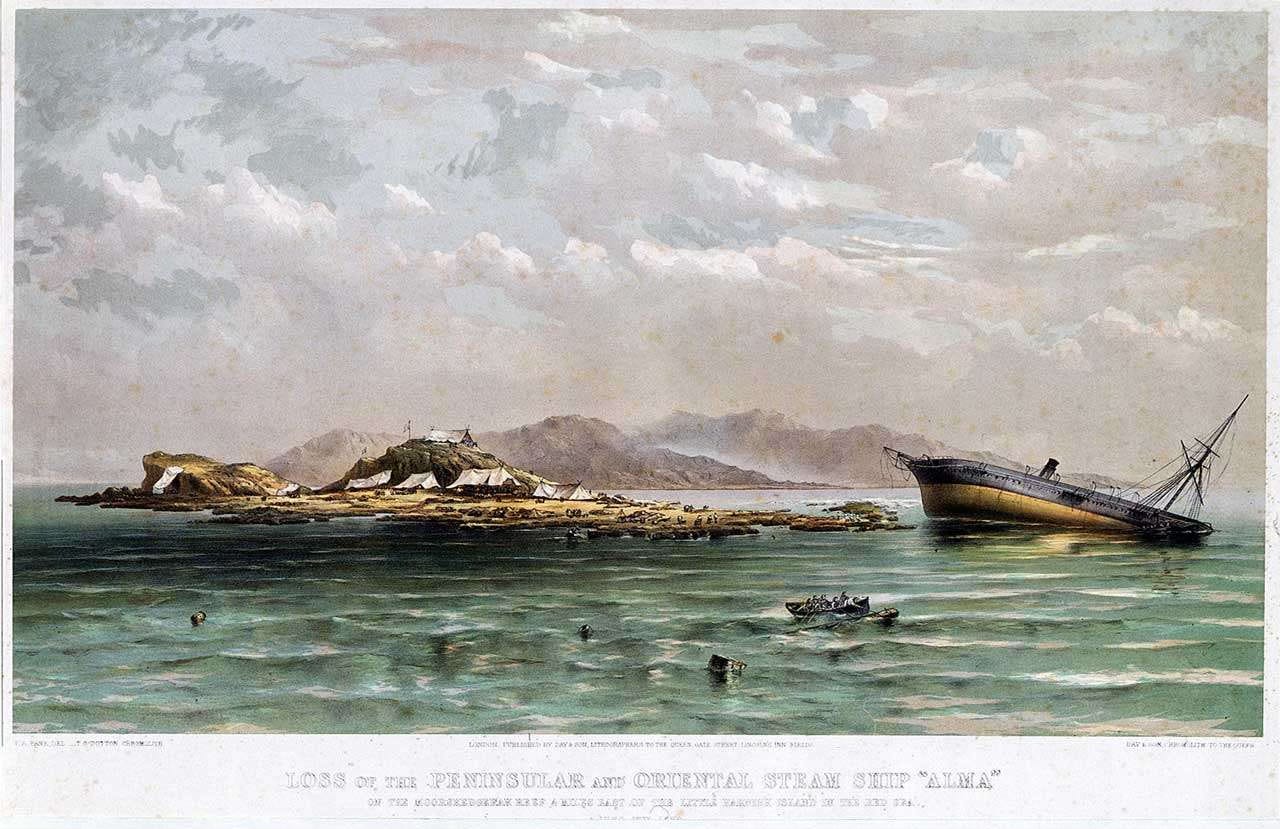
A quick bit of research established that the Alma was a steam-powered passenger liner owned by P&O which plied the waters between Suez and Calcutta (Kolkata), originally launched under a different name in 1854. Before its commercial service it had taken troops to the Crimean War, hence being renamed after one of the war’s chief battles.
It was not the luckiest of vessels – in 1857 it suffered a broken propeller shaft en route to Suez, but managed to limp to Aden. But the real disaster came on 12th June 1859, when it struck a reef off the island of Haruish in the Red Sea. A contemporary report in the Annual Register noted: “There were about 140 passengers…The India and China mails were also on board, and a cargo worth £200,000.”
The ship’s captain had been bedridden with illness, and the blame was therefore laid at the door of his chief officer W H Davis (or Davies). The ship filled with water rapidly and “All the females and many of the male passengers were in bed, and the suddenness of the accident and the position of the vessel, placed them in the greatest jeopardy.”1 As it happens, a first-hand account of the events survives, published in a new magazine called Once a Week in December of the same year, ‘The Wreck of the Alma’, by ‘A Passenger’, signing themselves ‘J.B.’ at the end of the piece.
J.B. gives us a very detailed report. Here’s how the incident began:
The moon had just gone down, the night was perfectly serene, and the waves of the Arabian gulf tranquil as a lake in summer. It was three o’clock a.m., and except a few who remained on deck to escape from the intolerable heat below, we had retired to our cabins to seek that repose which is not easily found when the thermometer ranges at or above 90 degrees of Fahrenheit. No dream of danger molested us for a moment…
There were three fearful crashes, and in a few seconds the vessel heeled over, and floods of water rushed in at the port-holes. We heard the orders given to drive on—to go a-head—in the hope, no doubt, that the reef might be got over, but with fear that if a hole had been made in her bottom, her backing would have taken us into deep water, when she would have gone down perpendicularly, and all must have perished. Everybody rushed forth from their cabins. There were many screams and cries, especially from mothers who were seeking their children,—many supplications for deliverance, many prayers for forgiveness of sins, many commendations of souls to God. Those who were able, made their way to the door of the saloon and up the staircase to the sloping deck. But the rising of the waters soon closed that means of retreat. From the cabins on the port-side, which was under water, the passengers were rescued by those who were on the starboard side, which was high and nearly dry; but the slope of the deck made it difficult to maintain a footing. Planting our heels against anything that offered resistance, and holding on by whatever we could seize as a means of support, we watched the waters rising, rising, rising—extinguishing the lights as they rose, till we were left in utter darkness, waiting the moment when we should be overwhelmed, or, wholly exhausted, drop into the engulfing waves…
Our little group consisted of six persons—three males, three females. We discussed our chances of redemption, and abandoned hope.
Rescue from their immediate situation came quickly, though:
Ropes and friendly hands came down through the skylight… Every energy was exerted for our rescue, and rescued we all were, though many were wounded and bruised while dragged over the waters amidst the floating furniture, the broken planks, and through the apertures of escape. We had no garments on but our night dresses; we were nearly naked and barefooted… One by one we were pulled out of our watery prison, and lowered over the side of the Alma into boats below.
There are touching scenes, too:
Among those who had been aided down into the boat was an old lady who had lived more than fifty married years in India, and was returning with her husband, whose age exceeded fourscore, to end their long pilgrimage in their native land. Most touching was the anxiety they exhibited not to be “separated,” whether for life or death. “O! let us two be preserved together, or together die.”
This was far from the end of their ordeal, however – the lifeboats were insufficient to take them to the mainland, and thus began several days marooned on the reef. “Having neither shoes nor stockings, our feet were cruelly cut by the sharp and jagged coral, and we often fell on our hands, elbows and knees from the extreme pain of the wounds,” the narrator explains, using a nightcap to protect one foot at least.
In the main, the account reports on great cooperation and mutual kindness in their plight – other than some of the crew who looted the passengers’ baggage. And almost everyone survived, though not without many suffering sun exposure from four days on the reef (from which the poor ship’s purser died).
And presumably, somewhere among all the mail and effects lost… was Jonathan Martin’s visionary painting that had led to disaster at York Minster. Perhaps it was cursed?
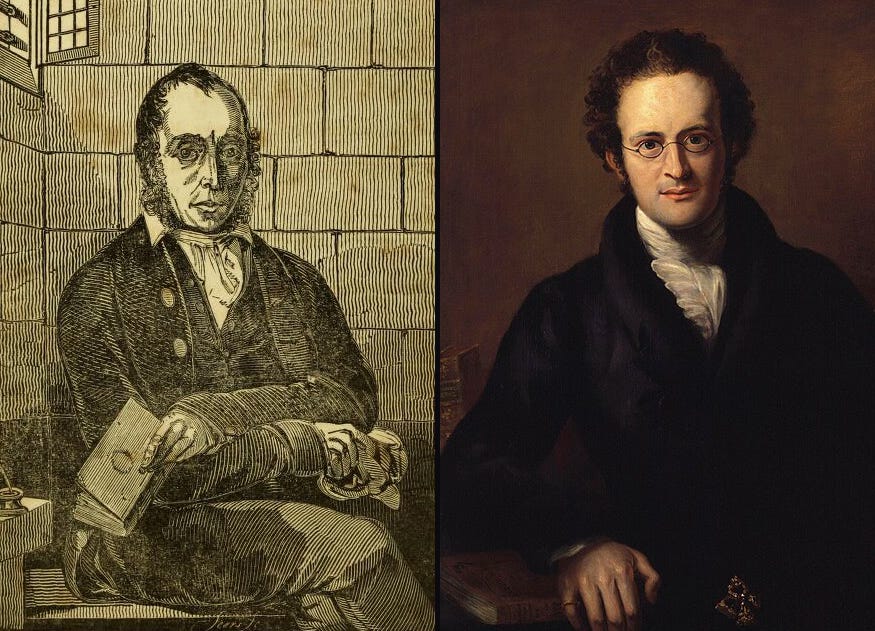
‘J.B.’ was enough of a clue to track down the name of this author at last: Sir John Bowring, no less. Born in 1792, he was a serial traveller, writer and linguist who became the fourth Governor of Hong Kong, a role he held until the year of the shipwreck but one coloured by a series of scandals. (Also, two years before that he and his wife fell victim to arsenic poisoning during the Second Opium War,2 and she sadly died from it. So it goes.)
Further research revealed that Bowring was a friend of Charles Dickens, in whose journal All the Year Round the Martin interview had been published.3 Another anonymous piece in the same journal, ‘To China in a Gunboat’ (1865), is known to have been by Bowring.4 We also know that Bowring lost some of his work to the Alma wreck.5 All of this joins up to make it pretty certain that he was the interviewer of Martin early in his career – at a time when he was also editor of the Westminster Review, a publication created by Bowring’s great mentor, the utilitarian philosopher Jeremy Bentham.6
So there we have it. But a few things certainly intrigue me. If Bowring owned the painting of the vision that inspired Jonathan Martin to arson, a painting which must have been made between 1829 and 1838, it seems surprising that it would be with him on this voyage more than 20 years later – why not leave it at home? Did it hold some ongoing fascination? Also, he says it “has lost much of its distinctness” from the shipwreck – suggesting he must have gone to some effort (or had some luck) in retrieving it from those “bituminous waters”. And why take the trouble to make a copy? (“Made at the time” – how?)
Part of me wants to imagine this painting somehow cast a curse on Bowring’s affairs – the loss of his wife to arsenic, the shipwreck… and more?7 But of course, I’m being fanciful. Though here’s another question: where is it now?8
As a final note, here’s Bowring’s sober rationale for those multiple dreams of skulls:
The dream was but the uncovering of the passing scene, on which the shadows of death were so adjacent to the business of life.
Edit: part 3 of this mini-series is here.
PS. If you’re anywhere near Oxford on Friday 22nd May, I’m compering this event at 7pm! Do say hello:
ENCOUNTERS WITH LANDSCAPES
Friday 22 May • Quaker Meeting House, Central Oxford • 7–9pm
An evening of short films and discussions featuring…
Paul Whitewick, archaeology/landscape YouTuber (248,000 followers)
James Attlee, award-winning psychogeographical writer
Louise Ryland-Epton, early modern historian and John Aubrey expert
C.M. Taylor, award-winning filmmaker and writer
The Annual Register report further notes, “There was also on board an Arab pilot, who it was stated was engaged merely for the satisfaction of the insurers, and the captain and officers never sought and habitually disregarded his advice… It is also said that the old Arab pilot warned the third officer that the ship was on a dangerous course, but that, as usual, no attention was paid to his warning.”
A subject we touched in before in the story of Henry Loch and Harry Parkes, the latter closely connected to Bowring.
Once a Week, it turns out, was only created as a result of its publishers falling out with Dickens when they published his earlier journal, Household Words (they refused to print an ad in Punch in which the great novelist bad-mouthed his wife). He then created All the Year Round so he had full editorial control…
In 1859 Bowring would publish a book on his visit to the Philippines, in which he mentions that his notes on Philippine languages – he was a polyglot himself – were lost when the Alma went down.
We’ll meet Bentham in my next piece.
How about this, too: back in 1834, Bowring recommending a new system of accounting to the government. The old tally sticks were burnt, which started a fire in the House of Lords and destroyed most of the Palace of Westminster – this is what led to the rebuilding of Parliament and creation of the site we know today. Apparently Bowring years later described himself as the “unintentional incendiary”. And it was this fire which led to the loss of the official weights and measures – coincidentally Bowring was a keen supporter of a metric system (though Britain took another century to agree to it). And Bowring was apparently the person who suggested to Byron – an old friend of Histories – that he should go to Greece, where he would die. Bowring was connected to pretty much every major name of the era (but hopefully not all of their deaths…). As far as I can tell I’m the first person to identify Bowring as Martin’s interviewer.
Bethlem’s Museum of the Mind holds the only significant collection of his surviving works – just a handful, and not this one. Some are pretty disturbing!
Ooh fascinating! Really enjoyed this