
As I described in my earlier pieces, all around the world ancient cats were having a great time, be it having tiny bespoke outfits made for them in Japan, or miniature shoes in Persia, or being venerated as gods in Eygpt. Surely things were cool for them in medieval Europe too, right? Um, yes, about that… much of what follows really isn’t great for cats.
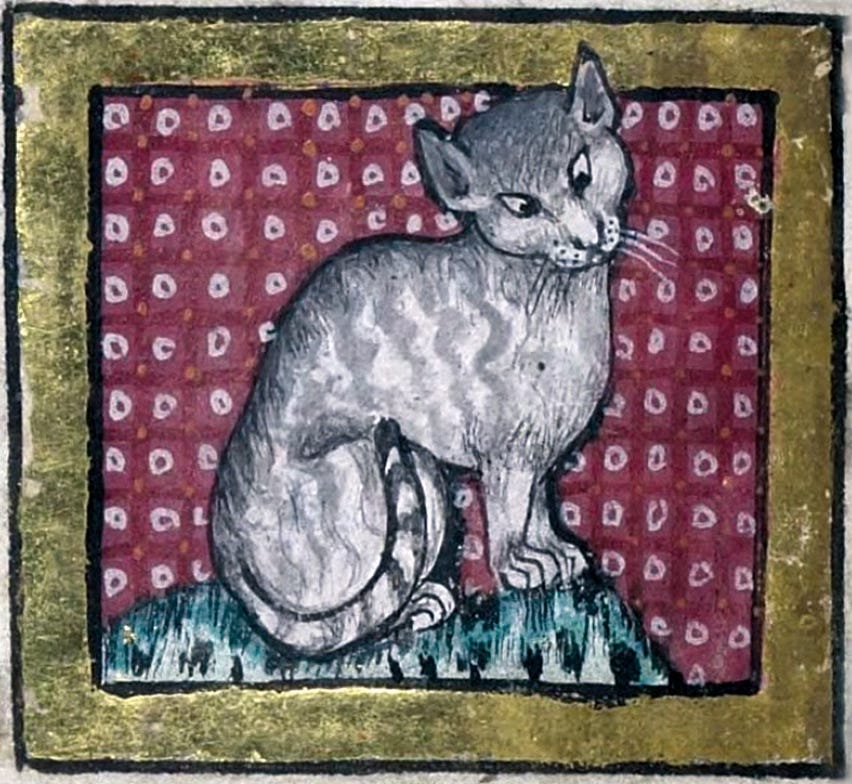
To this day a festival takes places each year in Ypres, Belgium, called Kattenstoet1 which is devoted to cats. There is a cat parade, people dress up (oftentimes as cats), there are simply massive floats that look like cats. “Hang on,” you might think, “you don’t seem to be making a very good case here, you are talking about an adorable cat celebration!” Well, yes, today it may seem to be an adorable celebration of all things feline, but the origin of the tradition is much more gruesome. You see, kattensteot ends each year with someone dressed as a jester throwing toy cats off the top of the belfry2 of the cloth hall down to the square below.
Originally real, live, cats were thrown from the tower to their death or serious injury on the ground. It is unclear exactly how the tradition started. One theory is that over the winter the cats helped protect the wool that was stored in the call by keeping down the mouse population. In the spring the wool was sold, the cats were no longer needed so obviously the only thing to do with them was take them up to the top of the tower and throw them off. An alternative explanation is that cats were associated with witchcraft, and by killing the cats one was also killing evil spirits. We will learn more about cats and witches in a minute, but in case you think that I am being unfair to the good people of Ypres by mentioning a gruesome tradition from the ancient past, this might shock you. The last time that real cats were thrown from the top of the tower was 1817, little more than two hundred years ago.
Why did the Europeans hate cats? Well, to put it simply they thought that they were evil. For sure, they were handy to have around for killing mice and suchlike, but they really couldn’t be trusted at all. Why was this? Well, in Christian teachings the act of a cat playing with a mouse was often likened to the say in which the devil would play with a sinner before ultimately casting them down to a eternity of damnation and torture in hell. In 1484 Willian Caxton wrote in his Royal Book:
The devyl playeth ofte with the synnar, lyke as the catte doth with the mous.
Cats were not simply considered to be allegories of the devil, some also believed that they actually were a facet of the great Satan himself, taken beastial form to represent him on Earth, do dire deeds, and be worshiped by witches and heretics. The concept of cat-as-the-devil can be traced back to the 12th century and St Bartholomew of Farne. Obviously he wasn’t actually a saint at that point,3 but that doesn’t really matter. What does matter is that he used to fight against the devil, really quite often. In these battles the devil would take the form of a mouse. Or a lion. Or a bull. Or an ape. Or (finally) a cat. Now it may seem a little odd that only the cat got associated with the devil as a result, but the reason seems to be that the whole “cat playing with a mouse is like the devil playing with a sinner” thing had already set people against them.
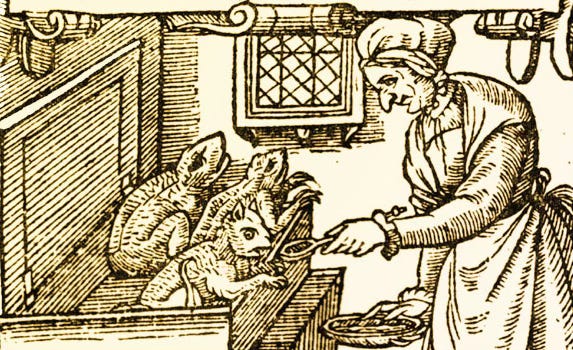
Around the same time that Bartholomew was fighting a devilish cat the Welsh writer (and later archdeacon of Oxford) Walter Map was stoking the anti-cat fire. In his book De nugis curialium (which roughly translates as “Trinkets for the Court”) he wrote about the heretical activities of the Publicans4 and the Patarines. Anyway, Map wrote of the devil-worshiping practices of these heretics. In them the devil would appear to them in the form of a black cat. After he had appeared the Satanists would then, err, extinguish all of their lamps and fumble around in the dark until they could get their hands on the cat. Having grasped the feline, sorry, the devil, they would demonstrate their devotion to him by, um, kissing him under the tail. Whatever these people actually believed I have to say that you have to be pretty dedicated to kiss a cat’s bum to prove it. Whilst this probably sounds totally absurd it was very bad news for cats, and also for humans (particularly women) who liked cats. De nugis curialium, and manuscripts like it, played a role in defining medieval notions of witchcraft, and cats were very much a part of it.
The practice of “black cat bum kissing” astonishingly appears multiple times in the literature of the period. A few decades later Willam of Auvergne wrote in Tractatus de fide et legibus of Cathars and Waldensians taking turns to kiss the bottom of a black cat described as being the size of a small dog (possibly he could have just said “a cat the size of a large cat”). Alan of Lille wrote of the Cathars:
Vel Cathari dicuntur a cato, quia, ut dicitur, osculantur posteriora catti, in cujius specie, ut dicunt, apparet eis Lucifer5
Not long afterwards the devilish nature of cats acquired an official status that was to haunt them for centuries to come. The German preacher Konrad von Marburg claimed to have uncovered a Satanic cult that worshiped a diabolical black cat. “Uncovered” in this context needs to have the slight caveat that the people involved confessed to their behaviour when tortured to the point of death, so maybe it wasn’t totally true. It was, however, good enough proof for Pope Gregory IX to establish the Papal Inquisition, and to issue the decree Vox in Rama which called for a crusade against such heresy.
This decree goes into some detail about the rites of the heretics. A ceremony that involved meeting a giant toad, and kissing a skinny white man, ended with a statue of a black cat coming to life. This living statue-puss would walk backwards towards the participants with its tail raised in the air so that the master of the sect, and any new initiates, could kiss it on the bum. From then on cats in general and black ones in particular, were considered to be highly suspicious.
The specific connection between witches and cats dates from around the same time. Gervase of Tilbury, a favourite of King Henry the Second, wrote in his Otia Imperialia6 of witches who flew through the air at night and could change their shape to take on the form of a cat. Unluckily for the cats, he also claimed that if a witch was wounded when in the shape of a cat, her injuries would remain when she retook human form. This basically gave people free rein to abuse cats, on the off-chance that some were transformed witches who they could identify later on by looking for injured women. It pretty much goes without saying that in a culture where there were high levels of spousal abuse it wasn’t going to be that hard to find women with cuts and bruises and so the process appeared to confirm its own validity.
There is an extensive list of folk tales that tell some form of the “woman and cat sharing injuries story”. From the Netherlands there is the story of a cat that has a pan of hot butter thrown over it, only to reappear as an old woman, covered in burns the following day. In both Norway and Germany tale is told of a cat that had its paw cut off, only for the following day the miller’s wife to be missing a hand.7 And other versions also exist from Wales, Austria, and the USA where the woman isn’t necessarily the miller’s wife, but the whole severed paw/hand thing happens.
Things really came to a head in 1486 when Heinrich Kramer published the Malleus Maleficarum.8 This was basically an all-purpose guide that taught you all about witches and what to do with them.9 It was a prime text in the witch trials that, over the following centuries, resulted in around 50,000 people (mostly women, mostly over the age of 40) being burned at the stake. In the book Kramer restates the “women as cats” myth with a story in which a man beats off an attack from three cats, only to be thrown in prison a short time later, accused of assaulting three “matrons of the town”. Things are looking bad for this chap – he is facing a sentence of death, when the wise magistrates realise that of course there was some devilish connection between the women and the cats and he is quite innocent of the crimes of which he has been accused. As for the fate of the women, the book does not recount, but Kramer makes it perfectly clear that they were in no-way innocent bystanders – they had to have formed a pact with the devil. I find it hard to imagine that things worked out well for them…
You may be thinking that such absurd (and utterly horrendous) beliefs are artefacts long consigned to Europe’s past. If so, you may be in for a shock. The last victim of a witch-hunt in England, was “Dummy” the Witch of Sible Hedingham,10 in 1863. Yes, Victorian England with its railways, telegraphs, industry, and science. And witch hunts. Poor Dummy was an elderly deaf-mute man. He worked as a fortune teller, and was accused by one Emma Smith of cursing her with a disease.11 A drunk mob threw him in a brook, beat him with sticks, and he died as a result. Smith and a friend of hers who led the mob were caught, tried, and convicted of causing his death.12 That isn’t even the last killing of a witch. In Ireland, in 1895, Bridget Clearly was beaten and burned to death by her husband because he believed that his “real” wife had been taken away by fairies and replaced her with a witch. And in 1997 - yes 1997 - two Russian farmers killed a woman and injured five members of her family because they believed that she had used folk magic against them.13
Rumours abound that centuries of cat persecution in Europe ultimate came back to bite the humans who carried it out. It has been claimed that the reduced numbers of cats allowed rats and mice to flourish. The rats in particular were hosts for the fleas that carried the bubonic plague that ravaged the continent on multiple occasions from the 14th to 18th centuries. The evidence to back up this theory really doesn’t exist though. It is possible that the demonisation of cats reduced their numbers sufficiently for there to be slightly high numbers of rats around, but the impact is likely to be trivial. Despite the church and various obsessed citizens taking issue with cats (and the people who lived with cats) there were still a hell of a lot of cats around.
One reason we can be sure of this is actually due to the outbreak of the Black Death in London in 1665. In order to slow the spread of the disease the mayor ordered the killing of all of the cats and the dogs in the city (as it was thought, wrongly, that they were, at least in part, responsible for transmitting it). This was an estimated total of 40,000 dogs and 200,000 cats. Given that the population of London at the time was around 460,000 people that works out at more than one cat per household on average. To put this in context, there are thought to be 580,000 cats living in London today, with a human population of nearly 9 million people. There were a lot more cats per head of the population 350 years ago even though we don’t think that they are manifestations of the devil any more.
Franz Helm of Cologne an artillery master14 in the first half of the 16th century wanted to make things even worse for cats. Five hundred years ago there weren’t really such things as artillery battles – two forces opposing each other on the opposite sides of a field and firing things at each other. No, artillery was used to overcome besieged cities, by smashing holes in their defences or setting them on fire. Helm was an expert in this field, and in 1625 a collection of his works was published as the influential Armamentarium principale oder Kriegsmunition und Artillerie-Buch.15 In this tome he critically assessed all of the existing means of attacking cities (including many detailed in 1420’s Feuerwerkbuch)16 as well as suggesting a number of innovative means of attack.
In order to set fire to well-fortified cities that were impregnable to other forms of attack Helm proposed the use of the “rocket-cat”. Now you may think that is some kind of mistranslation, or misunderstanding. Surely he didn’t propose using cats with rockets attached to them? Nah. He did. He totally did. How did the “rocket-cat” work? Helm usefully explains what to do in the text:
Create a small sack like a fire-arrow ... if you would like to get at a town or castle, seek to obtain a cat from that place. And bind the sack to the back of the cat, ignite it, let it glow well and thereafter let the cat go, so it runs to the nearest castle or town, and out of fear it thinks to hide itself where it ends up in barn hay or straw it will be ignited.
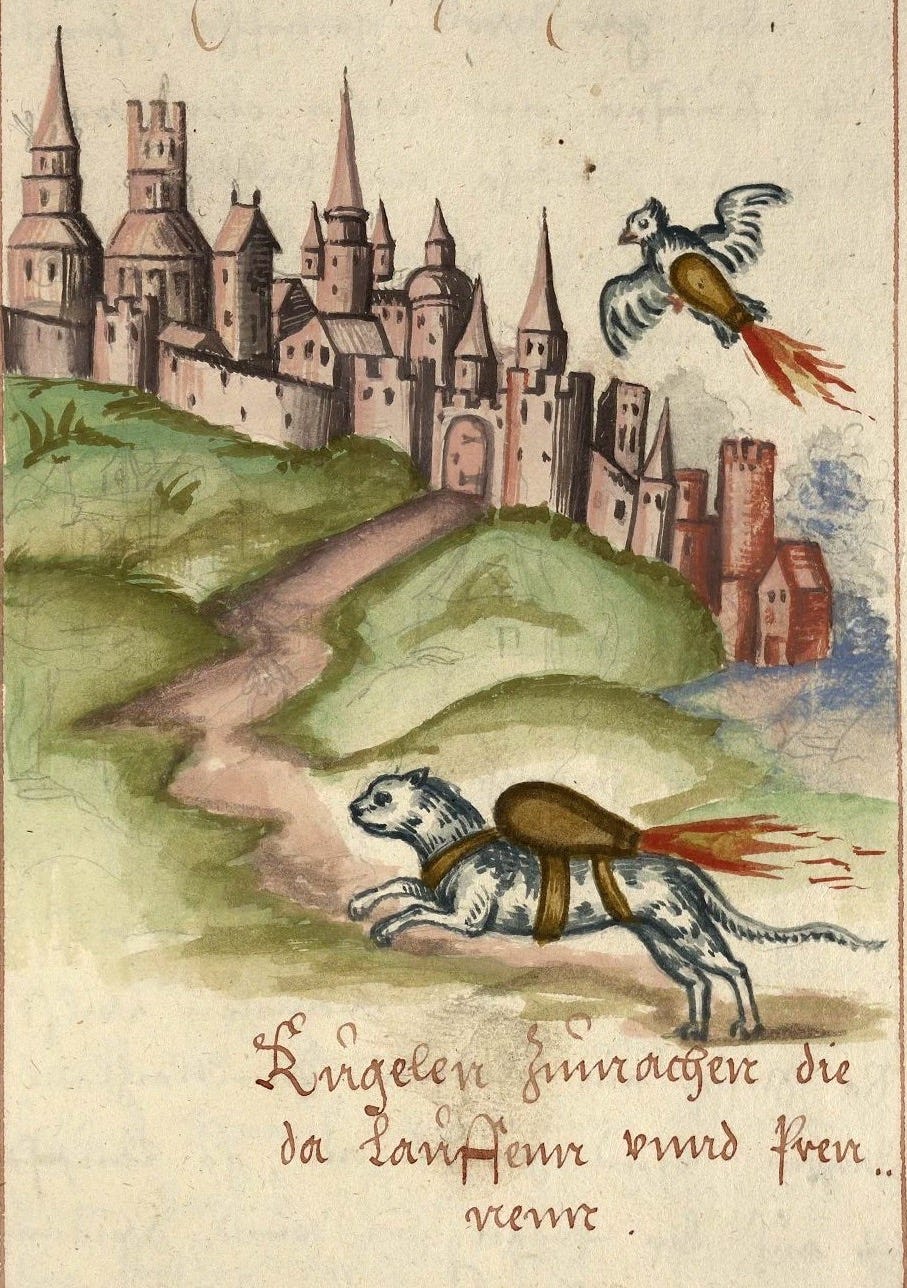
Thankfully there is no evidence that anyone ever actually followed Helm’s advice. It has been pointed out that whilst you may be able to strap a load of burning stuff and explosives to the back of a cat you sure as hell can’t control where they are going to run to. The poor, freaked-out, animals are just going to go crazy and run in all directions. Quite possibly into your own camp, setting that on fire instead.
Well, at least more recent military minds don’t have such bat-shit crazy ideas about using wild animals as incendiary devices! Hold that thought for a second. During the Second World War the United States military came up with something called the “bat-bomb”. The concept was simple. Take a hibernating Mexican free-tailed bat. Actually, take a thousand of them. Stick them into a large bomb casing. Oh, wait, before you do they attached a 14 gramme (0.5 ounce) timed napalm incendiary bomb to each bat. Then drop the bat-bomb over Tokyo (where many houses were made of wood and paper). As the bomb wafts down on its parachute the bomb casing would spring open, releasing (and, presumably, rudely awakening) the bats. The bats (a little bleary-eyed) would head to the nearest places to roost. The bombs would detonate, Tokyo would burn to the ground. Simple.
The man behind the bat-bomb was a dental surgeon named Lytle S. Adams who believed that bats were created:
…by God to await this hour to play their part in the scheme of free human existence, and to frustrate any attempt of those who dare desecrate our way of life.
President Franklin Roosevelt was well aware of this plan, and said of Adams:
This man is not a nut. It sounds like a perfectly wild idea but is worth looking into.17
This wasn’t just some crazy theoretical exercise. The USA actually built and tested bat-bombs. In the first test the bats were accidentally released early and roosted under a fuel tank. Which they ignited. Incinerating the test range. Ultimately the project got canned because it was decided that nuclear weapons would be more effective.
I have tried to find some positive medieval European descriptions of cats and it has been a bit of struggle. There is this from 1397 in De proprietatibus rerum (“On the properties of things”) by Bartholomaeus Anglicus which starts okay, but then, err, gets pretty bad:
He [the cat] is a full lecherous beast in youth, swift, pliant, and merry, and leapeth and reseth on everything that is to fore him: and is led by a straw, and playeth therewith: and is a right heavy beast in age and full sleepy, and lieth slyly in wait for mice: and is aware where they be more by smell than by sight, and hunteth and reseth on them in privy places: and when he taketh a mouse, he playeth therewith, and eateth him after the play. In time of love is hard fighting for wives, and one scratcheth and rendeth the other grievously with biting and with claws. And he maketh a ruthful noise and ghastful, when one proffereth to fight with another: and unneth is hurt when he is thrown down off an high place. And when he hath a fair skin, he is as it were proud thereof, and goeth fast about: and when his skin is burnt, then he bideth at home; and is oft for his fair skin taken of the skinner, and slain and flayed.
Although it took centuries, views did begin to change and this is perhaps best signified by the 1727 book Les Chats by François Augustine de Paradis de Moncrif (1687-1770). This is probably the first book dedicated exclusively to cats and whilst it is in part a satire upon the French upper classes at the time it is nonetheless clear in its affections for our feline friends. It ends, as I now shall as well (in part, at least), with the 1558 poem Épitaphe d’un chat by Joachim du Bellay (1522-1560):
Now living makes me angry;
And so, Magny, that you may know,
Why I am so distraught,
It is not for having lost
My rings, my money, my purse;And why is it then? Because
I have lost for three days
My possessions, my pleasure, my loves.And what? Oh, grievous memory!
My heart almost bursts,
When I speak of it, or when I write of it:
It is Belaud, my little gray cat:
Belaud, who was by chance
The most beautiful work that Nature
Ever made in matters of cats:
He was Belaud, the death of rats,
Belaud, whose beauty was such,
That it is worthy of immortality.
Literally “Festival of the Cats”.
It is pretty high up, I have seen pictures.
Nor was he called Bartholomew, he was called Tostig, and then he was called William.
In case you were wondering, the “Publicans” were not a group of people who ran pubs, they were followers of Arnold of Brescia (who criticised the wealth of the Catholic church). Possibly a few of them ran pubs as well.
This crudely translates as “The Cathars kiss the bum of the devil cat”.
This literally translates as “Recreation for an Emperor”, basically an early type of encyclopedia. People may have issues with Wikipedia today, but it is orders of magnitude better than what Gervase turned out. Editing it some centuries later the philosopher Gottfriend Liebnniz described it as “a bag of foolish old woman’s tales”.
In some versions of the tale the miller’s wife then gets burned alive. Along with all of her children.
This is usually translated as the Hammer of Witches.
In a nutshell, torture a confession out of them, then execute them.
Yes, I thought that this name sounded made-up too. But no, it is a real place in Essex, current population around 4,000. The parish church looks charming.
It turned out that she had Lyme disease, which is caught from ticks, not curses.
They only got six months’ hard labour.
Sadly murders of people suspected of practising witchcraft continue in sub-Saharan Africa to this day, with albinos particularly being targeted.
He was described as a “shooter, cannonier and fireworker”. A “fireworker” didn’t mean someone who shot pretty rockets into the sky on special occasions. No, it meant a person who are really really good at setting fire to stuff. Yes, that was a useful life skill in the 17th century.
“Principles of armament, or book of war munitions and artillery”.
“Firework Book”.
He thought this. He was President of the USA. Nonetheless the Allies still won the war. Incredible.
The US president during WWI was Franklin Roosevelt, not Theodore.