
In my previous piece I described the history of domestic cats in ancient Egypt and early Europe. This week I’ll explore the story of our furry friends in East Asia and beyond.
Evidence has been found of cats living around humans in China around 5,300 years ago. It is not clear that they were what we would consider to be domesticated cats, but the handful of bones recovered from an ancient refuse pit indicate that they were smaller than wild cats and much more likely to be similar to the domesticated cats that were living in Egypt at the same time. It is possible that the practice of keeping cats spread from Africa to Asia, or that it emerged independently in both places – we simply can’t be sure. Certainly by around 2,000 years ago cats were widely kept in ancient China and held in considerable regard. This has caused some people to wonder why the cat is not one of the 12 animals of the Chinese zodiac. There is a myth that says the animals were chosen by the Jade Emperor by holding a race – the first 12 to finish would be selected. As the cat was nocturnal and would normally be sleeping during the day when the race was going to be held it asked its friend the rat to wake it before the race was due to start. The rat, alas, broke its promise leaving the cat happily snoozing, and in so doing gained a place in the zodiac itself. When the cat finally awoke it was, to put it bluntly, very cross with the rat, and swore vengeance upon it and all of its enemies. And that is why, to this day, cats are ferocious hunters of rats.
Cats spread to Japan via China, possibly as early as the sixth century, and were likely first presented as gifts to members of Japanese nobility. The kanji character for the Japanese word for cat neko (猫) looks like the Chinese word kone: “likes rats”. They were certainly well established in the Imperial Court more than a thousand years ago. We can be sure of this because of the diary of Emperor Uda who ruled Japan from 887 through 897. The entry that he wrote on the 11th March 889 is titled For the Love of a Cat and I think that it is one of most beautiful love-letters to a cat ever written:
On the 6th Day of the 2nd Month of the First Year of the Kampo era. Taking a moment of my free time, I wish to express my joy of the cat. It arrived by boat as a gift to the late Emperor, received from the hands of Minamoto no Kuwashi.
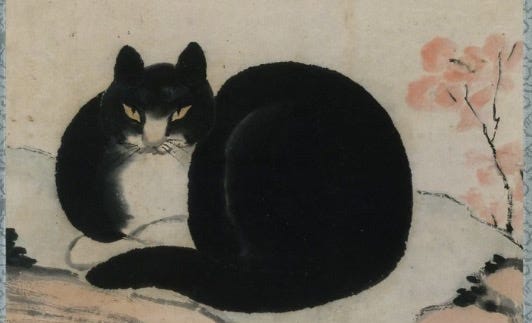
The color of the fur is peerless. None could find the words to describe it, although one said it was reminiscent of the deepest ink. It has an air about it, similar to Kanno. Its length is 5 sun, and its height is 6 sun. I affixed a bow about its neck, but it did not remain for long.1
In rebellion, it narrows its eyes and extends its needles. It shows its back.
When it lies down, it curls in a circle like a coin. You cannot see its feet. It’s as if it were circular Bi disk. When it stands, its cry expresses profound loneliness, like a black dragon floating above the clouds.
By nature, it likes to stalk birds. It lowers its head and works its tail. It can extend its spine to raise its height by at least 2 sun. Its color allows it to disappear at night. I am convinced it is superior to all other cats.2
Uda was not the only Japanese emperor to be fond of felines. Emperor Ichijo who reigned a century later owned a beast that he named Myoby no Otodo, which translates as Chief-Lady-in Waiting-of-the Inner Palace – a very fancy title indeed! Myoby no Otodo had more than just a title – she had actual, human, ladies-in-waiting to tend to her needs,3 and the emperor instructed his tailor to make tiny suits of clothing for her and her kittens. That is very sweet (I should note that this happened in the year 999 when the emperor was only 13 years old) but if Myoby was like the cats I have known then I think she was probably a bit pissed off at being made to play dress-up.
Now, you may be thinking “hang on, surely commoners (that is “working folks”) couldn’t be allowed to live in the Imperial Court of Japan?”. Okay, so you probably weren’t, but if you had been you would have been quite correct. In order for his beloved cats to live in the court Emperor Ichijo decreed that cats were not allowed to work, and they were officially part of the aristocracy, specifically the “Fifth Order of the Court”. This life of feline leisure astonishingly lasted more than six hundred years until 1602. At that time rats and mice were causing a serious threat to Japan’s crucial silk trade (they like to eat the silk worms) and so the government was forced to act. A decree was issued that made it illegal to house or feed cats, or to sell them or give them as gifts. Pretty much overnight cats were cast out of their comfortable homes and forced to fend for themselves, which must have been a bit of a shock to the kitties concerned. It would certainly have been very tough for them, but as far as the government was concerned the law worked. Without humans to feed them the cats decimated the rodent population and saved the silk trade.
These imperial cats were very distinctive in that they had very short bobtails, and they exist to this day as the Japanese Bobtail breed. This distinctive feature is the result of a genetic mutation in the cats originally brought over from China. At least that is what scientists will tell you based upon their DNA analysis and suchlike. The real reason is somewhat different. Originally Japanese cats had long tails, just like all of the others. Then disaster struck. Many years ago a cat was curled up by a fire on a cold winter’s day. A bit too close to the fire it turned out… Its tail caught alight and the poor kitty ran in panic through the city, accidentally setting fire to many buildings in the process. The emperor, seeing his magnificent capital reduced to ashes, was furious. He decreed that all cats should have their tails chopped off to ensure that it never happened again.4
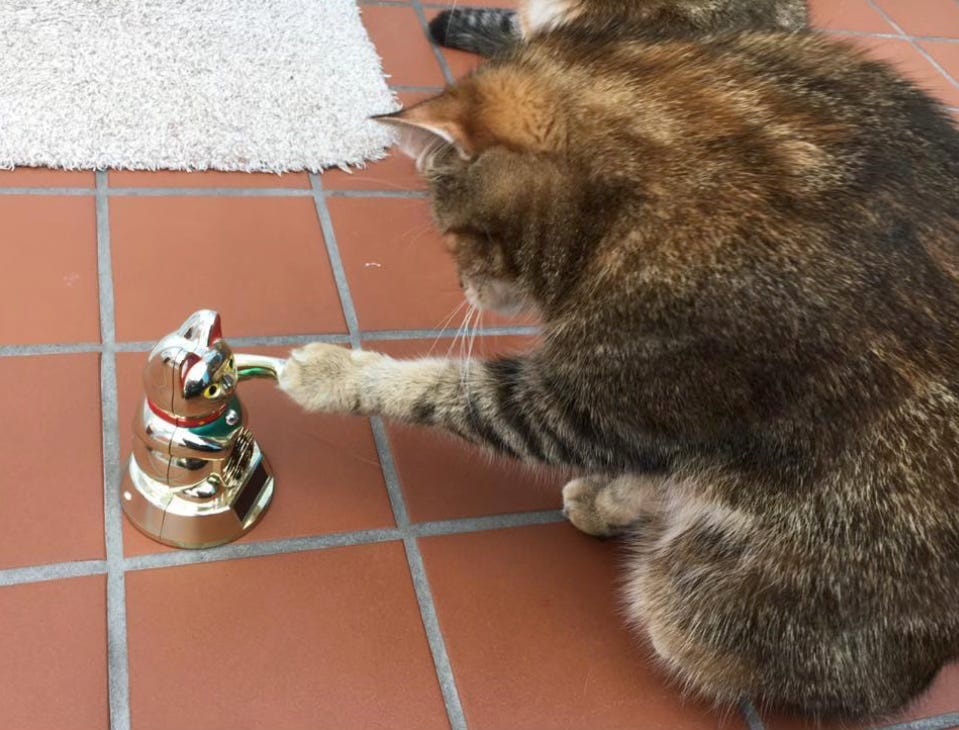
Another legendary Japanese cat is more fondly remembered. You may well have seen a small model cat in a shop or restaurant window (or indeed a home) with its paw raised. There are also battery and solar powered versions where the paw bobs up and down waving. It actually isn’t waving at you – the Japanese gesture to beckon is made by holding up the hand, palm down, and folding the fingers back and forth. That is why this is the Maneki-neko, the “beckoning cat”. Maneki-neko are believed to bring their owners good luck and there are a number of stories about why this may be the case. One is that its gesture is similar to the movement a cat makes when it is washing its face, and there is an ancient Japanese belief that when a cat washes its face a visitor is soon to arrive (I should note that if a visitor arrived every time the cat I live with washed its face there wouldn’t be any room left in my home). This belief possibility originated from an old Chinese proverb that says that when a cat washes its face then rain is coming. Why is rain going to bring visitors (and, indeed, be lucky)? Well, if you run a shop or inn, rain is good for business as people will come inside to shelter from it. Statues of cats washing their ears that are more than 1,500 years old have been found in China, and these could be the earliest forms of Maneki-neko.
There are a couple of alternative stories that may explain why this beckoning cat is considered to be lucky. One is that the 17th century samurai Li Naotaka was caught in a torrential storm and took shelter under a tree. Looking out through the rain he saw a cat sitting in a nearby temple, waving its paw in a beckoning manner. Intrigued he headed over to the temple to find out why the cat was calling him over (or maybe because he just wanted to give the kitty a quick fuss, the story is unclear on this point). When he got to the cat the tree he had previously been sheltering under got struck by lightning, were it not for the cat, he would have surely died! Another tale tells of a poor shopkeeper who took pity upon a stray, starving cat and shared his meager supplies of food with it. To thank him the cat would sit in his window and beckon in customers and the business flourished as a result.
The reverence with which cats were held in Japan is maintained to this day, most notably on the island of Tashirojima. In the 18th century the silk was, like many other places in Japan, a hugely important industry, and as we have learned cats were vital to saving this trade from the attacks of rats and mice. Being an island there was no way for cats to naturally migrate to the area, so they were imported by the industrious locals and allowed to flourish. In addition to silk production, fishing was an important industry on Tashirojima and this worked out well for the cats. Not only were there lots of scraps of fish lying around, the fishermen believed that the cats brought them good luck, and that the behaviour of the cats could be used to predict the weather and the locations of fish. In order to help bring in a good catch the fishermen would ensure that the cats were well fed.
Tragedy struck one day when a cat was killed by a falling rock whilst the fishermen were working. The men were so upset that they buried the cat and raised a shrine to it – a Nekoj-inja. Over the years more shrines were built for cats and as a result there are now more than ten on this tiny island. As the fishing and silk industries slowed, so the population of the island reduced and it is now home to around 70, generally older, humans. The story is somewhat different for the cats, they are now believed to number more than 500, so many in fact that Tashirojima is now known as “Cat Island”. Most of these cats are what we would term feral, but that does not mean that they are unloved and poorly cared for. The islanders continue to feed them and tend to their needs, with a special team of volunteers called Nyanko Kyouwakoku. That whole notion of cats bringing good luck and wealth? Well, for the people of Tashirojima it looks like it is true. Thousands of tourists visit the island each year to see their amazing cats! And what about cats predicting what is going to happen in the seas, surely that can’t be true too? Well, probably not in the way that the sailors thought hundreds of years ago, but something happened fairly recently that suggests that cats can sense things in nature that are invisible to us. In 2011 the island was struck by the tsunami caused by the Tohoku earthquake (don’t worry, both cats and humans got through it okay). Before the waters arrived a number of the cats were seen to be behaving very strangely, yowling at things that weren’t there and generally being very stressed out. Were they trying to warn the humans who had looked after them for so long? I’d like to think that perhaps they were.
The respect shown to cats in the Middle East is in part a result of how highly they are revered in Islam, and the prophet Muhammad was known to love the creatures. His favourite cat was named Muezza and there are numerous stories about her. One tells how she bowed to the prophet one day as he returned from the mosque, he stroked her three times in return and gave her the power to always land on her feet if she fell. In another she was sleeping on the sleeve of his robe when the call to prayer sounded. Rather than move and wake the cat Muhammad instead cut the sleeve off his robe allowing her to continue to sleep peacefully. One of Muhammad’s companions was known as Abu Hurairah which literally translates as “Father of a Kitten” a name bestowed due to his huge affection for felines. Abu Hurairah once said that Muhammad declared that a woman who starved a kitten and didn’t even give it water was destined to go to hell. Another companion of the prophet, Abu Saeed reportedly owned a cat who once saved Muhammad from a poisonous snake. There is also said to be a connection between the markings on cats and Islam. Muhammad petted the cat that had saved his life from the snake and left four dark lines on its forehead. Similarly the “M”-shaped marking on the heads of tabby cats is said to arise from him gently resting his hand on Muezza.
Because cats are so obsessed with washing themselves they are considered in Islamic tradition to be ritually clean which means that they are free to enter people’s homes and even mosques. Indeed cats are so clean that water they have drunk from is permitted to be used for wudu, the ritual washing of the body. It isn’t just Japan that has places dedicated to cats. In Aleppo, Syria, there used to be a compound known as Jami al-Qitat which translates as “Mosque of the Cats”. It is said to have been built as a cat hospital by a wealthy merchant, Osman Pasha, in 1730 to thank the feisty felines for ridding his granaries of rats and mice. Now, you might be thinking that might have been a couple of rooms and a handful of cats. If so, you are way off in terms of scale. Victorian travellers reported hundreds, sometimes even thousands of cats being fed each day on a special feeding ground. There was also a special nursery for kittens and a hospice for elderly cats to live out their final days in comfort. Osman Pasha left sufficient funds in his will to ensure that the operations could continue for decades after his death. This may sound like a lovely thing to you, but European visitors in the 19th century found it, well, pretty appalling. One traveller expressed surprise at the fact that the Muslims of Aleppo refused to drown kittens (as that was common practice in Europe at the time) and commented:
How strange it is, that Christianity should be harder towards animals than the inferior religions, just as slavery is worst among Christian nations.
In ancient Perisa the attitude to cats was somewhat different. In Zoroastrian mythology they were said to have been the unholy product of sex between the human woman Jamak and a devil. Far from being the epitome of cleanliness they were classed as a hated “wolf species”. It was said that if a cat ate from a bowl it would still be unclean even if it had been washed seven times. Were a cat to urinate in water then it would kill all of the fishes in the sea. It wasn’t just fish that they could kill – if a person ate food that had been touched – even fleetingly – by the whiskers of a cat they would then waste away and die.
Despite all of these stories it seems that cats were much loved by the Persians and, as in many other places, played a valuable role in keeping down the populations of rats and mice. According to legend, this fact was once used for political advantage. King Khosrow II who ruled Iran from the late sixth and early seventh centuries sent an evil man named Ray to be the governor of the city of his rival Bahram Chobin. Once settled, Ray ordered all of the cats in the city to be killed, which led to a massive explosion in the population of rats and mice. So much so that the people were forced to flee the city. The tale goes on to say that the city was ultimately saved by the Queen, who gave a playful kitten to Khosrow and in so doing persuaded him to let the cats return.
Much like their contemporaries in Japan, Persian royalty at the end of the first millennium were very attached to their feline friends. Prince Rukn al-Dawla was noted for his adoration for his cat-friend. So much so that when people wanted to petition him for favours they would tie their requests around the neck of his cat because in that way he was sure to see them. One Sufi sheik was also said to love his cat so much that he had tiny shoes5 made for it so that it could sleep on his prayer carpet without its claws damaging the costly material.
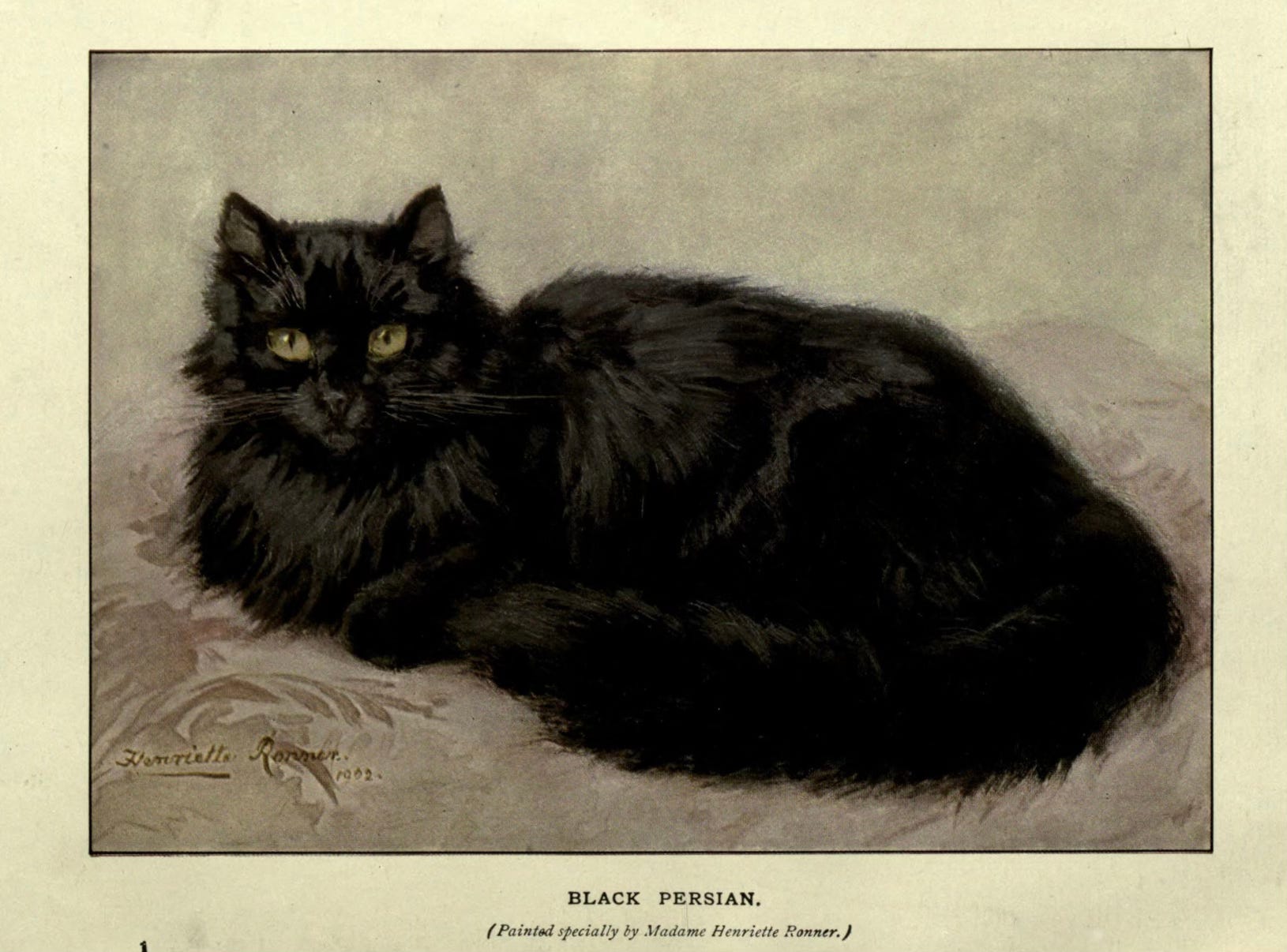
Persian cats, those glorious balls of floof, have their own creation myth. The great hero Rostam6 is said to have once saved a magician from a gang of thieves. The magician wanted to repay the man who had saved his life, but Rostam told him that he had everything he desired in the world. The magician took that as a challenge, and decided to create something that the great hero had no idea that he desired. He sat by the fire and took up a handful of smoke, a pinch of fire, and reached up to grab the brightest star in the sky. He mixed them all up together and then opened his hands and there sat a perfect Persian kitten. Its soft fur was like a cloud of smoke, its eyes glinting like starlight, and its tiny pink tongue like a tongue of flame.
In my final piece in this mini-series I’ll be exploring the history of cats in medieval Europe (spoiler, it wasn’t great for much of time) including a hare-brained scheme to use them as a weapon of war…
I am wholly unsurprised by this.
To be fair, I suspect that everyone thinks that the cat(s) that live with them are superior to all others.
Being waited on by humans is a tradition maintained by domestic cats to this day. =They just aren’t usually lucky enough to get a dozen humans to wait on each of them.
I kinda get where he was coming from, but I think that if a single cat with a flaming tail can burn down a city then you then it is probably more the fault of your urban planning than the terrified kitty. =Maybe it would have been better to think about improving the building regulations and perhaps forming a fire brigade instead?
I don’t think that it would have been that easy to put tiny shoes on a cat, let alone to ensure that the cat kept them on. I once had to put a cat in a special t-shirt after it had an operation (in order to stop it licking its stitches). That was not fun for either me or the cat. I really don’t want to repeat it. Cat is doing fine now.
He had loads to adventures and carried out a tonne of amazing feats – think the Persian equivalent of Hercules.
Love 💗 it,😽
Fabulous history 🐈⬛