
In my previous piece I explored how humans had chilled things prior to the invention of mechanical cooling – often with incredible ingenuity and stunning feats of engineering. Today I’ll be digging into how modern cooling came about.
People have known for thousands of years that evaporating water (and, indeed, other liquids) has a cooling effect, but it wasn’t until really very recently that someone thought to actually study it. In 1755 the Scottish physician and scientist William Cullen (1710-1790) carried out the earliest known series of experiments into this phenomenon, as he reported in the 1756 paper Of the Cold produced by evaporating Fluids, and of some other Means of producing Cold:
A Young gentleman, one of my pupils, whom I had employed to examine the heat or cold that might be produced by the solution of certain substances in spirit of wine, observed to me, That, when a thermometer had been immersed in spirit of wine, tho’ the spirit was exactly of the temperature of the surrounding air, or somewhat colder; yet, upon taking the thermometer out of the spirit, and suspending it in the air, the mercury in the thermometer, which was of Fahrenheit’s construction, always sunk two or three degrees. This recalled to my mind some experiments and observations of M. de Mairan, to the same purpose; which I had read some time before… When I first read the experiments of M. de Mairan in the place referred to, I suspected that water, and perhaps other fluids, in evaporating, produced, or, as the phrase is, generated some degree of cold. The above experiment of my pupil confirmed my suspicion, and engaged me to verify it by a variety of new trials.
Inspired by the findings of his assistant, he then conducts a series of experiments himself:
I began by repeating the experiment with spirit of wine, and found, when I had taken the utmost care to have the spirit exactly of the temperature of the air, that constantly however, upon taking the thermometer out of the spirit, the mercury sunk several degrees, and indeed continued to sink so long as the ball of the thermometer continued wet with the spirit of wine. I found also, when the ball began to dry, and the mercury to rise again in the stem of the thermometer, that, if the ball was again dipped into the spirit, and immediately taken out, the mercury in the thermometer might be again observed to sink; and that thus, by repeated dippings, the cold produced might be rendered very remarkable. The cold produced was also observed to be still greater, when, between each dipping, the thermometer was moved very nimbly to and fro in the air; or if, while the ball was wet with spirit of wine, it was blown upon by a pair of bellows, or indeed if the air about the ball was otherwise any how put in motion… By taking these methods, I have, by spirit of wine, made the mercury in the thermometer sink from 44 degrees to below the freezing point; and, by employing some other fluids to be mentioned by and by, I have produced a sinking of the thermometer much more considerable.
The cause of the cooling effect is the phase change from a fluid to a gas: in a liquid molecules are held together by intermolecular attractions, to escape into the gas phase a molecule needs enough energy to overcome these attractions, what is called the latent heat of vaporisation. Put simply, when something evaporates it sucks heat out of its surroundings and uses that energy to separate the molecules. Cullen learned this through a series of experiments in which he discovered that more volatile liquids had a greater cooling effect, and that carrying out the test in a partial vacuum (created through the use of an air-pump) which lowers the boiling point of liquids and hence increases the speed of evaporation also resulted in more significant temperature reductions.
From the above enumeration I imagine it will appear, that the power of evaporating fluids in producing cold, is nearly according to the degree of volatility in each. If to this we join the consideration, that the cold is made greater by whatever hastens the evaporation, and particularly, that the sinking of the thermometer is greater as the air in which the experiment is made is warmer, if dry at the same time; I think we may now conclude, that the cold produced is the effect of evaporation.
Finally, he was able to create ice, the first recorded time this was done so with such a method:
In one experiment, before exhausting the receiver, the thermometer had stood at 50 degrees, and, after exhausting, we could judge very certainly that it sunk below 20. In another experiment made with the nitrous aether, when the heat of the air was about 53 degrees, we set the vessel containing the aether in another a little larger, containing water. Upon exhausting the receiver, and the vessels remaining for a few minutes in vacuo, we found the most part of the water frozen, and the vessel containing the aether surrounded with a thick and firm crust of ice.
A couple of years later, in 1757 and 1758, these experiments were repeated by none other than friend of Histories Benjamin Franklin! Franklin had heard about the discoveries from a Scottish scientist and carried out the work in Cambridge with the mathematician John Hadley:
By dipping first the ball of the thermometer into the ether, it appeared that the ether was precisely of the same temperament with the thermometer, which stood then at 65; for it made no alteration in the height of the little column of mercury. But when the thermometer was taken out of the ether, and the ether, with which the ball was wet, began to evaporate, the mercury sunk several degrees. The wetting was then repeated by a feather that had been dipped into the ether, when the mercury sunk still lower. We continued this operation, one of us wetting the ball, and another of the company blowing on it with the bellows, to quicken the evaporation, the mercury sinking all the time, till it came down to 7, which is 25 degrees below the freezing point, when we left off. Soon after it passed the freezing point, a thin coat of ice began to cover the ball. Whether this was water collected and condensed by the coldness of the ball, from the moisture in the air, or from our breath; or whether the feather, when dipped into the ether, might not sometimes go through it, and bring up some of the water that was under it, I am not certain; perhaps all might contribute. The ice continued increasing till we ended the experiment, when it appeared near a quarter of an inch thick all over the ball, with a number of small spicula, pointing outwards. From this experiment one may see the possibility of freezing a man to death on a warm summer’s day, if he were to stand in a passage through which the wind blew briskly, and to be wet frequently with ether, a spirit that is more inflammable than brandy, or common spirits of wine.
Being the polymath that he was, Franklin then realised that sweating cooled people down due to its evaporation. As far as I have been able to discover, he was the first person to reach this conclusion:1
May not several phaenomena, hitherto unconsidered, or unaccounted for, be explained by this property? During the hot Sunday at Philadelphia, in June 1750,1 when the thermometer was up at 100 in the shade, I sat in my chamber without exercise, only reading or writing, with no other cloaths on than a shirt, and a pair of long linen drawers, the windows all open, and a brisk wind blowing through the house, the sweat ran off the backs of my hands, and my shirt was often so wet, as to induce me to call for dry ones to put on; in this situation, one might have expected, that the natural heat of the body 96, added to the heat of the air 100, should jointly have created or produced a much greater degree of heat in the body; but the fact was, that my body never grew so hot as the air that surrounded it, or the inanimate bodies immers’d in the same air. For I remember well, that the desk, when I laid my arm upon it; a chair, when I sat down in it; and a dry shirt out of the drawer, when I put it on, all felt exceeding warm to me, as if they had been warmed before a fire. And I suppose a dead body would have acquired the temperature of the air, though a living one, by continual sweating, and by the evaporation of that sweat, was kept cold.
Once it had been discovered that it was possible to create ice using mechanical means, one might have thought that this discovery would soon be utilised to produce the stuff on demand. In fact it took the best part of a century before artificial ice production took off in earnest. In part this was down to simple engineering. Sure, you could use a bucket of evaporating ether to freeze some water, but this would rapidly use a load of (fairly expensive) ether. In order for the approach to be commercially viable a closed-loop system was needed whereby the gaseous ether (or similar substance) was captured and recompressed back into a liquid. High-quality seals and pumps were required, and, additionally, a means of dispersing the heat released from the liquefaction of the vapours.
The other factor was that while harvested ice was expensive, it wasn’t that expensive and so it was commercially challenging to build and run the machines required (even if the engineering challenges had been overcome). At the turn of the 19th century, you could buy a pound (0.5 kg) of ice in London for 1d wholesale or 2d delivered to your door (£7-14 or $10-20 in today’s terms). For sure it was something of a luxury, but nothing like the extent to which, say, a pineapple was.
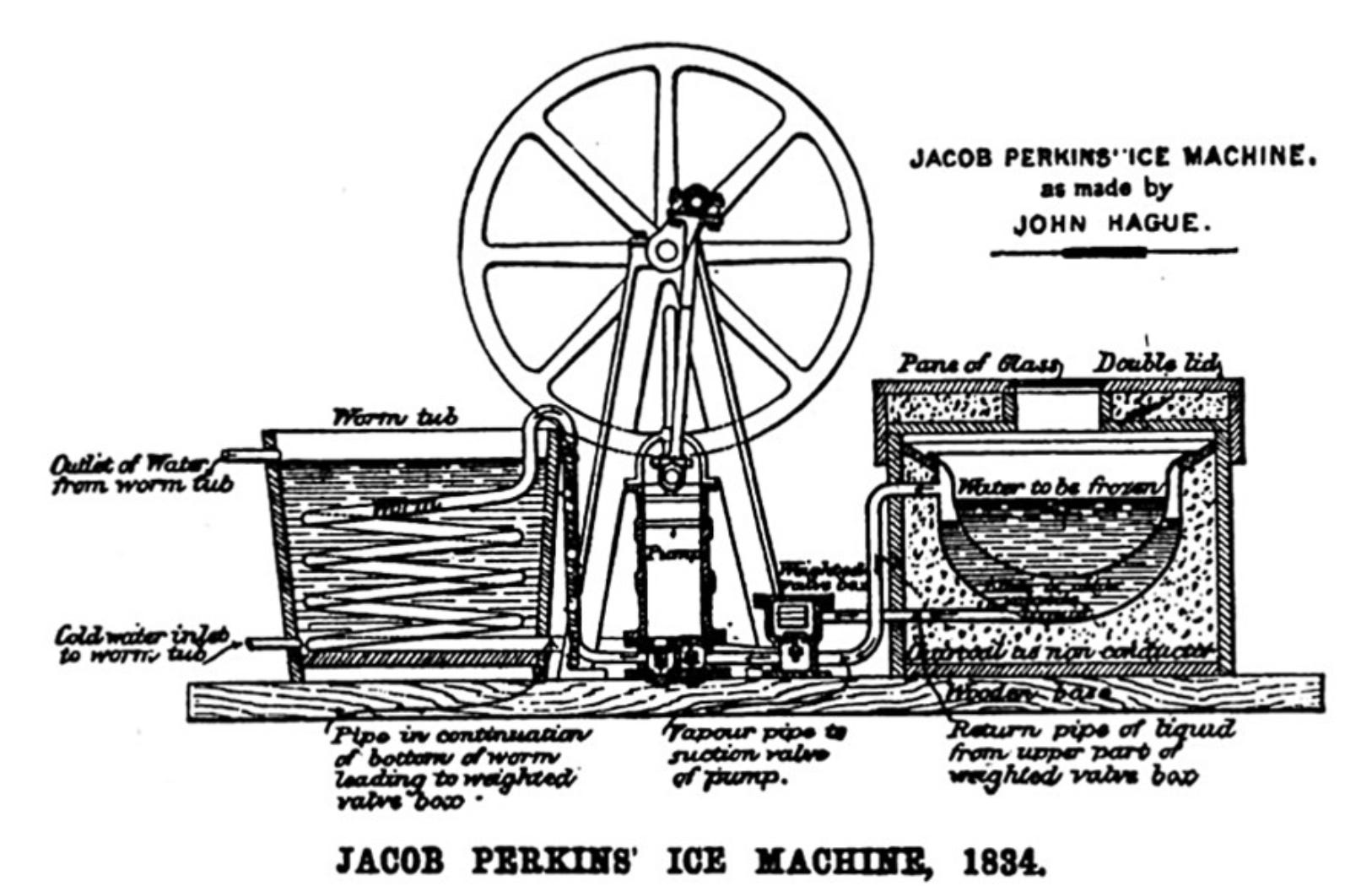
In 1805 the American engineer Oliver Evans (1755–1819) was the first person to describe how vapour compression refrigeration could work, but his designs were purely theoretical. It wasn’t until nearly 30 years later, in 1833, that someone actually built a machine that could make ice. The person to do so was Jacob Perkins (1766-1849), sometimes known as “The Father of the Refrigerator", who both patented and built a working ice-machine. Except while he was undoubtedly the brains behind the invention, it was his associate, John Hague, who had the engineering skills to turn it into a reality. They were assisted by an apprentice engineer, John Bramwell, who wrote about their creation almost 50 years after the events, in 1883:
A small machine of this kind was made for Mr. Perkins by Mr. John Hague, the engineer, and Mr. T. R. Crampton (now, like Mr. Loftus Perkins, a member of your Council) and myself, who were apprentices at that time to Mr. Hague, assisted in its manufacture.
It was intended to use sulphuric ether in the machine, but as a matter of fact, it was put to work with the volatile liquid arising from the destructive distillation of caoutchouc, and it succeeded in producing ice, and in doing so in the height of summer. The apparatus was a small one, carried on a wooden base—according to my recollection, some five feet long by two feet or two feet six inches wide.
At one end there was a jacketed copper pan, the interior of which held the water to be frozen, while in the jacket was the volatile liquid and its vapor. The pan was inclosed in a wooden box, containing powdered charcoal as a non-conductor. From the top of the jacket a pipe was led away to the suction valve of an air pump, fixed in the middle of the wooden base.
From the delivery valve of this pump a pipe proceeded to the top of a worm, contained in a worm tub, supported on the wooden base, at the end opposite to that where the jacketed pan was. The worm tub was supplied with water, from an inlet at the bottom, and the escape was by an overflow at the top.
A pipe, in continuation of the lower end of the worm, was connected to the under side of a valve box, in which was a valve loaded to about fifteen pounds to the inch, so that the vapor in the worm was subjected to this pressure, as well as to the cooling influence of the water, and by these means was brought back to a liquid condition. From the upper side of the valve box a pipe proceeded to the bottom of the jacketed pan, to convey the liquid to it, thus completing the circuit.
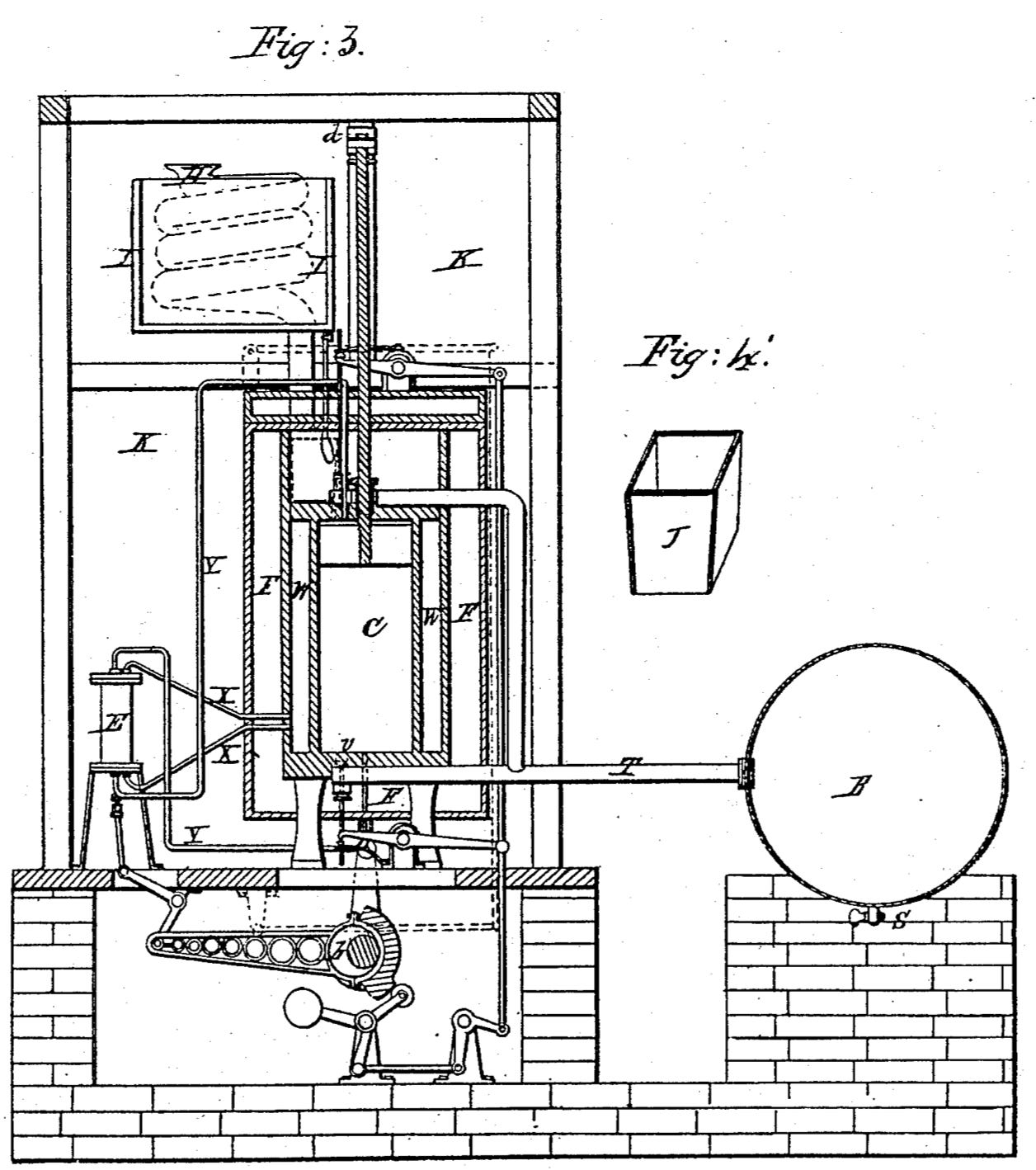
This machine didn’t, however, herald the age of mechanical cooling. Only a single device was constructed, the seals and the pump remained challenging, and the refrigerants used were highly inflammable. It took the Scottish-born, Australia-based publisher James Harrison (1816–1893) to make commercial ice-making a reality. In 1851 he developed a machine that used a compressor to force the refrigeration gas through a condenser and thus liquifying it (and releasing heat in the process) – the same approach that we use today. His machine could produce three tonnes of ice a day, and was patented and sold around the world.2
Okay, so we have machines making ice, but this is supposed to be a history of air conditioning; how do the two connect? Well, the ice the machines produced was used for air conditioning. The first approach was very simple, and initially suggested by Dr. John Gorrie3 in Florida in the 1840s as a means of cooling fever patients – hang a large basin of ice from the ceiling of a room and let the cool air disperse down. This then advanced to having a load of ice in front of mechanical fans which would blow the cold to the desired location. Ice-cooling became a big deal, with theatres and auditoria using it widely in the second half of the 19th century. The 1,400-capacity auditorium of Scranton High School, for example, could get through six and a half tonnes of ice in a single evening.
This had the downsides of having to schlep tonnes of ice around, and having to deal with the resultant meltwater, so it wasn’t long before people began to experiment with the idea of cutting out the middleman (middle-ice?) and simply cooling the air directly. This would both be clearly more efficient, and also it would help address another problem: humidity. The extent to which the temperature of the air feels hot depends upon the amount of water it contains. I have felt cooler in a desert at 40 degrees C (104F) with very low humidity than I have in a rain forest at 30 C (86F) where the air is literally dripping.
In 1903 the new New York Stock Exchange building opened with a system developed by Alfred R. Wolff which worked to both cool and dehumidify the air in the building. By cooling brine and pumping it through coils in the ventilation system it was able to drop the temperature by ten degrees Fahrenheit and reduce the relative humidity by thirty percentage points. A year earlier, however, saw the development of not only the first electrical air conditioning unit, but also the formulation of cooling as an engineering discipline. Willis Carrier (1876–1950) was an engineer at Sackett & Wilhelms, a Brooklyn printing plant when he was tasked to solve a problem. It wasn’t that the workers were too hot (I mean, they likely were, but the management weren’t that bothered) rather the air was too humid, causing paper to expand and contract which threw multi-colour printing out of register.
Carrier approached this challenge not from thinking “how cool do we want this room to be” but rather “What condition do we want this air to have, and how do we maintain it?”. In 1911 he presented his “Rational Psychrometric Formulae” which gave engineers the tools to calculate what happened when air is heated, cooled, humidified and dehumidified. In 1915, he and several colleagues founded the Carrier Engineering Corporation4 specifically to design and sell systems for industrial air conditioning.
In 1922 he made a further breakthrough with the centrifugal chiller. Previously refrigeration plants used reciprocating piston compressors but were large and relatively inefficient. Carrier’s solution, a rapidly rotating centrifugal compressor, made cooling much more economical, and soon shops, cinemas, and theatres could advertise themselves as “places to escape the heat”. One such system was introduced at New York’s Rivoli Theatre and 1925 and they reported that it increased their box office take by $5,000 (over $100,000 today) a week.
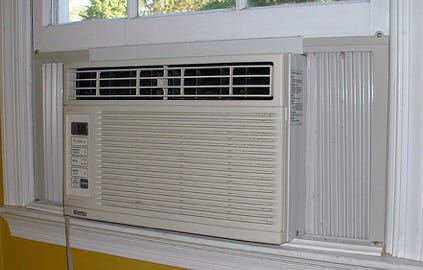
We are still not quite at the air-conditioning that we see today. The next major step was made by Frigidaire (“Frigid Air”, geddit?) in 1929 when they introduced a split-system room cooler for home and small shops. The large, noisy condenser unit was separated from the in-room device and placed outside where it could dump the exhaust heat. These units were however both heavy and expensive and didn’t really take off. 1932 saw the launch of window units, developed by engineers such as H. H. Schultz and J. Q. Sherman. You will almost certainly be familiar with these, they handily sit on the window ledge and pump the heat outside. They were (and still are) both ugly and fairly noisy.
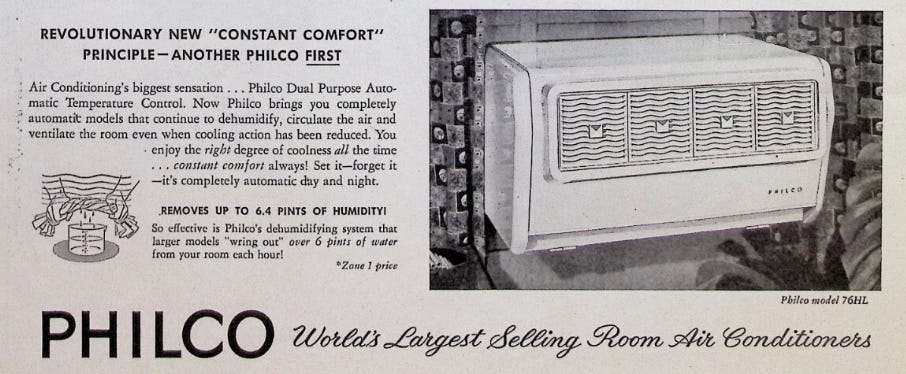
Finally, in 1968, Mitsubishi introduced a system in Japan where a small compressor/condenser unit was mounted on the outside wall of the house and refrigerant was run through pipes to long, shallow units that could nestle just under the ceilings in rooms – very much what I picture5 today when I think about air conditioning. The heat has abated in the UK since I started writing this series, but I am sure it is bound to return, if not later this year then next. Sometime in the winter (when demand is likely to be lower) I am going to get someone round to quote me for air conditioning…
Or rather for whom a written record of this discovery survives.
He also invented machines for directly cooling beer without creating ice first (essential business in Australia!). It all went a bit wrong later when he invested a fortune in a scheme to ship meat from Australia to England kept fresh with ice. The ice melted before the voyage was completed, the meat became rotten and he went bankrupt.
He also patented an ice-making machine.
It trades to this day, and is a $20 billion company.
Actually I can’t picture anything, I have aphantasia, but that is a whole different story…
Marvellous. I’ve been waiting to read this. Thank you.