
In my last two pieces I looked at aspects of the life of Kenneth Grahame, creator of The Wind in the Willows (namely, being held up at gunpoint and the sad story of his son). But if it hadn’t been for one of Grahame’s early mentors, that international bestseller might never have existed. This man’s influence also spread to two other world-famous children’s works – but we’ll get to that.
Soon after Grahame’s first article was published in 1888, he got his first real break as a writer thanks to William Ernest Henley (1849–1903), a poet who was also the editor of the National Observer, a short-lived newspaper (1888–97) which published a number of major literary names of the era, among them Thomas Hardy, H.G. Wells and George Bernard Shaw. This was one of a series of editorships which, along with his own poetry, established Henley as a major literary figure of the late Victorian era (there’s even a sculpture of him by his friend Auguste Rodin, and it sits in the crypt of St Paul’s Cathedral).
But today, Henley is little known – remembered most, if at all, for his 1875 poem ‘Invictus’,1 which arguably became the anthem for the legendary ‘stuff upper lip’ of the British in his era. This stanza (there are only four) gives its core message:
In the fell clutch of circumstance,
I have not winced nor cried aloud.
Under the bludgeonings of chance
My head is bloody, but unbowed.
… and it famously ends, “I am the master of my fate: I am the captain of my soul.”
This poem has echoed through history: Winston Churchill referenced it in a speech to Parliament during the Second World War; Nelson Mandela used to recite it to his fellow prisoners at Robben Island; and political prisoners and campaigners across the globe have referred to it.2
But the key thing I want to explore here is why Henley wrote this appeal to resilience in the face of adversity in the first place – and it was certainly not born purely of the imagination.
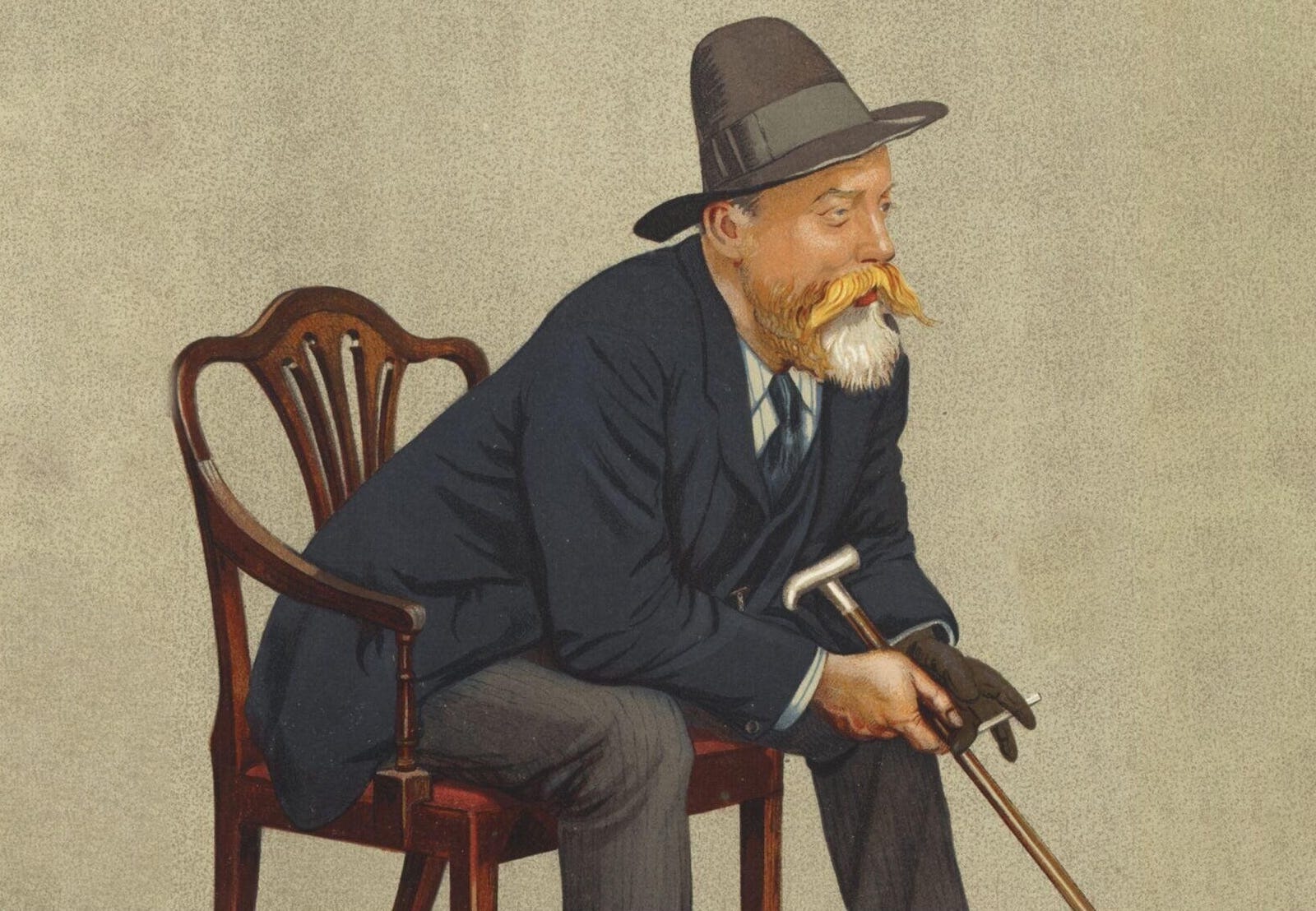
Henley was born in Gloucester, eldest son of a poverty-stricken bookseller and stationer. He started school there, but his education was soon interrupted by bouts of both poverty and ill health – from age 12, tuberculosis infected his bones, and he had to walk on crutches. A determination not to let this beat him was apparent event then – “he hopped along blithe and gay on his two crutches,” his brother Joseph would later recall. Joseph also remembered an occasion when a local bully jeered at the pair, and William cast aside his crutches to engage in a fight.
By 1867, he had left school to seek work in London, but 1868 was his first annus horribilis: his father died in February and then William had to be admitted to St Bartholomew’s Hospital. He would spend ten months there, and at some point during this period his left leg was amputated below the knee, replaced with a wooden leg – he was still only 16 years old. After his discharge from hospital, he lived in a variety of lodgings across London, and began writing for periodicals. But his health troubles persisted, and by 1872 the infection had spread to his other leg.
In this period, he had befriended an East End coffee house owner called Harry Nichols – when Henley was able, they would drink and walk the streets of London into the night, and thanks to the survival of William’s letters to Harry,3 we can get a first-hand insight into William’s life as his affliction began to dominate his life once again.
In 1872, William moved to Margate in Kent in the hope of benefiting from the sea air. From his lodgings, he wrote to Harry:
… there can no longer be a doubt that I have, literally, put my foot in it, and deeply too. I am afeard my marching days are over. The Bohemian you wot of lies a-dying: what sort of a monster will spring from his ashes I don’t care to anticipate. Something very different from the vagabond of old time, I doubt not… Mr Treves4 tells me that if it suppurates I shall have a devil of a time with it, for that indubitably the mischief will affect the bones. And you know what that means… No more walking between tavern and tavern in the night…
He is not immune to a young man’s interests, though:
And there are so many nice girls here. Or, rather, the girls look nicer here than elsewhere, and not without reason. Fresh and rosy, with loosened hair and all the brilliance of the summer sea in their eyes, my soul goes forth and embraces them all.
In early 1873 he was admitted to the Royal Sea-Bathing Infirmary in the town. He wrote to Harry:
Here I am at last, my boy! With a straw bed, half a dozen meals a day, a superintendent to look after me, a parson to pray for me, and an agreeable young woman to tuck me in. So far, so good. Here I am and I intend making the best of it.
He was worrying about money (“I am indeed woefully impecunious”) but always optimistic: “My foot is decidedly better: I am inclined to discredit the necrosed bone hypothesis. On the whole I do not see any reason to doubt of my ultimate recovery.”
That was not to be – by the summer, his foot was worse again, and after hearing in London of a surgeon whose work was being famed, he travelled to Edinburgh Royal Infirmary to see him. That man was Joseph Lister (1827–1912) – the pioneer of antiseptic surgery. William wrote to Harry, “[I] am informed by Mr Lister that probably my foot’ll have to come off”. He was only just turning 24.
In the end, Lister was able to save his foot after all, but William would spend the best part of two years in hospital. In a letter to Harry, he gives us a close-up insight into the patient experience (look away if you’re squeamish!):
There was a long cut across the foot, from ankle to ankle, dividing vessels, tendons and everything, and laying open the affected bone, which in its turn was scooped out (gouge and pliers) so that a large triangular cavity was the result, the apex of which pointed to the toes. This cavity was filled with strips of lint steeped in carbolic oil; changed first of all every four hours, then every eight hours, then twice a day, then once a day, the leg itself being bandaged onto a long iron splint and the foot pulled out so as to expose every part of the internal surface of the cavity to the action of the oil. In this position it was left to granulate… to bring the lips of the wound together and leave them to unite and heal…
After his main operation, William would write to Harry:
Out of chloroform, I find my foot is still all there. Saturday, 30th August, the Professor says, ‘You can write and tell your friends that I have done what I could and that I am perfectly satisfied.’ Since then, going on as well as possible. For the present, therefore, my foot is SAVED!!!
(He also has high praise for Lister: “He is a great surgeon, my boy! Antiseptic surgery, his theory and practice, will have to fight its way, to fight for life. I think I am justified in saying that, next to the use of anesthetics, it is the most beneficent discovery of the century.”)
By May 1874, William’s spirits were as high as ever, and he is able to delight in the little things of life:
I am close to the window and through it I can see the grass-plat in the quad, the sweet sun shining on the daisies and dandelions, chasing the shadows slowly from point to point along the windows and flashing on the skylights, like the amiable tyrant he is. I can see the quick, bright sparrows fighting over the crumbs I throw them, the corpulent crows wandering about, breast-high in the grass, after belated worms, the hospital terrier, a jolly, ugly, lively, kindly dog, with the most intelligent tail I ever saw, larking with his friends, barking at the birds and flying (in fun) after the cats who come to sun themselves and snooze on the window-sills after their nocturnal philanderings.5
The boredom of being stuck in hospital also led to a literary flowering for William. He read widely, and wrote too, beginning his poetry collection In Hospital.6
It was in hospital that William met his wife-to-be, Hannah Boyle, whose brother was a fellow patient. He made lifelong literary friends, too: notably Leslie Stephen, whose daughter born a few years later would become best known as Virginia Woolf, and a young Scotsman, whose own life had been dogged by ill health of a different kind. He was the son of a lighthouse engineer, native to Edinburgh, and another aspiring writer: Robert Louis Stevenson. Stevenson wrote of this first encounter in a letter to his close friend Fanny Sitwell in 1875:
Yesterday Leslie Stephen, who was down here to lecture, called on me and took me up to see a poor fellow, a sort of poet who writes for him, and who has been eighteen months in our infirmary and may be, for all I know, eighteen months more. It was very sad to see him there, in a little room with two beds, and a couple of sick children in the other bed… Stephen and I sat in a couple of chairs and the poor fellow sat up in his bed with his hair and beard all tangled and talked as cheerfully as if he had been in a king’s palace… He has taught himself two languages since he has been lying there.
And who became the most famous character in Stevenson’s first major success, the 1883 Treasure Island? Long John Silver – the man with the wooden leg.7
Henley’s fortitude was exemplary – not just stoicism in the face of difficulties, but great cheer too. Tragically, his resilience would be tested yet further – his daughter Margaret died in 1894 at the age of five. She too left a strange literary legacy – as a lisping toddler she called another family friend, the writer J.M. Barrie, her ‘fwendy-wendy’, and this inspired him to give the name Wendy to the pal of his Peter Pan.
Without Henley’s influence, would we have had The Wind in the Willows or Treasure Island, or indeed some of the most famous works of Rudyard Kipling or W.B. Yeats, both of whom he gave literary breaks to by publishing them?
William’s own last published work was ‘A Song of Speed’ (1903), an enthusiastic hymn to the new motor car, an embodiment of his optimistic world view (“There be good things, Good things innumerable”). But alas, the world of speed would be his end – in 1902, he had fallen from a railway carriage,8 and this rekindled his TB, which finally killed him at home in Woking, Surrey, on 11th July 1903. So it goes.
Let’s end with the final poem of In Hospital, though – ‘Discharged’, the epitome of William’s sunny philosophy:
Carry me out
Into the wind and the sunshine,
Into the beautiful world.

O, the wonder, the spell of the streets!
The stature and strength of the horses,
The rustle and echo of footfalls,
The flat roar and rattle of wheels!
A swift tram floats huge on us…
It’s a dream?
The smell of the mud in my nostrils
Blows brave—like a breath of the sea!

As of old,
Ambulant, undulant drapery,
Vaguery and strangely provocative,
Fluttered and beckons. O, yonder—
Is it?—the gleam of a stocking!
Sudden, a spire
Wedged in the mist! O, the houses,
The long lines of lofty, grey houses,
Cross-hatched with shadow and light!
These are the streets…
Each is an avenue leading
Whither I will!

Free…!
Dizzy, hysterical, faint,
I sit, and the carriage rolls on with me
Into the wonderful world.
Originally untitled – ‘Invictus’ was given to it by the essayist and anthologist Sir Arthur Quiller-Couch, who had been the best man at Kenneth Grahame’s wedding.
More controversially, it has also been quoted by the Oklahoma City bomber Timothy McVeigh and Brenton Tarrant, the gunman at the 2019 New Zealand mosque shooting.
These letters were published in Blackwood’s Magazine in 1943 by J.H. Hallam, who noted, “they may perhaps carry encouragement to some of the many afflicted in this present war”.
I think this might be a young Frederick Treves (1853–1923), who a decade later would become famous for his work with Joseph Merrick, the ‘Elephant Man’.
He also writes of a pretty nurse called Miss Webb who “is the plague of my life; I have made all sorts of attempts to get acquainted with her…”
The 28 poems ran from ‘Enter Patient’ to ‘Discharged’, some in standard rhyming form and others using ‘free verse’, a pioneering mode for the time – as was his realist tone, which shocked some of the more fusty readers. For example, in ‘Operation’, “You are carried in a basket, / Like a carcase from the shambles…”.
In a letter of 1883, Stevenson wrote to Henley: “I will now make a confession. It was the sight of your maimed strength and masterfulness that begot John Silver in Treasure Island. Of course, he is not in any other quality or feature the least like you; but the idea of the maimed man, ruling and dreaded by the sound, was entirely taken from you.” The two men would go on to collaborate on multiple projects, though sadly their friendship would founder just a few years later.
It happened because “a fool-guard started his train before I could board it”. He wrote to a friend on the day: “I got badly thrown on my way hither, on Coombe and Malden Station. By an extraordinary piece of luck (or turn of favour) I saved my life. But I was horribly shaken…”
A fascinating insight into the lives of the authors
Thank you, gives a different perspective on the other writers inspirations.