
As with many a drama, the details took time to emerge – some quickly, some less so, and with varying degrees of reliability. The earliest report I can find is from the Pall Mall Gazette of 24th November, 1903. This is how it begins:
OUTRAGE AT THE BANK OF ENGLAND
ATTEMPT TO MURDER THE SECRETARY
A man made a determined attempt on the life of… [the] Secretary of the Bank of England, at the premises of the Bank this morning.
The Bank authorities, says the Exchange Telegraph Company, are very reticent as to what actually occurred; but it is understood that the man gained admission to the presence of [the Secretary], and then produced a revolver and fired four shots at him in rapid succession.
The report describes the capture of the assailant very briefly (we’ll get to all that), and hastily pasted at the bottom of the page, just before going to press, was this addition:
The name of [the] assailant is stated to be George Frederick Robinson, aged about thirty years, and he is believed to have come from the East-end. The man, it is understood, has been pronounced insane.
If you’ve heard this story before, you’ll know why I’m suppressing certain details. If not… we’ll get to everything.
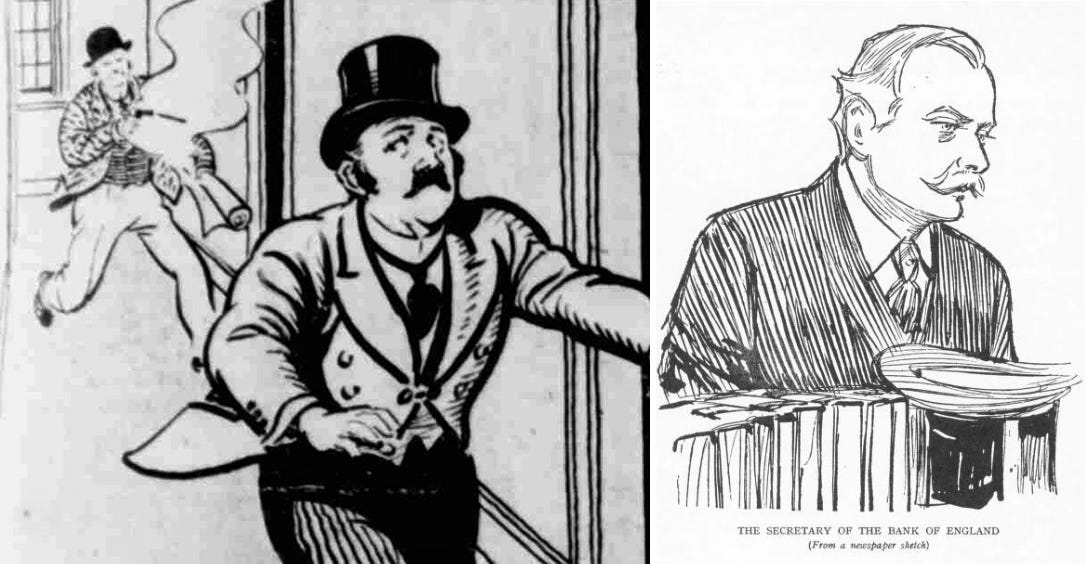
The Secretary at the heart of it all was, at least, unharmed, and fired off a reassuring note to his family the same day:
Darling M.—Just a line to tell you not to be alarmed at any rumours or statements on posters &c. There was a lunatic in here this morning, “shooting free” with a revolver, but nobody got hurt at all, except the lunatic, who was secured after some trouble. Yrs, M.1
By 7pm the same day, an enterprising reporter for The Echo had got hold of many more details.
A man securing admission to one of the private rooms of the Bank of England, drew a revolver and fired four shots in the presence of… the secretary, the bullets narrowly missing that gentleman.
He, however, escaped injury, and the Ben was arrested after a severe struggle.
From inquiries made by an “Echo” representative, there would appear to be some uncertainty as to whether the man in custody fired intentionally at … the secretary of the Bank, or not. The officials themselves maintain considerable reticence as to the actual facts, but, according to the statements of some, the man fired the revolver at random—fired the first shot in the floor, and then turned and and fired three other shots in quick succession…
The struggle with the man is described a having been most fierce and prolonged. According to the statement of one of the officials of the Bank, the man fought like a wild animal, and it was only when the fire-bose had been brought to play upon him for several minutes that he was in any way subdued…
He was still lying on the stretcher on the floor of the police station when our representative called there some time after his arrest.
He is a middle-aged man of good physique, with slightly curly black hair and florid complexion, and was wearing a short, dark, velvet-collared overcoat, slightly frayed at the edges.
He bore several marks of the means adopted to subdue his violence. There were several large pieces of court-plaster it the back of his head, his collar was torn, and there was no mistaking the complete drenching be had received from the fire-hose. He was still unconscious… The man’s whole appearance gave the impression that he was of unbalanced mind.
… The prisoner is stated to have given his name as George Frederick Robinson, of Westbourne-street, Sloane-square…
According to the Exchange Telegraph Company, Robinson is known as a man who held very peculiar ideas as to the distribution of wealth, and his derangement of mind also included some extraordinary notions as to the welfare of the human race.
This is as much a story about how news breaks and gets updated as it is the drama of the moment – I’ve read many inconsistencies in the reports of these events, both then and in more recent times. Both of the on-the-day newspaper reports I have quoted relied specifically upon the Exchange Telegraph Company. This had been set up in 1872 to disseminate commercial news from the London Stock Exchange – picture the classic ticker tape spitting out in gentlemen’s clubs and offices across London (my great-great grandfather would have been reading this output). By 1879, it was also offering a general news service too.2
From then on, news came thick and fast. Two days after the events, the London Times reported that the prisoner was now in Bow Infirmary, having been too distressed to appear at a hearing in Mansion House, where the charge was “wandering at large—deemed a lunatic—in Threadneedle Street” (the home of the Bank of England to this day). A week later, the Times added that further charges were on the sheet: “feloniously discharging a loaded revolver” at the Secretary “with the intent to murder him”; the same charge with George Tombie as the victim – he was the head waiter at the Bank; and for threatening to shoot Inspector Bacon and Detective Digby of the City Police.
The most useful account, however, can be found in the Proceedings of the Central Criminal Court from 14th December,3 and the transcript begins with the words of the Secretary himself:
I am the secretary to the Bank of England. On November 24th I went to the waiting room of the Bank about 11 a.m. I saw the prisoner there—I had never seen him before—I said “Mr. Robinson” in a tone of interrogation. He said “Can I see Sir Augustus Prevost?” (he is the late governor).
I said “No”. He said “Can I see Mr. Morley the deputy governor?” (he is now really governor). I said “Mr. Morley has not arrived at the Bank; will you tell me what your business is?” He said “I suppose you are in charge”. I said “Yes”—he then rose to his feet (he was seated when I entered the room). He handed me this roll of paper (Produced) and said, “If you read that you will see what my business is.”
I said, “I have no time to read petitions or unfastened rolls”. I was standing in the doorway holding the door in my hand. The roll was tied up with a bit of black ribbon at one end and a bit of white at the other—when it was afterwards opened it was found to contain nothing except the words “All of them served”.
I did not open it at that time; I handed it back to him… He said “I will read it myself”—he put it on the table and then sprang sideways the whole length of the table and putting his hand into his breast pocket drew out a revolver—when I saw that I retired through the doorway—the last time I saw the revolver it was pointing in my direction.
I closed the door and as I ran into the passage I heard two shots and I heard two more as I went into the lobby—I sent for the police and then recollecting that there were two other approaches to the corridor where the prisoner was standing I ran round to make them fast… I afterwards saw two holes in the ceiling—the visible ceiling is a false one made of plaster; one bullet had stuck in the wood work of the real ceiling and the other had fallen back into the false ceiling. This (Produced) is part of the wood work and this the revolver—the piece of wood has a bullet sticking in it now.
Head waiter George Tombie then explained he heard two further shots:
I saw the prisoner come out of the waiting room and try to open the door of the passage which had been fastened. He called out, “Come on you cowards, you curs”—he had a revolver in his right hand then. I think the police were then on the other side of the door. The prisoner turned round and saw me—he instantly levelled the revolver—I sprang back and heard a report…
He bravely managed to lock Robinson in a room and summon the police – who then gave their own evidence to the court. Inspector Samuel Bacon added further dramatic details:
I opened the door and saw the revolver pointed at me—I clutched hold of the prisoner by his arm; he swung himself round and jumped out of my grasp; he yelled and ran from the door to the middle of the room—he said “If you move I will shoot you; send me that tall man; I want that tall man” [the Secretary]…
I was waiting for the hose to arrive; it came and the first stroke caught him full in the face—he was so dumbfounded that he stooped down. He recovered himself just as Detective Digby and I rushed into the room—the prisoner jumped into the air and threw the revolver with all his might—it just missed me and went through the glass of the library bookcase. I picked it up and rushed at him—as I was doing so he picked up a heavy chair—he lifted it above his head and rushed at two other officers and attempted to deal them a terrific blow—it slightly caught one of the officers on the hand but it practically missed him and caught the edge of the table and broke a piece off—we then secured him. By that time we were nearly drowned by the water from the hose. I examined the revolver and found five empty cartridge cases in it where the cap had been exploded and one where the cap had not been exploded—that one is filled with candle grease and a little bit of gold on top of it.
Bacon then explains that they went to Robinson’s lodgings and found a box with more than 40 further cartridge cases. The weapon was a Colt .45 with six chambers “of military size, double action” as the press reported.
And the strange scroll that Robinson was carrying came up again:
…when he was at the station he was rambling about several things. I said “Supposing that black ribbon had been taken off that petition first, what would have happened?” He said, “He would have had to look out for himself”. I said “Suppose the white had been taken off first”—he smiled and said, “Oh, then he would have been all right.”
Gradually details of Robinson emerged. I have pieced together what I can from a variety of newspaper reports – some written much later – and my own research at family history websites. Born in Stepney, East London to harness manufacturer Joseph Robinson and his wife Lillie (both also Londoners), George grew up in middle-class comfort, attending the City of London School and Margate College in Kent. Then, as the Times reported:
Mr Dwyer [Robinson’s defence counsel] said the prisoner went to the Klondike [this is at the time of the Gold Rush], where he lived a very hard life for some years. He worked a considerable claim, but being bitten by one of his sleigh dogs he was unable to continue to work. He left and went down south, and ultimately joined the second Canadian contingent4 and served with distinction in South Africa. He subsequently went to West Africa, which shattered his health. He came back to London where he had three attacks of malaria and a sunstroke, and received some money which a mining company owed him, and he embarked in a motoring business. Latterly he had been somewhat peculiar in his manner, and caused some anxiety to his parents… The poverty in this metropolis appealed to his better nature, and aggravated his mental condition.
In 1944, the Daily Express added details from his landlady in Westbourne Street: “On arrival in England he tried to get work. Day after day he became more morose, spending most of the time reading in his bedroom.” After the incident, Robinson was reported to have spoken about the contrast between the gold in the Bank and the poverty in the East End, and said “The laws of England want reforming.” Sadly we learn little more of his voice from all these stories – other than one passing remark made to the Secretary in court after the latter had testified about the revolver being pointed at him: “If I pointed the revolver at you, you must have been on the roof.” Is this a sign that Robinson had intended no actual harm? Was the gold and candle grease replacing some of the bullets in the cartridges some sort of symbol of his political statement?
From Bow Infirmary, the unfortunate Robinson was taken to Brixton Prison, and then to Broadmoor Criminal Lunatic Asylum (still a secure psychiatric hospital today) in Berkshire. I think we must assume he spent the rest of his days there. He was certainly still there at the time of the 1921 Census and in 1925 a 49-year-old man called George F. Robinson had his death registered at Easthampstead, Berkshire – just four miles from Broadmoor.5 So it goes.
But what of that Secretary of the Bank of England who came up against Robinson? He was a pillar of society, a deeply conservative man who took his duties seriously. He had started at the Bank as a clerk at the age of only 19 in 1879, after being denied the chance to attend the University of Oxford (the city where he went to school) by his uncle – his mother had died when he was young and he was estranged from his alcoholic father. After 20 years at the Bank, he was appointed its youngest-ever secretary, a role he held for a decade. A friend and colleague there, Sidney Ward, would later reminisce:
He was always helpful and never obstructive, conservative though he was. I can’t imagine anyone who, at that time, was better suited for the position which he held as Secretary of the Bank of England. In all the push and bustle of a great institution, the conflicting interests of different departments, and the personal jealousies, sometimes, of their chiefs, [he] was just the man to hold the balance—always there, always wise, never too busy to see any one, a sound adviser of the Governor, never rattled and universally respected—he was a far greater force than most men imagined at the time. And, as all those who have lived the best part of our lives know, it is the silent forces, not the noisy ones, which guide the world.
After the drama at gunpoint, the Secretary was inundated with letters from the public. Because… he had another life.6 Alongside his banking career, he had developed one as a writer, mainly for children. And he was soon to become the author of one of the most famous children’s books ever written.
And yup, you guessed it… we’ll talk about that next time!
M for ‘Mont’ – a family nickname which gives nothing away about his real identity! (His wife’s name didn’t begin with M either, in fact.)
From the 1950s it became known as Extel, and this brand still exists today, though for data analysis rather than news.
Available at the excellent Old Bailey Online website.
Tantalisingly, Broadmoor’s archives hold letters written to and from Robinson – perhaps I will go there and investigate someday.
One of his biographers said of him, “He was built in compartments.”