
In my previous piece I explored how humans measured time up until around the first century CE. Most people, particularly those living in rural areas, would have had no real relationship to formally measured time – hours were simply something that didn’t intrude into their lives. Their days would revolve around the broad passage of the sun – nature’s timekeeper. Those in Europe that did have some access to a water clock or a sundial would have been interacting with a form of time that is very different to the one that we are familiar with today. Instead of measuring equal, sixty-minute hours the duration of their hours would vary from season to season as the length of daylight waxed and waned.
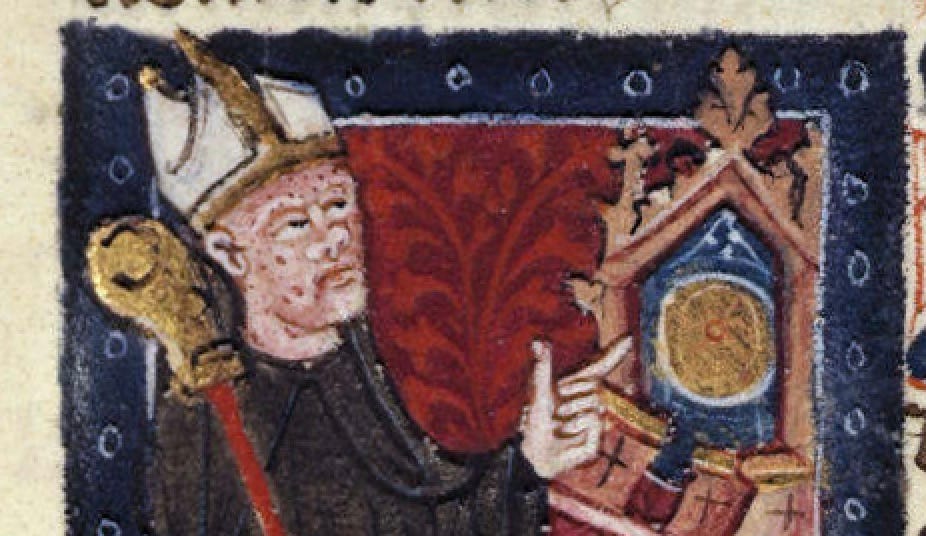
We have a lovely example of just how foreign hours were to most people at that time (and thanks to Mary Catelli for bringing this to my attention!) from a fragment of a lost play Boeotia (The Boeotian Woman) which was probably written by Plautus (c. 254 – 184 BC):
Par ut illum di perdant, primus qui horas repperitquique adeo primus statuit hic solarium;qui mihi comminuit misero articulatim Diem!nam <unum> me puero Venter erat solarium,multo omnium istorum optumum et uerissumum.ubi is te monebat, esses, nisi quom nil erat.nunc etiam quom est non estur, nisi Soli lubet.itaque adeo iam oppletum oppidum est solariis, maior pars populi aridi reptant fame.
May the gods ruin the fellow who first invented hours, and moreover the one who first set up a sundial here; poor me, he tore Day to pieces for me, limb by limb! When I was a boy, Belly was your only sundial, and by far the best and truest of them all. When he reminded you, you’d eat, unless there was nothing there. Now even when there is something there one doesn’t eat, unless Sun sees fit. What’s more, the town is now so full of sundials, the majority of the population creep around dry from hunger.
Move on a thousand years, to the start of the second millennium, and things have not really changed very much at all. In researching this piece I have been surprised (though upon reflection probably shouldn’t have been) to discover quite how relatively recent “our” form of timekeeping really is. Unequal hours still persisted, and work was driven by light, rather than a clock. One thing that was different was that more people would have at least been aware of which (unequal) hour it was, even if that did nothing to modify their behaviours. Christian institutions, such as the Benedictines, had very structured days, with activities taking place at specific times. Monks and nuns would have been frequently made aware of what the hour was by the ringing of bells, and these aural time-signals would have been heard by the people living outside the institutions’ walls.
In the Rule of St Benedict we see clearly how, due to unequal hours, the time of, for example, dining, varied over the course of the year:
From holy Easter until Pentecost
let the brothers take dinner at the sixth hour
and supper in the evening.From Pentecost throughout the summer,
unless the monks have work in the fields
let them fast on Wednesdays and Fridays until the ninth hour;
on the other days let them dine at the sixth hour.
This dinner at the sixth hour shall be the daily schedule
if they have work in the fields
or the heat of summer is extreme;
the Abbot’s foresight shall decide on this.Thus it is that he should adapt and arrange everything
in such a way that souls may be saved
and that the brethren may do their work
without just cause for murmuring.From the Ides of September until the beginning of Lent
let them always take their dinner at the ninth hour.In Lent until Easter let them dine in the evening.
But this evening hour shall be so determined
that they will not need the light of a lamp while eating,
Indeed at all seasons
let the hour, whether for supper or for dinner, be so arranged
that everything will be done by daylight.
The notion of splitting the day into 24 equal hours had actually been around for more than a thousand years in Europe by that time (and longer in China, as we saw in my last piece). And whilst it wasn’t being used in day-to-day life we know that people like the Greek astronomer, geographer, and mathematician Hipparchus (c.190 - c.120 BCE) were using it in their work. In his Commentary on Aratus and Eudoxus he wrote about using equal hours for astronomical observation:
Χωρὶς δὲ τῆς ἐν ταῖς συνανατολαῖς καὶ ⟨συγκατα-⟩ δύσεσι θεωρίας εὔχρηστον εἶναι νομίζω καὶ τὸ παρακολουθεῖν ἡμᾶς, τίνες τῶν ἀπλανῶν ἀστέρων ἀπέχουσιν ἀπʼ ἀλλήλων κατὰ τὸ ἑξῆς ὡριαῖα ἰσημερινὰ διαστήματα. τοῦτο γὰρ ἡμῖν εὔχρηστόν ἐστι πρός τε τὸ τὴν ὥραν τῆς νυκτὸς ἀκριβῶς συλλογίζεσθαι καὶ πρὸς τὸ τοὺς ἐκλειπτικοὺς τῆς σελήνης χρόνους καὶ ἕτερα πλείονα κατανοεῖν τῶν ἐν ἀστρολογίᾳ θεωρημάτων.
But apart from the theory of the East and the West, I think it is useful to observe which fixed stars are separated from one another by successive equinoctial hourly intervals. For this is useful for us both for determining accurately the hour of the night and for understanding the times of lunar eclipses and many other astronomical matters
We also have a nice example from Ptolemy’s Geography (c. 150CE) where he notes the length of the longest day in equal, rather than seasonal, hours:
Paphos has its longest day of 14,25' equinoctial hours, and varies eastwards from Alexandria one quarter of an equinoctial hour.
In terms of actually using “modern” hours to organise one’s whole day the first European of note that we know did so was none other than the Anglo-Saxon king, Alfred the Great (849-899). The Welsh monk Asser describes him doing so in his The Life of King Alfred (written in 893 and is a rare, detailed example of a first-hand account of a notable person from that period):
After long reflection on these things, he at length, by a useful and shrewd invention, commanded his clerks to supply wax in sufficient quantity, and to weigh it in a balance against pennies. When enough wax was measured out to equal the weight of seventy-two pence, he caused the clerks to make six candles thereof, all of equal weight, and to mark off twelve inches as the length of each candle. By this plan, therefore, those six candles burned for twenty-four hours, a night and a day, without fail, before the sacred relics of many of God’s elect, which always accompanied him wherever he went.
Sometimes, however, the candles could not continue burning a whole day and night, till the same hour when they were lighted the preceding evening, by reason of the violence of the winds, which at times blew day and night without intermission through the doors and windows of the churches, the sheathing, and the wainscot, the numerous chinks in the walls, or the thin material of the tents; on such occasions it was unavoidable that they should burn out and finish their course before the appointed hour.
The king, therefore, set himself to consider by what means he might shut out the wind, and by a skilful and cunning invention ordered a lantern to be beautifully constructed of wood and ox-horn, since white ox-horns, when shaved thin, are as transparent as a vessel of glass. Into this lantern, then, wonderfully made of wood and horn, as I before said, a candle was put at night, which shone as brightly without as within, and was not disturbed by the wind, since he had also ordered a door of horn to be made for the opening of the lantern. By this contrivance, then, six candles, lighted in succession, lasted twenty-four hours, neither more nor less. When these were burned out, others were lighted.
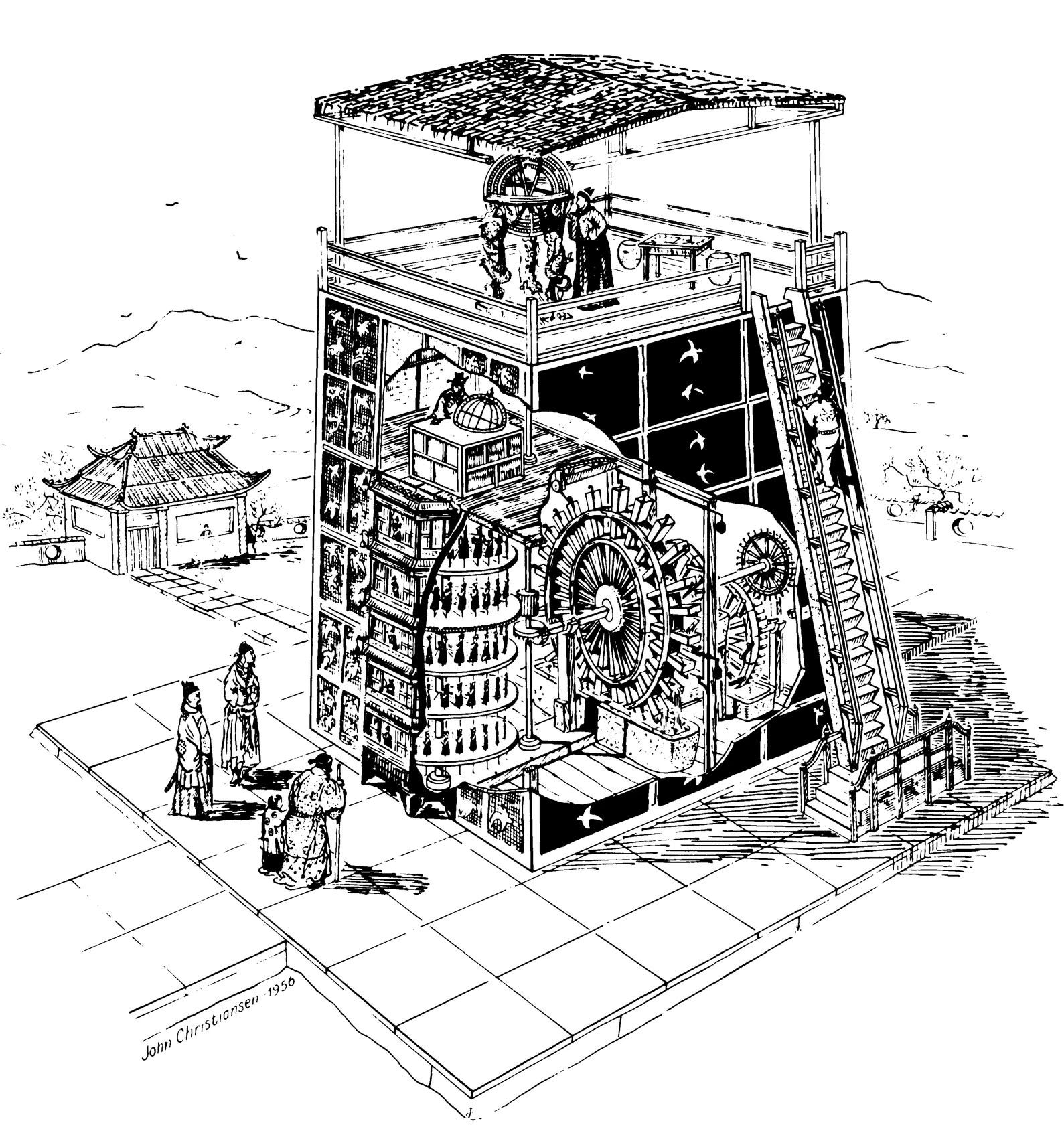
The use of what were then very expensive candles for accurate timekeeping was pretty much the preserve of kings. In order for equal hours to take hold in the general population you needed to come up with better ways of measuring time. The Chinese had been already using equal hours (or equal double hours, to be more precise) for more than a thousand years at this point. To measure and report these hours they developed water1 clocks of the most astonishing complexity. The Chinese polymath Su Song (蘇頌, 1020-1101) built a clocktower which, though water driven, used both an escarpment and a chain-drive. This enabled a highly regulated clock to be constructed, as Su Song himself explained:
The chain drive is 19.5 ft long (5.9 m). The system is as follows: an iron chain with its links joined together to form an endless circuit hangs down from the upper chain-wheel which is concealed by the tortoise-and-cloud (column supporting the armillary sphere centrally), and passes also round the lower chain-wheel which is mounted on the main driving-shaft. Whenever one link moves, it moves forward one tooth of the diurnal motion gear-ring and rotates the Component of the Three Arrangers of Time, thus following the motion of the heavens.
He later wrote in his memorial:
According to your servant's opinion there have been many systems and designs for astronomical instruments during past dynasties all differing from one another in minor respects. But the principle of the use of water-power for the driving mechanism has always been the same. The heavens move without ceasing but so also does water flow (and fall). Thus if the water is made to pour with perfect evenness, then the comparison of the rotary movements (of the heavens and the machine) will show no discrepancy or contradiction; for the unresting follows the unceasing.
The motion gear rings and upper drive wheel each had 600 teeth, which broke the day into increments of 2 minutes and 24 seconds (which, as we learned in my previous piece, allowed the 12 shí and 100 kè that they day was broken down into to be meshed mathematically). The resulting device was a thing of both mechanical and aesthetic beauty and contained 133 different clock jacks to indicate and sound the hours.
Water clocks similar to, but less elaborate than, the Chinese ones were in use in medieval Europe. For example, according to Jocelyn de Brakelond, in 1198, during a fire at the abbey of St Edmundsbury (now Bury St Edmunds), the monks “ran to the clock” to fetch water (so it must have held enough of the stuff to be useful in fire-fighting). But the real game-changer was the invention of the fully mechanical clock. For a device that would achieve such ubiquity it may come as a surprise to learn that we know neither who invented it nor even roughly when it was invented. What we do know is that between 1280 and 1320 there was an increase in the number of references to clocks and horologes in church literature, which suggests that there were more of these devices being installed in religious institutions. What we don’t know for sure is whether this was an expansion of water clocks or if perhaps a new invention, the fully mechanical clock, had entered the scene. In 1283, for example, a large clock was installed in Dunstable Priory, and whilst no trace of it now remains, the location, behind the rood screen, would have been too small for it to have been a water clock, so it was probably a mechanical one.
A decade earlier in Norwich Cathedral there is a reference to a payment for a mechanical clock in what was then the priory but it turned out to be not that great at keeping regular time, so in 1308 a new one was commissioned. The costs of the replacement device (sadly destroyed in a fire in the 17th century) we have recorded in wonderful detail:
Clock – For one plate of metal bought, 4½d. Sounds purchased, 16d; for making five images, 20s. Item, boys making heads, 3s. In wages of Master Robert, 30s. Andrew and Roger, carpenters, are also mentioned as employed at this period. The total of the expenditure, between Michaelmas and Christmas, amounted to £4. 19s 8¼d.
In the Compotus for 1323, several entries occur under the head Orologium. Payments of wages to Andrew the carpenter, to Robert, to Roger de Stoke; with the following payment for the latter for carriage of his clothes and tools, 8s. For a hose of Latoun, 4s. 7½d.
Also to Master Adam, the sculptor, for making twenty-four little images, 11s. Also for 200 Caen stones, 22s. Also to John, blacksmith, for ironwork for the clock, 3s. 9d, Also delivered to Robert of the Tower, for making of the great dial, 10s; and so much in danger of being lost, because from his poverty he was unable to perfect the work, nor was any thing to be obtained from him. Total, £6. 13s. 9¼.
The oldest surviving mechanical clock is probably the one in Salisbury Cathedral which dates from 1386 (though this title is somewhat disputed and fought over!).
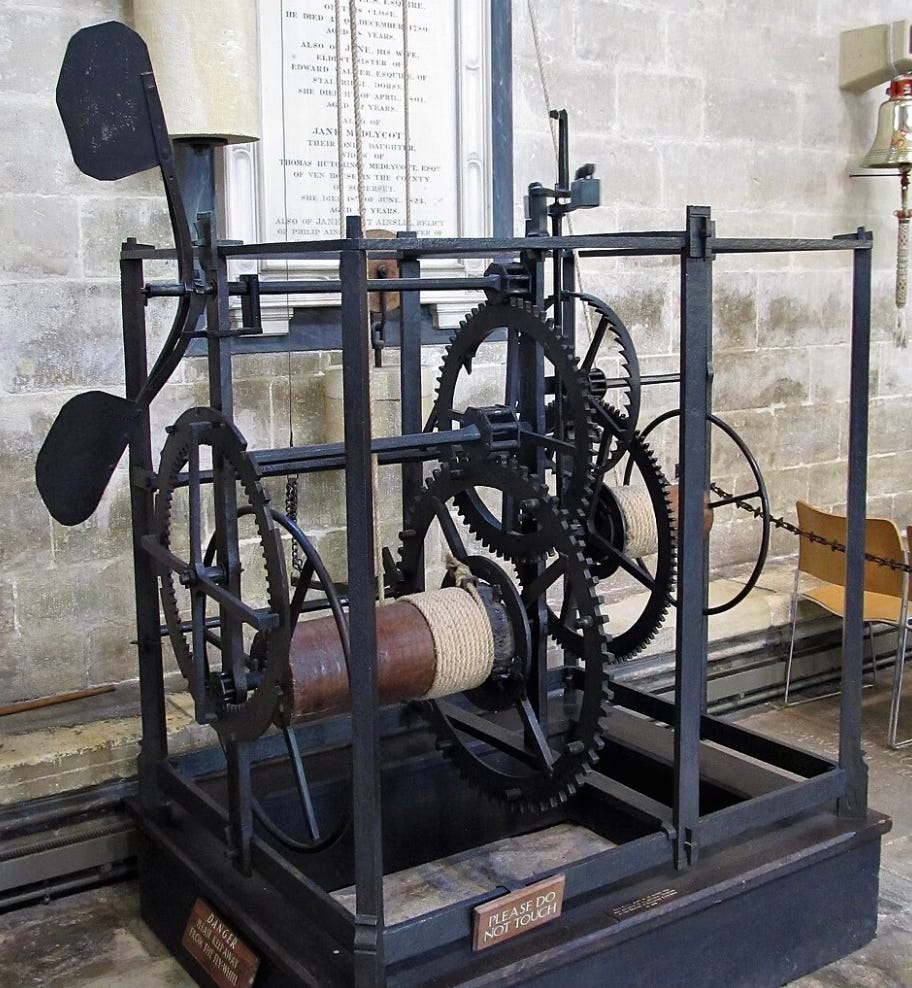

What was the innovation that enabled these clocks to be constructed? I am not particularly mechanically minded so I am going to explain this in fairly simplistic terms. These early mechanical clocks worked like this:
A drum or barrel around which a rope or chain was wound
A heavy weight was attached to the end of the rope/chain
As the weight descends, so it would turn the drum
The turning of the drum would drive a set of gears inside the clock, which would process the time.
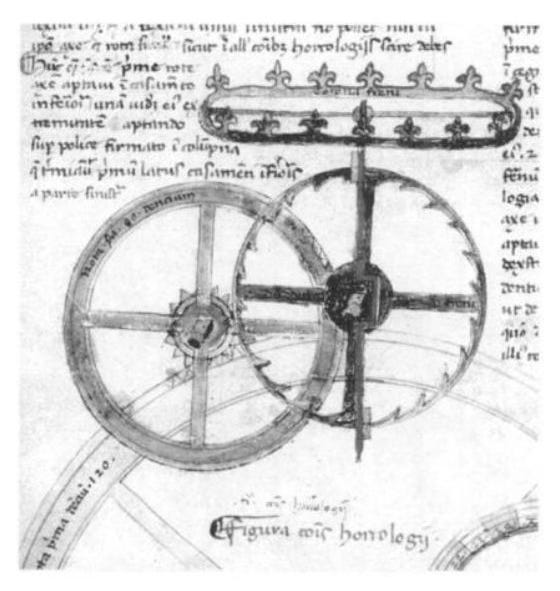
There was, however, a problem. If there was nothing to restrain them the gears would spin freely. In order to prevent this there was the key invention, the verge escarpment which worked like this:
The last toothed wheel in the gear train was called the crown wheel
As the wheel turned a tooth of the wheel presses on one pallet
That push rotates the verge and foilot
As they rotate, the first pallet moves clear
The tooth of the crown wheel escapes
The wheel advances until a tooth on the opposite side
The second tooth now pushes the verge out of the way
The cycle then repeats
This means that the rotation of the crown wheel progresses in consistent, uniform steps. Now I realise that this description may not make much sense (it didn’t to me until I saw it)2 so here is a little animation showing how it worked:
Or if this helps more, here is a one of the earliest existing drawings of a verge escapement, in Giovanni de Dondi's astronomical clock, the Astrarium, built 1364:
Whilst these clocks kept time, they didn’t necessarily keep good time (as the replacement of the one in Norwich shows). In part this was because they were hard to accurately construct and configure, and in part due to their design. The speed of the rotation of the drum was dependent upon the force of the weight pulling down on it, and the radius of the drum itself. When freshly wound all of the rope (or chain) would be wrapped around the drum.As time went on, and the rope descended, there would be less and less of it so the radius of the drum would diminish.
A surprising feature of many of these early clocks is that they lacked a face. They signalled the time by ringing bells upon the hour. For most people back then a clock wasn’t something that one looked at, it was something one heard. Those that did have faces would only have a single hand, showing the slow progression of the hours. Indicating minutes was simply not a thing. In my final piece I will (at last!) explain how we started using minutes and also look at how time became standardised around the world.
And mercury, often swapped out for water in the winter as the latter would freeze.
Really digging into the development of mechanical clocks one of the reasons why this piece took me way longer to write than I was expecting. I know that actually it isn’t very complicated, but it doesn’t help that I also have aphantasia, and so can’t visualise things.