
For about 30 years (between the ages of 17 and 47)1 I didn’t wear a wristwatch. This wasn’t a pose: the strap broke and I never got around to having it fixed, and as the months passed I became increasingly good at knowing what the time was – and also where the time could be spied on public clocks. As the years went on I became really good at it. A friend would say “What’s the time?” and I’d say “2:37” and often be accurate to the minute. It was, all things considered, a pretty useless skill to have. After all, you know, watches are a thing; and then even more so when smartphones came in and the time was just there in my pocket. All the time. Despite this low-key obsession with time it never occurred to me to think about why we measure time in the way that we do, so these pieces will be exploring how we ended up with 24 hours each of 60 minutes and each of those of 60 seconds and how people measured time before we got decent mechanical clocks.
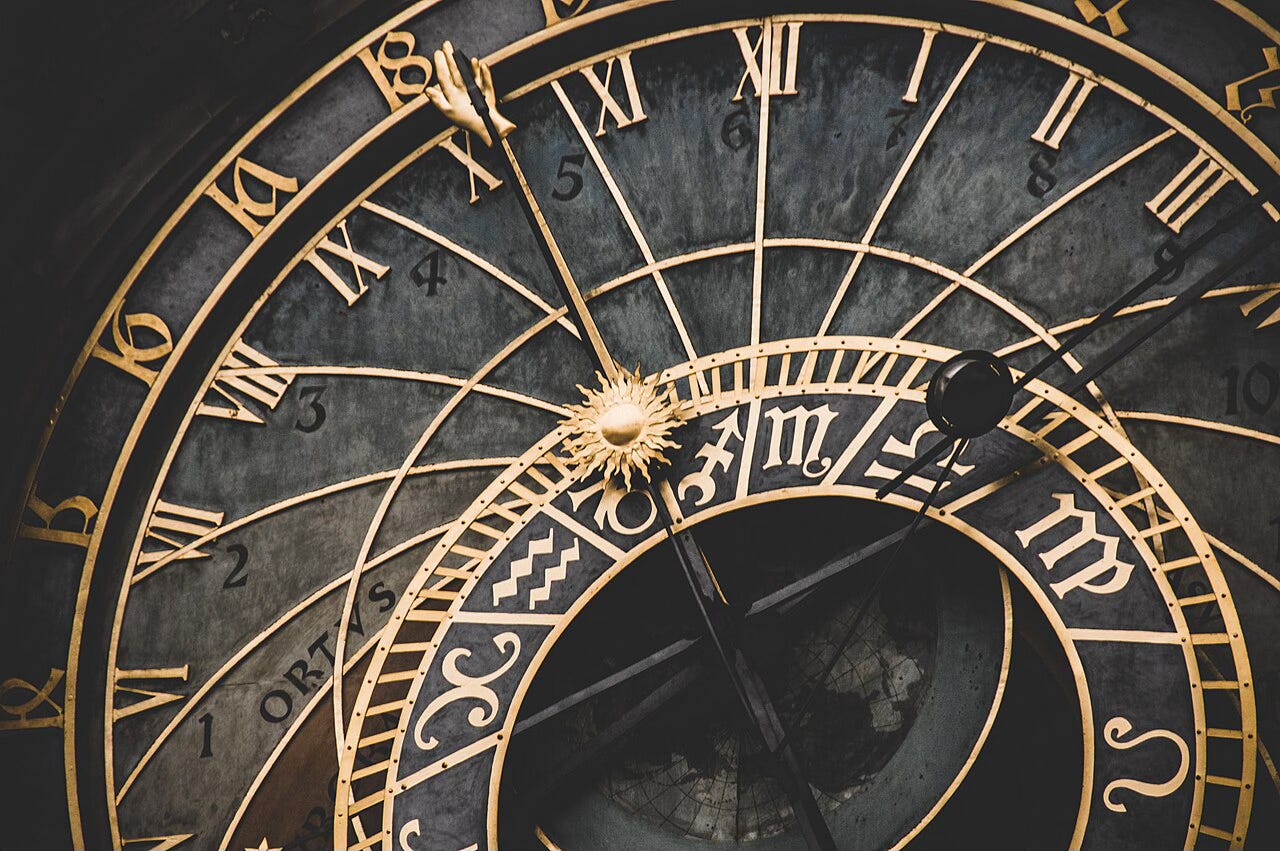
The concept of breaking up the day into 24 segments probably arose in Ancient Egypt probably around the start of the New Kingdom 3,500 years ago. As you might have guessed there is some uncertainty about this but we know that they were doing so at this point due to the discovery of an ancient sundial. This shows the day being divided into 12 sections, and the night was similarly divided into 12. You may be wondering, why 12? After all, we have ten fingers and ten toes and now pretty much everyone uses base-10 in their day-to-day lives. One long-held theory is that each of your four fingers has three joints, so you can easily count up to 12 on one hand by tapping them with your thumb. 12 is also easily divided by 2, 3, 4, and 6.
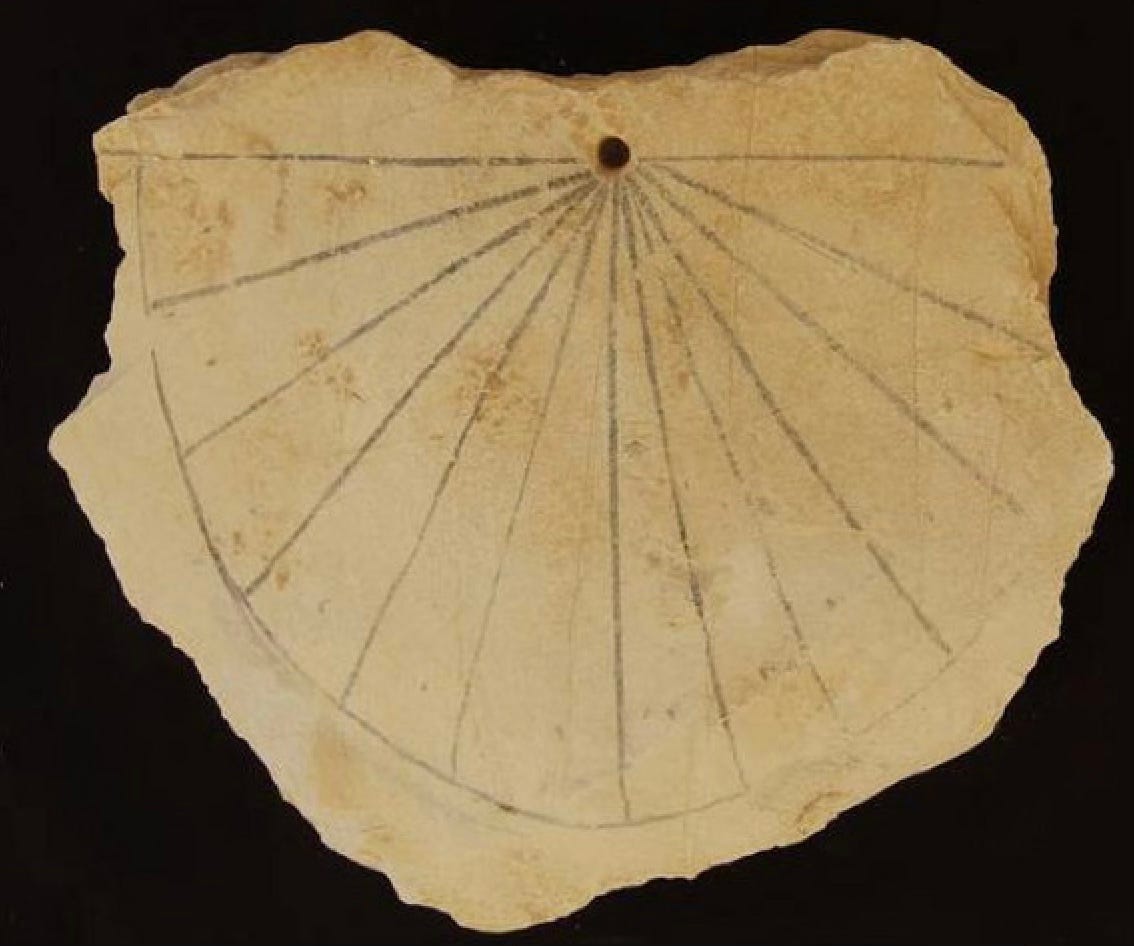
When it comes to specifically measuring time there is another explanation. The Egyptians defined a set of 36 stars which could be used to segment the heavens into equal slices. Of these 18 were used to track the passage of time, and of those 3 each were assigned to dawn and dusk leaving the appearance of 12 stars to break the night into “hours”. Having broken the night up into 12 chunks it then seemed pretty logical to do the same for the day, hence 24 hours.2
These hours were, however, very different to the ones that we use today. The day (meaning period of light) was separated into 12 equal parts however the length of the day, and hence the hours, would vary significantly by season.3 This means that the ancient concept of time was very different to the one that we are familiar with today. The “time” of, for example, the third hour would be radically different in December when compared to June (though obviously noon and midnight would be the same).4 The timings of the hours in Ancient Rome would have looked something broadly like this:5
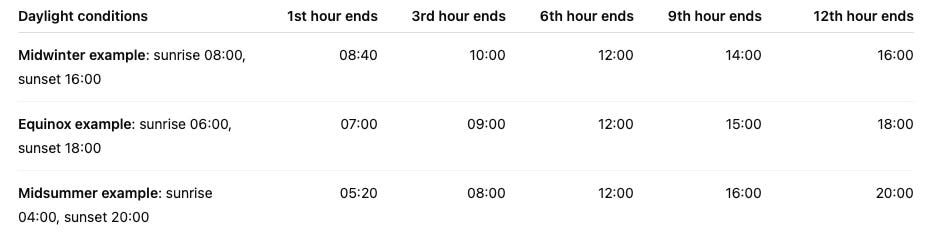
It may seem strange to us that time was measured, but inconsistent over the year, and could still be of use, but it was quite straightforward. If you arranged with someone to meet at “the third hour tomorrow” they would know exactly when you meant. People would use measured hours to organise their days to an extent, but which hours they chose would vary over the course of the year. We have a nice example of this from a letter Pliny wrote, describing how the bathing time of one of his friends varied:
When he is told that the bathing hour has come – which is the ninth hour in winter and the eighth in summer – he takes a walk naked in the sun, if there is no wind. Then he plays at ball for a long spell, throwing himself heartily into the game, for it is by means of this kind of active exercise that he battles with old age. After his bath he lies down and waits a little while before taking food, listening in the meantime to the reading of some light and pleasant book.6
One of the most common means of measuring time, as already mentioned, was something we are doubtless all very familiar with – the sundial. As you know they consist of a flat plate (or dish) and a gnomon7 which casts a shadow upon it. As the sun moves over the course of the day, so the shadow moves across hour lines, enabling the time to be easily read. For a sundial to measure time correctly, it has to be configured to the location of its use. A sundial’s geometry has to match the latitude of the place, because the Sun’s daily path across the sky changes with latitude. The gnomon is typically set parallel to Earth’s axis, so its angle to the horizontal depends directly on local latitude. Sometimes though people, err, forgot about this point, as Pliny once again records:
Marcus Varro records that the first public sundial was set up on a column along by the Rostra during the First Punic War after Catina in Sicily had been taken by the consul Manius Valerius Messala [263 BC], and that it was brought from Sicily thirty years later than the traditional date of Papirius's sundial. The lines of this sundial did not agree with the hours, but all the same they followed it for 99 years, till Quintus Marcius Philippus who was censor with Lucius Paulus [164 BC] placed a more carefully designed one next to it, and this gift was received as one of the most welcome of the censor's undertakings. Even then however the hours were uncertain in cloudy weather.
As Pliny noted, sundials are great so long as the sun is shining so what did people do when it was cloudy, or nighttime? The answer is through the use of waterclocks, the oldest known example of which is the approximately 3,400-year-old Karnak clepsydra. This is a stone vessel with a hole at the bottom through which water dripped out, with tapered sides to ensure that the rate of dripping would be constant as it emptied out. Down the sides is a series of 12 marks or “false holes” – to tell the time you just had to look where the water level was in relation to those holes. Ah, but hang on, how would that work given that the length of each hour would vary over the course of the year? Simple, there were 12 columns of marks, one for each month of the year (Egyptians had been dividing the year into 12, 30-day months and five feast days since around 4,500 years ago).8
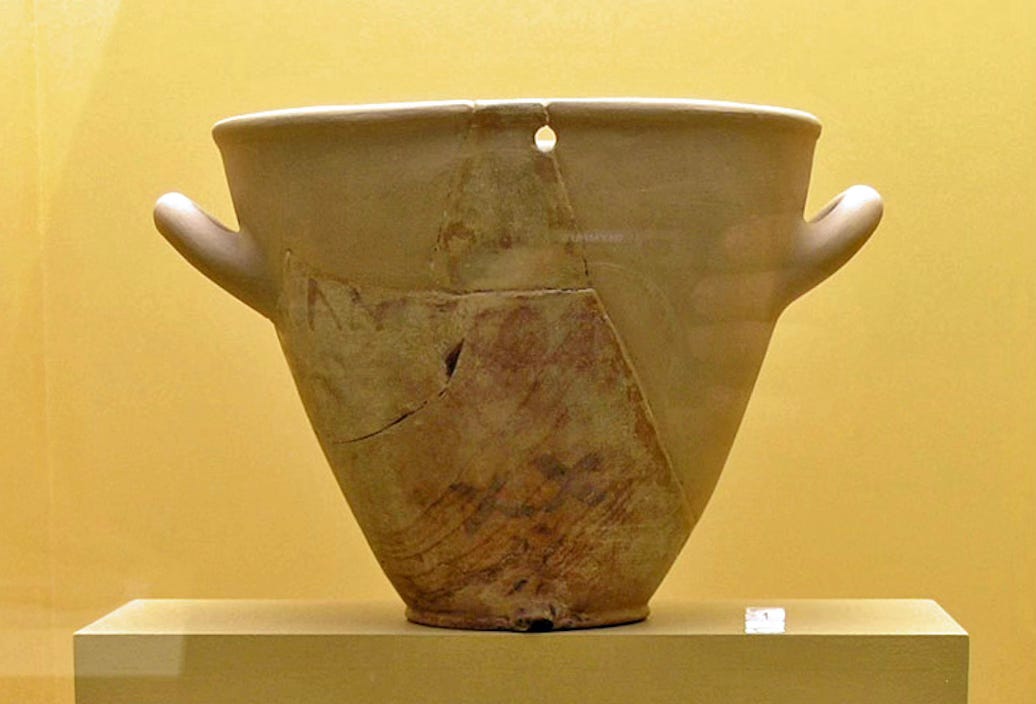
Obviously there would be some variation within a month, but this was deemed accurate enough for ensuring that religious rites took place at the correct time. Suffice to say it was no small challenge to accurately taper the clock and calibrate for it to be of use, but devices such as this seem to have worked exceptionally well. We also have a good idea of who the person was with the smarts to invent this as the tomb of an Egyptian court official, Amenemhet, dating back more than 3,500 years has an inscription upon it reading:
I was the one who devised the water-clock (clepsydra) for the measurement of the hours of the night.9
Water clocks of this nature were also used to measure precise intervals of time, such as in Roman courts of law, where the advocates had strict limits placed upon the extent to which they could speak, though it turns out that one could haggle for more time as Pliny (yet again!) explains:
However, as soon as I had pulled myself together and collected my thoughts, I began my address, and though I was nervous I was on the best of terms with my audience. I spoke for nearly five hours, for, in addition to the twelve water-clocks — the largest I could get — which had been assigned to me, I obtained four others.
The technology of water clocks soon developed far beyond simple clay jars, floats were used that could more directly indicate the time or even play sounds as Vitruvius recorded in his Ten Books on Architecture (late 1st century BCE):
Hence, Ctesibius, observing that sounds and tones were produced by the contact between the free air and that which was forced from the pipe, made use of this principle in the construction of the first water organs. He also devised methods of raising water, automatic contrivances, and amusing things of many kinds, including among them the construction of water clocks. He began by making an orifice in a piece of gold, or by perforating a gem, because these substances are not worn by the action of water, and do not collect dirt so as to get stopped up.
Water clock innovation was also taking place in China. Around the year 200 BCE they moved away from vessels that had water flowing out of them, and replaced them with ones that filled with water, with a float indicating the time. Measuring time with water could be problematic though. It would evaporate, would expand and contract with temperature and even freeze if the temperatures fell sufficiently low in the winter. This latter problem was addressed by keeping the water heated with burning torches, until the year 976 when the engineer Zhang Sixun hit upon the idea of replacing the water with mercury. Some clocks were thus designed to work with water in the summer, and mercury in the winter.
The Chinese were also doing something that the European’s weren’t – they were dividing their days into consistently equal, rather than seasonal, hours. More than two thousand years ago they divided their days into 12 double hours called shí (時) that were named with the Twelve Earthly Branches: zǐ, chǒu, yín, mǎo, chén, sì, wǔ, wèi, shēn, yǒu, xū, hài. Alongside shí, the day was also divided into kè (刻), literally “marks,” probably referring to marks on a clepsydra or sundial. For long stretches of imperial history, a day was treated as 100 kè, so one kè was 1/100 of a day: about 14 minutes 24 seconds. Because 12 shí and 100 kè do not divide neatly into one another, traditional Chinese systems often used smaller intermediate fractions. One important one was a subdivision equivalent to 1/600 of a day, about 2 minutes 24 seconds which let the 12-shí and 100-kè systems mesh mathematically.
So there were several pretty good ways of measuring time two thousand years ago, but they weren’t exactly portable were they? What did people do when they were out and about, or did they simply not worry about time too much? You may have seen a scene in a historical comedy where someone is asked the time and they pull up their sleeve revealing a sundial strapped to their wrist. This is obviously a gag, but interestingly it isn’t that far from the truth! Vitruvius, writing in the late 1st century BCE describes in the context of many sundial innovators how they left instructions for making “portable pendulous dials”:
Berosus the Chaldean, was the inventor of the semicircle, hollowed in a square, and inclined according to the climate. Aristarchus the Samian, of the Scaphe or Hemisphere, as also of the discus on a plane. The Arachne was the invention of Eudoxus the astrologer, although some attribute it to Apollonius. The Plinthium or Lacunar, an example of which is to be seen in the Circus Flaminius, was invented by Scopas the Syracusan. The sort called Πρὸς τὰ ἱστορούμενα, by Parmenio. That called Πρὸς πᾶν κλίμα,º by Theodosius and Andrias. The Pelicinon by Patrocles. The Cone by Dionysodorus. The Quiver by Apollonius. The persons above mentioned not only invented other sorts; but the inventions of others have come down to us, such as the Gonarche, the Engonatos, and the Antiboreus. Many also have left instructions for constructing the portable pendulous dials.
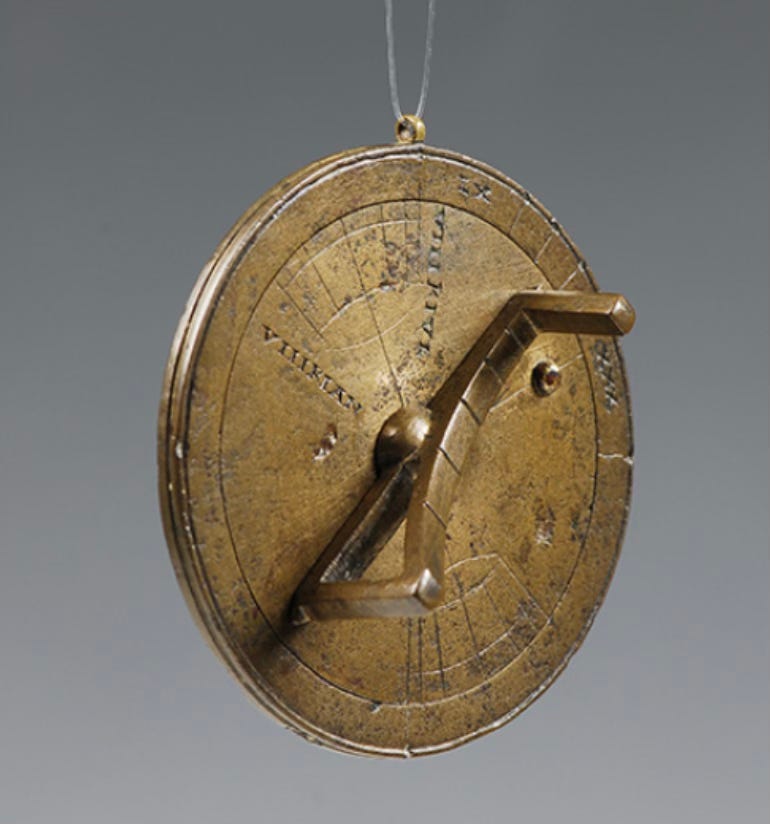
And one dating from around the year 250CE can be seen in the Museum of the History of Science in Oxford. For sure, it wasn’t something to be worn on the wrist, but it was basically the ancient equivalent of a pocket watch:
“Hang on a minute!”10 you may be thinking “why hasn’t he mentioned hourglasses yet?” Surely they are one of the oldest means of measuring time?” So that is what I assumed as well before researching this piece, but what I learned was quite surprising. It seems that hourglasses are actually not really that old at all. There is a relief on a sarcophagus from Villa Albani in Rome dating from around 350 CE (or perhaps 120-130 CE) which shows something that looks a bit like an hourglass but beyond that possibility the earliest visual representation we have can be seen in Ambrogio Lorenzetti’s Allegory of Good Government, painted in 1338–1339, where the figure of Temperance holds an hourglass.
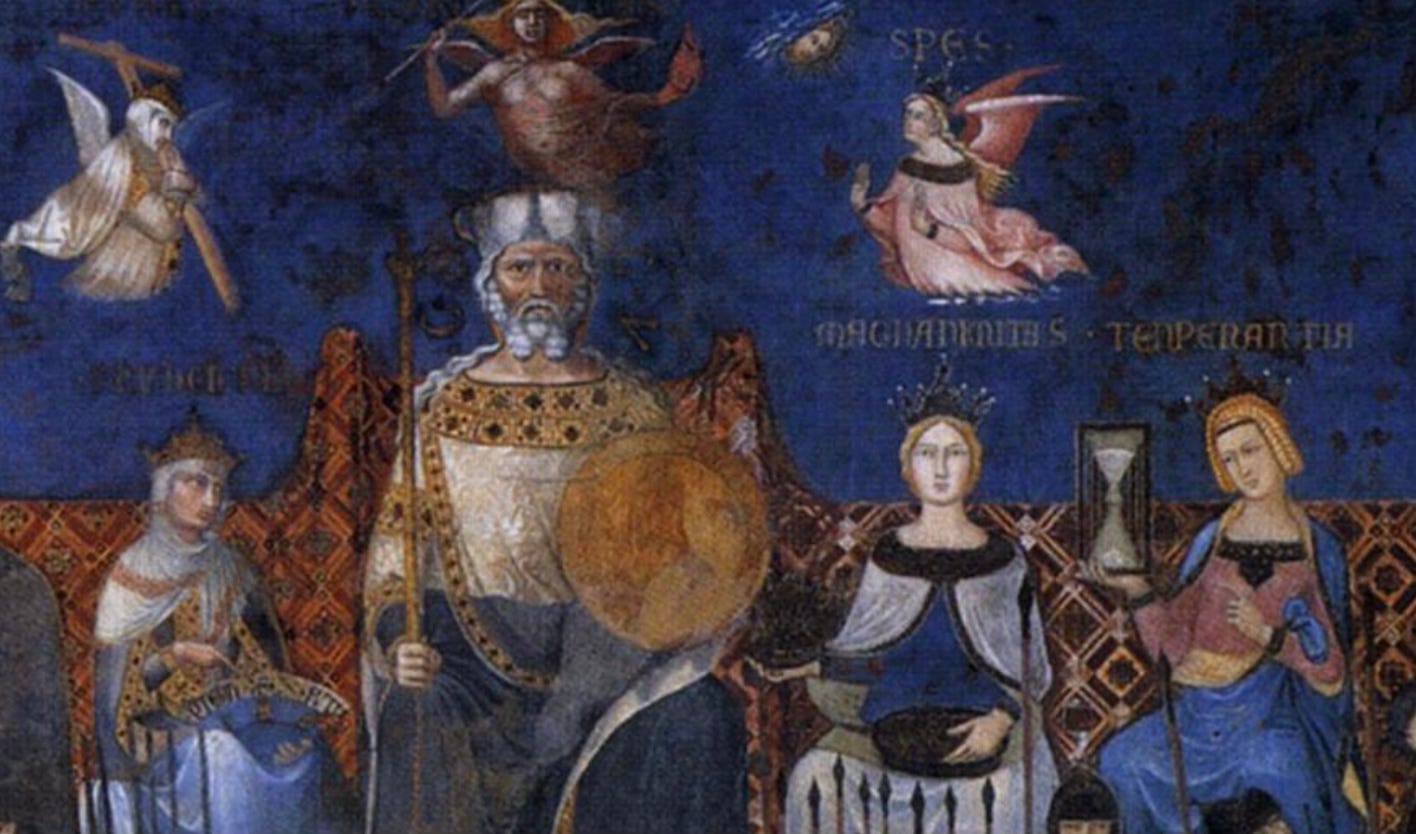
Obviously they must have been invented prior to that point, but it seems unlikely that they had been in use for a thousand years without any other mention of in literature or representation in art. The earliest written reference we have dates from around the year 1345, mentioned in a receipt of Thomas de Stetesham who was the clerk of the King’s ship La George:
The same Thomas accounts to have paid at Lescluse, in Flanders, for twelve glass horologes (" pro xii. orlogiis vitreis "), price of each 41⁄2 gross', in sterling 9s. Item, For four horologes of the same sort (" de eadem secta "), bought there, price of each five gross', making in sterling 3s. 4d.
Despite having numerous ways to measure it, ancient peoples clearly had a very different relationship with time than the one we have today. You were very unlikely to have many set events at specific times of the day, arrangements would be much more general, other than in formal legal, government and military situations (and even then, as we have learned, the clock in Rome was wrong for nearly a century). The standardised measurement of time was also very unevenly distributed. Only a handful of incised sundials survive from the Roman era,11 for example. If you lived outside of a significant urban centre you simply would have had no access to the measuring of time. People in rural villages would probably have known about the division of time into hours, but they would not have used that system. Rather their days would have been structured around natural indicators of time – sunrise, noon, sunset etcetera. They didn’t have access to time, but they also had no need to know what the time was, their lives were ordered by nature rather than a clock.12
In my next piece I’ll explore some other ways of measuring time, including the use of scent, as well as digging into how we ended up with minutes and seconds.
Then I got a Fitbit, like the massive middle-aged cliché that I am.
There is another factor that also strongly pushes people towards 12. There are usually 12 full moons in a year. This was a really obvious thing for people to note, and if they were predisposed to that number on account of their fingers it seems likely that this would have sealed the deal. The fingers were corporeal. The full moons could be considered divine.
There are some instances of people using equal hours around this time, which I will explore in more detail in my next piece.
I should add that a 2024 paper suggests that some Egyptian labourers were probably using equal hours to manage their working days some 3,000 years ago.
Actual sunrise was around 4:30am (5:30am with summer time used today) but you get the idea.
Sounds like a pretty nice life to be honest.
One of my favourite words!
The division into 12 months is almost certainly due to the whole finger-joint-counting thing and it makes me pretty much certain that this too ended up deciding the hours.
I would have been pretty proud of that too, and would have wanted it recorded on my tomb.
Yes, I know I haven’t explained how minutes came about yet…
Several hundred have been found in total, but most without any markings other than a line to indicate noon. This again supports the view that precise measurement of time wasn’t that important, but that it was of use to get a general sense of how far through the day one was.
To be honest some days this sounds like bliss to me.
I will enjoy this series. For what it's worth, here are some of my own contributions on the subject:
https://endlesschain.substack.com/p/time-it-flexes-like-a-whore
https://endlesschain.substack.com/p/what-did-the-railways-ever-do-for - on the benefits and disadvantages of knowing what time it is.
I can also know the time to within a few minutes when I don't need to know the time. Except when I'm working on the computer: then, I lose all track of time. Like I'm doing now.
I like the story I heard once of a Frenchman being guided by an Arab camel-herder across a desert. The Frenchman asked what time it was, and the herder shaded his eyes and looked up at the sun, and replied, "We have enough light to reach our destination. If you want to know the time, look at your watch." The herder doesn't measure time; he measures light.
There are Roman comedies where a country guy laments that the merciless sundial chops up his days into hours.