
In my previous piece I explored how French fries (chips) as we know them came into being surprisingly late in the scheme of things, evolving from fried slices of potato to the familiar baton shape on the streets of Paris in the late 18th and early 19th centuries. But what of the Anglophone world? When did they first encounter this most indulgent of potatoey delights?
.jpg)
The answer may surprise you – it could be argued that, astonishingly, we had the fax machine1 before we had the French fry – but let’s start by delving into some of the myths about their origin, before trying to get to the truth of the matter. It is often said that Thomas Jefferson, who lived in Paris between 1784 and 1789, introduced the fry to the Americas sometime around the start of the 19th century. Indeed some people claim that he actually invented this famous dish.2 Jefferson loved his food, and brought back many French recipes upon his return to the USA, written in that language, some in his own hand. It is believed that some, or possibly all, of these recipes were dictated by Adrien Petit, Jefferson’s maître d’hôtel (which negates the idea that Jefferson was the inventor of them). The one that is of significance to us refers to “pommes de terre frites à cru, en petites tranches” – definitely fried potatoes, but, crucially “en petites tranches”, in little slices. These were not fries, but rather the earlier form of fried potato which could be cooked more quickly and in less oil (but also had a greater tendency to both stick to themselves and the surface of the pan).
There is stronger evidence that this is how Jefferson ate his fried potatoes from The Virginia House-wife, a recipe book published in 1824 by Mary Randolph, kinswoman to the great man:
Peel large potatoes, slice them about a quarter of an inch thick, or cut them in shavings round and round, as you would peal a lemon; dry them well in a clean cloth, and fry them in lard or dripping. Take care that your fat and frying-pan are quite clean; put it on a quick fire, watch it, and as soon as the lard boils and is still, put in the slices of potatoes, and keep moving them till they are crisp; take them up and lay them to drain on a sieve; send them up with very little salt sprinkled on them.
Where then can we find the first reference to fries being served in England or America? Some might suggest that the answer might lie with great friend of Histories Charles Dickens! In The Tale of Two Cities (1859) we have the following line:
Hunger was shred into atomics in every farthing porringer of husky chips of potato, fried with some reluctant drops of oil…
Given that ‘chips’ is the British word for ‘fries’ this seems pretty compelling perhaps, but the words that follow it belie this theory. These potatoes were cooked in “...some reluctant drops of oil” – this was not a vat of fat in which batons were cooked, rather a shallow pan where slices could be fried in the bare minimum of that expensive oil. There is further evidence that chips at this time didn’t mean fries, but rather something more akin to crisps (aka potato chips) from a recipe entitled ‘Potato Chips’ in The English Cookery Book: uniting a good style with economy...,3 edited by J.H. Walsh and published in the same year:
Wash and peel some potatoes, then pare them, ribbon-like, into long lengths; put them into cold water to remove the strong potatoe [sic] flavour; drain them, and throw them into a pan with a little butter, and fry them a light brown. Take them out of the pan, and place them close to the fire on a sieve lined with clean writing paper to dry, before they are served up. A little salt may be sprinkled over them.
Trying to find the first reference to proper baton fries in English has been a surprisingly lengthy task, and I do not claim that my findings are wholly robust, but nonetheless, here we go. I started by going back further in time, to The Cook’s Oracle4 published in 1817, where there are numerous fried potato recipes, but, sadly, none that are fry-like:
Cold Potatoes fried.—(No. 102.)
Put a bit of clean dripping into a frying-pan: when it is melted, slice in your potatoes with a little pepper and salt; put them on the fire; keep stirring them: when they are quite hot, they are ready.
Obs.—This is a very good way of re-dressing potatoes
Potatoes fried in Slices or Shavings.—(No. 104.)
Peel large potatoes; slice them about a quarter of an inch thick, or cut them in shavings round and round, as you would peel a lemon; dry them well in a clean cloth, and fry them in lard or dripping. Take care that your fat and frying-pan are quite clean; put it on a quick fire, watch it, and as soon as the lard boils, and is still, put in the slices of potato, and keep moving them till they are crisp. Take them up, and lay them to drain on a sieve: send them up with a very little salt sprinkled over them.
There is even a recipe for whole fried potatoes:
Potatoes fried whole.—(No. 105.)
When nearly boiled enough, as directed in No. 102, put them into a stew-pan with a bit of butter, or some nice clean beef-drippings; shake them about often (for fear of burning them), till they are brown and crisp; drain them from the fat.
Obs.—It will be an elegant improvement to the last three receipts, previous to frying or broiling the potatoes, to flour them and dip them in the yelk [sic] of an egg, and then roll them in fine-sifted bread-crumbs; they will then deserve to be called POTATOES FULL DRESSED.5
As a bit of a change from all of those fried slices of potato, I also found an early recipe for what I think is best described as a potato hash:6
To Fry Potatoes for Breakfast or Supper.—No meat or bacon is required to be eaten with these; in Somersetshire it forms the only breakfast dish of the peasantry, many of the middle classes, and is frequently seen at the tables of the wealthy, throughout the year. If potatoes are left from dinner, these will do; if not, boil some the day before frying, but if overboiled [sic] they will not be good; when cold, chop them very fine, as fine as for suet, but not mash them; sprinkle a little salt over; for a vegetable-dish full of potatoes, have in a frying-pan about two tablespoonfuls of dripping or bacon-fat, made boiling hot; put in the potatoes, stir them about well; when hot through, put them together with the knife or spoon (but not press them) into about the size of the dish they are to be served on; now let them brown for ten minutes; then, when brown, place the dish on the top, and turn them over; serve them hot, with hot plates.
Eventually I found this in an 1883 recipe book published by the Chicago Herald Cooking School:
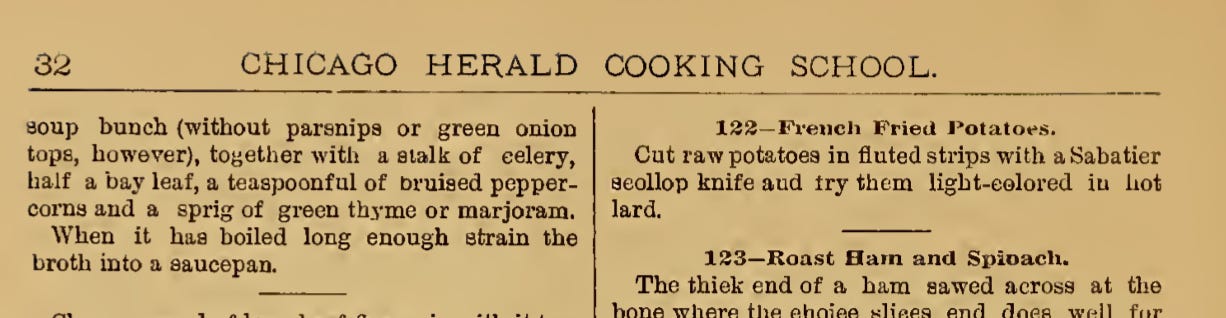
Could these be modern French fries? The description is a bit unclear, it may be that these are simply another iteration of the thin sliced strips previously described. Not good enough, I fear. A bit later, in 1894’s Practical Gastronomy7 by Charles Herman Senn we get a recipe for straw fries:
Very thin strips of potato, shape and size of matches, fried a light brown colour in clarified butter
At last, in Auguste Mario’s 1910 book Easy French Cookery: Containing over 300 Economical and Attractive Recipes from a Celebrated Chef’s Note-Book we have the following which is unequivocally a description of fries as we know them!
234. FRENCH FRIED POTATOES (Pommes frites). Cut some potatoes in strips of about 1½ inch long and ½ inch thick, and cook as for Straw Potatoes.
But this does seem shockingly late; could we go earlier?8 We could, and we can, and we shall, because in Miss Parloa’s New Cook Book from 18809 we have this:
Pare small uncooked potatoes. Divide them in halves, and each half in three pieces. Put in the frying basket and cook in boiling fat for ten minutes. Drain, and dredge with salt. Serve hot with chops or beefsteak. Two dozen pieces can be fried at one time.
Finally, definitively French fries in an 19th-century English-language source! There may well be earlier references that I have been unable to track down, and, of course, people were certainly eating fries in the Anglophone world before anyone thought to capture that fact in writing, but it seems pretty certain that they are something that has only been around there for less than 200 years. Today global consumption is in the ranges of 20-30 million tonnes of the things with the average American eating around 58 pounds (26 kilos) of fries. You may expect me to say that I will be having chips for tea tonight, but honestly, after all this research, I think that I am going to take a break from them for a while…
Alexander Bain, a Scottish mechanic and inventor, received a British patent in 1843 for an “electric printing telegraph”, generally regarded as the first fax-like machine.
But we know from my first French fries piece that this simply isn’t true.
Or, to give it its full title, The English cookery book: uniting a good style with economy and adapted to all persons in every clime; containing many unpublished receipts in daily use by private families / collected by a committee of ladies. Which is a bit of a mouthful.
Or, to give it its full title, THE COOK’S ORACLE; AND HOUSEKEEPER’S MANUAL. CONTAINING Receipts for Cookery, AND DIRECTIONS FOR CARVING. ALSO, THE ART OF COMPOSING THE MOST SIMPLE AND MOST HIGHLY FINISHED BROTHS, GRAVIES, SOUPS, SAUCES, STORE SAUCES, AND FLAVOURING ESSENCES; PASTRY, PRESERVES, PUDDINGS, PICKLES, &c. WITH A COMPLETE SYSTEM OF COOKERY FOR CATHOLIC FAMILIES. THE QUANTITY OF EACH ARTICLE IS ACCURATELY STATED BY WEIGHT AND MEASURE; BEING THE RESULT OF ACTUAL EXPERIMENTS INSTITUTED IN THE KITCHEN OF WILLIAM KITCHINER, M.D. ADAPTED TO THE AMERICAN PUBLIC BY A MEDICAL GENTLEMAN. Which is one heck of a mouthful.
I don’t really understand what “full dressed” really means in this context, nor why potatoes prepared in other ways might have been partially dressed or even, shockingly, naked…
I OCRed this from an original text somewhere but I now cannot for the life of me find out what the source was. Sorry…
Or, to give it its full title, Practical gastronomy and culinary dictionary, being a valuable guide to cooks and others interested in the art of cookery, containing sketches and quotations of culinary literature : a complete menu compiler and register of most known dishes in English and French, with practical observations on the same. Which is… ah, you’ve probably got it by now…
Ah, you may be thinking (or, more realistically, not) what about the 1822’s The French Cook by Louis Eustache Ude which is referenced on the French fries Wikipedia page? Well it says: These are to be turned when raw, and cut of the same thickness as in No. 1 [the size of two-penny coins] ; then fry them in clarified butter. If you should have any goose dripping, it would do better. When the potatoes are fried of a fine brown colour, and crisp, drain all the grease on a towel, and serve them quite hot on a napkin or in a deep dish, for this entremets cannot be dished nicely in any other way. Do not forget to sprinkle them over with a little pounded salt. So definitely not French fries.
Copyright is dated from them, it looks as though it was actually first published in 1881.