
A couple of years ago I wrote a piece about the history of crisps (potato chips) but I have to confess they are not my favourite form of wildly unhealthy deep-fried potato. No, that honour lies with the chip (French fry – apologies to my British readers, but I will be referring to them as “fries” from now on!). They are (probably usefully for my girth) a rare treat, as I don’t own a deep-fat frier and the oven versions are just not quite as good.
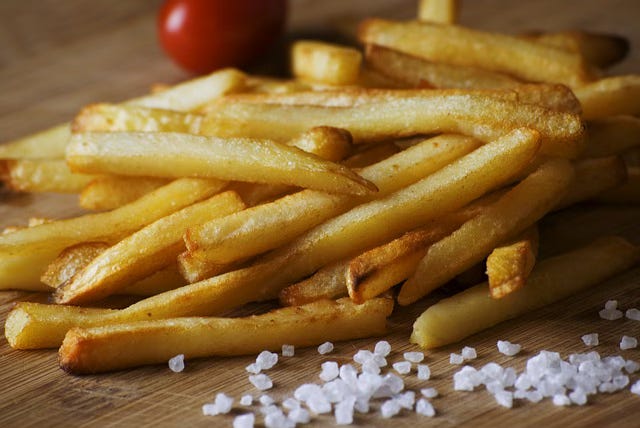
As with crisps we have a very clear story for the origin of the fry. In 1984 the Belgium journalist and historian Jo Gérard published an article describing how he had found a family manuscript dating back to 1781 which described how, in winter, the good people of Namur would fry up potatoes in the absence of fish:
Les habitants de Namur, Andenne et Dinant ont l’usage de pêcher dans la Meuse du menu fretin et de le frire pour en améliorer leur ordinaire, surtout chez les pauvres gens. Mais lorsque le gel saisit les cours d’eau et que la pêche y devient hasardeuse, les habitants découpent les pommes de terre en forme de petits poissons et les passent à la friture comme ceux-ci. Il me revient que cette pratique remonte déjà à plus de cent années
The inhabitants of Namur, Andenne and Dinant are accustomed to catching small fish in the Meuse and frying them to improve their ordinary fare, especially among poor people. But when frost seizes the waterways and fishing there becomes hazardous, the inhabitants cut potatoes in the shape of little fish and fry them like that. It comes back to me that this practice already goes back more than a hundred years.
How lovely, my life is made so much easier when something has a clear origin story! Except no one else seems to have ever seen this manuscript and it remains unfindable to this day. Many people, particularly French writers on the matter, suspect that he made it up as a means of establishing Belgium primacy for a dish which has become inexorably linked to their national culture.
So what is the real story? Well, it turns out that actually fries were invented by Teresa of Ávila (better known as Saint Teresa, 1515-1582) or at least that is one of the myths that one might stumble across online. It seems pretty clear that she was eating potatoes (at a fairly early date in Europe) but we can’t say for sure if they were fried, nor what shape they took had such frying occurred. There is the text of a letter that she sent on the 19th of December 1577 to María de San José which includes the passage:
Jesús sea con vuestra reverencia siempre, mi hija. La suya recibí, y con ella las patatas y el pipote y siete limones. Todo vino muy bueno; mas cuesta tanto el traer, que no hay para qué me envíe vuestra reverencia más cosa ninguna, que es conciencia.
Jesus be with you always, my daughter. I received your letter, and with it the potatoes, the barrel, and seven lemons. All the wine was very good; but it costs so much to bring it, that there’s no need for you to send me anything else, for that is conscience.
And an earlier letter, from 26th of January of the same year, shows that she both ate and enjoyed potatoes, but, alas, still has no description of how they were cooked:
Dios se lo pague, mi hija, amén, amén, amén; y las patatas, que vinieron a un tiempo, que tengo harto mala gana de comer, y muy buenas llegaron; y las naranjas, que regocijaron a algunas enfermas.
May God recompense you for it all, my daughter. Amen, amen, amen. Also for the potatoes which came at a time when I had no appetite, but arrived in good condition, and the oranges, which were a treat to some of the sisters who were out of health.
I have to confess that I have gone down a bit of a rabbit hole attempting to find the earliest reference to fried potatoes. A possible contender is a passage from Cautiverio feliz, y razón individual de las guerras dilatadas del reino de Chile (Happy Captivity, and Particular Account of the Protracted Wars of the Kingdom of Chile) which was written by Francisco Núñez de Pineda y Bascuñán (1607–1682) sometime in the late 17th century, but not published until 1863. There is no mention of fries in the original edition, but a 2001 critical edition of the book contains the following passage, relating to an event that took place in 1629:
…porque las mujeres casadas del presidio y sus maridos, cual envió la sopa todavía con muchos huevos fritos por encima, cual el guisado de pescado seco, y otros, el marisco de choros secos machas ostiones y otros géneros; unas enviaban las papas fritas y guisados, otras los porotos y garbanzos, y el capitán y cabo que tenían dispuestos otros cinco o seis potajes, y por postre unos buñuelos bien sazonados con azúcar y canela.
…because the married women of the garrison and their husbands sent various dishes: one sent soup still topped with many fried eggs, another a stew of dried fish, and others shellfish of dried mussels, clams, oysters, and other kinds; some sent fried potatoes and stews, others beans and chickpeas, and the captain and the corporal had another five or six dishes prepared, and for dessert some fritters well seasoned with sugar and cinnamon.
If this is correct, then Chile can lay claim to being the earliest known location of fried potatoes, but they were unlikely to be the fries that we know today. Early fried potatoes were cut into slices, partly because it enabled them to be cooked faster and more significantly it used a lot less fat or oil. It is easy to forget, living in the time that we do where vegetable oil is probably the cheapest available foodstuff in terms of cost per calorie, that fat and oil used to be much scarcer and more expensive. Poor people would have cooked with animal fats, for sure, but only in small quantities. It would have been highly unusual to have a sufficient amount to fill a pot large enough to cook fries in, and even if you could there was no real reason to do so when you could sauté slices instead.
Recipes such as this one from 1811’s Le Cuisinier impérial, ou l’art de faire la cuisine et la pâtisserie pour toutes les fortunes by A. T. Raimbault are typical of the period:
Pommes de terre frites : Vous les pelez toutes crues et les coupez en tranches
Fried potatoes: Peel them all while raw and cut them into slices
It certainly didn’t make a lot of sense to have a large pot of oil that was used at home only to cook dinner for your family. If you were into mass catering however, things were a little bit different. While oil was relatively costly, potatoes were cheap, took little preparation, and could be swiftly fried en-masse. Towards the end of the 18th century fried potatoes became a popular street food in France, most notably in Paris in the theatre districts and around the Pont Neuf. The earliest written references I can find about the practice come from the 1830s, such as this one from Le Gastronome, 28 November 1830:
C’est admirable ! à voir le peuple de Paris et ses pommes de terre frites au soleil, et ses marchandes de harengs tous chauds, et ses poires cuites au four, on croirait qu’il vit pour manger, et cependant c’est tout au plus s’il mange pour vivre
It’s admirable! Seeing the people of Paris with their sun-fried potatoes, their vendors selling piping hot herring, and their baked pears, you’d think they lived to eat, and yet, at best, they eat to live
And it is from the same publication, less than a year later (28th April 1831), that we crucially find a description of potatoes being cut into batons, rather than simply slices:
Nobles pommes de terre frites, chères au comité de salut public, j’admire vos diverses métamorphoses ! D’abord, c’est l’enveloppe terreuse que râcle un couteau ébrêché... ce ne sont pas des beignets : on coupe les longues dans leur longueur, les rondes dans leur rondeur, puis dans cet état de crudité elles vont pêle-mêle au fond de la tôle noircie changer de goût et de couleur.
Noble fried potatoes, beloved of the Committee of Public Safety, how I admire your many transformations! First, your earthy covering is scraped away with a nicked knife… these are no fritters: the long potatoes are cut lengthwise, the round ones cut into rounds, and then, still raw, they are thrown together into the bottom of a blackened metal pan, where they change both flavour and colour.
Why, almost 200 years ago, was there a movement away from frying sliced potatoes to the batons that we now consider to be French fries? After all, as noted above, thin slices cook more rapidly and in less oil than thicker sticks? There are probably two factors that came into play. The first is that sliced potatoes are, due to their large surface area, much more likely to stick both to each other and to the base of the pan in which they are being cooked. As a result they required more attention and stirring. The second is that it is, as we have all doubtless experienced, very easy to pick up and eat a rectangular stick of fried potato with one’s fingers.
We have a lovely demonstration of this in a lithograph by Honoré Daumier printed in Le Charivari from the 19th February 1842 showing an an actor from the Funambules theatre hustling to the stage door eating what are clearly fries:
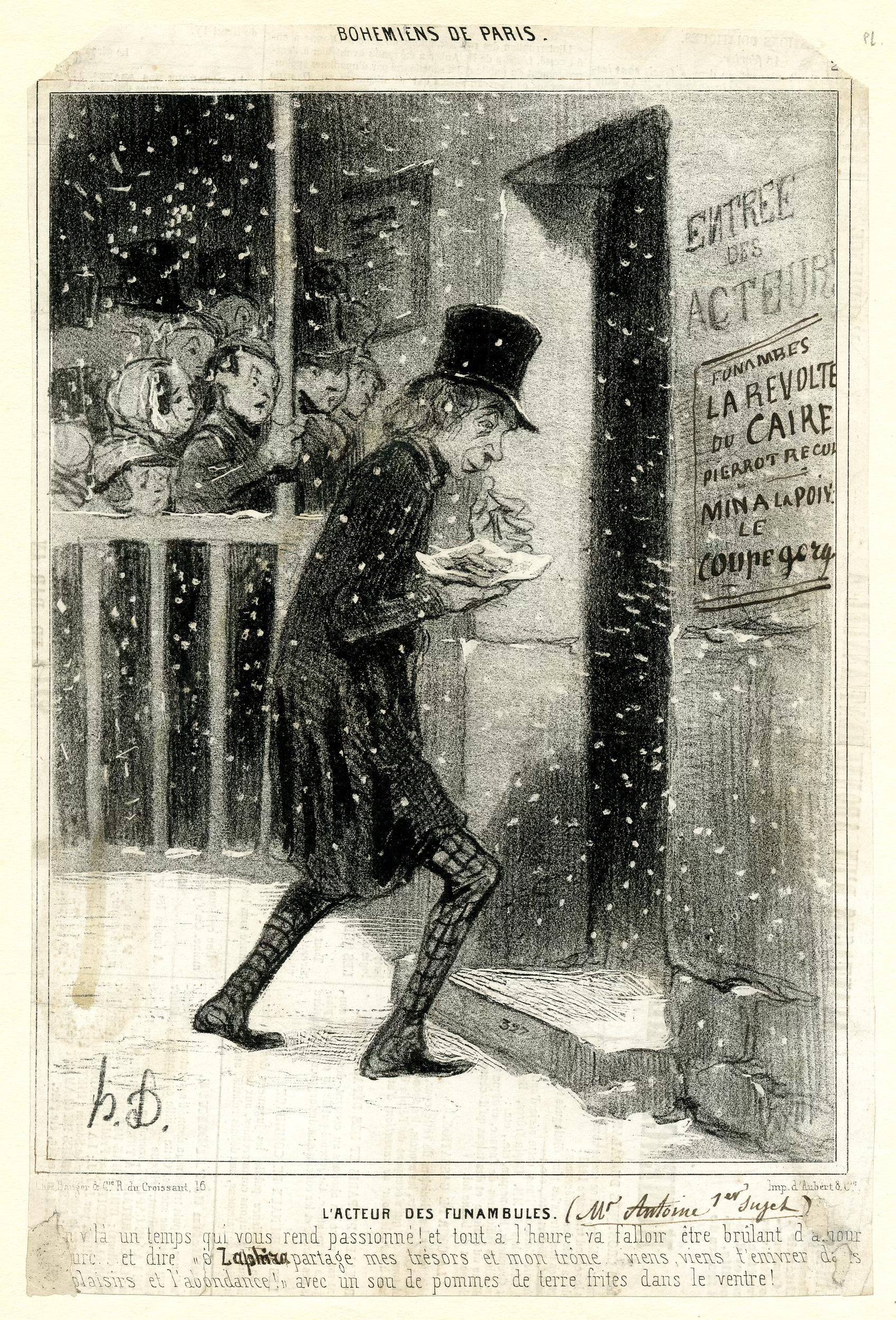
The text underneath reads:
... there is a moment that fills you with passion! and in a little while you must be ablaze with love ... and say, Zaphisa [?], share my treasures and my throne; come, come and lose yourself in pleasure and abundance!’ — all while your stomach sounds like fried potatoes!”
So by the mid-19th century we clearly had French fries, as we would consider them, being eaten in France, but what about the Anglophone world? In Part 2 I will be exploring that history, including the claim that Thomas Jefferson introduced French fries to America and the development of that oh-so-British dish,1 fish and chips.
Or is it?
Fascinating. I admire the way you weave priamry sources into these little histories and make them fun, educational, while raising good questions about how we know about the past.