
In my previous piece I explored how coffee spread from Ethiopia to Yemen and then across the Islamic world (with the odd stutter along the way). In today’s post I’ll examine how this morning pick-me-up arrived in Western Europe and the impact it had when it did.
The story of European coffee begins with the capture of Constantinople but the Ottomans in 1453 because this turned the city into their imperial capital: a huge administrative, commercial, diplomatic, and cultural hub linking the Balkans, Anatolia, the eastern Mediterranean, Syria, Egypt, and eventually Yemen. This was followed by the conquest of the Mamluk Sultanate in 1516–1517, which brought Syria, Egypt, the Hijaz connection, and much of the Red Sea commercial world into the Ottoman sphere. As we learned in my last piece, coffee drinking was well-established in Egypt at that point, particularly in Cairo and it wasn’t that long before the drink spread to Constantinople itself.
We can date very precisely when this great beverage arrived in the city, from a history written by İbrahim Peçevi (aka Peçevî İbrahim Efendi) – Tārīḫ-i Peçevī (“Peçevi’s History.”) which was probably written in the early 1640s, and is a history of the Ottoman Empire, with good details on the period from 1520-1640:
Before the year 1554, no coffee was seen, much less sold, at Constantinople. If ever it was so much as heard of, it was only when the Sultaness obtained an order to prohibit the use of it at Mecca, as we have already mentioned, from the accounts she had received from pilgrims or other travellers into Arabia, Egypt, or Syria. But in that year, which was near a hundred years from the time it was discovered by the Mufti of Aden, in the reign of Soliman the Great, son to Selim the First, two men, named Schems and Hekim, the one from Damascus, the other from Aleppo, set up each of them a coffee-house in that quarter of Constantinople called Takhtacalah, furnished with very neat couches and carpets, on which they received their company, which at first consisted mostly of studious persons, lovers of chess, trictrac, and other sedentary diversions.
And as the generality of the Turks soon came to relish this sort of meeting-place, called in their language Cahveh Kaneh, the number of them multiplied insensibly. They looked upon them as very proper places to make acquaintances in, as well as to refresh and entertain themselves at an easy charge, a dish of coffee costing but an aspre, which is not a halfpenny of English money. Young people near the end of their public studies, such as were ready to enter upon public posts; cadhis out of place, who were at Constantinople making interest to be restored, or asking for new employments; the muderis, or professors of law and other sciences; and, in fine, persons of all ranks flocked to them. At length even the officers of the seraglio, the pashas, and others of the first quality were seen to go openly to the coffee-house; and as this served to increase their reputation, so it multiplied the number of them to too great an excess.
These final lines are particularly important in showing just how socially transformational these coffee houses were. To use the terminology of the 21st century they were a novel urban space – non-domestic, non-religious, conversational, and comparatively open to men from different social ranks. For cultures where alcohol consumption was permissible taverns had served this function for centuries, but in those where it was banned there previously had been no such places.
Less than 20 years later we get the first Western European account of coffee by the German physician Leonhard Rauwolf who encountered coffee in Aleppo in 1573 (and published his account in 1582):
Among other things they have a good drink, which they hold in high esteem, called by them Chaube. It is almost as black as ink and is very useful in ailments, especially of the stomach. They are accustomed to drink this early in the morning, also in open places, before… before everyone publicly, without any hesitation, from deep earthenware and porcelain bowls, as hot as they can bear it. They often raise it to their lips, but take only small sips, and then pass it on, as they sit beside one another in a circle.
For this drink they use a fruit called Bunnu by the inhabitants. On the outside, in size and color, it looks almost like laurel berries, and is enclosed in two thin little shells. According to their old reports, it is brought from India. But since the fruit itself is light, and inside has two yellowish kernels separately enclosed in two little husks; and since, in its effect, name, and appearance, it is very similar to the Buncho of Avicenna and the Bunca of Rhazes in the Almansor, I shall consider it to be that, until I receive better information from learned men. This drink is very common among them.
For that reason there are many people in the bazaar who pour it out for sale, as well as many merchants who sell the fruit. Moreover, they also regard it as just as valuable and healthful as we among ourselves regard wormwood wine, or other herbal wines. Nevertheless, they would still prefer wine, if they were permitted it by their law, as was clearly seen under Emperor Selim, when he granted and allowed them wine: how they drank it, namely, that they came together daily, and when they sat together drinking, one did not merely drink one or two glasses of unmixed strong wine to another, but four or five little cups at once, of the kind that come to them from Venice; and they drank these down one after another so quickly and with such eagerness that, as I saw many times, they did not take enough time between them even to eat a bite or a few morsels.
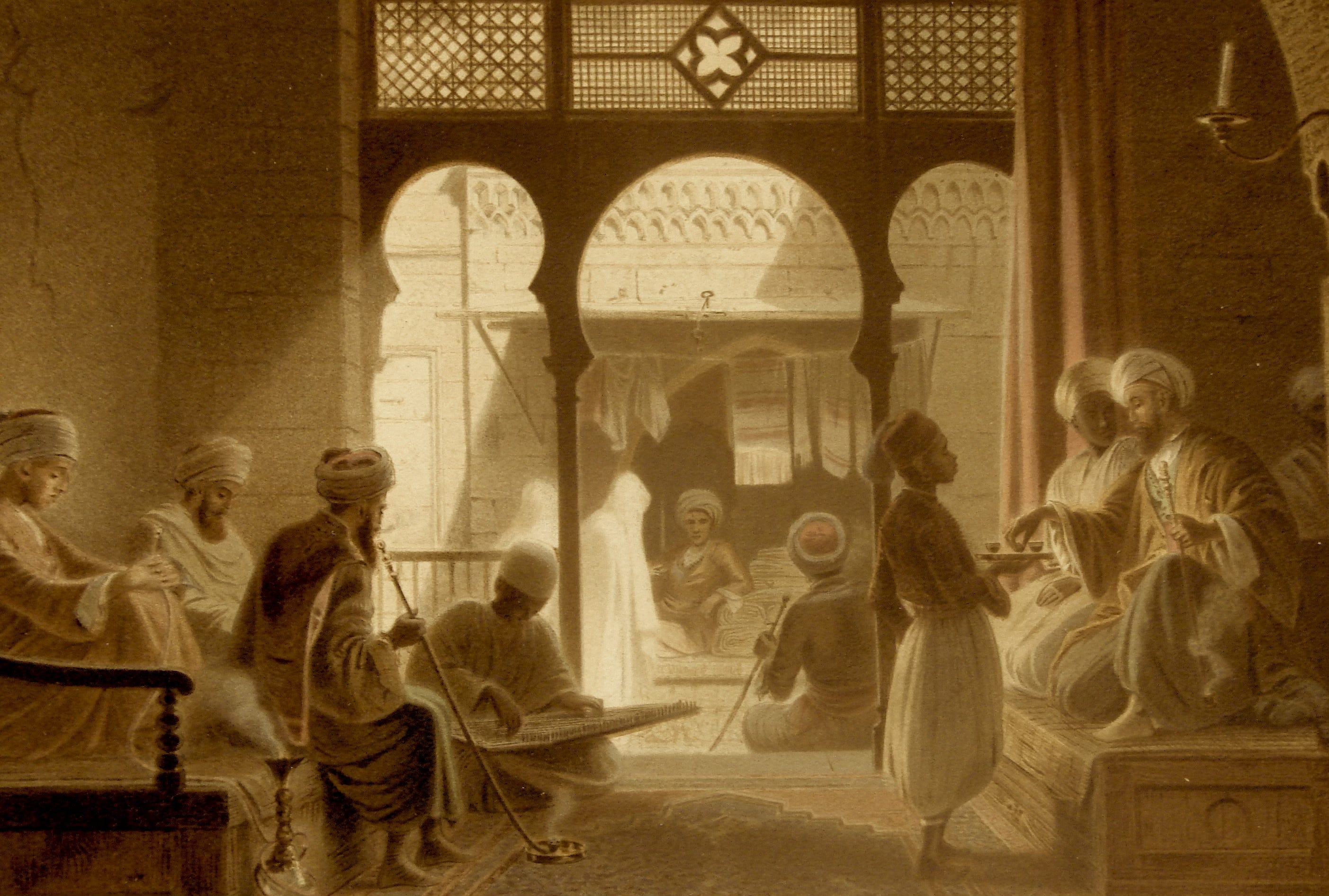
As to when coffee made its way into Western Europe, let’s just say that one can go down lots of rabbit holes attempting to answer that question! It probably arrived in Venice in or shortly after 1615 because that is when Pierre (Pietro) Delia Valle (1586–1652), a well known Italian traveler and author of Travels in India and Persia, wrote a letter from Constantinople to his friend Mario Schipano in Venice:
The Turks have a drink of black colour, which during the summer is very cooling, whereas in the winter it heats and warms the body, remaining always the same beverage and not changing its substance. They swallow it hot as it comes from the fire and they drink it in long draughts, not at dinner time, but as a kind of dainty and sipped slowly while talking with one's friends. One cannot find any meetings among them where they drink it not.... With this drink, which they call cahue, they divert themselves in their conversations.... It is made with the grain or fruit of a certain tree called cahue.... When I return I will bring some with me and I will impart the knowledge to the Italians.
We don’t know for sure if he carried through with this promise, but it seems likely that coffee was low-key drunk in the city for medicinal reasons not long after that. If we want a good, dated, account of coffee being drunk in Western Europe then we can do worse than look to my home town of Oxford. In a note added to his diary entry for the 10th of May 1637 (when he was admitted to the college), John Evelyn wrote that the following took place in Balliol:
There came in my time to the College one Nathaniel Conopios, out of Greece, from Cyrill, the patriarch of Constantinople, who, returning many years after, was made (as I understand) Bishop of Smyrna. He was the first I ever saw drink coffee; which custom came not into England till thirty years after.
The best guess for when this coffee-drinking took place is 1638–1639, possibly 1639, if Conopios came to Oxford as a refugee after the death of Patriarch Cyril Lucaris in June 1638. It was also Oxford that saw the first recoded coffee house in Western Europe1 opening, as the city’s greatest antiquarian, Anthony Wood, wrote about it in the year 1650:
This yeare Jacob a Jew opened a coffey house at the Angel in the parish of S. Peter, in the East Oxon; and there it was by some, who delighted in noveltie, drank. When he left Oxon he sold it in Old Southampton buildings in Holborne neare London, and was living 1671.
And that coffee shop is still there today! Okay, it isn’t, but there is a later building on the site which is now a cafe which trades upon this history:2
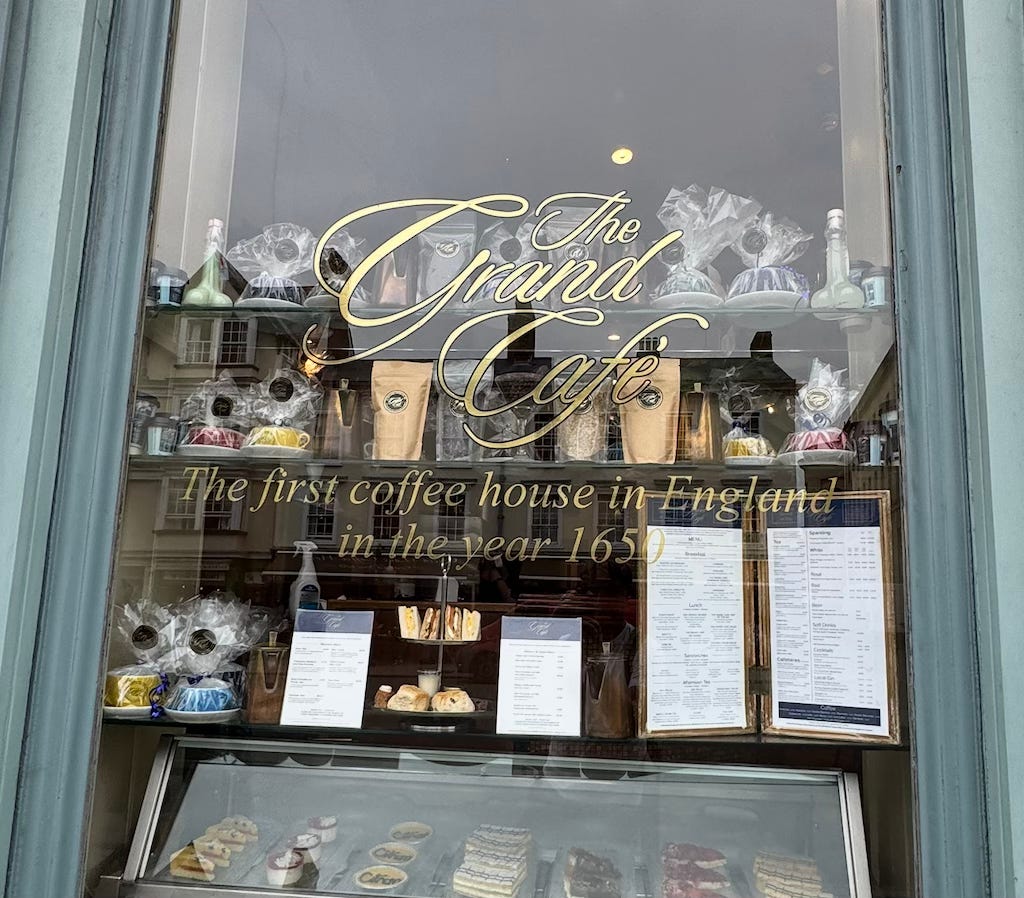
Four years later he writes about another establishment, just across the road from the first:
Coffey, which had been drank by some persons in Oxon 1650, was this yeare publickly sold at or neare the Angel within the east gate of Oxon; as also chocolate, by an outlander or a Jew.
And his coffee shop is still there too! Except whilst coffee has be sold very close to that site for more than 370 years, it seems that it has moved around a bit over that time. What we do know is that it is the location where, in 1768, Jeremy Bentham encountered the phrase “the greatest happiness of the greatest number” in a pamphlet and helped inspire his development of utilitarianism:
Somehow or other, shortly after its publication, a copy of this pamphlet found its way into the little circulating library belonging to a little coffee-house, called Harper’s coffee-house, attached, as it were, to Queen’s College, Oxford, and deriving, from the popularity of that college, the whole of its subsistence. It was a corner house, having one front towards the High Street, another towards a narrow lane, which on that side skirts Queen’s College, and loses itself in a lane issuing from one of the gates of New College.
This year, 1768, was the latest of all the years in which this pamphlet could have come into my hands. Be this as it may, it was by that pamphlet, and this phrase in it, that my principles on the subject of morality, public and private together, were determined.
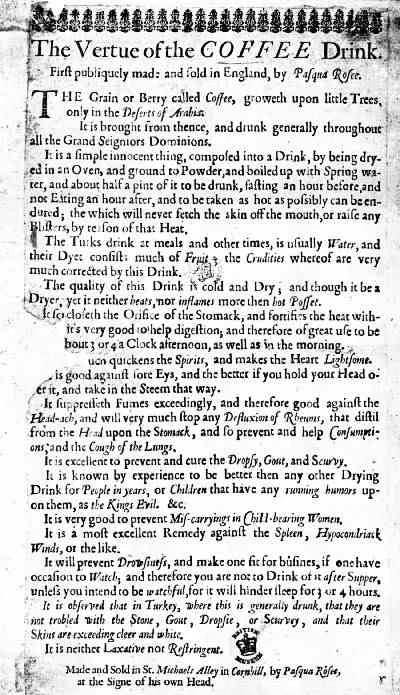
Two years after the first coffee shop opened in Oxford, one did in London, and it was advertised with this brilliant hand-bill:3
In the decades that followed the number of such establishments exploded across the city, with their number likely in excess of 1,000 by the end of the 17th century. At the same time they spread all across the continent, most famously, perhaps, in Vienna which is noted for its coffee house culture to this day. According to legend, after they liberated the city from the second Turkish siege in 1683 a group of Polish-Habsburg soldiers found some sacks full of strange beans in a cellar. They initially thought it was camel feed, and wanted to burn them however the Polish king Jan III Sobieski gave them to one of his officers, Jerzy Franciszek Kulczycki. Kulczycki, realising what they were (and conning the king out of a valuable product) brewed them up with some milk and sugar, and open the first coffee house in the city. Except the first coffee house in the city was actually opened in 1685 by an Armenian businessman named Johannes Theodat. Which is not such a good story…
As in Constantinople these houses provided a wholly novel space for people (well, men) to interact, gossip, read the latest newspapers and broadsides, and so on. As Henri Misson described the London coffee houses in 1698:
“You have all Manner of News there: You have a good fire, which you may sit by as long as you please: You have a Dish of Coffee; you meet your Friends for the Transaction of Business, and all for a Penny, if you do not care to spend more.
So noted were they for these kind of interactions that they became known as “penny universities” though some writers, such as the one who wrote this satirical verse in a 1667 broadside, felt that was perhaps overstating their function a little:
At Coffee-House when they are plac’d,
you’d scarce believe it true.They know all that is Good or Hurt,
To bless ye, or to save ye;
There is the Colledge and the Court,
the Countrie, Camp and Navie;
So great a Universitie,
I think, there ne’re was any:
In which you may a Scholar be
for spending of a Penny.A Merchant’s ‘Prentice there shall show
you all and every thing,
What hath been done, and is to do,
‘twixt Holland and the King;
What Articles of Peace will be,
he can precisely show;
What will be good for Them or We,
he perfectly doth know.Here men do talk of every thing,
with large and liberal Lungs,
Like women at a Gossipping,
with double tyre of Tongues;
They’l give a Broadside presently,
soon as you are in view,
With Stories that you’l wonder at,
which they will swear are true.The drinking there of Chockalat
can make a Fool a Sophie:
‘Tis thought the Turkish Mahomet
was first Inspir’d by Coffee,
By which his Powers did over-flow
the Land of Palestine:
Then let us to the Coffee-house go!
‘tis cheaper far than Wine.You shall know, there, what Fashions are;
How Perrywiggs are curl’d;
And for a Penny you shall heare
all Novells in the world;
Both Old and Young, and Great and Small,
and Rich and Poore you’ll see:
Therefore, let’s to the Coffee all,
Come all away with me.
Exaggerated though the quality of eduction one might receive there might be, these were definitely places for the exchanging of ideas, and particularly political ideas. We have an example of this from the diary of Samuel Pepys, from the 23rd January 1663 where there is talk of a rising in the north:
Thence to Mr. Grant, to bid him come for money for Mr. Barlow, and he and I to a coffee-house, where Sir J. Cutler was; and in discourse, among other things, he did fully make it out that the trade of England is as great as ever it was, only in more hands; and that of all trades there is a greater number than ever there was, by reason of men taking more ‘prentices, because of their having more money than heretofore. His discourse was well worth hearing. Coming by Temple Bar I bought “Audley’s Way to be Rich,” a serious pamphlett and some good things worth my minding. Thence homewards, and meeting Sir W. Batten, turned back again to a coffee-house, and there drunk more till I was almost sick, and here much discourse, but little to be learned, but of a design in the north of a rising, which is discovered, among some men of condition, and they sent for up.
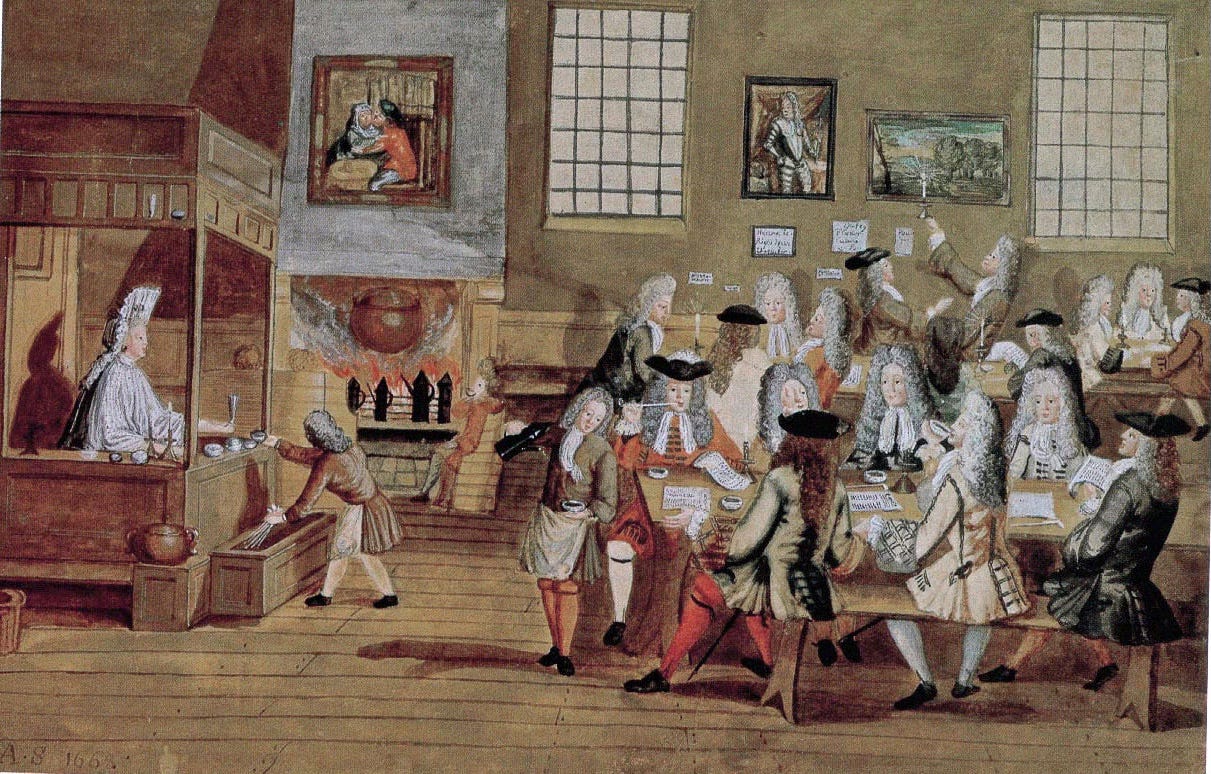
Not everyone was thrilled about such activities, chief amongst them King Charles the Second who was trying to main a somewhat rickety restoration monarchy. In order to reduce the risk of people scheming against him over a cup of Java on the 29th of December 1675 he issued “A Proclamation for the Suppression of Coffee-Houses” requiring them to be shut down on the 10th of January, a scant two weeks later. He argued that he wasn’t doing so just because of people coming up with nefarious plots but also because tradespeople were chillaxing there when they should have been working!
Whereas it is most apparent, that the Multitude of Coffee-houses of late
years set up and kept within this Kingdom, the Dominion of Wales, and the
Town of Berwick upon Tweed, and the great resort of Idle and disaffected
persons to them, have produced very evil and dangerous effects; as well
for that many Tradesmen and others, do therein mis-spend much of their time,
which might and probably would otherwise be imployed in and about their
Lawful Callings and Affairs; but also, for that in such Houses, and by
occasion of the meetings of such persons therein, divers False, Malitious
and Scandalous Reports are devised and spread abroad, to the Defama-
tion of His Majesties Government, and to the Disturbance of the Peace and Quiet of the Realm; His Majesty hath thought it fit and necessary, That the said Coffee-houses be (for the future) Put down and Suppressed, and doth (with the Advice of His Privy Council) by this His Royal Proclamation, Strictly Charge and Command all manner of persons, That they or any of them do not presume from and after the Tenth day of January next ensuing, to keep any Publick Coffee-house, or to Utter or Sell by retail, in his, her or their house or houses (to be spent or consumed within the same) any Coffee, Chocolet, Sherbett or Tea, as they will answer the contrary at their utmost perils.And for the better accomplishment of this his Majesties Royal Pleasure, His Majesty doth hereby Will and require the Justices of Peace within their several Counties, and the Chief Magistrates in all Cities and Towns Corporate, that they do at their next respective General Sessions of the peace (to be holden within their several and respective Counties, Divisions and Precincts) recall and make void all Licenses at any time heretofore Granted, for the Selling or Retailing of any Coffee, Chocolet, Sherbett or Tea. And that they or any of them do not (for the
future) make or grant any such License or Licenses, to any person or persons Whatsoever. And his Majesty doth further hereby declare, that if any person or persons shall take upon them, him or her, after his, her or their License or Licenses recalled, or otherwise without License, to sell by retail (as aforesaid) any of the Liquors aforesaid, that then the person or persons so Offending, shall not only be proceeded against, upon the Statute made in the Fifteenth year of His Majesties
Reign (which gives the forfeiture of five pounds for every moneth wherein he, she or they shall offend therein) but shall (in case they persevere to Offend) receive the severest punishments that may by Law be inflicted.
Given at Our Court at Whitehall, this Nine and twentieth day of December 1675. in the Seven and twentieth year of Our Reign.
God save the King.
However he quickly back-tracked somewhat, due to pressure from business owners, and two days before the ban was due to come into effect the proclamation was watered down. The coffee shop owners said that they were very sorry that people had been saying nasty things about him in their premises, and that it would never happen again. Oh, and they would all swear oaths of allegiance to him. This seems to have done the trick:
Whereas His Majesty by His Royal Proclamation bearing date the 29th day of December last, upon the Reasons therein contained, did Command and Require all manner of persons, from and after the Tenth day of this instant January, to forbear to Sell or Vtter by Retail (to be spent within their respective Houses) any Coffee, Chocolate, Tea or Sherbett, and did give Directions to His Justices of the Peace, and the Chief Magistrates (within their respective Counties, Cities and Towns Corporate) not to grant any new Licences to that purpose, and to revoke Licences formerly granted.
And whereas since the issuing forth of the said Proclamation, several Retailers of the said Liquors, by their humble Petition on the behalf of themselves and other Retaylers, did humbly Represent to His Majesty, That there are great quantities of Coffee and Tea at present in their hands, for which the Duties are already paid; besides what are already Shipped in parts beyond the Seas for England, and cannot be Remanded without great loss to the Owners thereof. And further, thereby, (confessing the former Miscarriages and Abuses committed in such Coffee-Houses, and expressing their true Sorrow for the same, and promising their utmost Care and Endeavour to prevent the like, for such time as they shall be permitted to Retail the said Liquors in their respective Houses) did humbly Beseech His Majesty, That He would be Graciously pleased to give them some further time for the Vending of the said Commodities, which would otherwise lie upon their hands.
And did further Offer, That if they might be permitted to continue to Retail the said Liquors (within their respective Houses) they would not onely take the Oaths of Allegiance and Supremacy, but also enter into Recognizances to His Majesty respectively, at the Sessions of the Peace to be holden in the respective Counties, Cities and Liberties where their Houses are to be.
It wasn’t just King Charles who had it in for coffee houses. As noted above, these were essentially male preserves that both helped strengthen even further the “old boys networks” and also took them away from their wives and partners. One (or possibly several, the authorship is unknown, just stated as “A well-willer”) woman was sufficiently irked by this that in 1674 she published The Women’s Petition Against Coffee.4 In it she satirically attempts to get men to shun coffee largely on the basis that it, ahem, impairs their performance:
That since ’tis Reckon’d amongst the Glories of our Native Country, To be A Paradise for Women: The same in our Apprehensions can consist in nothing more than the brisk Activity of our men, who in former Ages were justly esteemed the Ablest Performers in Christendome; But to our unspeakable Grief, we find of late a very sensible Decay of that true Old English Vigour; our Gallants being every way so Frenchified, that they are become meer Cock-sparrows, fluttering things that come on Sa sa, with a world of Fury, but are not able to stand to it, and in the very first Charge fall down flat before us. Never did Men wear greater Breeches, or carry less in them of any Mettle whatsoever.
There was a glorious Dispensation, ’twas surely in the Golden Age, when Lusty Ladds of seven or eight hundred years old, Got Sons and Daughters; and we have read, how a Prince of Spain was forced to make a Law, that Men should not Repeat the Grand Kindness to their Wives, above NINE times in a night: But Alas! Alas! Those forwards Days are gone, The dull Lubbers want a Spur now, rather than a Bridle: being so far from doing any works of Supererregation that we find them not capable of performing those Devoirs which their Duty, and our Expectations Exact.
The Occasion of which Insufferable Disaster, after a serious Enquiry, and Discussion of the Point by the Learned of the Faculty, we can Attribute to nothing more than the Excessive use of that Newfangled, Abominable, Heathenish Liquor called COFFEE, which Riffling Nature of her Choicest Treasures, and Drying up the Radical Moisture, has so Eunucht our Husbands, and Crippled our more kind Gallants, that they are become as Impotent, as Age, and as unfruitful as those Desarts [sic] whence that unhappy Berry is said to be brought.
For the continual sipping of this pittiful drink is enough to bewitch Men of two and twenty, and tie up the Codpice-point without a Charm. It renders them that use it as Lean as Famine, as Rivvel’d as Envy, or an old meager Hagg over-ridden by an Incubus. They come from it with nothing moist but their snotty Noses, nothing stiffe but their Joints, nor standing but their Ears: They pretend ’twill keep them Waking, but we find by scurvy Experience, they sleep quietly enough after it.
A Betrothed Queen might trust her self a bed with one of them, without the nice Caution of a Sword between them: nor can all the Art we use revive them from this Lethargy, so unfit they are for Action, that like young Train-band-men when called upon Duty, their Amunition [sic] is wanting; peradventure they Present, but cannot give Fire, or at least do but flash in the pan, instead of doing Execution.
Despite these challenges coffee houses survived, and not only survived, they thrived. One could write a book (or several) about their impact upon society, but just in England alone they helped lead to the creation of the Royal Society and the modern insurance industry though Lloyds of London, which began life in Edward Lloyd’s coffee house. Jonathan’s Coffee House performed a similar service for securities. Brokers excluded from the Royal Exchange gathered in coffeehouses; John Castaing posted prices of stocks and commodities there in 1698. Eventually the activity helped form the London Stock Exchange.
In my final piece I will explore how coffee grew over the centuries that follow to become a daily staple in our homes and on our high streets.
If all this is making you thirsty, here’s a previous piece we’ve had on making the perfect brew – well, 17th-century style anyway:

Yes, I am aware of the claimed opening of a coffee shop in Venice in 1645, but the earliest robust date for that city is 1683. Similarly the claim that one was opened in Livorno, Italy, in 1632 I can only find in secondary sources. With Wood we have someone who was on the ground, at the time, writing about it.
You can see a hint of a reflection of the author in this picture…
I think that it might just be over-selling the benefits of coffee a little bit.
Or, to give it its full title, The women's petition against coffee representing to publick consideration the grand inconveniencies accruing to their sex from the excessive use of that drying, enfeebling liquor. Which is a bit of a mouthful.
Splendid piece. I have been looking forward to it. Thank you, John.