
A history of… coffee (Part 1)
Despite rumours to the contrary, dancing goats had nothing to do with it…
I am addicted to coffee. Actually, I am addicted to caffeine – coffee is just the method by which I choose to consume it. It helps that I really like the taste of coffee too though. The few times I have tried to completely cold turkey on caffeine I have felt very grim and I have always returned to it, but I do attempt to limit my intake. I’ll make a full French press first thing in the morning, and that is all I allow myself to have over the course of the morning.1

It is often the case when I write these pieces that I discover that incredibly familiar things are either much older than I expected (for instance, drinking straws) or much younger (French fries). Coffee falls into that latter category, somewhat to my surprise, as it has basically always been potentially available in the West, and didn’t need the Colombian Exchange to happen before we could start pouring it down our throats.
Coffee was, it seems, wholly unknown to the ancient Romans, Greeks, and Egyptians. Or was it? We have this line from Plutarch, writing about the Spartans:
τῶν δὲ σιτίων ἐνδοξότατος ἦν ὁ μέλας ζωμός
Among their foods, the black broth was the most renowned
The English traveller and writer Sir Henry Blount (1602 - 1682) suggested that this broth could indeed be coffee:
They have another drink not good at meat,2 called Cauphe, made of a Berry as big as a small Bean, dried in a Furnace, and beat to Pouder [sic], of a Soot-colour, in taste a little bitterish, that they seeth and drink as hot as may be endured … it is thought to be the old black broth used so much by the Lacedemonians…
I have to say I find Sir Henry’s suggestion wholly fanciful. I can’t believe that the Spartans started their day with a cup of Joe and there aren’t more obvious, tangible, records of them doing so. Similarly given how coffee tends to enmesh itself into every society it encounters then why were the Greeks and Romans not sipping on Java? The general consensus is that this “black broth” was probably some kind of concoction made from pig’s blood, not the kind of thing that I would like to face first thing in the morning.
Besides (handily for me) we know exactly how coffee was discovered and it took place nearly a thousand years after Plutarch was writing. The story takes place in Ethiopia in the 9th century and brilliantly it involves dancing goats:
A young goatherd named Kaldi noticed one day that his goats, whose deportment up to that time had been irreproachable, were abandoning themselves to the most extravagant prancings. The venerable buck, ordinarily so dignified and solemn, bounded about like a young kid. Kaldi attributed this foolish gaiety to certain fruits of which the goats had been eating with delight.
The story goes that the poor fellow had a heavy heart; and in the hope of cheering himself up a little, he thought he would pick and eat of the fruit. The experiment succeeded marvelously. He forgot his troubles and became the happiest herder in happy Arabia. When the goats danced, he gaily made himself one of the party, and entered into their fun with admirable spirit.
One day, a monk chanced to pass by and stopped in surprise to find a ball going on. A score of goats were executing lively pirouettes like a ladies’ chain,3 while the buck solemnly balanced, and the herder went through the figures of an eccentric pastoral dance.
The astonished monk inquired the cause of this saltatorial madness; and Kaldi told him of his precious discovery.
Now, this poor monk had a great sorrow; he always went to sleep in the middle of his prayers; and he reasoned that Mohammed without doubt was revealing this marvelous fruit to him to overcome his sleepiness.
Piety does not exclude gastronomic instincts. Those of our good monk were more than ordinary; because he thought of drying and boiling the fruit of the herder. This ingenious concoction gave us coffee. Immediately all the monks of the realm made use of the drink, because it encouraged them to pray and, perhaps, also because it was not disagreeable.
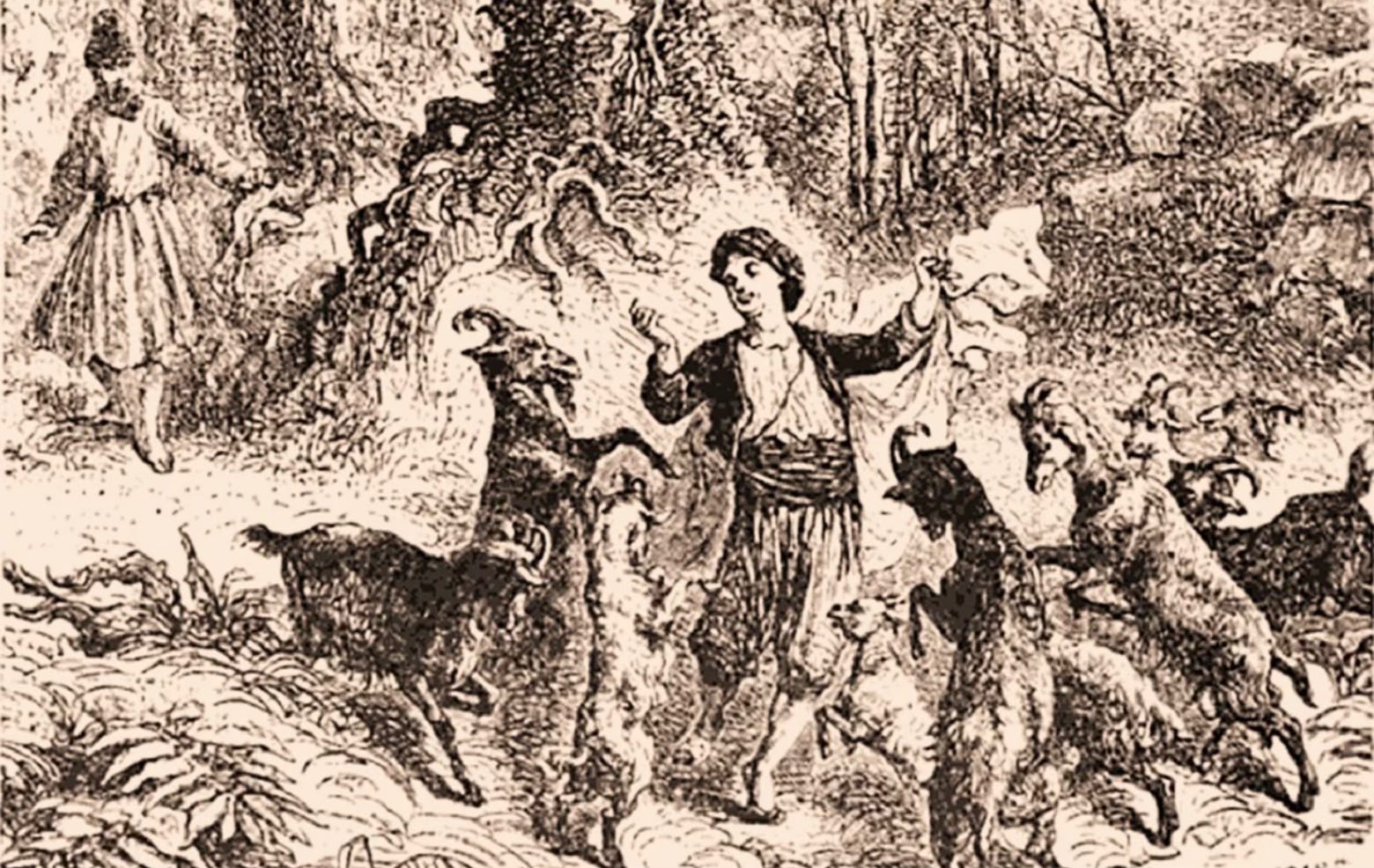
I read a version of this story more than 45 years ago as a kid and I absolutely loved it4 – people drink coffee today because of a bunch of dancing goats! The younger me would have been saddened to learn, however, that it is not true at all. The first mention of Kaldi’s name occurs in the passage that I quoted above, which comes from William H. Ukers’s 1922 book All About Coffee which claims that it has been taken from an earlier French source (though I have not been able to track that down, and fear that he might simply have made this up).
It seems that this is a late 19th or early 20th century version of a similar story from 1671 in the book Discorso della salutifera beuanda cahue, ò vero Cafe’ del sig. D. Fausto Nairone Banesio maronita trasportato dalla latina, alla lingua italiana da Er. Frederic. Vegilin di Claerbergen Leouardiense Frisone (Discourse on the healthy drink of the Cahue, or true Cafe, by Mr. D. Fausto Nairone Banesio, Maronite, translated from Latin into Italian by Er. Frederic. Vegilin of Claerbergen, Leouardiense Frisian.):
…it must be said that this drink called Cahue, or Cafè, was discovered by accidental experience, as will be clear from what is about to be narrated.
For, according to the common tradition of the Orientals, a certain keeper of camels — or, as others say, of goats — complained to the monks of a certain monastery in the region of Ayaman, which is Arabia Felix, that his herds, not merely once in the week but throughout the whole night, were staying awake and leaping about beyond their usual habit. The prior of that monastery, led by curiosity, judged that this must come from the pastures. Carefully examining, together with his companion, the place where the goats or camels had been feeding on the night when they were leaping about, he found there certain little shrubs, on whose fruits, or rather berries, they had been feeding.
He wished to test for himself the powers of this fruit, and so, boiling them in water, he soon found by experience that the drink made from them aroused wakefulness at night. From this it came about that he ordered it to be used daily by the monks for their night vigils, so that they might be readier to attend the prayers of the night. And because, from this daily drink, they experienced day by day various and very healthful effects for human well-being and good bodily condition, this new kind of drink, by chance and by the marvelous providence of God, gradually spread through that whole region, then in the course of time through other provinces and kingdoms of the East, with such wholesomeness that it reached even western regions, and especially European lands.
Therefore they say that the first discoverers of this drink were the aforementioned Christian monks, having learned it from the keepers — so to speak, the nurses — of goats or camels. The Turks themselves, as they are generally accustomed to do, admit this; and in gratitude to them, and from devotion of spirit, they pour out prayers for them, especially those Turks who are the preparers and distributors of this drink. For these men have their own daily prayers for Sciadli and Aidhrous, because they assert that these were the names of the aforementioned monks.
A great abundance of these little shrubs is found in Arabia Felix. They bear fruits like cacao, but split lengthwise like the stone of a date, and they are divided two by two within the same husk.
Interestingly this version changes the monks from being Muslims to Christians (possibly due to the biases of the author) however it seems that this tale is a version of an even older one. عمدة الصفوة في حل القهوة (which transliterates to ʿUmdat al-ṣafwa fī ḥill al-qahwa and roughly means “The mainstay of the elite concerning the permissibility of coffee.”) was written by Zayn al-Dīn al-Jazīrī (also Abd al-Qādir al-Jazīrī) around 1558 (but likely drawing on earlier works) and here the story is as follows:
Other accounts of coffee’s origin exist, but they are not equally reliable. One such account, reported by Nairon, says that a camel driver - or, according to others, a goatherd - complained to monks in Arabia that his camels or goats remained awake all night on certain days of the week and leaped about contrary to their usual behaviour.5 The prior or abbot of the monastery, curious to know why these animals were so wakeful and lively, observed them with a companion at the place where this happened. Finding that they had been eating the fruit of certain shrubs, he boiled the fruit in water and discovered that the drink excited wakefulness. He ordered his monks to drink it so that they might more easily attend the divine office at night. Then, when the monks found from daily use that the beverage had several good effects on health, it spread gradually through the country and then through the provinces of the East.
al-Jazīrī is very skeptical of this story (and also notes that it has been appropriated by the Christians):
The author gives little credit to this story. Nairon cites no authority for it; he merely calls it the common tradition of the Orientals. In plain terms, that means that it is a tale current among common people, not a report on which sensible persons should rely. Moreover, it is easy to see that the tale is a fable based on the true origin already reported by Abd al-Qadir from earlier authorities. Eastern Christians appear to have been pleased to claim honor from it. The prior or abbot and his companion are, in this interpretation, Jamal al-Din al-Dhabhani and Muhammad al-Hadrami; the monks are the dervishes who spent the night in prayer with them.
There is another reason to reject the monastery version. Nairon cannot sustain the claim that such monks existed in Arabia Felix at the relevant time. There may have been monks there before Muhammad, for history teaches that there were Christians as well as idolaters in Arabia in that earlier period. But after Muhammad, Arabia Felix became Muslim. Nor can the monks in question be the monks of Mount Sinai, for Mount Sinai lies in Arabia Petraea, not in Arabia Felix. If coffee had been introduced in the age of such monks, ancient Arab and Persian historians and poets would surely have mentioned it.
So where does coffee come from? The beans that are ground for us each day come from two species of plant – Coffea arabica (better known as arabica) and Coffea canephora, (aka robusta). Recent genomic work has found that arabica is the result of an ancient (between 350,000 and 610,000 years ago), natural, hybridisation between C. canephora and C. eugenioides in or near Ethiopian forests and it seems likely that the first humans to consume coffee dwelt in the same woods. Due to a lack of written records it seems likely that people were partaking of the black stuff (or, more likely, chewing on the berries) for hundreds or even thousands of years before the first accounts that we can find today.
For the earliest history of coffee embedding itself in society we turn once again to al-Jazīrī who in the following passages is talking about the mid-1400s to the mid-1500s:
The first great spread of coffee, according to the report the author transmits, took place in Yemen. Its early appearance is connected with the shaykh, the imam, the learned and saintly man Jamal al-Din Abu Abd Allah Muhammad ibn Said, known as al-Dhabhani [died around 1470], so called from Dhabhan, a town in Yemen. He was attached to Aden, where he held a significant legal office and gave fatwas. At some point he travelled to Persia. There he saw men from his own country drinking coffee. At first he did not inquire closely into the reason for their practice or the benefit they drew from it.
When he returned to Aden, his health was disturbed. Remembering what he had seen, he tried coffee and found benefit in it. Beyond the restoration of health, he noticed certain special properties: it dispelled heaviness caused by vapors rising to the head; it gladdened and enlivened the spirit; it brought joy; it helped loosen the bowels; and above all it prevented sleep without causing the discomfort that often accompanies sleeplessness. This last property was of special importance to him. He had turned to devotion, and he associated with Sufis or dervishes. He and they took coffee together at the beginning of the night and spent the night until morning in prayer, remembrance, and other exercises of strict devotion. It gave them freedom of mind and alertness of spirit in exercises that others had not been able to sustain in the same way.
Because Jamal al-Din al-Dhabhani was a man of position and reputation, his example gave coffee credit in Aden. Soon he and his dervishes were not the only ones who used it. Men of the law who loved reading adopted it; artisans who needed to gain time for their work adopted it; travellers who had to journey by night in order to avoid the heat of the day adopted it; and finally the whole city of Aden adopted it. Those who did not need to keep vigil, or who did not seek wakefulness, drank it by day in order to profit from its other benefits.
If this account is accurate, then we can date the start of the spread of coffee in the Yemen (from where it would then expand across the Islamic world, into Western Europe and across the globe) fairly accurately, as the accounts relating to Jamāl al-Dīn al-Dhabḥānī are generally agreed to be relating to the 1450s, and it would seem that he was pivotal in the development of the drink:
This, then, is the first origin of the widespread public use of coffee. It had existed before, for there were people who drank it without ill effect, and perhaps without clearly understanding its advantages. But it remained obscure until Jamal al-Din al-Dhabhani - a discerning man capable of recognising the excellence of a precious drink - brought it into public favour. He was joined in this by Muhammad al-Hadrami, another weighty doctor from Hadramawt, who drank it and supported its use.
Coffee then spread to Mecca, but it wasn’t long before it ran into a few problems as (once again)6 al-Jazīrī recounts:
In the year 917 AH, corresponding to 1511 CE, coffee suffered a fierce blow at Mecca. Khayr Beg, governor of Mecca under Qansuh, the sultan of Egypt, was leaving the sanctuary after evening prayer when he saw a circle of men seated there with a lantern, drinking coffee in preparation for keeping vigil through the night and reciting praises connected with the birth of Muhammad. He was surprised to see people drinking in that form in the very sanctuary, which Muslims so greatly venerate. Since he had not yet heard of coffee or of the way it was taken, he first believed that they were drinking wine.
When the coffee-drinkers noticed that the governor was observing them, they put out their light, which increased his curiosity. He sent some of his men to them and had them brought before him to account for their action. His astonishment grew when he saw that they had a pot and cups. What they told him - that the drink was common in Mecca and publicly sold in places where people gathered to take it - did not satisfy him, especially when he learned that in such places people also played, sang, and danced. All this led him to suspect that coffee intoxicated; and even if it did not intoxicate, he judged that it gave occasion for actions intolerable in Islam. He therefore forbade the men to drink it further, ordered them to disperse to their homes, and commanded that such assemblies should not be held again.
Khayr Beg didn’t want to be seen to be banning the drink simply on a whim, so he took steps to ensure that there was a formal basis for its prohibition:
Early the next morning Khayr Beg summoned the officers of justice, the most famous doctors of the law from the orthodox schools, several devout men, and many notables of Mecca. When they had assembled, he related what he had seen and the disorder that he had learned coffee was causing in the city. He added that he was resolved to interrupt its course, but that he did not wish to act without consulting them. He had called them in order to communicate his design and ask their opinion.
In order for the drink to be banned, it had to be proved harmful to health. Luckily there were some people on hand willing to make that case:
There were then at Mecca two Persian brothers, both doctors, learned in logic and Muslim scholastic theology, and also practicing medicine. They were not, however, very skilled in medicine, and one of them had already written against coffee, perhaps because it took away from them many patients. Since they were considered the leading physicians of Mecca, Khayr Beg, urged also by his imam and disposed to suppress coffee entirely, called them and explained the matter.
The two physicians gave the same opinion. They asserted that the bunn of the husks, from which the Meccans prepared coffee, was cold and dry, and that by these two qualities it was very harmful to health.
Most of the doctors, through weakness or complaisance toward the governor, gave their opinion orally in conformity with that of the two physicians and their supporters. Only one defended coffee with warmth. Although he was a professor of theology and jurisprudence and had the authority of mufti, the false zealots, unable to answer his arguments, heaped insults upon him and treated him as unfaithful to his religion because of his firmness.
The condemnation of coffee therefore passed. It was declared a drink forbidden by the law. The sentence was drawn up at length, in emphatic terms, to express the triumph supposedly won by extirpating the abuse that had slipped in. It was signed by several doctors, and the governor made it into a dispatch and sent it to Sultan Qansuh. At the same time, Khayr Beg had proclaimed in the public squares and crossroads of Mecca not only the prohibition of selling coffee, but the prohibition of drinking it, whether in public or in private, under penalty of the punishment incurred by those who violate the Muslim religion.
The crackdown then began:
In execution of this prohibition, the officers of justice forced the coffeehouses to close and searched out all the coffee they could find - especially the husk coffee used there - both in the coffeehouses and in the merchants’ stores, and burned it. Authority prevented coffee from being taken in public, and some were punished for contravening the ban. But Khayr Beg could not prevent private use. Many who drank it did not believe they were violating the law, because the condemnation had not passed unanimously in the assembly. They said that the doctor who opposed the condemnation had no weaker reasons for approving coffee than the others had for condemning it. Nevertheless, when one Muslim was caught drinking it at home, he was severely punished and paraded through the public squares on an ass as an ignominious example.
Luckily for morning routines of billions of people today, it didn’t hold:7
The governor’s rigorous prohibition did not last long. Sultan Qansuh received his dispatch and did not approve his indiscreet zeal. On the contrary, he was astonished that Khayr Beg had dared to have coffee condemned in Mecca while people in Cairo found it beneficial and while Cairo had doctors more capable than those of Mecca of deciding whether Muslims might use it. He therefore ordered him to revoke the ban. As for the disorders, he should use his authority to prevent them. The sultan added that if a thing were to be forbidden merely because it was used in a manner offensive to religion, then one would have to include among forbidden things even the water of the well of Zamzam if someone drank it in an irreligious way.
And things didn’t end well for the governor either:
Khayr Beg had the displeasure of seeing his high-handed undertaking fail. The people of Mecca even believed themselves avenged, for the following year his successor arrived with orders to make him account for his extortions. He was beaten to death while being forced to reveal where his money was; and his brother, to avoid the torture, killed him himself.
Nor for those two doctors:
The two Persian physicians who had contributed most to the prohibition of coffee also came to a bad end. Seeing that they had lost their credit in Mecca and were regarded only with contempt and indignation, they banished themselves and withdrew to Cairo. Some time afterward Sultan Selim I, emperor of the Turks, entered Cairo after the conquest of Egypt. The two men were convicted of making imprecations against him and were put to death.
Coffee was now firmly established in the Islamic world, and in my next piece I’ll explore how it spread into Europe, and what happened when it did.
If I consume caffeine after noon now my already not great sleep gets totally wrecked.
No, I have no idea what he means by this either…
Come on, seriously?
I mean, what’s not to like? Dancing goats!!
This version does seem a bit more credible than the whole spinning and dancing account.
I am quoting extensively from his work mostly because it is simply fascinating, but also because as far as I can tell the entirety of this book has never been translated into English before (or if it has, it hasn’t been published or otherwise made publicly available). Some fragments have been translated into English, either directly from the Arabic or retranslations of French and German translations, but not all of it. I found a scan of the original Arabic text, ran it through OCR, then put the output through a translation engine to get this version. You can also find parts of it in Coffee and coffeehouses : the origins of a social beverage in the medieval Near East by Ralph S. Hattox, published in 1985.
Or rather, become the norm in other Islamic states.
Fascinating, enjoy your discoveries. I am always at a loss when I try to imagine how our ancestors figured some things out. Especially in cases where making something takes a few steps that are not necessarily intuitive. I can see someone opening a watermelon to eat the fruit inside. It is harder for me to imagine someone making something like bread... or anything that requires several steps... did our ancestors just wildly experiment...
This is fascinating. I have read much about coffee, but there’s something new here every so often. Thank you.
I can’t touch it after midday either, but when I was a resident it could hardly touch me! Thank you. Looking forward to Part 2.