
HAMLET: My father—methinks I see my father.
HORATIO: Where, my lord?
HAMLET: In my mind’s eye, Horatio.
(William Shakespeare, Hamlet I.2)
A few weeks ago, I mentioned Professor Carolyn Steedman’s book on how historians envisage and convey the past, Picture This. When I was reading it, I was particularly interested in a section where she refers to “Francis Galton’s (1822–1911) investigations into the visual imagination, made in the 1870s”.
Now, the observant among you will have perhaps noticed my colleague Paul here has occasionally alluded to having something called ‘aphantasia’ – defined as the inability to voluntarily form images in one’s mind. The variation between how people see things in their ‘mind’s eye’ is fascinating – my sister-in-law, an artist, can picture things on that mental screen really clearly and vividly. I’m somewhere nearer to Paul’s end: I can only get a vague, blurry visual sense (which I wonder whether is connected to being severely myopic since childhood). And let’s not even get into weird stuff like synaesthesia.1
It turns out that although the word ‘aphantasia’ was only used for the first time as recently as 2015, but the notion of picturing things in the mind of course is familiar to most people, and was captured in Shakespeare’s ‘mind’s eye’ phrase, as well as much considered by philosophers. As far back as 350 BCE, Aristotle observed in De Anima that “the soul never thinks without a mental image”.
As the Age of Enlightenment dawned, such thoughts became more detailed. In René Descartes’s Sixth Meditation (1641), for example, he wrote:
To make this clear, I will first examine how imagination differs from pure understanding. When I imagine a triangle, for example, I don’t merely understand that it is a three-sided figure, but I also see the three lines with my mind’s eye as if they were present to me; that is what imagining is. But if I think of a chiliagon [i.e. a thousand-sided figure], although I understand quite well that it is a figure with a thousand sides, I don’t imagine the thousand sides or see them as if they were present to me. When I think of a body, I usually form some kind of image; so in thinking of a chiliagon I may construct in my mind—strictly speaking, in my imagination—a confused representation of some figure. But obviously it won’t be a chiliagon, for it is the very same image that I would form if I were thinking of, say, a figure with ten thousand sides. So it wouldn’t help me to recognize the properties that distinguish a chiliagon from other many-sided figures. In the case of a pentagon, the situation is different. I can of course understand this figure without the help of the imagination (just as I can understand a chiliagon); but I can also imagine a pentagon, by applying my mind’s eye to its five sides and the area they enclose.
And in 1710, the idealist philosopher Bishop George Berkeley (1685–1753) wrote in The Principles of Human Knowledge:
I find that I do indeed have a capacity for imagining—representing to myself the ideas of particular things that I have perceived—and of splitting those ideas up and reassembling them in various ways. I can imagine a man with two heads, or the upper parts of a man joined to the body of a horse. I can consider the hand, the eye, the nose, each by itself abstracted or separated from the rest of the body.
But his focus is mostly on the limits of pure abstract thinking without ultimately needing to picture something specific. And some philosophers have questioned how vivid mental pictures can really be. David Hume, for example, wrote: “The most lively thought is still inferior to the dullest sensation.”
The earliest scientific discussion of how different people envisage things in the fabled mind’s eye, though, seems to be by Gustav Fechner (1801–1887),2 the German physicist, philosopher and psychologist, in his 1860 Elemente der Psychophysik. He included a close examination of his own mental vividness or lack of it, contrasting ‘after-images’ of things actually seen with those of things purely imagined:
In general, memory and fantasy images always appear to me as something lacking in corporeality, airy, breathy, in contrast to the more material impression of the after‑images.
Thus, the drawing of the memory and fantasy images is more vague and blurred than that of the after‑images. I am not able to obtain clear, sharp outlines even on the most familiar memory images of the objects that are daily before my eyes, while the after‑images appear with corresponding sharpness as directly seen objects…
With all my efforts, I cannot reproduce colours in the memory images of coloured objects, or only in fleeting, doubtful appearances when recalling very striking impressions (for example, when I think of cut eggs on spinach, where the white, yellow and green stand out very sharply against each other) while I receive vivid coloured after‑images in the open as well as the closed eye. I also never dream in colours, but all my experiences in dreams seem to me to proceed in a kind of twilight or night.
I am not able to recall even the most familiar memory‑images.
Fechner then went on to interview six other people and tabulated their responses, looking at whether it is easier to ‘see’ in the mind’s eye with one’s actual eyes open or closed, the degree of vividness, and to what extent colour was noticeable.
He also quotes a striking account by Goethe (a man who was both poet and scientist):
I have the gift, when I close my eyes and, with my head bowed down, think of a flower in the centre of my visual organ, it does not remain for a moment in its first form, but it spreads out and from within it unfolds again new flowers of coloured, even green, leaves; they are not natural flowers, but fantastic, but regular, like the rosettes of the sculptors. It is impossible to foresee the sprouting creation, but it lasts as long as I like, does not tire and does not intensify.
And Fechner also shares an anecdote about an unnamed portrait painter:
When a model came along, I looked at it attentively for half an hour, sketching on the canvas from time to time. I didn’t need any longer. I would remove the canvas and move on to another person. When I wanted to continue the first portrait, I took the man in my mind, I put him on the chair, where I saw him as clearly as if he were ‘616’ written in the sky; and I can even add with sharper and more vivid shapes and colours. I looked from time to time at the imaginary figure, and I began to paint; I suspended my work to examine the pose, absolutely as if the original had been before me; every time I cast my eyes on the chair, I saw the man.
I guess every one of us could supply a fascinating data point for this sort of thing, and I’m sure we all know ‘visual’ vs. ‘verbal’ thinkers. But the first person to study the degree of mental visual vividness with any scientific rigour was indeed Francis Galton (1822–1911), in his 1880 paper ‘Statistics of Mental Imagery’, published in the journal Mind. This is how he set out his stall:
I desire to define the different degrees of vividness with which different persons have the faculty of recalling familiar scenes under the form of mental pictures, and the peculiarities of the mental visions of different persons.
Now, yes, before I look into that further, we’d better address the elephant in the room: while Galton is acknowledged as an astonishingly diverse and prolific scientist (he gave us, for example, the concepts of statistical correlation and regression towards the mean and was a pioneer of the forensic use of fingerprints),3 he is most remembered for coining the term ‘eugenics’ and promoting the notion that different races were in a hierarchy, with white people firmly at the top – ideas that, alas, have all too much currency today but without any foundation in biology. And, further, he believed in selective breeding to create a superior humanity – an idea which of course Nazi Germany took up all too eagerly. So it is complicated to showcase Galton – but none of this changes the fact that he was a relentlessly curious scientist with many interesting ideas quite separate from his toxic ones.
So, back to his paper. He devised a questionnaire – it had many questions, but the core of it was this:
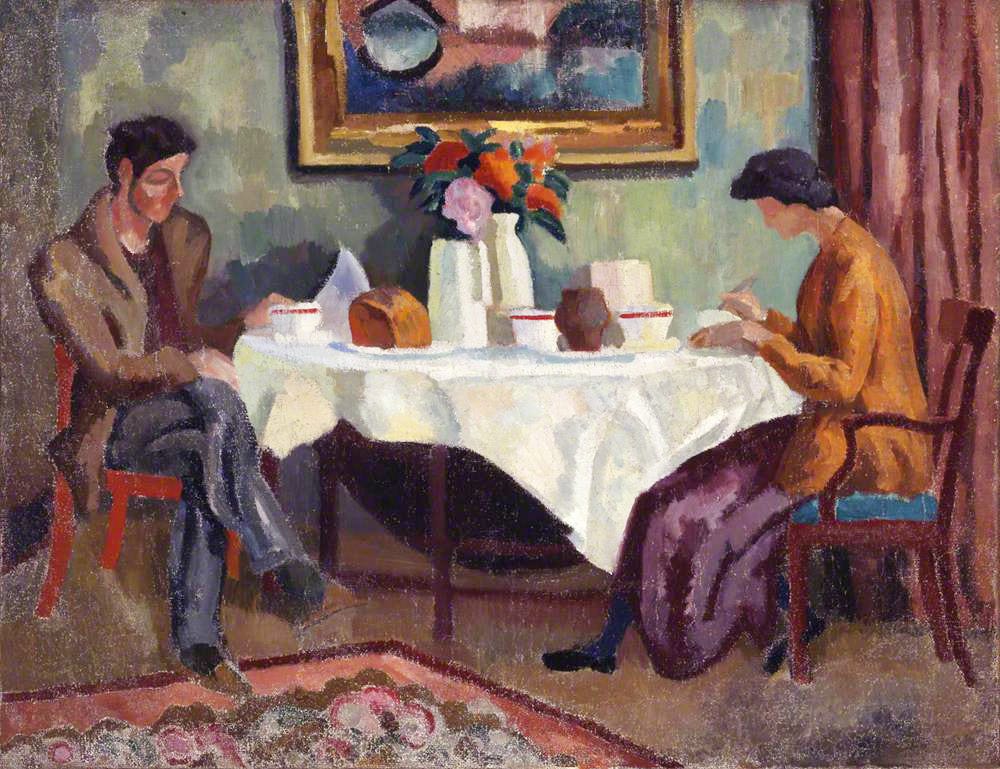
Before addressing yourself to any of the Questions on the opposite page, think of some definite object—suppose it is your breakfast-table as you sat down to it this morning—and consider carefully the picture that rises before your mind’s eye.
1. Illumination.—Is the image dim or fairly clear? Is brightness comparable to that of the actual scene?
2. Definition.—Are all the objects pretty well defined at same time, or is the place of sharpest definition at any one moment more contracted than it is in a real scene?
3. Colouring.—Are the colours of the china, of the toast, bread-crust, mustard, meat, parsley,4 or whatever may have been on table, quite distinct and natural?
He initially gave this to 100 scientists (including his half-cousin Charles Darwin) and was taken aback by the results:
The first results of my inquiry amazed me. I had begun questioning friends in the scientific world, as they were the most likely class of men to give accurate answers concerning this faculty of visualising, to which novelists and poets continually allude… To my astonishment, I found that the great majority of men of science to whom I first applied, protested that mental imagery was unknown to them, and they looked on me as fanciful and fantastic in supposing that the words ‘mental imagery’ really expressed what I believed everybody supposed them mean. They had no more notion of its true nature than colour-blind man who has not discerned his defect has of the nature of colour. They had a mental deficiency of which they were unaware, and naturally enough supposed that those were normally endowed, were romancing.
So he got more data:
On the other hand, when I spoke to persons whom I met in general society, I found an entirely different disposition to prevail. Many men and a yet larger number of women, and many boys and girls, declared that they habitually saw mental imagery, and that it was perfectly distinct to them and full of colour.
The more I pressed and cross-questioned them, professing myself to be incredulous, the more obvious was the truth of their first assertions. They described their imagery in minute detail, and they spoke in a tone of surprise at my apparent hesitation in accepting what they said.
There isn’t space to go into further detail here, but it’s hard not to wonder about this disparity: what is it about scientists that (perhaps, at least in Galton’s sample) predisposes them toward aphantasia? Is it a question of neurodivergence of some kind (research in the last five years suggests it may be)? Of training of their faculties? Of a determined focus on exteriorities? Or maybe they tend to have poor eyesight? I’ll let you speculate for yourself!5
And in the meantime: can you picture what you had for breakfast?
Something for another time. And something our friend Craig has been exploring lately through text and film.
He also created the first weather map, invented a special whistle for testing people’s hearing, pioneered psychometric testing… you get the idea.
Parsley for breakfast? Er, OK.
It took a while before Galton’s paper had much influence. Looking on Google Scholar, there are only 7 citations between 1880 and 1940, then another 7 between 1940 and 1960. And then it escalated: 40 between 1960 and 1980, 58 for 1980–2000, and a whopping 343 from 2000 to 2020.