
Something different this week – sort of a guest post, in the form of an edited extract from a fascinating new book by Professor Carolyn Steedman, Picture This: Historians writing seeing, which I’ve had the privilege of helping publish this month. I’ll set the scene first.
In August 1805, two young working men from a Nottinghamshire village dressed themselves as fashionable gentlemen, went looking for women at the races, strutted into the theatre – and provided their friend Joseph Woolley with irresistible material for mockery.
Joseph Woolley (c.1770–1840) was a framework knitter from Clifton, near Nottingham. Framework knitting used a mechanical ‘stocking frame’ and had been invented by William Lee, not far from there, in the late 16th century. It was the first significant mechanisation of the textile industry, and thus an important precursor to the Industrial Revolution. The framework knitting trade was particularly prevalent in England’s East Midlands (and London in the earlier years). It was also not without controversy – the original Luddites (followers of the fictitious rebel weaver Ned Ludd) were ‘frame breakers’ who took exception to this mechanisation, starting in the decade after Joseph Woolley was writing below.
And I’ve touched on the subject of the Luddites here before, as Lord Byron’s maiden speech in Parliament was on that very subject:

Woolley is distinctive for his time because he kept detailed diaries of work, money, drinking, friendship, sex and village life in the early 19th century – and all, unusually, from a direct working-class perspective. His diaries have proven a great resource for social history – though here we can enjoy some of the more ribald content. Woolley was a gifted comic observer.
In one of her previous books, An Everyday Life of the Working Class, Professor Steedman quotes, for example, a passage in Woolley’s diary where he vividly recounts a fight between two women over a matter of sexual jealousy:
Sometime towards the end of August, George Smith and his wife had an argument. She was jealous of him and Mary Hardy, believing that they were more intimate than they ought to be.
One day, as Mary Hardy was walking up through the town, Smith’s wife remarked that she was wearing a very fine cap and said that she wished she could afford to wear such fine caps herself. This led to a fierce quarrel between the two women. After calling each other every whore and bitch they could think of, they parted ways.
Smith’s wife went back into the house and began hurling every insult she could think of at her husband. She accused him of having bought Moll Hardy that fine cap. When they had made each other as angry as they possibly could, they began throwing pots at one another, until they had broken almost every pot in the house.
George then ran away, intending to become a soldier. But his wife and all the children who were old enough to run chased after him as far as the drove gate leading out of Lambard’s Close, screeching and entreating and begging him to come back. His wife promised that, if he returned, she would behave herself from then on.
Between her pleas and the children’s squealing, George was persuaded to turn back. And now, thanks to their own foolishness, he has to buy more pots.
In the following extract from Picture This, Woolley turns his attention to two friends whose attempts to cut a fashionable figure at Nottingham Races and the theatre in August 1805 did not go quite as they intended.1
Woolley developed great facility in set-piece fights between men, and women (the latter particularly exhilarating in the writing), and between sexual partners. On one occasion he wrote a fine ‘Knitters’ Tuesday Night’, which described a high old time with a lot of very inebriated village women. This was October 1801, when news came through from London that preliminaries to the Peace of Amiens had been signed. There were festivities in Nottingham but Woolley stayed at home: “[t]here was a collection made… they had a leg of Mutton and some beef at Langfords it served them all day of Monday October the 12 and Tuesday the 13”.
On Tuesday “the wimmen had a tea drinking” and much revelry, for they had
gathered about £2 [and] 5 or 6 shillings… to spend in ale and very merry they were for they danced around the candlesticks and up and down the room jumbling one among another just as if they were all mad and some sung, some smoked and some swore while others lied [lay down]… to finish off all, one pissed in a certain man’s hat, [put it on his head] and the piss ran down his hair upon his shoulders while her husband pissed on the fire shovel and tongs… They were good company all the night long till about 2 o’clock in the morning.
Where does the satire lie? In the reader’s knowledge of Robert Burns’ ‘The Cottar’s Saturday Night’ and the high sentimental seriousness of Burns’ paean to rural goodness?2 Woolley could have read it, for it was published in the Kilmarnock edition of 1786; Charles Sutton’s Nottingham bookshop and circulating library to which Woolley subscribed may have stocked this or a later edition. But any satiric relationship between the two ‘Nights’ is made entirely in the reader’s – the historian’s – mind.
It is the same with Woolley’s finest and longest satiric set-piece. He went into Nottingham nearly every Saturday of his diary-writing life, to deliver the stocking-shapes he had knitted to a middleman hosier along the way and to get shaved and spruced up for his own Saturday Night Out. He wrote several satirical vignettes of dead-drunk Clifton women vomiting in Nottingham gutters and of Clifton husbands and wives having a right set-to on market day.
In August 1805 he was highly amusing (he certainly amused himself) in describing the stratagems of young men seeking out sex in the city. Two of his Clifton friends went to Nottingham Races; they “bought a list of the sporting ladies3 and at night they agreed to go and see two of them they were to meet at such a place at such a time”.
But one of the two men, Gervase Reckless, met up with “an old companion from Mansfield… and went to Sneinton feast with him instead of meeting Thomas Langford” (son of the Clifton landlord referred to in the extract above) as arranged:
Langford stayed waiting and havering about till very late at night and then was first to come home by himself like a fool as he was… damning and swearing because he was disappointed of his miss and company too on the road.
Undeterred, the lads were back the next day with a different strategy. Woolley saw them at the racecourse, arm in arm, flaunting themselves around “Just like some people of vast great property and… above speaking to their betters. So I leave you to guess if they would speak to their inferiors”.
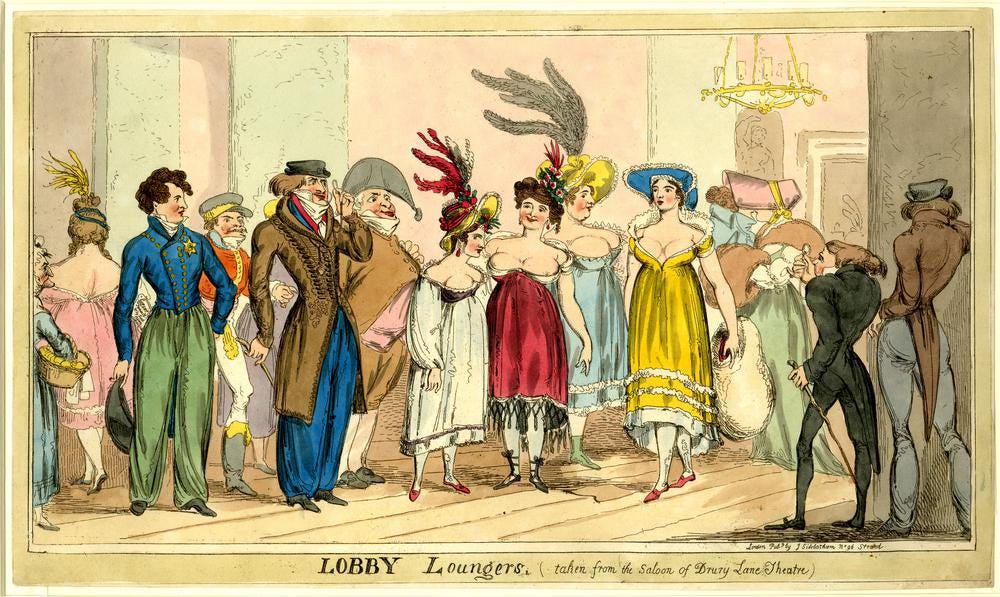
When they’d splendoured their way through the crowd (without being taken any notice of by anyone, Woolley drily noted) they rambled off to a public house where “fop-like they strutted and splendoured about to show themselves till the sober part of the company was quite sick to see them”. Then the fine “gentlemen must go to the play”. Bustling up to the theatre gallery in fashionable disarray, “their hats set in style”, waistcoats unbuttoned to show the neckerchiefs they “had stuck in their bosoms to make them look like a fantail pigeon”, they appeared to have forgotten the sporting ladies, and even the strategy of attracting some misses by their display. After all, said Woolley, they were just a “stockinger and cobbler” and everyone knew it, despite the gloves “which they wore for fear people should know their profession and for fear that the ladies should be frighted at their course bare hands”.
The Boys (and Woolley) knew all about the fashion-clothes of the fop: that is the taken-for-granted of his commentary. Woolley’s thesis about fashion-consumption, masculinity and what came to be called ‘respectability’, was that Reckless and Langford performed their pretensions to gentility, or gentlemanliness, by the way they dressed and how they behaved. Woolley was highly amused by their failure to convince their audience that they were anything but a stockinger and a shoemaker. This was not condemnation of fashion-clothes for Woolley bought them himself, spent a fair amount on fine neckerchiefs, on shirts, suits and breeches, and was particularly fond of his own grey coat. One September day in 1805 his mates in the pub paid the crier to ring around Clifton village “to give notice there has absented himself from dinner these last two days from the sign of the Coach and Horses (Langford’s inn) a stout young man in a gray coat who ever can give information where he may be found shall be well rewarded for their trouble”. This was fondly satirical of Woolley’s habitual dress – and of him.
In August, at the Nottingham Theatre, some may have managed to watch The School of Reform, despite the antics of Langford and Reckless. The play promotes a satiric strategy for married women seeking ascendancy over their husbands: confound all expectations by just keeping quiet. Performances commenced on the 6th – “being the first Race Day” – and lasted the week. It was playwright Thomas Morton’s great success, praised 20 years on and in the 21st century for introducing low-life language and psychology to the stage. ‘Hurry Scurry: or the Tailors’ Rumpus’, also staged that night, may have represented working-class mores to a (partly) working-class audience, but we are never likely to find out how, as this kind of mimed and musical comic interlude was designed to evade theatrical censorship and no script (if script there ever was) has survived.
Woolley wrote about none of this, only implied that he was familiar with theatre-going and knew when to laugh and when to applaud. He was watching the show up in the gallery where the lads were once more on the lookout for the sporting girls: “I believe that the ladies attracted… their attention more than the players,” wrote Woolley, sardonically.
Tom and Gervase had new, curlicued
fashionable stick[s] in their hands as full of knobs and in and outs or bended in all the… forms imaginable which they made use of to nap the seats with when anything attracted their attention in the play but that was very seldom for they understood the play just as much as if one of their four-footed brothers Long Ears [asses or donkeys].
When it was all over they were “so tired with showing their ignorance at the races and at the play that they could not walk home”. They slept on a settle in an alehouse, leaving “about seven o’clock the next morning without their breakfasts”. Reckless “went to bed and lay till about five o’clock in the afternoon and so two fools spent their money and they was neither company for themselves nor anybody else”.
Enjoy your weekend, folks!
Carolyn Steedman’s Picture This asks how fellow historians imagine the people, places and lives they write about, and how those imaginings are conveyed to their readers. How were people taught to look? What did words, pictures and objects allow them to notice – and what remained unseen? Can a historian recover not only a vanished world, but the ways in which its inhabitants perceived and imagined it? You can get the book from Amazon or direct from my UK publishing house here.
The commentary is by Carolyn, with minor editing by me, and I have modernised the spelling of the diary transcripts to aid the reader. Her book uses the original text.
Lists of prostitutes working the provincial race meetings were widely available from at least the middle of the 18th century. Nottingham Races ran from Tuesday 6 August to Thursday 8 August, as recorded in the Nottingham Journal, 27th July 1805.