
Doing the research for my series on time I came across a fascinating story that I thought it would be interesting to share as a stand-alone piece. We are so used to having accurate time just sitting on our wrists, or available at our fingertips on our phones, it is difficult to image that not only is this a fairly recent phenomenon but that not that long ago people were willing to pay good money to ensure that that they knew the correct time. Now you might be thinking that I am talking about the speaking clock (Time of Day in the US) – which, I confess, I used to love calling as a young child – but no, this story is about a much older – and a much more labour intensive – way of sharing the time.
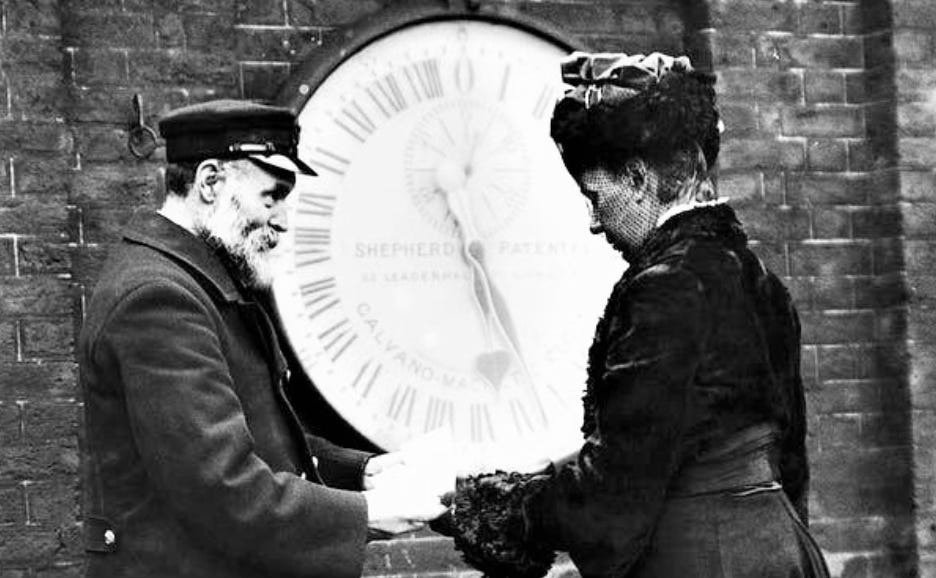
By the early 19th century clocks were pretty good at keeping time, but not perfect. A number of institutions, such as business in the City of London, law offices, et cetera were keen to ensure that their time was perfect with “perfect” in this context meaning being exactly the same as the Greenwich Mean Time (GMT) measured at the Royal Observatory. Whether such accuracy was strictly necessary is somewhat open to question as a good clock would only drift by a few seconds each week, but people believed that it was, and so they took steps to ensure that they were in sync. These businesses would generally rely on the clockmakers of London having the correct time, and so would send their clerks over to get regular updates. The clockmakers themselves would send each someone up to the Royal Observatory a few times a week, where they would knock on the door, ask to see the clock, then set their watch by it.
So many people ended up doing this that it began to seriously interrupt the work of the Astronomer Royal, George Airy (1801-1892)1 that he imposed a restriction. Soon after taking up the post in 1835 he limited people to only coming to check the time on Monday mornings. By 1840 even this was too much of a hassle and he moved to block all access. The Observatory’s second assistant John Henry Belville (1795-1856) saw the opportunity for a nice little side-hustle. As people couldn’t come to see the time, he would take the time to them. And so with Airy’s blessing he did just that. Setting his pocket watch from the observatory clock he would go around London and let people look at it each week, provided they paid an annual subscription. This worked very well, and soon he had 200 clients signed up to his service.
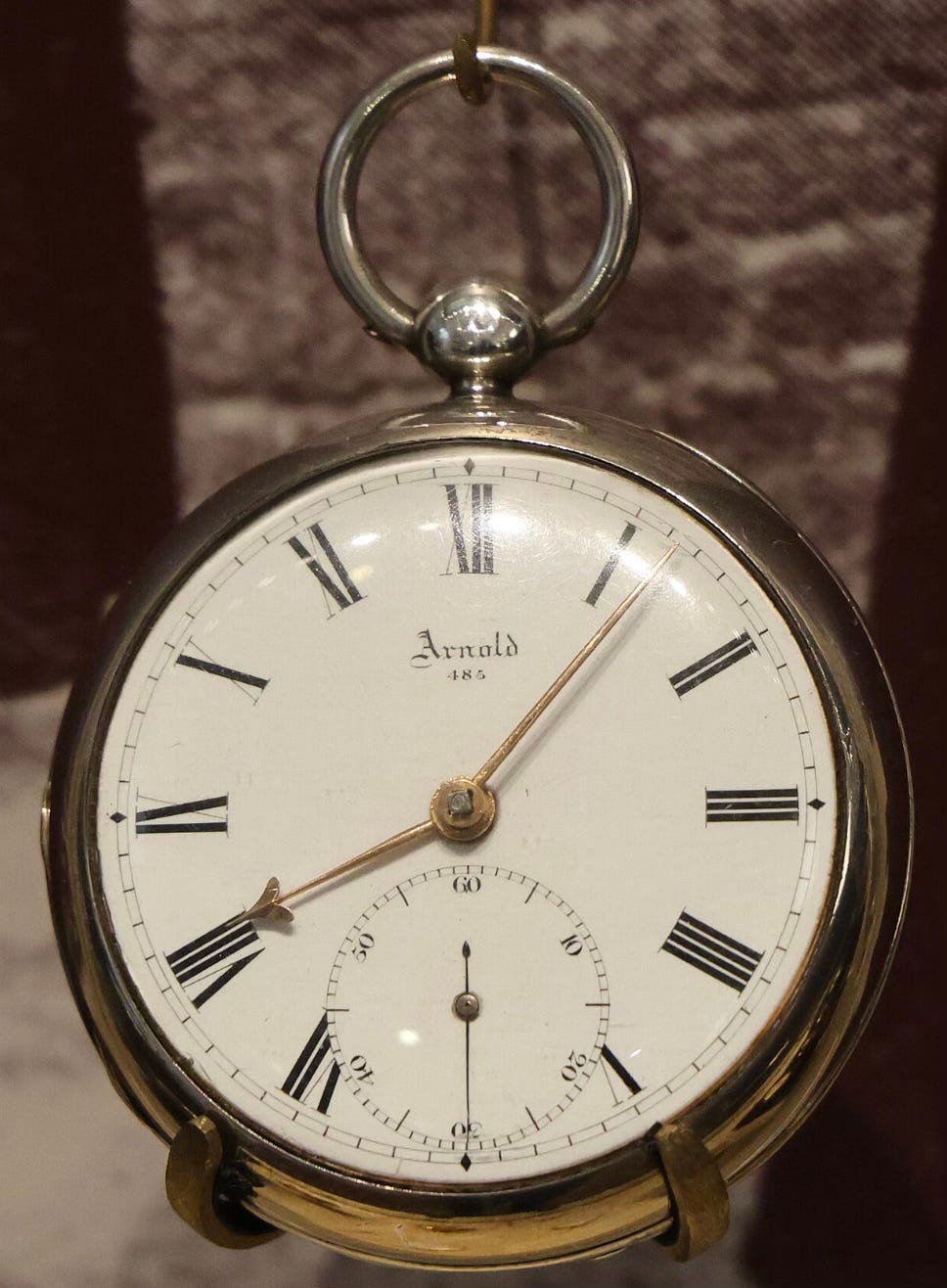
Clearly the watch he used had to be very accurate, and it was. It was a 1794 John Arnold pocket chronometer (No. 485/786) which had originally been made for the Duke of Sussex, who refused to take it on the basis that it “looked like a bedpan”! I think that is somewhat unfair, but you can judge for yourselves:

John Henry continued this operation for 20 years until his death in 1856. This was obviously a tragic event personally for his widow, Marie, but it was also devastating for her financially. She was not entitled to his civil service pension, and as she wasn’t an employee of the Royal Observatory she had no access to the precious time that was the foundation of their side business. In desperation she wrote to George Airy, requesting that she be allowed access to the clock and be able to continue her husband’s business:
I am encouraged by your goodness to advance another petition. Being engaged to take the Greenwich time to 67 of the principal chronometer makers in London I have to request admission once a week to the clocks in the observatory in order to test my own regulator – it would inspire those who have taken up the widow of their esteemed friend with additional confidence if you could accord me this favour.
Airy, being by all accounts a pretty decent human being,2 agreed to this, and Marie continued selling time for another 36 years before retiring. Her rights of access were then passed down to their daughter Elizabeth Ruth Naomi Belville (1854-1953) who carried on the family business.
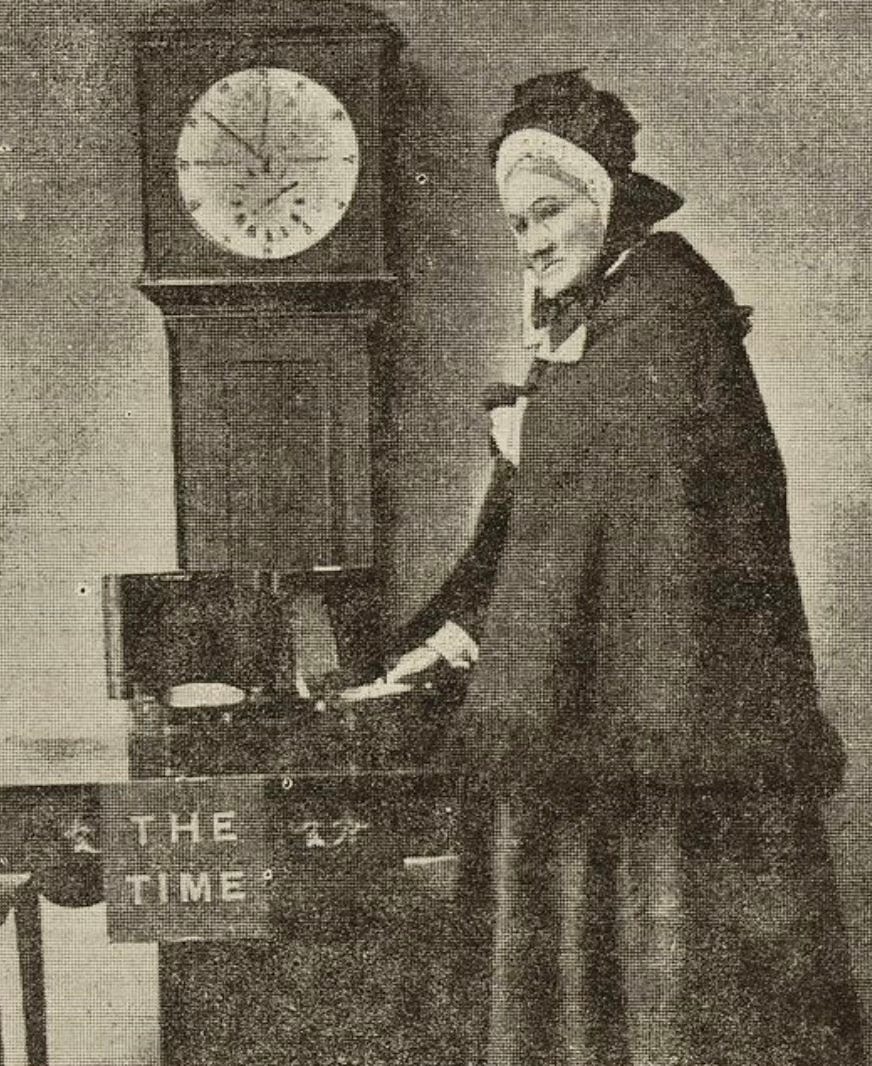
By this point, however, there was some competition in the world of time-selling. The General Post Office had for some time been offering a service that was the bleeding edge of chronological technology at the time. This was a telegraphic subscription by which the Greenwich Time Signal was sent to devices within the client businesses which would automatically ensure that their clock was perfectly correct. You may think that would have spelled the end for the hand-delivered time service, but it didn’t. For at start it was much more expensive – in 1881 it cost £14 a year for companies within half a mile of the post office (and they needed to buy the appropriate kit), whilst the Belvilles were charging a mere £4 a year. I also suspect that some people simply liked the tradition of in-person timekeeping.
So Ruth Belville continued her daily routine of collecting the time and sharing it around London to her happy customers. Then, on the 8th of January 1908 a letter appeared in The Times claiming the the clocks of London were “lying” and, by extension, slandering the work of Ruth:
LYING CLOCKS.
TO THE EDITOR OF THE TIMES.
Sir,—Surely there should be some censorship as to the time kept by clocks exposed to public view in the streets of London. It is not unusual within a hundred yards to find clocks three or four minutes at variance with each other. Highly desirable as individualism is in many respects, it is out of place in horology. A lying time-keeper is an abomination, and should not be tolerated. A by-law might well be framed requiring clocks in public places to be synchronised with standard time; the penalty for repeated disregard to be removal of the offending dial.
I have the honour to be, Sir, your obedient servant,
JOHN A. COCKBURN.
10, Gatestone-road, Upper Norwood, S.E., Jan. 6.
Who was this John A. Cockburn? Was he just a “concerned citizen”? No, far from it. He was a director of the Standard Time Company (and also a “Sir”) that, surprise, surprise, offered just such a time synchronisation service as the one he suggested be mandated in his letter. The company had started out as Barruad and Lund making clocks and watches, but they branched out into electrical time synchronisation from around 1868. They had one of the Post Office time subscriptions which ensured their central clock was correct, and then over rented telegraph wires they would send out hourly signals to specialist clocks in their clients’ premises which would synchronise to this time. Crucially they undercut the £14 fee charged by the GPO (I have seen references to their service costing £4 and £5 5s 0d a year at different points).
The business did well, particularly gaining a new client base in the form of pubs with the introduction of the Licensing Act of 1872 (which required a precise closing time)3 but nonetheless John thought that it wouldn’t hurt trying to raise a bit of a stir. And stir he did create. An editorial appeared in the paper the following day, which whilst broadly supportive of his take on the issue felt that he went a little far in suggesting a legal remedy:
“A by-law,” says Sir John Cockburn, “might well be framed requiring clocks in public places to be synchronised with standard time; the penalty for repeated disregard to be the removal of the offending dial.” We are not sure that this is the right way to go to work. It is quite true that individualism is, as our correspondent says, “out of place in horology.” But perhaps the remedy rather lies in co-operation than in compulsion. Many of the clocks exhibited in public places in London are exhibited by private persons who probably believe they are doing a public service, and undoubtedly are doing it, if they only take reasonable care to keep their clocks reasonably accurate.
The paper published a slew of letters on the issue in the weeks that followed, some being very much on his side, whilst others took issue with his claims about the accuracy of public time:
We note with pleasure your memorandum announcing the great clock at Westminster as being the “nearest approach to a standard timekeeper that we have in London.” Might we add a record of its performance from the last official report of the Astronomer-Royal based upon automatic signals received at Greenwich?
“Its apparent error was not greater than 0.5 sec. on 39 per cent. of the days of observation, not greater than 1 sec. on 67 per cent., not greater than 2 sec. on 89 per cent., not greater than 3 sec. on 99 per cent., and exceeded 4 sec. on only two occasions.
This is surely entitled it to be London’s standard time-keeper.
We are, Sir, yours respectfully,
E. DENT AND CO. (Ltd.)
(W. A. PYALL, Secretary,Makers of the Standard Clock (the Great Standard Timekeeper) of the United Kingdom to the Royal Observatory, Greenwich, also makers of the Great Westminster Clock, “Big Ben.”4
61, Strand, W.C., Jan. 13.
What really made things personal for Ruth Belville happened a few months later on the 4th March 1908. That evening another director of the Standard Time Company, St John Winne,5 delivered a lecture at the United Wards Club entitled “The Time of a Great City: A Plea for Uniformity”. This was essentially an extended version of the case made by his colleague’s letter to The Times but he went out of his way to single out – and ridicule – poor Ruth:
It may be interesting and amusing to some of you to learn how Greenwich mean time was distributed amongst the clock and watch trade in London before the present arrangements came into vogue… A woman possessed of a chronometer obtained permission from the astronomer royal of the time to call at the observatory and have it corrected as often as she pleased. She then made it the business of her life, until she reached a great age, to call upon her customers with the correct time, and on her retirement this useful work was, and even today is, carried on by her successor, still a female, I think.
A fair few people in the audience were clockmakers, and took some umbrage at Winne’s comments about the quality of their products. That didn’t, however, stop them piling in on Ruth. One person doing so was Daniel Buckley, who worked for Dent and Co., as the minutes recorded:
…it is quite true, a lady did do it [delivered Greenwich time], and another took her place, but I may say that that lady calls at our establishment to see whether she has the correct time (laughter)
Having attacked the quality of her product, Winne went on to attack Ruth’s character, suggesting that she had used her feminine wiles to gain access to the observatory:
A woman possessed of a chronometer obtained permission from the Astronomer Royal at the time (perhaps no mere man could have been successful) to call at the Observatory and have it corrected as often as she pleased.
Winne’s attempt to destroy his competitor backfired on him. The press got wind of the lecture, and though Winne had been careful not to name Ruth directly, it was very clear who he was talking about, and reporters tracked her down. The public, it turned out, loved the idea of a woman going around London selling the time and Ruth acquired new customers as a result. Amongst the wealthy there was a certain cachet to having your time delivered each week by a real person. And not just any person, she was the “Greenwich Clock Lady” (newspapers such as the Kentish Mercury dubbed her thusly in their case using the headline “Greenwich Clock Lady: Romance of a Regular Visitor to the Observatory.”) And as for Winne’s service people were quick to point out that it could be described as “second-hand time”. His customers were not getting the time directly from the source at the Observatory, rather it went from there to the Standard Time Company before then being passed on. Of course this didn’t make any technical difference, but it still felt as though it was somehow less pure.
As for Ruth Belville herself she, astonishingly, went on selling the time until 1940 (albeit to perhaps 50 customers at that point) when a combination of her age, and the fact that the country was in the midst of World War Two, caused her to retire. She died three years later, and even though she had long drifted from the public consciousness she still merited an obituary in The Times, the very paper that had started the Lying Clocks debate some 35 years earlier:
Miss Elizabeth Ruth Belville, who has died at Wallington, Surrey, at the age of 89, devoted half a century to taking the correct Greenwich time to business houses in London on a watch 100 years old. Three times a week6 she went to Greenwich where she obtained a certificate of accuracy for her watch.
I guess he wasn’t doing much, you know, observing, during the day, but I am sure there was other admin and stuff going on that he had to attend to.
But sadly not decent enough to fight against the Civil Service powers to get her the widow’s pension that she clearly deserved.
We know that the Crown Tavern in London purchased the time from the STC in 1884 for a while at least. But having been to, ahem, a fair few pubs in my time I find it somewhat surprising that they felt this level of accuracy was necessary. Not least because the people checking their closing time would be highly unlikely to have an accurate measure of the time themselves. Perhaps it was to avoid being tapped up for bribes. I am guessing here, but possibly they were being told they had been open too late, and without a provably accurate clock they could not disprove the assertion, and had to fork over some cash to avoid prosecution.
Yes, the Big Ben.
Okay, so the Wikipedia entry on this says that his surname is “Wynne”. A BBC article about Ruth also calls him “Wynne (sometimes Winne)”. I, obviously, went back and read the scanned pages of the transactions of the meetings of the United Wards Club for March 1908 where he is consistently called “Winne”, so I am sticking with that. And yes, it is exactly this kind of thing that causes these pieces to take way longer to write than I anticipate.
I actually think it was more like once a week, certainly by then.
This is the most interesting read of my 2026 so far!
Fascinating ! In your footnote 3 you refer to "The Crown Tavern" . Possibly this is The Crown on Clerkenwell Green , once well known for its large collection of clocks - which might explain your doubts as to whether a pub would need to subscribe to a correct time service ....