
A couple of months ago I wrote about the travel writer Thomas Pennant, marking his 300th birthday and quoting from one of his tours of Scotland. Now I’m just back from my own tour of that fantastic nation (I lived there 30 long years ago and have been aching to return to the Highlands).
A highlight of my trip was visiting the Isle of Lewis and Harris1 in the Outer Hebrides for the first time. It rained. A lot. But was magical. I’ll probably write about some of this elsewhere, but on the shelves of my Airbnb in Stornoway there was a book which caught my eye and I’m going to talk about this time. The book in question was Travels in the Western Hebrides from 1782 to 1790 by the Rev John Lanne Buchanan, published in 1793.
In his prefatory ‘advertisement’ to the book, Buchanan intriguingly notes,:
What I have written, I well know, will give offence to many petty tyrants: but I am actuated by motives of humanity, and of duty to the common Parent and Lord of all mankind. And I thank God, who has given me grace to speak the truth with boldness, notwithstanding the menaces of certain unprincipled oppressors.
And thereby hangs a tale…
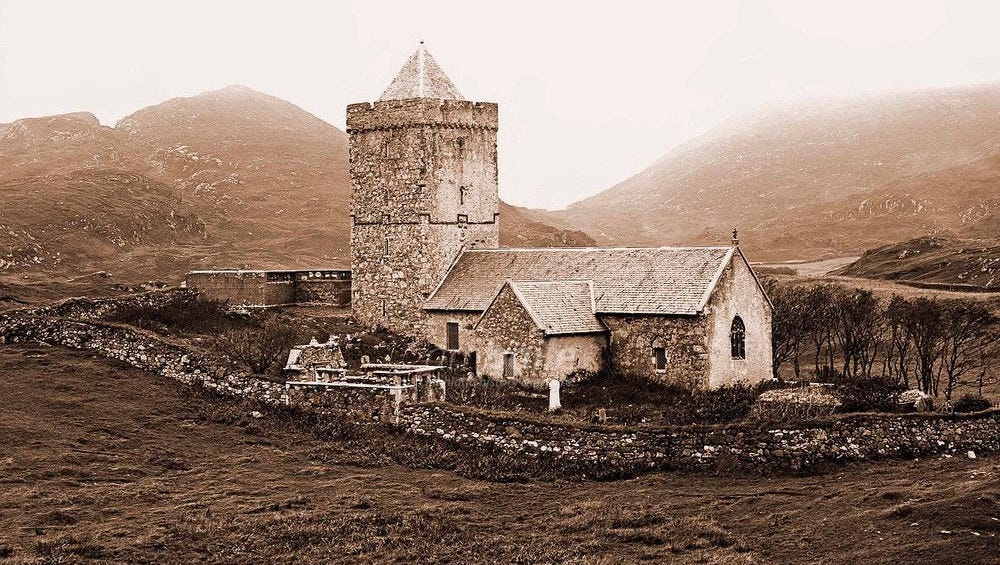
Full details of Buchanan’s life are elusive but we know he came from Menteith in Perthshire, was schooled in Callander and then studied at Glasgow University. On joining the (Anglican) Church of Scotland, he became the minister’s assistant at Comrie2 in his native county.
After that, he became the Church’s missionary to the Western Isles (aka the Outer Hebrides) – his observations on life there being recorded in his book. He was perhaps sent because of his knowledge of Scots Gaelic – even today, Lewis is the part of Scotland with the highest percentage of Gaelic speakers.3 In later life he lived in London, and the trail of his life goes cold in 1816.
In his Travels, Buchanan provides many details of life in the islands: what they wore, what they ate (“Potatoes and fish generally make up their first meal, and the whole family commonly eat out of one dish called the claar.” And cormorant broth) and where they lived:
The huts of the oppressed tenants are remarkably naked and open; quite destitute of furniture, except logs of timber collected from the wrecks of the sea, to sit on about the fire, which is placed in the middle of the house… These huts, being thus without locks to their doors, and without separate apartments, we need not be surprised to find the virtue of their women severely tried…
Oppressed tenants? And so we come to a big theme in his book. He describes in detail the hierarchical society of the islands, and particularly how some of the ‘tacksmen’ (who rented from the landowners, often their relatives, and held considerable power) treated the ‘scallags’ – peasant land labourers who were often little more than slaves. Buchanan even mentions other travel writers – including Thomas Pennant and Samuel Johnson – noting “none of them ever touched on the horrid island of Harris”.
In fact, in the book Buchanan claims “There is not, perhaps, any part of the world, where the good things of this life are more unequally distributed”. And extraordinarily, in the book he presents a long comparison between the lives of these scallags and those of black slaves in the West Indies. Here is an extract showing his numbered points:4
First, then, with regard to the respective conditions of their life, in general, it is none of their own chusing. The African, when he is not sold on account of some crime, is bereft of his freedom, and forced into slavery by fraud or violence. The Hebridean slave is neither, indeed, trepanned into slavery by guile, nor compelled by physical compulsion; but he is drawn into it by a moral necessity, equally invincible; by a train of circumstances which are beyond his power to control; and leave him no option, but either to serve some master as a scallag, or often to protract a miserable existence for some time, in the forest, and near the uninhabited seashores, where he may pick up some shell-fish, to perish, with his wife, perhaps, and little ones, through cold and hunger.
Second. With regard to labour. The negroe works only from six o’clock in the morning to six in the evening: and out of that time he has two complete hours for rest and refreshment. The scallag is at work from four o’clock in the morning to eight, nine, and sometimes ten in the evening.
Third. With regard to respite from labour. The negroe is allowed only one day in the week for himself. And this, too, is the portion of time allowed to the scallag.
Fourth. With regard to food. The negroe has a plentiful allowance of such common fare as is sufficient to nourish him; besides his little property in land, or peculium, which he cultivates for himself, on the evenings, after he is done his master’s work; and on Sundays, and other holidays. The scallag is fed only twice a day, when at hard labour for his master, with water-gruel, or as they call it, brochan; or kail, or coleworts; with the addition of a barley cake; or potatoes: and all this without salt. But, for his family, and for himself, on Sundays, or when unable to work through bodily indisposition, he has no other means of subsistence than what he can raise for himself by the labour of one day out of seven, from a scanty portion of cold and moorish soil… The negroe, if he be tolerably industrious, can afford, on Saturdays, and other holidays, with pepper-pot, a pig, or a turkey, and a can of grog. Nay, many a negroe, I am well assured, has been known to clear, besides many comforts for his own family, by the produce of his little property, from twenty to thirty, and even forty pounds a year: so that there is a fair probability, that any negroe would soon be enabled to gain the price of his liberty, if he desired and deserved it. Of relief from bondage, and woe, the scallag has not a single ray of hope on this side of the grave.
Fifth. With regard to lodging and clothing. The negroe is comfortably lodged and fed in a warm climate: the scallag is very poorly clothed, and still more wretchedly lodged, in a cold one. And, as the negroe is provided by his master with bedding and body clothes, so he is also furnished by him with the implements of husbandry. The scallag, with sticks and sods, rears his own hut; procures for himself a few rags, either by what little flax or wool he can raise; or by the refuse or coarser parts of these articles furnished by his master: and provides his own working tools…
Sixth. With regard to usage or treatment. The slave is driven on to labour by stripes, so also is the scallag; who is even, as we have seen, formally tied up, on some occasions, as well as the negroe, to a stake, and scourged on his bare back. The owner of the slave, it may farther be observed, has a strong interest in his welfare: for if he should become sick, or infirm, he must maintain him; or if he should die, he must supply his place at a considerable expence. There is no such restraint on the peevish humours, or angry passions of a Hebridean laird or tacksman…
Wow. Now, let’s straight off acknowledge that Buchanan clearly didn’t have a very accurate picture of the reality of African slavery. As a contemporary reviewer (in The Analytical Review, 1793) noted tartly: “This very flattering account must have been suggested to the reverend missionary by some person interested in the slave trade”.
But it turns out that Buchanan had a very personal axe to grind, and not one that puts him in a very good light. And he even tried to blame someone else.
In a postscript to his 1794 book A General View of the Fishery of Great Britain, Buchanan noted of the Travels that his “veracity… is questioned”, particularly over negative remarks about the clergy (some of whom were tacksmen) on Harris. Buchanan claims he was “unguardedly advised” by one Rev William Thomson, who offered to help prepare the book for press. Buchanan complains:
But that Rev. gentleman abused the confidence placed in him, and discharged his whole wrath against part of the clergy and others, under the said author’s name; though he durst not attack his adversaries under his own. These scurrilities the author disclaims, and he has since resented the indignity severely; and shall purge out all his dirty eructations from his second edition.
Strong words – but it seems a bit unlikely that the many pages of text railing against the tacksmen came from Thomson rather than Buchanan himself, who must have signed off the book for press.5
And thanks to some detective work by Dr Alasdair Maclean, who published an edition of the Travels in 1997, we have the answer.
Maclean reveals that Buchanan “was not provided with a manse, and he was obliged to accept the hospitality of Dr. William Macleod, the tacksman of Luskintyre, which hospitality he allegedly repaid in 1788 by being found in bed with one of the Luskintyre maid-servants.”
Buchanan was brought before a Church committee (the minutes of which provide all the juicy details over several years) and his denials were believed because he was a priest. But in November 1790, bed-hopping Buchanan was at it again, and this time got another woman pregnant. Then a month later, he was accused of the attempted rape of another woman – the wife of a tacksman – some years earlier. So the ‘severely tried’ virtue of local women… was being severely tried by him.
Buchanan offered bribes to be let off by the Kirk Session, but was found guilty and deposed. And suddenly it all becomes a bit clearer. Maclean writes:
The principal witnesses called for the prosecution included Dr. and Mrs. Macleod of Luskentyre. Dr. Macleod is the chief object of the charges levelled against tacksmen in his Travels.
Ah.6
It’s complicated: it’s technically the same landmass – the largest of the geographic British Isles after Great Britain and then Ireland – but Lewis and Harris have their own clear identities and indeed distinct topographies.
Comrie, I’m intrigued to learn, lies on the Highland Boundary Fault and experience more earth tremors than anywhere else in Britain.
Another thing I learned on my trip was that there is a small but thriving community of Gaelic speakers in Nova Scotia, Canada. And I got talking to one on the ferry from Harris to Skye – he was taught by his grandfather in Nova Scotia, but locals in the Hebrides can nonetheless still detect a Harris accent in his Gaelic, handed down through many generations.
His terminology is that of his era, of course.
Another Scotsman, Thomson is an interesting chacrater in his own right – as well as being a minister he was a successful writer of numerous books, some of them under the pseudonym Captain Thomas Newte. He gave Newte his own fictional biography, and even succeeded in being elected to the Royal of Society of Edinburgh as Newte! The Dictionary of National Biography notes of his spat with Buchanan: “The quarrel between the two men was aired in public and Buchanan seems to have come off worse.”
None of this disproves cruelty by the tacksmen, of course – but whose word can we trust? One priest against another…