
Look, between ourselves, guys – and I know you’re smart enough to know a good deal when you hear one – a very wealthy and important person I know has got into difficulties while on holiday in Spain. Thing is, they’ve been mistakenly imprisoned and they now can’t access their Bitcoin wallet. If you could be super kind and lend some money towards their legal fees, we can get all this cleared up – and they have offered to give you a huge cash reward!
OK, no, obviously not. And you know a Nigerian prince scam when you see one, right?1 Ever since email took over our lives, many variants of this have proliferated. At the root of it is the idea of relieving people of a relatively small amount of money in return for the prospect of a huge return – it appeals to people’s greed, and indeed is a neatly self-filtering process because only the gullible will respond. And if it smells too good to be true, you can bet that it is.2
But the scammers’ business model works – it only takes a small percentage of people to fall for it. Here’s one bit of data, for example: “Out of one hundred such letters, twenty were always answered”.
However, that line was written… in 1827.
Its author was a fascinating Frenchman called Eugène-François Vidocq (1775–1857), who was the epitome of poacher turned gamekeeper as well as a classic ‘lovable rogue’. As a teenager in Arras, he developed a habit of stealing, despite being born into a wealthy family, starting with filching his parents’ silver and escalating from there. He was also an accomplished swordsman and got himself into multiple scrapes, including various duels while in the army.3
He saw action in 1792 in France’s war against Austria, but ultimately deserted, returning home to pursue a new line of trouble as a philanderer (again leading to duels). By the time he was 20 he had spent a good few months in prison, but this only taught him new tricks, especially as a fraudster and forger, and he would pursue various criminal schemes under various different identities. There were daring escapes from prison, too, including one dressed as a nun!
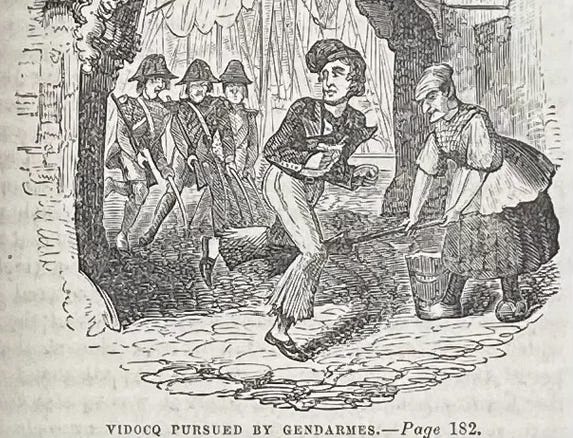
But in 1809, Vidocq reached a turning point – not unaided perhaps by a death sentence being pronounced against him in his absence. When he was re-caught, he offered to become a police informant, and turned out to be a very effective one from the network of criminal contacts he had built up, along with being trusted by them.
Astonishingly, Vidocq not only thrived as an informant but would go on to found France’s first criminal investigation agency, the Sûreté Nationale, and is remembered as both the founding father of the French national police and possibly even the first ever private detective. He also inspired Herman Melville, Edgar Allan Poe and Charles Dickens. This short article wasn’t even meant to be about him, but you can see the appeal!4
In 1827, Vidocq – still with his career as a private detective (and as a paper factory owner, employing fellow ex-cons) ahead of him – sat down with a ghostwriter and produced the Memoirs of Vidocq, published in 1828 and an instant bestseller. An English translation appeared the year after. And in this book, he discusses various frauds, including a variant of the Nigerian prince scam (known more widely under the category of ‘advance fee fraud’). He says the scam was known among his prison mates as “letters of Jerusalem”, but noting “the names of places and persons change according to circumstances.” He gives an example of such a letter, typically sent to someone known to be wealthy:
Sir,—You will doubtlessly be astonished at receiving a letter from a person unknown to you, who is about to ask a favor from you; but from the sad condition in which I am placed, I am lost if some honorable person will not lend me succor: that is the reason of my addressing you, of whom I have heard so much that I cannot for a moment hesitate to confide all my affairs to your kindness. As valet-de-chambre to the Marquis de — I emigrated with my master, and that we might avoid suspicion we traveled on foot and I carried the luggage, consisting of a casket containing 16,000 francs in gold and the diamonds of the late marchioness, We were on the point of joining the army at —, when we were marked out and pursued by a detachment of volunteers. The marquis, seeing how closely we were pressed, desired me to throw the casket into a deep ditch near us, so that it might not implicate us in case we were apprehended. I relied on recovering it the following night; but the country people… began to beat the wood in which we were concealed with so much vigor, that it was necessary to think only of escape…
It goes on explain how the ‘marquis’ sent the writer back to retrieve the casket, but he was apprehended…
In this cruel situation, having heard mention of you by a relation of my master’s who had property in your district, I beg to know if I cannot, through your aid, obtain the casket in question, and get a portion of the money which it contains. I could then supply my immediate necessities and pay my counsel, who dictates this, and assures me that by some presents I could extricate myself from this affair.
But even in Vidocq’s time, this was an old trick. The earliest statement I have found of this scheme dates from December 1791 (translated here from the Journal de Paris and penned by ‘Desmousseaux’, deputy assistant to the public prosecutor):
The citizens of Paris and of the Departments should be on their guard against letters addressed to them by prisoners.
These letters, known in the prisons by the name “Letters from Jerusalem,” state, in substance, that some man—usually a well-known person—while fleeing or dying, left with the signatory, who was his servant or trusted secretary, gold, jewels, or precious manuscripts; that, for fear of being pursued or robbed, he carefully buried them; but that some fatal circumstance (described in detail) caused him to be thrown into prison, where he is being held incommunicado.
Having heard of a man worthy of complete confidence, he wishes to reveal the location of his treasure to him and to share it with him, provided, however, that the honest man to whom he is writing will promptly advance him some sum of money to assist him in his misfortune.
And in one of his own later books (Voleurs, 1837, a guide to the nature and ruses of criminals), Vidocq discusses Jerusalem letters in more detail and specifically connects them with the 1789 French Revolution: more people were in prison, for one thing, and he says the criminals “chose those who regretted losing the old order of things and whom they believed might be tempted by the prospect of carrying out a profitable transaction”.
By the end of the 19th century, the most common form of this ruse was the ‘Spanish prisoner’ scam – I’ve found 1880s and 1890s newspaper reports referring to the “venerable buried treasure fraud” and there are many reports from the era. Here’s a version from 1910, reported in Minnesota but allegedly sent from Madrid:5
Dear Sir – Although I know you only from good references of your honesty, my sad situation compels me to reveal you an important affair in which you can procure a modest fortune saving at the same time that of my darling daughter.
Before being imprisoned here, I was established as a banker in Russia as you will see by the enclosed article about me of many English newspapers which have published my arrest in London.
I beseech you to help me to obtain a sum of 480,000 dollars I have in America and to come here to raise the seizure of my baggage paying to the registrar of the court, the expenses of my trial and recover my portmanteau containing a secret pocket where I have hidden the document indispensible to recover said sum.
As a reward I will give up to you the third part, viz., 160,000 dollars. I cannot receive your answer in the prison, but you must send a cablegram to a person of my confidence who will deliver it to me.
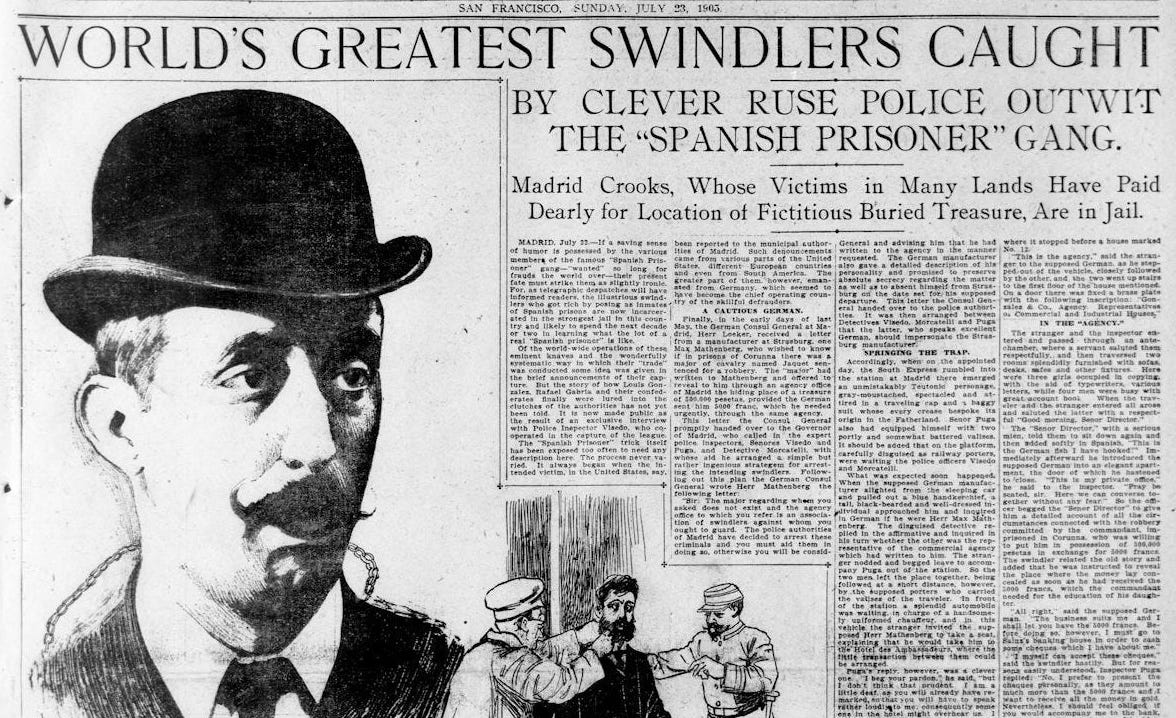
There are many other variants, of course – different dire straits, different rewards, different countries, and society has been playing Whac-A-Mole with them for centuries.
Same old story: humans have been doing naughty human things to other humans for a lot longer than we might imagine – facilitated inevitably by the latest political events or technological advances.
And if you like reading about this sort of thing, you can of course support us with a paid subscription. We guarantee no greater reward than helping two nerdy writers to keep doing what they do!
Also known as a 419 scam after the code for fraud in Nigerian criminal law.
I confess I was spurred to write this because this week I discovered – from two different people – that my name is being used in an AI-powered scam to extract money from wannabe authors who are hoping for representation by a literary agent. Sigh.
There was also a 1910 short story based on this, and the 1997 David Mamet movie, The Spanish Prisoner, was inspired by the general scam.