
The inspiration for today’s piece comes from two different places. The first is having written two pieces about Alice. The title of the second book in which she features Through the Looking-Glass, and What Alice Found There got me thinking that mirrors could be an interesting subject to write about. Shortly afterwards Instagram served up a brief video of Professor Mary Beard speaking at The Rest is History Festival, in which she said the following:
Romans would not have had a clue what they looked like because the Romans do not have effective mirrors. So you can go to a museum now and you can see things called ancient mirrors. They’re absolutely rubbish. All they are is a bit of polished metal. So to kind of shave yourself in the Roman world would have been a bit like the equivalent of shaving yourself using the back of a spoon. They do not know what they look like. Well, if you’re rich, you have somebody else shaving you and you have somebody else dressing you. Even down the social hierarchy, it’s a beard or someone to help you.
My natural inclination was to assume that one of this country’s greatest classicists would obviously be right about this. But somehow it didn’t feel right. Could she be wrong? I’d have to do some research. Which is why, as you will have doubtless realised from the title if nothing else, that I am going to be exploring the history of mirrors.
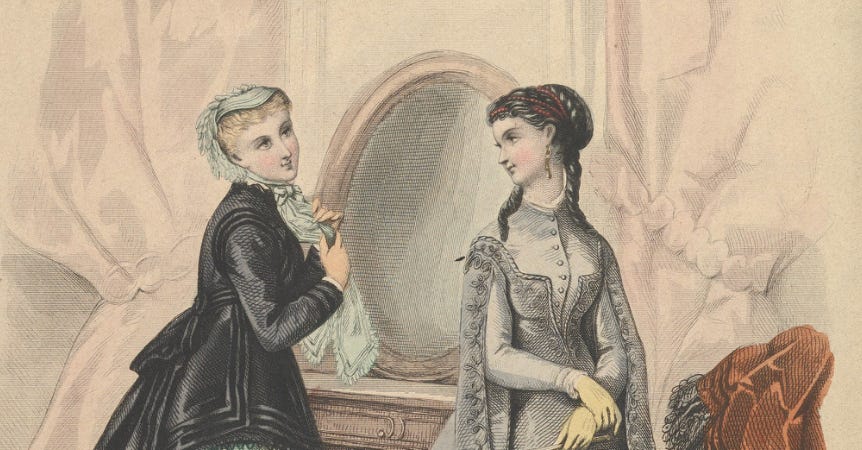
The earliest means for humans to see their own reflections was, of course, in pools of water. Probably the most famous account of such an event is the story of Narcissus, here recounted in Ovid’s Metamorphosis (written around 8CE):
There was a fountain silver-clear and bright, which neither shepherds nor the wild she-goats, that range the hills, nor any cattle's mouth had touched—its waters were unsullied—birds disturbed it not; nor animals, nor boughs that fall so often from the trees. Around sweet grasses nourished by the stream grew; trees that shaded from the sun let balmy airs temper its waters. Here Narcissus, tired of hunting and the heated noon, lay down, attracted by the peaceful solitudes and by the glassy spring. There as he stooped to quench his thirst another thirst increased. While he is drinking he beholds himself reflected in the mirrored pool—and loves; loves an imagined body which contains no substance, for he deems the mirrored shade a thing of life to love.
Some people were incensed by this tale, including the Greek traveller and geographer Pausanias, writing around AD 150–170:
It is utter stupidity to imagine that a man old enough to fall in love was incapable of distinguishing a man from a man’s reflection
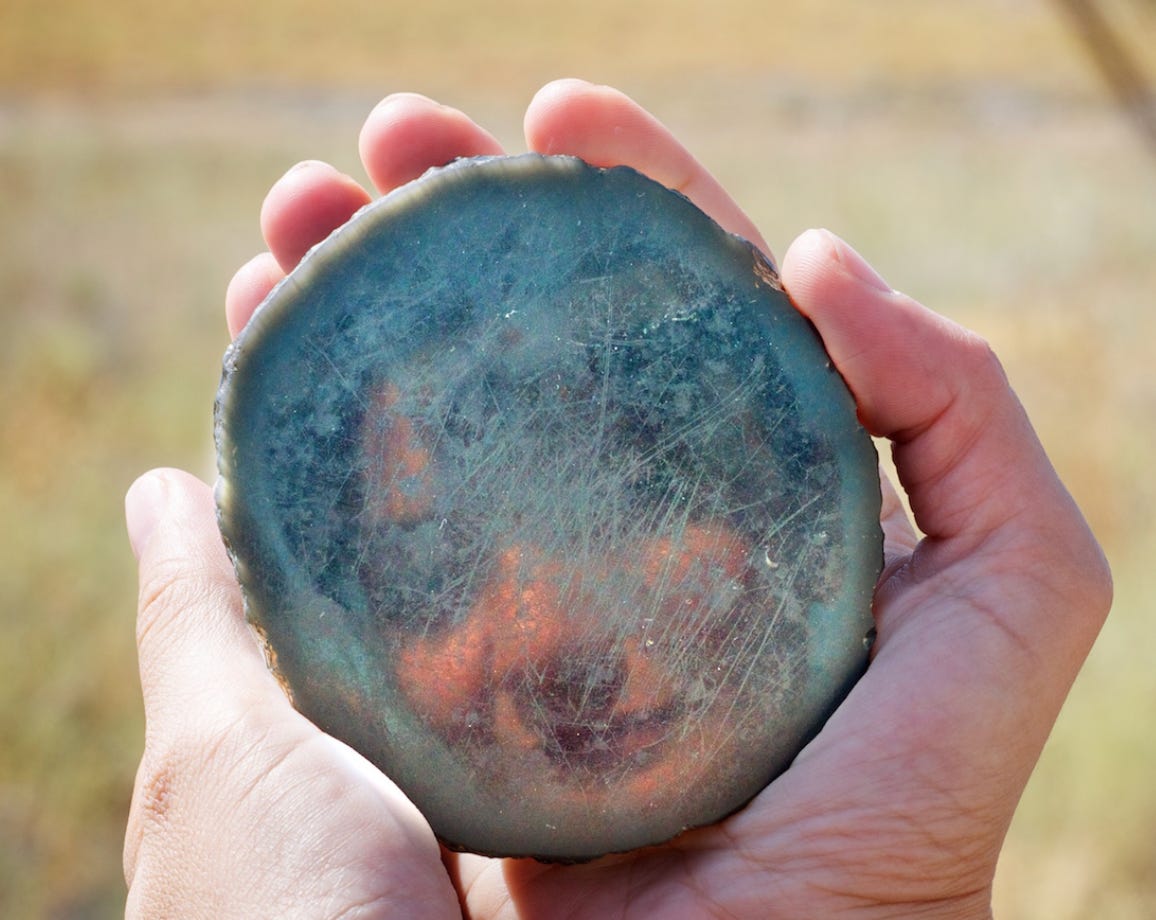
Mirrors have been around for a very long time. Among the earliest surviving manufactured mirrors are polished obsidian mirrors from Neolithic Anatolia, dating from around 6,000 BCE. Obsidian is a naturally occurring volcanic glass which. through careful grinding and polishing, can create a surface that can return a pretty decent image against its dark background. I have to admit I was fairly sceptical how good an 8,000-year-old stone mirror could be, but was blown away when I saw an actual picture of one.
Copper mirrors arose in Ancient Egypt around 5,000 years ago and in time became made of bronze. Here is an example that is around 3,500 years old.
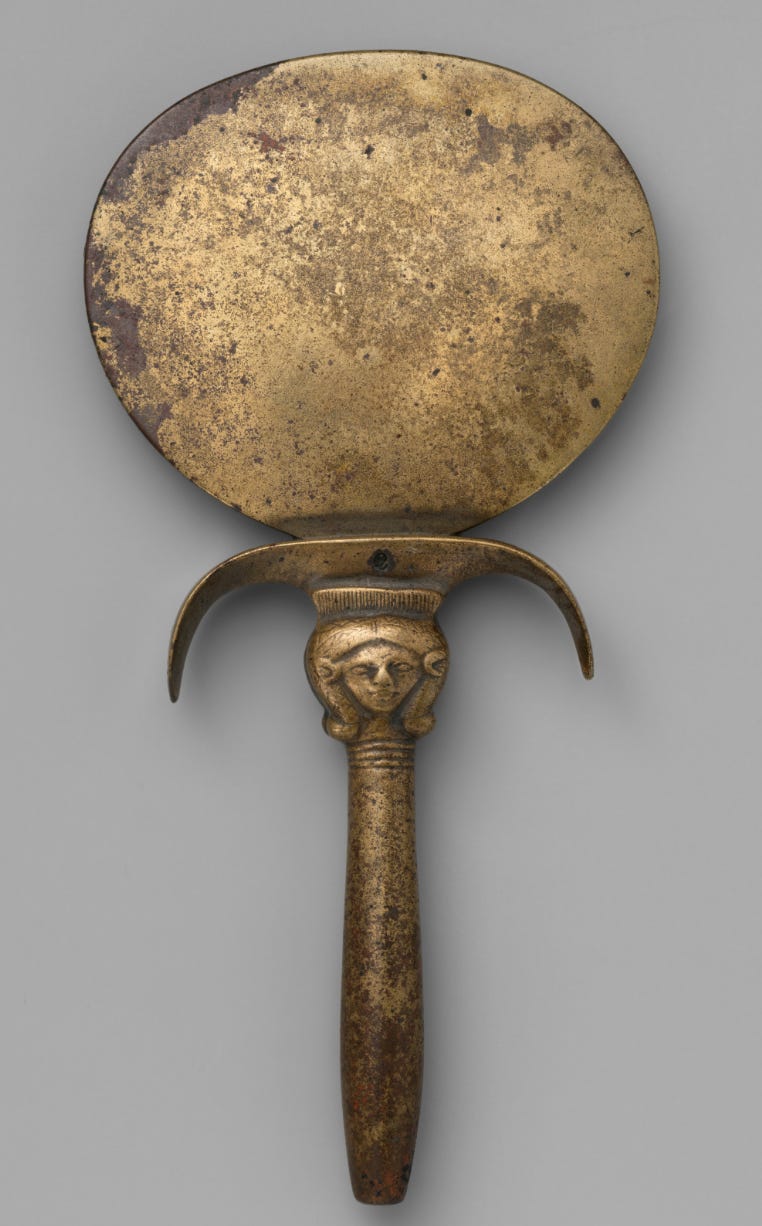
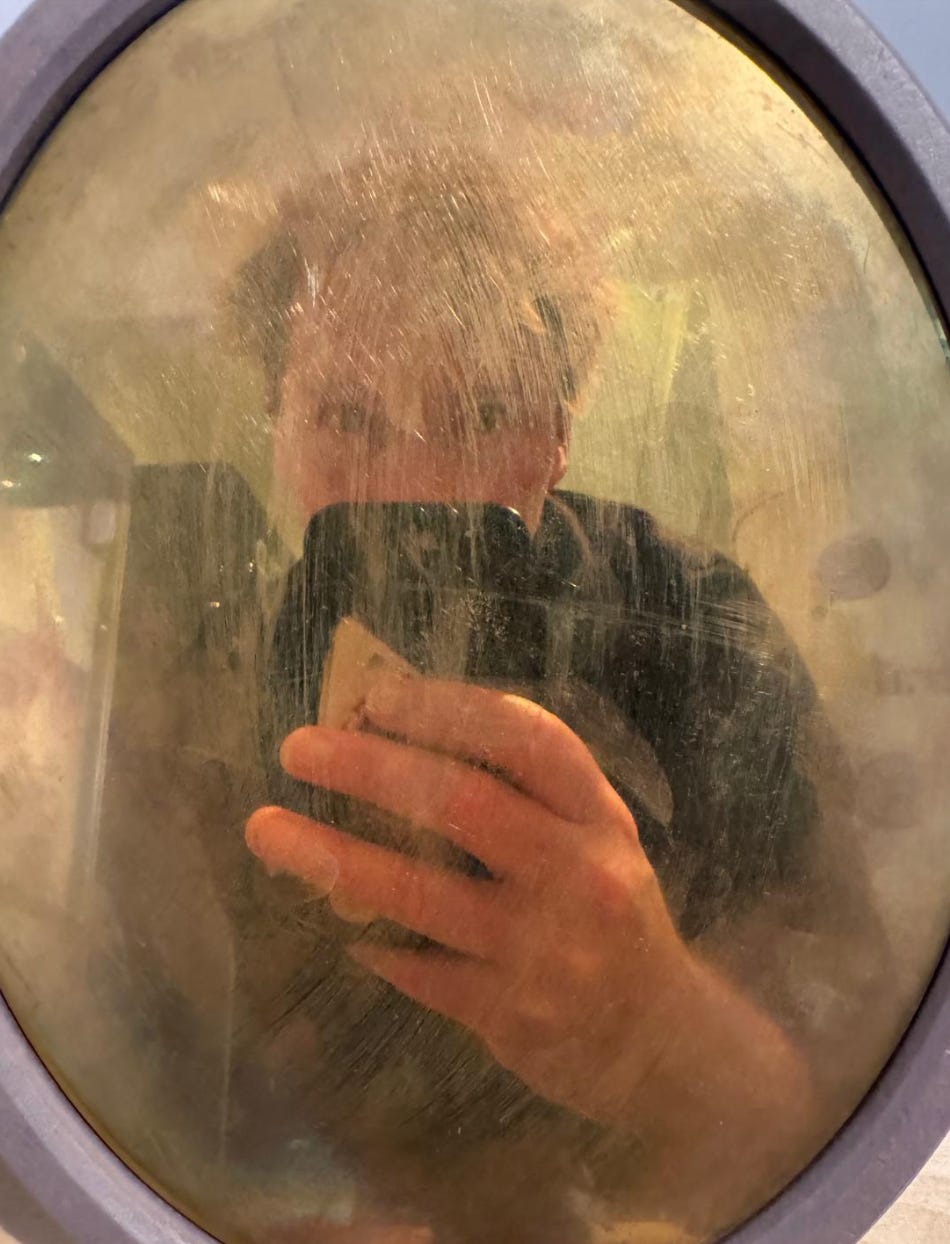
It is hard to know how good this would have been at reflecting, given its age and level of corrosion. I was, however, able to get a much better understanding of the quality of such a mirror a couple of weeks ago, when I was visiting the wonderful Melsonby Hoard at the Yorkshire Museum. Here they have a replica of a an ancient bronze mirror, and despite the scratches and marks from the hands of thousands of visitors you can get a sense of how good it would have been when new.1
The ancient Greeks had a thriving industry making bronze mirrors, including portable mirrors in little cases, not dissimilar to compacts today. But what of the Romans – is it possible that, somehow, mirrors just weren’t a thing for them? No, they had mirrors aplenty. Initially they too used bronze mirrors and had learned that by increasing the tin content in the alloy to around 25% (from the usual 12-15%, interestingly around the same time it is thought that the Chinese were doing the same) they could increase the reflectiveness of the surface and make it more silver in appearance. They then realised that even better mirrors could be made using silver itself. Pliny the Elder wrote of them in his Natural History (c. 77CE):
The best, in the times of our ancestors, were those of Brundisium, composed of a mixture of stannum2 and copper: at a later period, however, those made of silver were preferred, Pasiteles being the first who made them, in the time of Pompeius Magnus [first century BCE].
Of the silver mirrors he says:
But, really, it is a very marvellous property that this metal has, of reflecting objects; a property which, it is generally agreed, results from the repercussion of the air, thrown back as it is from the metal upon the eyes. The same too is the action that takes place when we use a mirror.
Okay, so the Romans definitely had mirrors, but does that mean that they used them? Specifically were they good enough to be used to shave one’s face? Yes they were, and we know this from Seneca’s Natural Questions (c. 63CE) :
Go now and laugh at the philosophers for discussing the nature of the mirror and inquiring why our face is reflected in it, and is turned toward us too. What did nature mean by giving us real bodies and then ordaining that phantoms of them also should be visible? What was her purpose in providing material of the sort capable of receiving and returning images? Not, I trow, that we men might use a looking-glass to pluck out the straggling hairs of our beard and polish up our face. Nature has never at any point merely provided resources for luxury.
Indeed he explains at length just how useful mirrors were for people to see themselves:
Many benefits have ensued; first, the knowledge of self, after that, devices to secure specific results. The comely man was taught to shun conduct that would degrade him. The uncomely learned that bodily defects must be compensated by virtue of character. The young man was reminded by his vigour that youth was the time for learning and for performing daring deeds of chivalry. The grey-beard was warned to have respect for his hoary hair and turn his thoughts sometimes to death.
He also said that the wealthy slave-owner Hostius Quadra (first century BCE) even used mirrors for more, ahem, lascivious purposes:
This man’s lust knew no distinction of sex. Among other things, he had mirrors constructed of the kind just mentioned, that reflected images of abnormal size, causing, for example, a finger to exceed the size of an arm in length and thickness. He so arranged his mirrors that he could see all his accomplices’ movements, and could gloat over the imagined proportions of his own body.
Ye, not content with seeing his sin, he surrounded himself with mirrors to multiply and group his scenes of vice. Even when he could not see directly, he employed the reflecting power of the mirrors to reveal scenes of revolting and abominable iniquity.3
Mirrors were by no means the preserve of the wealthy either:4
In short, everything has got so mixed up through our perverted refinements that all that used to be regarded as the decoration of women has become part and parcel of the outfit of man; I am understating, it is now an essential portion of a soldier’s kit.
And should one require even more proof that Romans shaved themselves with mirrors here is Clement of Alexandria writing about Roman Egypt around the year 200CE:
But for one who is a man to comb himself and shave himself with a razor, for the sake of fine effect, to arrange his hair at the looking-glass, to shave his cheeks, pluck hairs out of them, and smooth them, how womanly! And, in truth, unless you saw them naked, you would suppose them to be women.
So to return to Professor Beard’s comment, the Romans did have effective mirrors, they did know what they looked like as a result, and they did use them shaving. And as I have seen for myself, even a bronze mirror, inferior to the Roman’s silver ones, can provide an excellent reflection. But the story of mirrors does not end here. Pliny wrote in the first century CE of mirrors being backed with gold, which tantalisingly suggests that they were made of glass.5 We know for sure that they were by the end of the second century CE, as one was found in Padua, about 9 cm (four inches) across it was convex and astonishingly made from glass that was only 0.2mm (less than 100th of an inch) thick!
As with many other technological advancements the manufacturing of glass mirrors was essentially lost from Europe with the fall of the Western Roman Empire in the fifth century. By the 12th century, it had, however returned as we know from references such as this one from the English scholar Alexander Neckam (1157–1217), who discussed mirrors in De naturis rerum (On the Natures of Things).
Remove the lead placed behind the glass; [and] immediately no image is visible to the observer.
To make such mirrors a glassworker would blow a thin glass sphere. A reflective metallic mixture, usually containing lead, was put into it and swirled around to coat the interior of the sphere. Once this had cooled the sphere would be cut into small, circular, sections. Notably these would not be perfectly flat; rather a convex mirror would be created as can be seen in works of art of the time. Most famously in Jan van Eyck’s The Arnolfini Portrait (1434) (for more about van Eyck please check out my friend Craig’s writing about him):
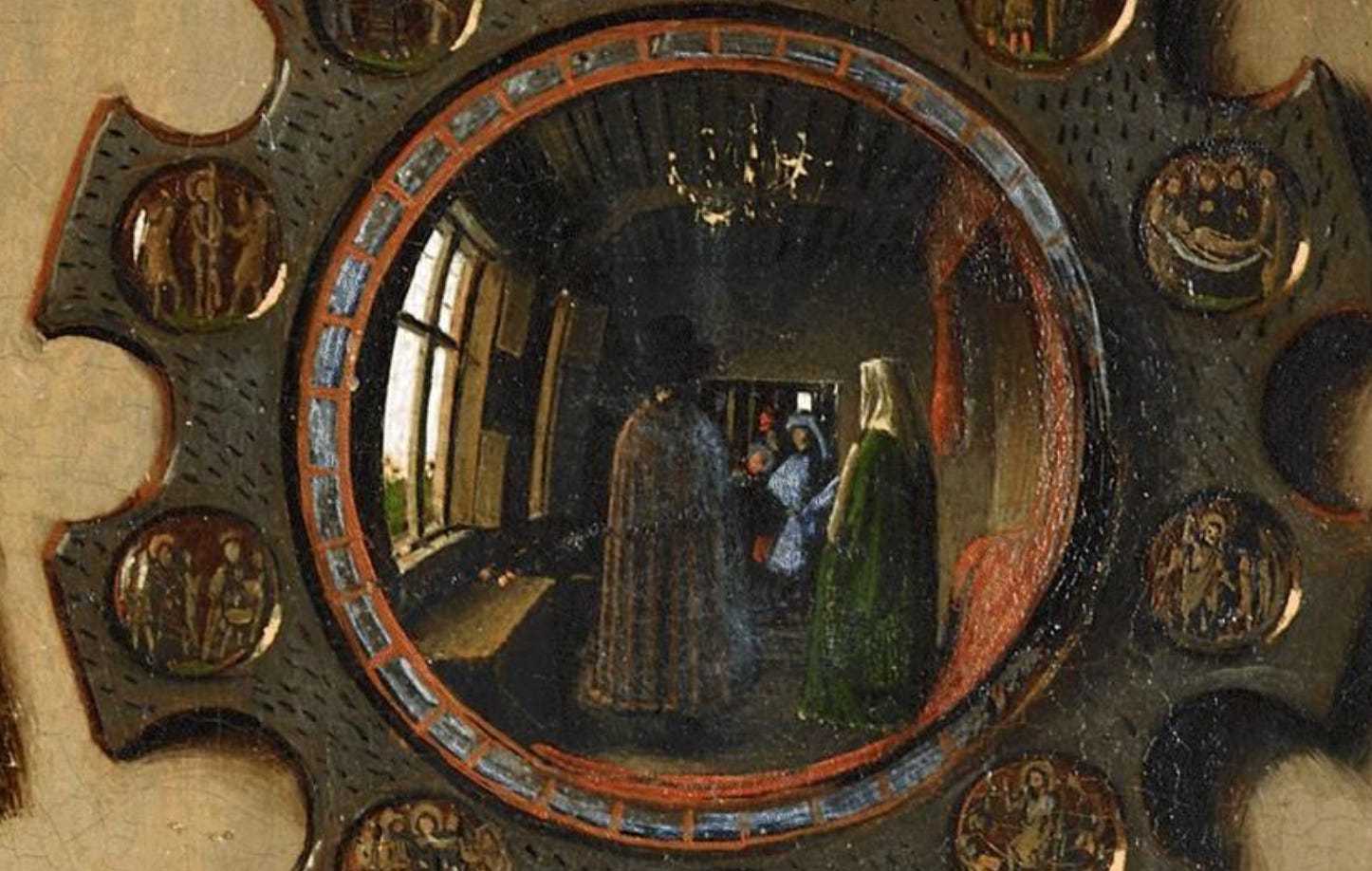
A few centuries later and the process had evolved to create flatter panes of glass, as recounted by the Italian natural philosopher Giambattista della Porta (1535–1615) describing Venetian glass-mirror manufacture in Magia Naturalis:
How Glass Looking-glasses are made,
I have seen it. They take the melted Glass out with an Iron; with their blast they
frame an empty Pillar; they open it on one side with their tongs, and whilst it is
red hot they lay it upon a plain plate of Iron, that is equally made; and they put it
into the furnace again, to make it softer; and that it may get the perfect plainness of
the iron plate, they leave it over the furnace to cool by degrees: When it is cool,
they do thusPolish plain Glasses.
They fasten it upon a plain Table with Gyp; underneath lyeth a most polite plain
plate of iron; they cast upon it the foresaid sand; they rub it with water by a stick,
leaning thereon, until it be perfectly plain; they take it from the Table, and glew
it on the other side, to polish them both: then they make them perspicuous, as I said
they did. Now will I shewTo terminate plain Glass Looking-glasses.
Glass or Crystal Looking-glasses, when they are made plain and equal, the Artist
makes a foil of the same bigness of Tin, that is level and thin, as perfectly as he can.
For if Crystal or Glass had no foil of Lead behind it, by its strength and thickness it
could never terminate our sight, nor stay the Image Printed upon it, but it would
let it slip away; for Glass is pure and transparent, and so would not contain it, by
reason of its brightness; and so the Image would vanish in it, as light in the Sun.
Wherefore upon this foil you shall wipe over with Quick-silver,6 by the means of a
Hares foot, that it may appear all as Silver: and when you see it fast on the superficies, you shall put it upon a fair white paper, and so upon the Glass; but first made clean with a linen clout, and polished: for if you handle it with your hands, the foil will not stick to it: with your left hand press down the Glass, and with the right take away the Paper, that the foil may cleave every where, and they bind fast together; laying a weight upon it for some hours, and so let it stand and stir it not.
In the 1690s glass-making technology advanced with the create of plate glass – molten glass was poured onto a metal table and flattened with a roller – there was no longer any need to cut up cylinders. The result panes still had to go through a significant amount of polishing to create and optically pure surface though. There were also problems of making mirrors by attaching sheets of mercury (usually combined with tin) to sheets of glass. As the passage above describes, the process was complicated and laborious. More significantly, it required the workers involved to handle a highly toxic element.
In 1835 the chemist Justus von Liebig (1803–1873) came up with an alternative. He figured out a way to deposit a thin film of silver onto glass instead, in a process which came to be known as chemical silvering. Thomas Drayton patented a method of making mirrors in this manner 1843, as described in Johann Beckmann's A History of Inventions, Discoveries, and Origins:
A patent for a very ingenious process for silvering glass was taken out in November 1843 by Mr. Drayton. It consists in depositing silver, from a solution, upon glass, by deoxidizing the oxide of silver in solution, so that the precipitate will adhere to the glass, without the latter having been coated with metallic or other substances. This is effected by mixing 1 oz. of coarsely powdered nitrate of silver with ½ oz. of spirits of hartshorn and 2 oz. of water; after standing for 24 hours, the mixture is filtered (the deposit on the filter, which contains silver, being preserved), and an addition is made thereto of 3 oz. of spirit (by preference, spirit of wine) at 60° above proof, or naphtha; from 20 to 30 drops of oil of cassia are then added, and after remaining for about 6 hours longer, the solution is ready for use.
The glass to be silvered must have a clean and polished surface; it is to be placed in a horizontal position, and a wall of putty formed around it, so that the solution may cover the surface of the glass to the depth of from ⅛th to ¼th of an inch. After the solution has been poured on the glass, from 6 to 12 drops of a mixture of oil of cloves and spirit of wine (in the proportion of 1 part by measure of the oil to 3 of spirit of wine) are dropped into it at different places; or the diluted oil of cloves may be mixed with the solution before it is poured upon the glass; the more oil of cloves used, the more rapid will be the deposition of the silver, but the patentee prefers that it should occupy about two hours. When the required deposit has been obtained, the solution is poured off; and as soon as the silver on the glass is perfectly dry, it is varnished with a composition, formed by melting together equal quantities of bees’ wax and tallow. The patentee states that, by experiment, he has ascertained that about 18 grs. of nitrate of silver are used for each square foot of glass.
Over the course of the second half of the 19th century such processes were further developed and industrialised, and as a result cheap, high-quality, mirrors became available to all. I am going to use one now because I think that I need to do something about my hair…
My hair is not normally quite that dishevelled; it was very windy outside. Also while my face isn’t that clear, had I been as close to the mirror as my fingers were the reflection would have been great.
Tin. Ish. It’s complicated.
It is quite possible that this was invented to slander Hostius Quadra; however, we do know that full-length mirrors were a thing at the time, so it is possible that this actually happened.
Okay, massive, imperial, sex-mirrors were almost certainly the preserve of the elite.
There is a lot of scholarly debate about whether or not he specifically meant that gold was used to back glass. I am going to cautious on this one.
Mercury.