
I have been fortunate enough to travel widely, both through work and for pleasure, and as a result I have stayed in hundreds of different hotels across around 80 countries – from the very humble1 to the really rather opulent.2 Until now it has never occurred to me when hotels as we know them came into being, or, indeed, what might have existed before them, so that is the history that I will be delving into today.
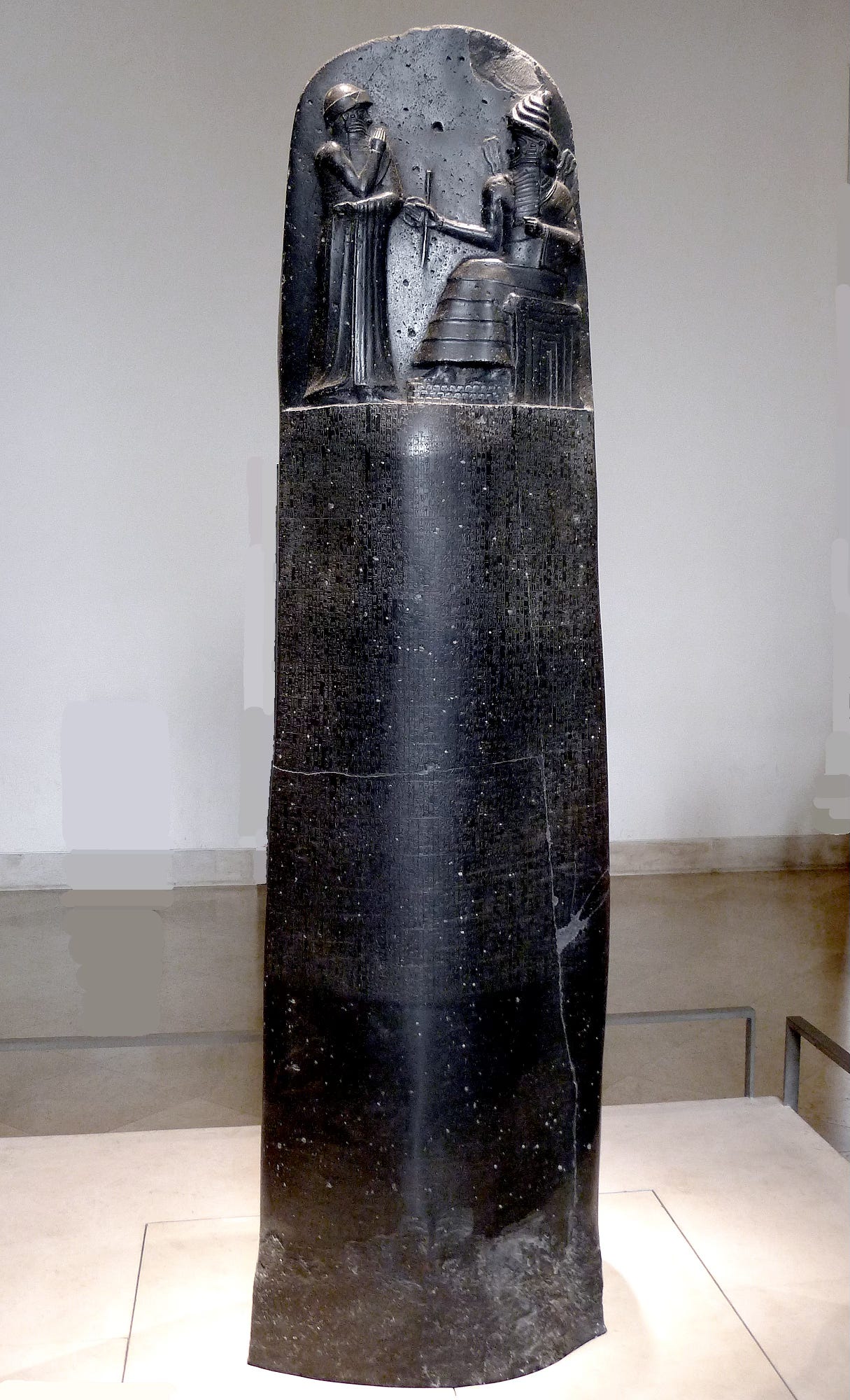
The earliest glimpses of paid lodging appear in ancient Mesopotamia’s written records. By the late Bronze Age, towns in Sumer and Babylonia hosted tavern-keepers (often female) who provided drink, food, and perhaps a cot for wayfaring strangers. These establishments straddled a fine line between freely given hospitality and commerce. The significance of taverns, and the extent to which they were clearly well-established can be seen from the fact that they are mentioned in a set of laws called Code of Hammurabi which dates from around 1750 BCE. One law ensures that customers (typically grain-traders for whom currency and product were one in the same) didn’t get ripped off:
If a woman wine merchant (tavern-keeper) does not accept grain according to gross weight in payment of drink, but takes money so that the price of the drink is less than that of the grain, she shall be convicted and drowned.
Another firmly puts the onus on the inn-keeper to ensure that people didn’t get up to mischief in her establishment:
If a wine merchant (tavern-keeper) has collected a riotous assembly in her house and has not seized those rioters and driven them to the palace, that wine merchant shall be put to death.3
And a third makes it clear that certain customers were just not allowed:
If a holy woman opens a tavern door or enters a tavern for a drink, she shall be burned to death.4

While there is little direct evidence of the amenities, the Code’s attention implies that these proto-inns were viewed as potential hotbeds of disorder as much as places of rest. It seems likely that the term for tavern was also used for venues that combined drink, the sex trade, and lodging. Travellers in Mesopotamia probably slept in the same room that the locals gathered to drink beer and wine in – a far cry from the private hotel rooms of today.
In pharaonic Egypt, formal inns as we know them were rare. Travel was common – along Nile canals, desert roads to mines, or overland routes for trade and pilgrimage – but lodging relied on a patchwork of hospitality and state provisioning. Egyptian sources don’t mention commercial inns, but they do speak of royal travel stations. The Greek historian Diodorus Siculus, writing in the 1st century BCE, describes an ancient relay system between Memphis and Thebes:
Yet twenty thousand chariots did in truth, we are told, pass out from it to war; for there were once scattered along the river from Memphis to the Thebes which is over against Libya one hundred post-stations, each one having accommodation for two hundred horses, whose foundations are pointed out even to this day.
If this account is accurate, pharaohs maintained way-stations with stables and lodgings for couriers and officials – essentially government inns. For the ordinary wayfarer, however, lodging depended on hospitality rather than payment. The concept of hospitality (hotep) was deeply ingrained; offering bread, beer, and shelter to a traveller earned religious merit.
Unlike their Near Eastern neighbors, the classical Greeks did not develop a robust system of inns in the Archaic and Classical periods. Instead, they exalted xenia, the sacred law of hospitality. To the Greeks, every stranger was potentially a guest sent by Zeus Xenios (Zeus the Hospitable). Paid lodging houses (pandocheia, “all-receiving places”) existed by the classical era, especially at seaports or along highways, but they had a dubious reputation. Far more esteemed was the ritual of guest-friendship. In Homer’s Odyssey, the code of hospitality is inviolable: even a ragged stranger must be bathed, fed, and given a bed before anyone asks his name. Odysseus reminds the Cyclops that:
Jove [Zeus] takes all respectable travellers under his protection, for he is the avenger of all suppliants and foreigners in distress5
Throughout the Greek world, people forged long-term guest-friendships (xenía), extending hospitality to each other’s family members across generations. A traveller from Athens bound for Syracuse, or from Corinth to Olympia, would carry letters of introduction to a proxenos or guest-friend who would host him for free. Such private hospitality networks reduced the need for commercial inns. Greek literature actually disdains innkeepers: they appear as innuendo in plays and fables, often as cheats or brothel-keepers. In one Greek proverb, “Trusting an innkeeper” was likened to trusting a thief. Nonetheless, by the 4th century BCE, the increase in travel (for festivals, athletic games, or commerce) led to more public inns. These were usually simple establishments – a tavern with a few spare rooms upstairs – where one paid a few obols to sleep on a mat. Still, many travellers preferred to sleep under a temple portico or in a wealthy acquaintance’s villa than to risk the unknown at a pandocheion.
The Romans, pragmatic as always, developed a dual system of lodging: one for official travellers and another for the public. Under the imperial cursus publicus (state post), a network of mansiones6 (posting inns) and mutationes (horse-changing stations) spanned the Roman roads at regular intervals (approximately every 15–20 Roman miles). These facilities were state-run and meant to expedite government business – couriers, magistrates, and imperial messengers had priority. According to Roman accounts, a mansio typically offered stabling for dozens of horses and mules, storage for wagons, and a few rooms or at least sheltered porticoes where an official could rest. Meals could be obtained and fresh mounts hired. The 4th-century Antonine Itinerary lists hundreds of such stations dotted across Gaul, Italy, Africa, and Asia Minor. Private citizens were technically not allowed to use these post-houses unless they carried an imperial warrant. Thus, everyday travellers relied on cauponae (inns or taverns) and tabernae diversoriae (lodging houses) for accommodation. The poet Horace gives us some fairly robust reviews of such establishments, recounting in his Satire 1.5, a journey along the Appian Way:
…to Forum Appi, then, crammed with bargemen and stingy innkeepers. We took this lazily in two days, though keener travellers than us take only one: the Appian’s easier taken slow! Here because of the lousy water my stomach declares war on me, and I wait impatiently while the others dine.
The marsh frogs and damned mosquitoes keep away sleep, while the boatman, drowned in sour wine, sings of the girl left behind and a traveller joins in.
Later, reaching Beneventum, he relates how at their lodging-house the overzealous host nearly burned the place down while roasting some less than impressive thrushes for supper:
Our industrious host nearly set himself on fire while roasting some scrawny thrushes… the flame went wandering through the old kitchen, then rushed to lick at the roof. You should have seen all the hungry guests and frightened slaves trying to grab the food and put out the fire.
Roman innkeepers were generally considered to be an untrustworthy bunch, which is probably why the law made them strictly liable for the safety of guests’ property. As one legal commentary explains, “the caupo is paid for permitting travellers to stay in his inn, and yet they are bound for the security of the property also”. If a traveller’s goods were stolen or damaged at an inn, the innkeeper could be sued even without proof of fault – a sign of how often such thefts must have occurred. Many Roman wayfarers preferred to avoid these caupona altogether. The wealthy or well-connected arranged hospitality through letters (much as the Greeks did). Cicero, for instance, rarely stayed at inns when touring his province; he lodged with local dignitaries or in the villas of friends. Still, for the average trader or pilgrim on the roads to Rome, inns were a necessary refuge – noisy, malodorous, and risky perhaps, but offering wine, stew, and a roof over one’s head for a few sesterces. By late antiquity, some larger cities had public inns (xenodochia) run by charities or municipalities, foreshadowing the hostels of the medieval period.
Whilst the Romans built roads and inns across Europe and the Near East, another hospitality network was flowering along the trade routes of South and Central Asia – one centred on Buddhist monasteries. In the centuries after the Buddha (5th century BCE), monasteries (viharas) multiplied in India. While meant for monks, these institutions embraced the ancient Indian custom of welcoming travellers of all sorts. Many Buddhist monastic complexes explicitly maintained guest houses for itinerant monks, pilgrims, and lay visitors. The monastic code (Vinaya) enjoined hospitality to strangers, and powerful patrons endowed monasteries with extra provisions “for the guest monks arriving from afar.” Over time, this evolved into a continent-wide web of free lodging for travellers motivated by religious duty rather than profit. One of the earliest state endorsements of this ideal comes from the Mauryan emperor Ashoka (3rd century BCE) who proclaimed in an edict:
Along roads I have had banyan trees planted so that they can give shade to animals and men, and I have had mango-groves planted and I have had wells dug and rest-houses built at every half kos.7
With the advent of the Islamic era (7th century onward), a new chapter in travel lodging unfolded across the Middle East, North Africa, and Central Asia. The rapid expansion of trade routes – from the Silk Road caravans carrying silk and spices, to the pilgrimage roads converging on Mecca – created an urgent need for safe, reliable inns at regular intervals. The Islamic solution was the caravanserai (from Persian karvansara, literally “caravan palace”), also known in Arabic as khān or funduq. These were large roadside inns designed specifically to host caravans, including merchants, pilgrims, and their pack animals. Early Muslim rulers, following precedents of Persians and Byzantines, began to sponsor the construction of these hostel-fortresses. Many stood on the ruins of earlier Roman mansiones or Sasanian caravan posts, now adapted to the needs of camel caravans. By the 10th century, the caravanserai network was a defining feature of travel in the Islamic world. Each caravanserai was typically a walled rectangular compound built around a spacious courtyard. The standard plan included a single sturdy portal (often an imposing arched gateway) through which loaded camels could enter. Inside, the courtyard allowed animals to be unloaded; around it ran an arcade with dozens of vaulted rooms for travellers to sleep in, usually raised on a platform above ground level (to prevent intruding animals or thieves). Most caravanserais featured a well or cistern for water, and latrines in a corner and many had a small mosque or prayer room as well.
The scale and architecture varied by region: Persian caravanserais along the Silk Road (such as the 11th-century Ribat-i Sharaf in Khorasan) were elaborate brick structures with four-iwan courtyards and even gardens. In the Syrian and Anatolian deserts, caravanserais (often called qāsur or castles) took on a more fortress-like appearance with solid bastions – reflecting the need to repel bandits. Despite differences, their purpose was uniform: to shelter travellers and their goods securely overnight. Crucially, many caravanserais were not run for profit but were endowed by rulers or philanthropists as pious charities. For instance, the Ummayad caliphs and later Seljuk sultans invested in caravanserais to promote commerce and earn divine favor by aiding wayfarers. One famous benefactor was Zubayda, wife of Caliph Harun al-Rashid, who around 800 CE built a string of inns and wells along the arduous Iraqi pilgrimage route to Mecca. According to Ibn Khallikan, “She established… rest stops and way stations along the route, as well as a number of water tanks.”
As the concept spread, different regions lent it local flavors. In the Persianate East (Iran, Central Asia), caravanserais often took ornate forms. The Safavid Persians (16th–17th centuries) built splendid caravanserais on the royal roads – high-walled inns with tiled mosaics and badgirs (windcatchers) to cool the guest rooms. Central Asian khans like those on the route between Bukhara and Samarkand sometimes included caravanserais within city gates that doubled as trading bazaars. Meanwhile, the Arab West and Maghreb developed the urban funduq (from Greek pandocheion). A funduq in a city like Fez or Cairo functioned as a combined warehouse and inn for foreign merchants. Typically a two-story khan in the suq (market), a funduq had storerooms on the ground floor for bales of goods and animals, and an upper gallery of small rooms where the merchants lodged. These were commercial enterprises, often administered by guilds or state officials, and they charged rent – but modest, and regulated
Even in Central Asia under the Mongols, the notion of spaced hostelries was maintained, as famously recorded by Marco Polo (1254–1324). He wrote that on the great highway of the Yuan Empire:
At every twenty-five miles… there is a posting station, called yām, with a spacious and palatial hostelry for lodging. These hostelries have splendid beds with silk coverlets… If a king came here, he would be well lodged. At each post, 400 horses are kept in readiness… And such posts are found along all the main highways of the Khan’s empire, each with three or four hundred horses and palatial lodgings.
Meanwhile in Japan, In the late 7th to 8th centuries, a network of roads was constructed across the country. Along these routes the government planted umaya (station stables), formal relay posts for officials on public business. The legal backbone came from the Taihō (701) and Yōrō (compiled 718; promulgated 757) codes; under this regime, posts were set at regular intervals — about every 30 ri (~16 km, 10 miles) — and stocked with five to twenty relay horses depending on a road’s grade. The posts offered stabling, fodder, duty staff, and simple quarters; their purpose was to keep state traffic moving, not to host private travellers. To gain access to the inns officials had to ring a bell, but not one at the post, rather one that they carried with them. Officials and couriers travelled with ekirei — bronze station bells issued by the centre or provincial offices as credentials. The bell’s notches governed how many horses one could requisition; on urgent dispatches the courier rode with the bell ringing, waking posts by sound alone.8
Outside the post roads, lodging relied upon institutions and kindness more than inns. Court-backed Buddhism in the Nara and early Heian eras fostered urban welfare houses and temple compounds that sometimes received travellers — especially monks, confraternities, and pilgrims. From this milieu grew shukubō (temple lodgings): guest halls inside temple precincts where religious visitors could sleep, eat simple fare, and join morning devotions.
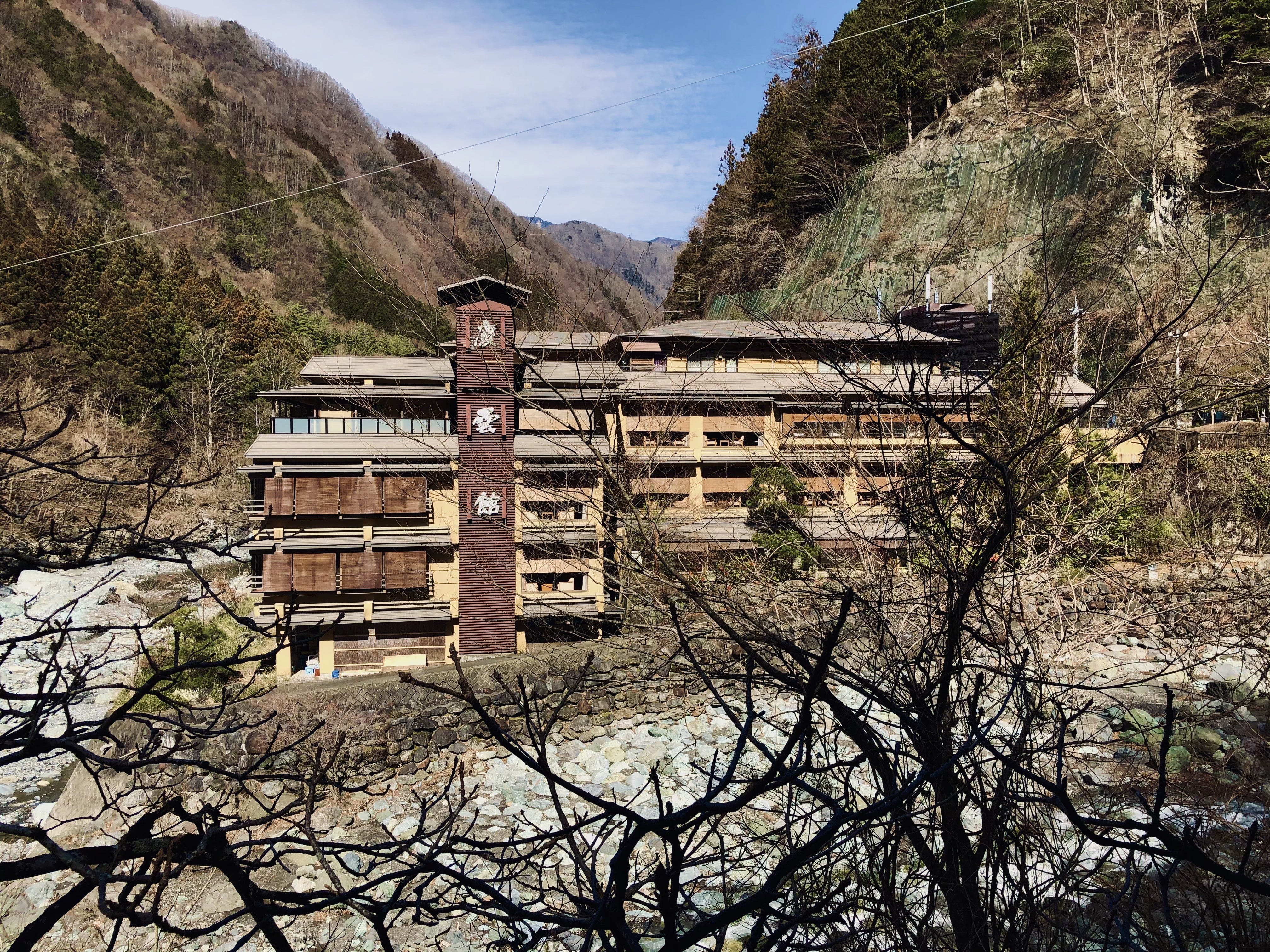
In my next piece I’ll expose the evolution of coaching inns and hotels proper, but I’ll end today talking about arguably the oldest functioning hotels in the world, also to be found in Japan. Thermal hot springs, onsen, around which inns, now called ryokan, err, sprang up. One of these, Nishiyama Onsen Keiunkan in today’s Yamanashi, traces its founding to the year 705 and is probably the oldest independent company in the world. It was run for an astonishing 1,300 years by 52 generations (including adopted heirs) of the same family until 2017 when no family members were willing to take it on and the general manager was selected as the new president.

Amongst the more humble was a place up in the Dieng plateau in Java, just a mattress on the floor, and water for washing had to come from the concrete mandi tank though one had to break the ice on the surface first if memory serves.
Probably the most opulent was The Savoy, in London, a 40th birthday treat.
Running a tavern back then had a much higher chance of being put to death than I was expecting.
This seems somewhat harsh…
Those of you familiar with what happens next will know that the Cyclops didn’t exactly adhere to this code of hospitality.
Yes, this is the origin of the word “mansion”.
This measures varies but is around 2 kilometres or 1.25 miles, which strikes me as being really very close together.
I imagine that this must have been very annoying.
On the higher note for a woman tavern-keeper, there is Kubaba, on the Sumerian king list, described as "the woman tavern-keeper, who made firm the foundations of Kiš."
I have known online discussions on this to revolve about the way they were more astounded that a tavern keeper could become king than a woman -- but perhaps they have reason to fear conspiracies in taverns.
How very fascinating! Such great research. Thanks for all the hard work that you do!