
In my previous piece I explored the spread of coffee across Europe, and how coffee shops played an important role in developing some aspects of modern society. What I perhaps didn’t make clear was the extent to which they did so while still being relatively niche establishments. By the 1680s there was only enough coffee in England to provide 25,000 people a dose of their daily Java (or to put it another way, sufficient for every adult in the country to drink just 2 cups per year). By the 1720s this number had more than tripled, but nonetheless the vast majority of people would simply never be tasting the stuff. It wasn’t until the mid 19th century that the industry had increased to the extent that there was enough coffee for everyone in the country to have a single cup a week (by way of comparison, today the Brits guzzle around ten cups per person per week on average). Tea was very much the beverage of choice, with the equivalent of a cuppa a day being drunk by the 1820s (and peaking in the 1950s with nearly five cups per person per day!)
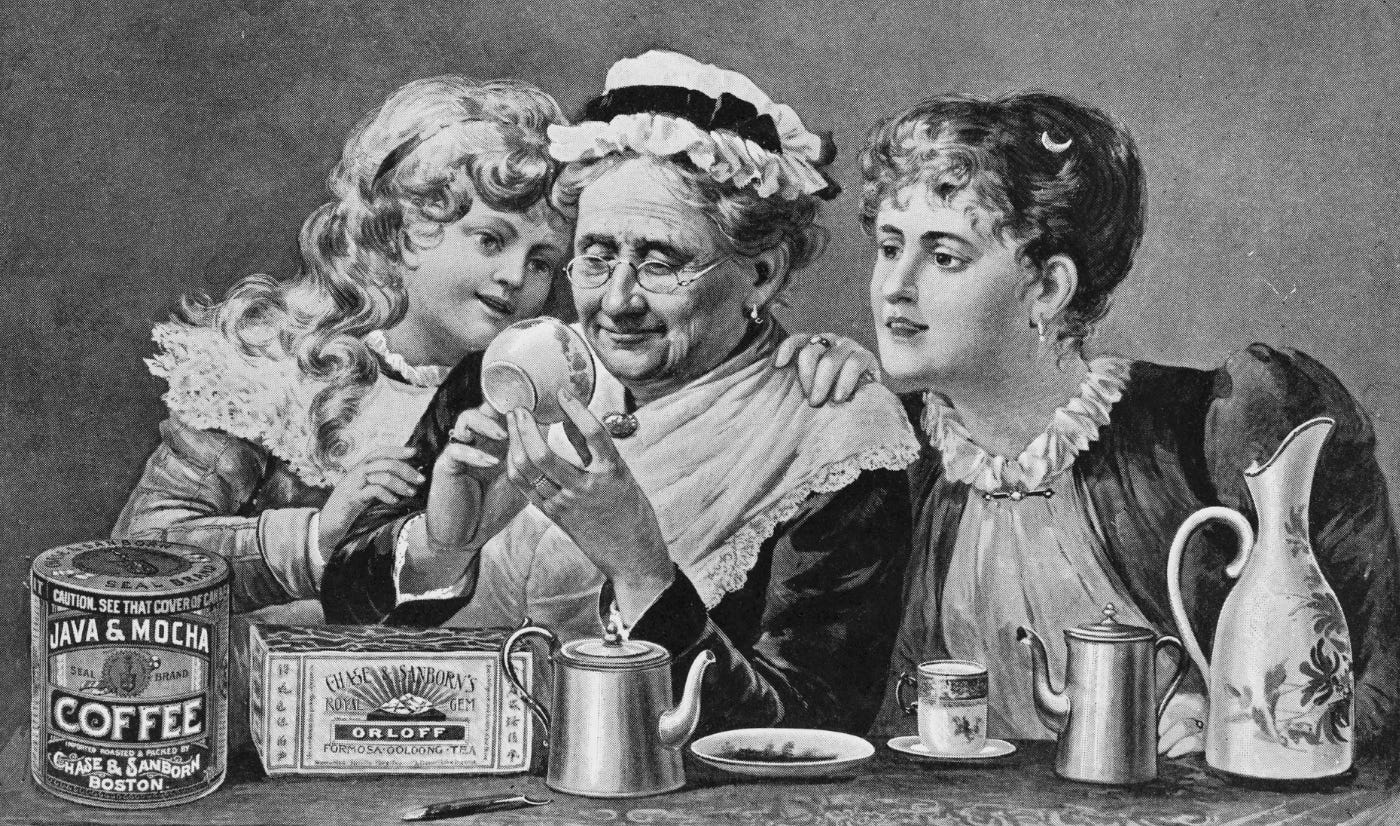
The barrier of access to coffee doesn’t seem to particularly have been price – in the late 17th century a cup would cost about the same as two pints of beer. In central London today that would be around £151 ($20) which is much higher than a cup of Joe from Starbucks, but beer was relatively a lot cheaper 350 years ago! The lack of coffee drinking was in part due to the limited supply of beans, and also because it wasn’t, unlike tea, a drink that people had the inclination or equipment to brew at home.
When coffee was made, it wasn’t in a manner that we would necessarily find appealing today, basically, boil up the grounds and drink it without milk and unsweetened, as per these approaches described in John Nott’s The cook's and confectioner’s dictionary, or, The accomplish’d housewife’s companion published in 1723:
171. To make Coffee.
TAKE running, or River-water, boil it, and put to a Quart, either one, two, or three Ounces of Coffee, as you like it, and let it boil only so long, as till the Coffee falls down.172. Another better way.
TAKE running, or River-water,2 put your Coffee in cold; mix it well with the Water, set them over the Fire, and let them warm, heat and scald, and boil together, till the Coffee sinks; then take it off, let it settle, and drink it.173. Another the best way.3
WHEN you have drank off a Pot of Coffee, put into the Pot to the Grounds, as much Water, as you design to make the next time, and boil them together; then take the Pot off the Fire; and let it stand to settle a quarter of an Hour; then pour off the clear Liquor, cast away the Grounds, wash the Coffee-Pot, then put in the Coffee you would make next time, pour the Liquor in scalding hot, and let them stand to infuse, till you use it; then set it on the Fire, let them warm and heat leisurely, till it boils, till all the Coffee is well boil’d down, then let it settle and drink it.
The coffee this produced was often not great. If boiled too much it would become bitter, and even after allowing it to settle one could get a load of gritty grains in one’s cup. Often egg white or isinglass was added in order to clarify the drink (though I doubt that this improved the taste). A better approach was advocated by Humphrey Broadbent year earlier in The Domestick Coffee Man:
Put the quantity of powder you intend, into your pot (which should be either of stone, or silver, being much better than tin or copper, which takes from it much of its flavour and goodness) then pour boiling-hot water upon the aforesaid powder, and let it stand to infuse five minutes before the fire. This is an excellent way, and far exceeds the common one of boiling, but whether you prepare it by boiling or this way, it will sometimes remain thick and troubled, after it is made, except you pour in a spoonful or two of cold water, which immediately precipitates the more heavy parts at the bottom, and makes it clear enough for drinking.
Some, make coffee with spring water, but it is not so good as river, or Thames-water,4 because the former makes it hard, and distasteful, and the other makes it smooth and pleasant, lying soft on the stomach. If you have a desire to make good coffee in your families, I cannot conceive how you can put less than two ounces of powder to a quart, or one ounce to a pint of water; some put two ounces and a quarter.
In France, however, a decade earlier, a more superior beverage, filtered coffee, was being produced. The grounds were put into a fustian (cloth) bag and boiling water was then poured over the top. This approach, which became popular in France, but never really spread to America or Britain, was not without its own problems. The cloth fabric of the bag would absorb the oils from the coffee and, over time, become greasy and hard to clean. And cleaning was an issue – leave it damp and it could go mouldy, dry it out too much and the coffee oils could go stale and impart a nasty taste – so often the solution was to keep the cleaned bag immersed in water, which sounds like a bit of a faff. Finally, no matter how much care one takes with one’s bag, the rate of flow of fluid through it, and hence the intensity of the coffee, would inevitably change over usage and time.
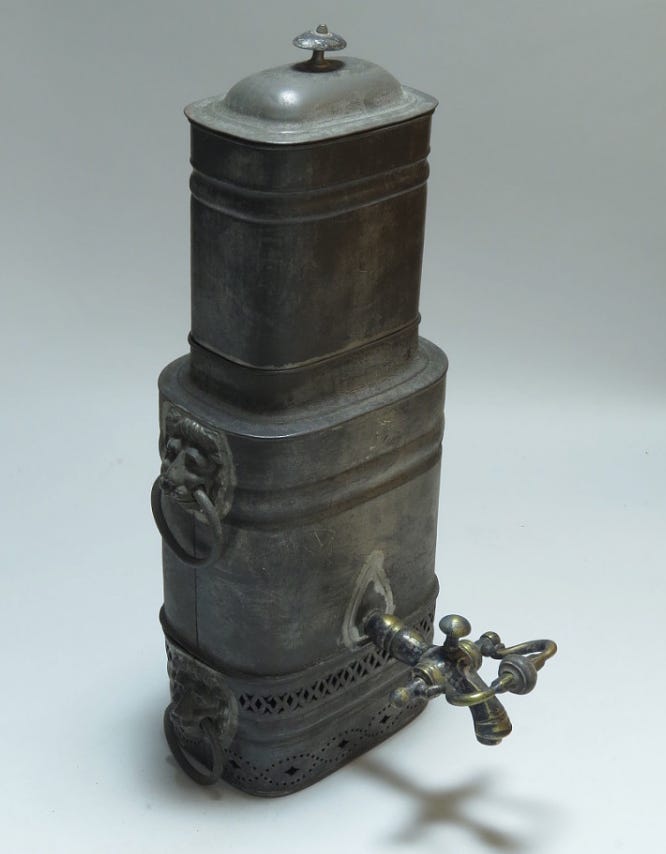
Towards the end of the 18th century, again in France, we see the next major advance in coffee making. This was a pot, initially made of tin, but later of porcelain, which consisted of two chambers, one above the other. At the join between them sat the coffee chamber: a perforated metal or porcelain grid, sometimes with a second pierced plate or ‘rammer’ above it. Ground coffee was placed on or between the perforated surfaces; hot water was poured into the upper vessel; the water passed slowly through the coffee bed and collected in the lower vessel. These were known as ‘De Belloy’ (or ‘Du Belloy’) pots taking their name from Jean-Baptiste de Belloy de Morangles, Archbishop of Paris and later cardinal. It seems unlikely that he actually invented them, it seems more likely that this honour lay with François-Antoine-Henri Descroizilles, a Rouen chemist and pharmacist, and that De Belloy or someone in his circle popularised the device in Paris. Whatever the precise origin, they were hugely popular, and highly regarded, as Jean Anthelme Brillat-Savarin (1755–1826) detailed in The Physiology of Taste:
A few years ago, everyone’s attention turned simultaneously to the best way to make coffee—a trend that stemmed, almost without anyone realizing it, from the fact that the head of government consumed a great deal of it.
Suggestions abounded: brewing it without burning the grounds or grinding them to dust, cold-brewing it,5 boiling it for forty-five minutes, using a pressure cooker, and so on.
Over time, I experimented with all these methods—as well as those proposed since—and, based on experience, settled on the Dubelloy method. This involves pouring boiling water over coffee placed in a porcelain or silver vessel perforated with tiny holes. You take this initial infusion, heat it to a boil, pour it through again, and the result is coffee that is as clear and delicious as possible.6
Among other experiments, I tried making coffee in a high-pressure kettle; the result was a brew heavy with extractive matter and bitterness—fit, at best, to scour a Cossack’s throat.
Savarin goes on to comment upon something I am all-too familiar with, the impact of the drink upon insomnia:
Doctors have expressed various opinions regarding the health properties of coffee and have not always agreed with one another; we shall steer clear of this debate to focus on the most important aspect: its influence on the organs of thought.
There is no doubt that coffee powerfully stimulates the brain’s faculties; indeed, anyone drinking it for the first time is certain to lose some sleep.
Sometimes this effect is mitigated or altered by habituation; yet there are many individuals for whom this stimulation persists, and who are consequently forced to give up coffee entirely.
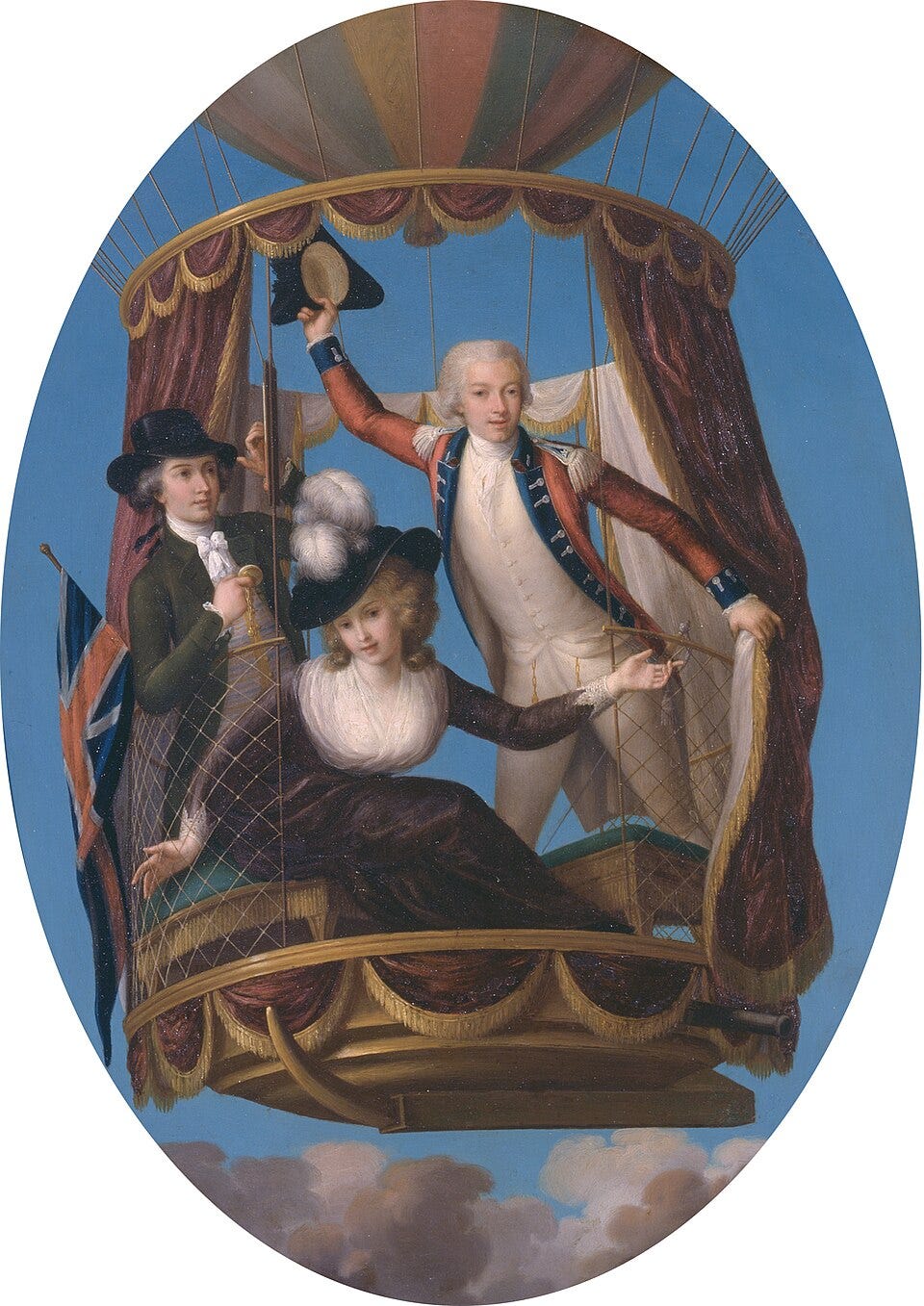
Similar devices soon became popular in Britain, though they could both use a metal/porcelain filter or, as became more commonly the case, a cloth bag suspended in the top chamber. They revelled in the name ‘Biggins’, seemingly named after one George Biggin (died 1803) and inventor and scientist who, among other adventures, flew in one of Vincenzo Lunardi’s balloons on the 29th of June 1785. This flight is notable because the aeronaut alongside Biggin was Letitia Ann Sage, the first British woman to fly! Oh, and also because they had to be rescued from an angry farmer by a group of Harrow schoolboys upon landing.7
Biggins did a pretty decent job of making coffee, and remained in use for more than century, but in some places the old 17th-century approach to making coffee still persisted. In the USA, even in the mid-19th century, we find coffee being boiled up, as per the recipe in in a cookbook from 1840:
Allow half a pint of ground coffee to three pints of water. If the coffee is not freshly roasted, you should put in more. Put the water into the tin coffee-pot, and set it on hot coals; when it boils, put in the coffee, a spoonful at a time, (stirring it between each spoonful,) and add two or three chips of isinglass, or the white of an egg. Stir it frequently, till it has risen up to the top in boiling; then set it a little farther from the fire, and boil it gently for ten minutes, or a quarter of an hour; after which pour in a tea-cup of cold water, and put it in the corner to settle for ten minutes. Scald your silver or china pot, and transfer the coffee to it; carefully pouring it off from the grounds, so as not to disturb them.
It would seem that some Americans preferred this type of boiled coffee over the more refined European methods of production, most notably Mark Twain, who was very snitty about the continental drink in his 1880 book A Tramp Aboard:
To particularize: the average American’s simplest and commonest form of breakfast consists of coffee and beefsteak; well, in Europe, coffee is an unknown beverage. You can get what the European hotel-keeper thinks is coffee, but it resembles the real thing as hypocrisy resembles holiness. It is a feeble, characterless, uninspiring sort of stuff, and almost as undrinkable as if it had been made in an American hotel.8 The milk used for it is what the French call “Christian” milk—milk which has been baptized.9
After a few months’ acquaintance with European “coffee,” one’s mind weakens, and his faith with it, and he begins to wonder if the rich beverage of home, with its clotted layer of yellow cream on top of it, is not a mere dream, after all, and a thing which never existed.
Next comes the European bread—fair enough, good enough, after a fashion, but cold; cold and tough, and unsympathetic;10 and never any change, never any variety—always the same tiresome thing.
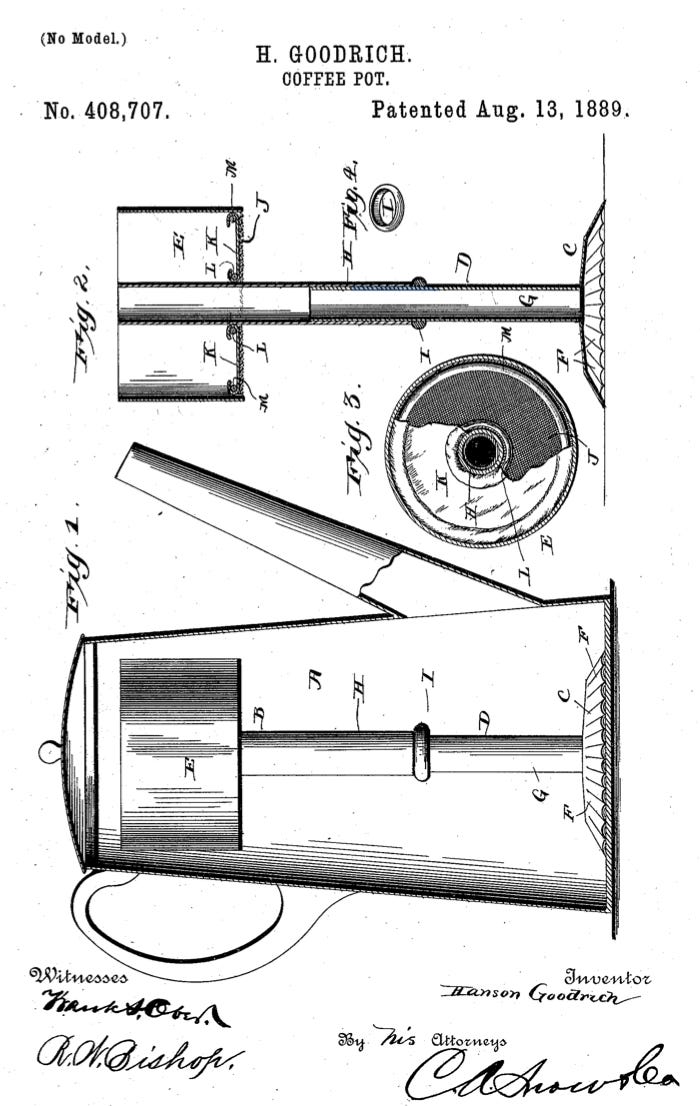
The next technical innovation occurred in 1819, when the Paris tinsmith Joseph-Henry-Marie Laurens produced a coffee-making device in which boiling water was raised through a tube and delivered over the coffee, this invention the first coffee peculator. Multiple variations of these pots were in use across the 19th century but their use really took off in the USA with the version patented by Hanson Goodrich 1889 – a pot that could sit on a stove have and have the coffee recirculated:11
Before I get into the developments which led to the machines that we find in the coffee shops that we visit today, a quick digression about the adding of milk to the drink. As mentioned earlier, initially coffee was drunk black, and unsweetened though some experiments with adding milk took place surprisingly early:
About 1660, Nieuhoff, the Dutch ambassador to China, was the first to make a trial of coffee with milk in imitation of tea with milk. In 1685, Sieur Monin, a celebrated doctor of Grenoble, France, first recommended café au lait as a medicine. He prepared it thus: Place on the fire a bowl of milk. When it begins to rise, throw in to it a bowl of powdered coffee, a bowl of moist sugar, and let it boil for some time.
By the mid-18th century, café au lait (coffee with milk) had become commonplace in France, particularly as a breakfast drink, as Pierre Jean-Baptiste Le Grand d’Aussy recounts in his Histoire de la vie privée des Français, depuis l’origine de la nation jusqu’à nos jours (1782):
There is no middle-class home where coffee is not offered at dinner. No shop girl, cook, or chambermaid who does not have coffee with milk for breakfast. This taste, believe it or not, has even reached the lowest classes of the common people.12
Arguably the most famous coffee-with-milk drink, the cappuccino has a history that is perhaps older than one may expect, and it certainly long predates the modern version of the drink. The Viennese Kapuziner arose in the 18th century as a dark cup of coffee with cream added to it (and later sugar and spices). It takes its name from the cappuccio, the hood worn by Capuchin friars as, once mixed, it shared the same brown colour.13 For the drink to become the one globally loved today the final major development in coffee technology had to take place, the invention of high-pressure coffee-making which created the espresso.
The Italian coffeemaker Illy describes that acme of the drink as being created in the following manner:
A jet of hot water at 88°-93°C (190°-200°F) passes under a pressure of nine or more atmospheres through a seven-gram (.25 oz) cake-like layer of ground and tamped coffee. Done right, the result is a concentrate of not more than 30 ml (one oz) of pure sensorial pleasure.
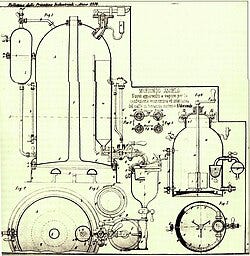
The original version of this brew was, however, a little different from this. In 1884 one Angelo Moriondo of Turin patented a machine for the “economic and instantaneous” preparation of coffee. This wasn’t the counter-top device you will be familiar with today, rather it was a large boiler at a pressure of about 1.5 bars that first pushed water through the coffee grounds, before a secondary boiler drove steam through it to finish the job. It produced coffee en-masse for the Turin Expo. It seems to have been a success, but it never really caught on as Moriondo only built a couple of the machines, and they were used solely in establishments that he owned – he basically thought that they were so good, that they would bring customers flooding in.
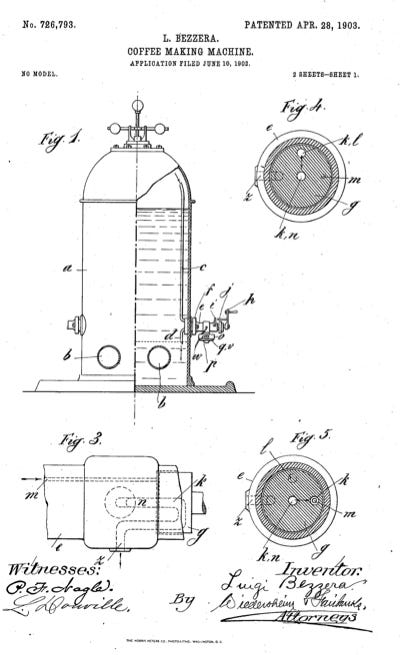
Next up we have Luigi Bezzera of Milan who, in 1902, created essentially the first modern expresso machine. It would produce individual cups on demand and had the portafilter,14 the little bucket-type thing that the coffee grounds sit in. Again though the pressure in this device was low by modern standards, 1.5-2.0 bars.
It wasn’t until 1938, with Achille Gaggia that we finally got expresso with crema, the foam that sits atop a good expresso. He invented a machine that used hot water, rather than steam, pressure which could achieve 9 bars, and the company that bears his name manufactures coffeemakers to this day. There is more I could add to this history, the invention of instant coffee, the debate over who really invented the flat white, and so on but I fear continuing much further would try your patience. And beside, I could really do with a cup of coffee right now…
That might be being a bit optimistic, I have been charged £10 a pint in a few places recently…
I have views about making coffee from river water – see later.
Why not just give us “the best way”?
The notion of drinking coffee made from water taken directly from the River Thames (which is about fifty yards away from me as I type these words, and a few mouthfuls of which I have swallowed while swimming) today frankly turns my stomach. The idea of using water from it in the early 18th century is simply disgusting.
Yup! Cold-brewed coffee isn’t a 21st century invention, it has been around for hundreds of years.
He is advocating here for a double-brewing approach, which obviously could also be done.
During the flight they ate chicken and ham, and drank a bottle of Florence wine and, err, threw the empty over the side…
I find it very hard to believe that Twain was unable to get a decent cup of coffee in France, or Germany, or Austria, or Italy.
He means milk that has had water added to it, and hence diluted.
Come on, dissing French and Italian bread now! (And also, lest I incite the ire of my German friends who have very strong views about the quality of their bread, German bread too!)
And also a version that could be retrofitted into an existing coffee pot.
Heavens! Even common people were drinking coffee!
Yes, capuchin monkeys are so named for the same reason.
No, I didn’t know it was called that either.
Excellent. Thank you.
Lol! I'm craving a cup now, too! Such a wonderful piece about how coffee came upon the scene and came to dominate the social milieu. I especially enjoyed how you integrated the primary source material. Thank you!