
I don’t follow sports.1 Some ten hours after I started typing these words England will be playing Norway in the World Cup quarter final but I won’t be watching, I simply have no interest in it, or rather no emotional engagement with it.2 To be clear, I don’t think that this means my interests are in any way loftier or better than those who follow football, they are simply different. I grew up in a house where sports were never watched, my father never kicked a football with me, and I was terrible at the sports I was forced to do at school. In many ways I think this leaves me with something of a social handicap – sport can often provide a common currency of conversation between two strangers, even if they support different teams.3 And if they do support the same team then there is an instant bond between them. On the other hand, given my somewhat monomaniacal mind, were I interested in sports I fear that I would have far less time to devote to reading 17th-century Spanish accounts of avocados. But then again, I am far less likely to find someone down the pub up for chatting about those…
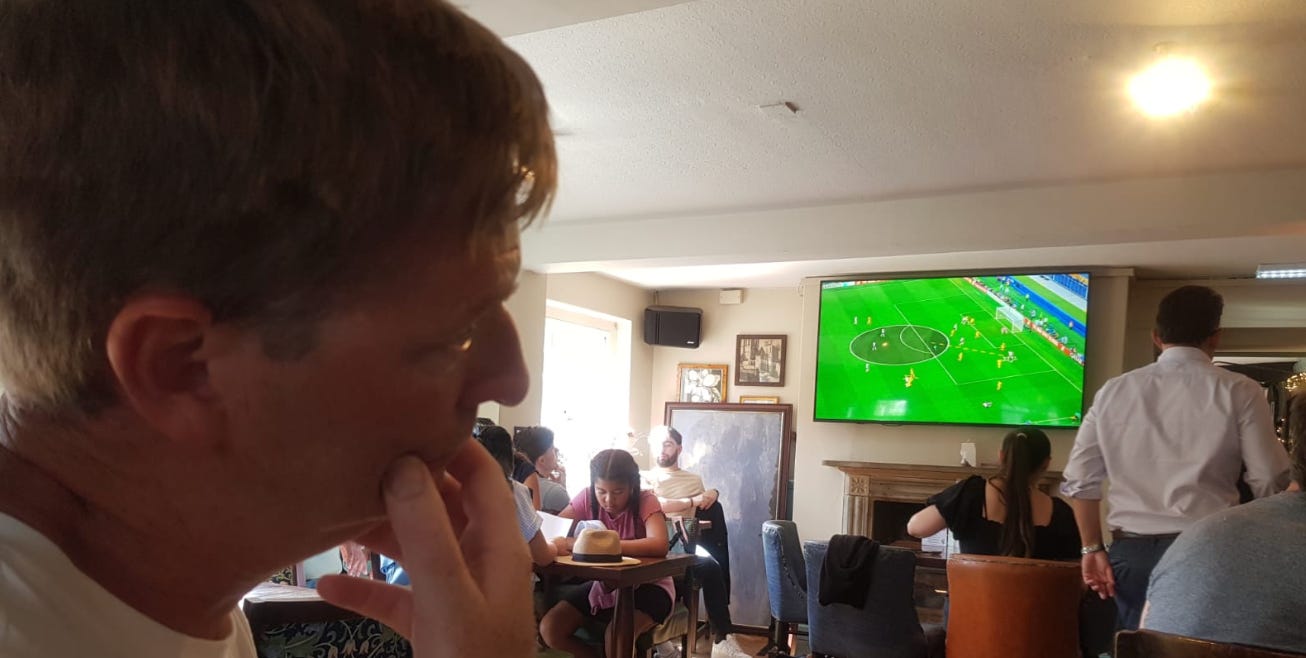
A week or so ago I overcame my disinterest to join my friend Craig down the pub to watch an England World Cup match,4 perhaps only the second5 football game I have watched in its entirety in my 53-odd years, and that inspired me to dig into the history of the sport a bit.
I should start by talking a bit about the name of the game, as I know that it is a point of some contention between nationalities. American readers will doubtless refer to it as “soccer” only to be lambasted by the residents of other countries with words along the lines of “It’s football! You are the only country who thinks that name refers to American football!”. The reality is that the global competition taking place this year is “association football”, there are many other similarly-named sports, such as “rugby football”. It may shock some of you to learn that not only is soccer a valid name for the game, it may actually be more appropriate than the more generic “football”!
In the 19th century British public school boys had a tendency to abbreviate words and add “er” to the ends of them. So rugby became “rugger” and breakfast became “brekkers” – a tradition that continues to this day, most notably with the nicknames of English cricket players.6 Association football was initially shortened to “assoc”, which soon became “soccer”. The earliest reference to it in print comes from a letter from a pupil published in the 25 November 1885 issue of The Marlburian (the magazine of Marlborough College):
I can’t help thinking it a great pity that there has been no ‘Association’ on the Common this term. It must improve the forward play and is certainly a pleasant change occasionally from everlasting Rugby.
Rather than signing it with his own name, the letter was said to have come from “soccer”. Within days, the spelling “Socker” appeared in magazines connected with Radley College and Old Hall School, suggesting that the term was already well known and circulating orally among schoolboys. So please don’t hate on our American friends for using the word (for ease, in the rest of this piece I will use the word “football” to mean “association football”).
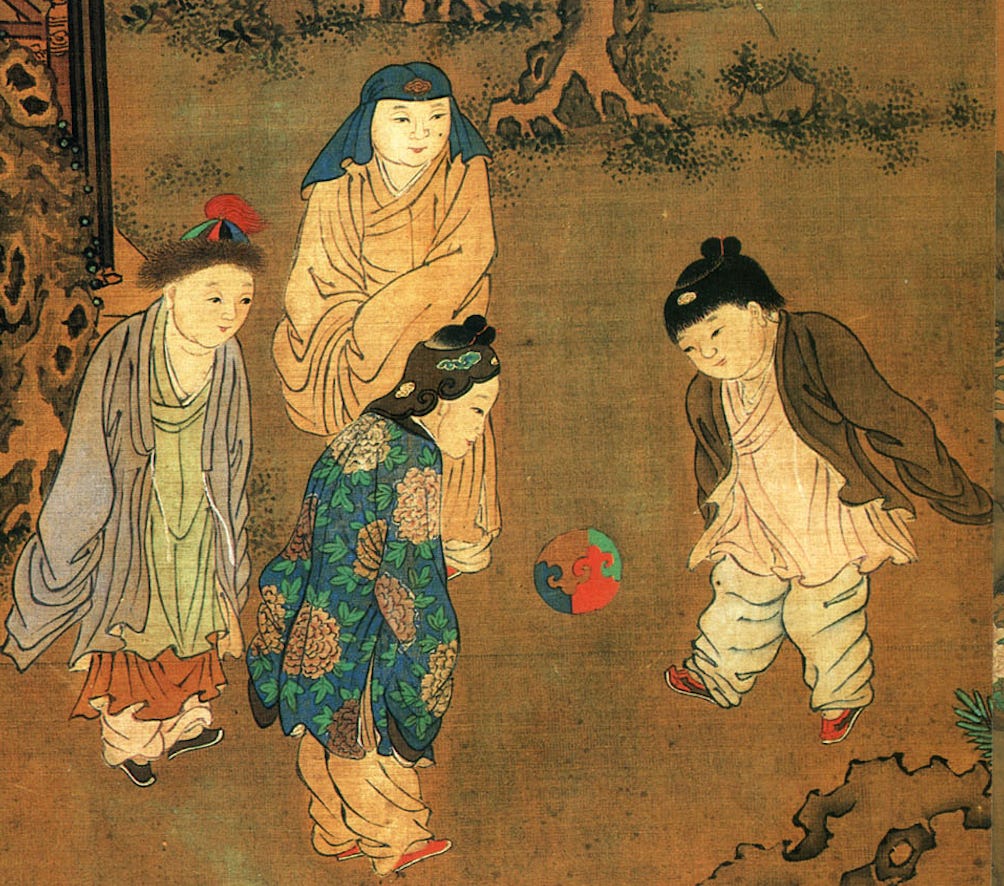
Back to the origins of the game itself. Humans have been kicking and throwing balls around with varying degrees of organisation for pretty much as long as the objects have existed. After all, what is the point of a ball is not to play with it? In ancient China there was the game Cuju (or ts‘u-chü) in which players from opposing teams attempted to kick a ball through an opening and into a hoop without using their hands, and also without it touching the ground. In this sense it was rather more akin to hacky sack than modern football. Not only was it popular as a means of recreation, it was also used as a training tool by the military, and it is in this context that we have the earliest reference to it, dating from around 300 BCE in the Zhan Guo Ce (《戰國策》, Strategies of the Warring States), there is a speech attributed to the diplomat Su Qin addressing King Xuan of Qi:
臨淄甚富而實,其民無不吹竽、鼓瑟、擊筑、彈琴、鬥雞、走犬、六博、蹹踘者。
Linzi is exceedingly prosperous and well supplied; among its people there are none who do not play the yu pipes, sound the se, strike the zhu, play the qin, fight cocks, race dogs, play liubo, or kick the ball.
And there is a nearly identical7 passage appears in Sima Qian’s Shiji (Records of the Grand Historian), composed in the early first century BCE:
Linzi was very wealthy and full. Its people were all playing the yu flute and the se, plucking the qin and striking the zhu, fighting cocks and racing dogs, playing liubo and kicking the ball. In Linzi’s roads, carriage hubs struck one another, shoulders rubbed together; joined robes made curtains, raised sleeves made canopies, and flung sweat fell like rain. The households were rich, the people sufficient, their wills high and their spirits proud.
We have an even earlier description of people playing with a ball in Homer’s Odyssey (c. 700 BCE):
Then when they had had their joy of food, she and her handmaids, they threw off their head-gear and fell to playing at ball, and white-armed Nausicaa was leader in the song…The princess tossed the ball to one of the handmaids; the maid she missed, and cast it into the deep eddy, whereat they shouted aloud; and goodly Odysseus awoke.
Then there is another Greek description of a more formal type of ball play from Athenaeus, in the Deipnosophists (c. 200 CE) He tells us that the game known in his day as harpastum (also harpaston) had earlier been called phaininda:
The ball-game now called harpastum was formerly called phaininda, which is the kind I like best of all. Great are the exertion and fatigue attendant upon contests of ball-playing, and violent twisting and turning of the neck.
We don’t the specifics of this game but it appears to have involved things akin to the feinting and passing of the modern game as he goes on share a much earlier description by Antiphanes, a comic poet of the fourth century BCE:
He seized the ball and passed it with a laugh to one player, while he dodged another; he pushed it out of the way of a third, and raised another to his feet amid resounding cries of “Out,” “Too far,” “Right beside him,” “Over his head,” “On the ground,” “Up in the air,” “Too short,” and “Pass it back.”
This game was, however, much more like rugby than football. The name harpaston comes from the verb ἁρπάζειν (harpazein), “to seize”, “snatch” or “carry off”, so one could think of it as meaning “the snatched ball” or “the snatching game.” The ball is likely to have been relatively small, the easier to throw and catch, possibly leather stuffed with feathers, or a bladder of some sort. We have a nice description of play during Roman times from the a letter written by Sidonius Apollinaris (c. 430 - 481/490) in the 5th century CE:
We soon split into two groups, according to our ages: one shouted for the ball, the other for the board-game, both of which were to be had. I was the leader of the ball-players; you know that book and ball are my twin companions. In the other group, the chief figure was our brother Domnicius, that most engaging and attractive of men: there he was, rattling some dice which he had got hold of, as if he sounded a trumpet-call to play. The rest of us had a great game with a party of students, doing our best at the healthful exercise with limbs which sedentary occupations made much too stiff for running. And now the illustrious Filimatius sturdily flung himself into the squadrons of the players, like Virgil’s hero ‘daring to set his hand to the task of youth’; he had been a splendid player himself in his younger years. But over and over again he was forced from his position among the stationary players by the shock of some runner from the middle, and driven into the midfield where the ball flew past him, or was thrown over his head; and he failed to intercept or parry it. More than once he fell prone, and had to pick himself up from such collapses as best he could; naturally he was the first to withdraw from the stress of the game in a state of internal inflammation, out of breath from exercise and suffering sharp pains in the side from the swollen fibres of his liver.8
It is in Europe of the middle ages that we see a much more football-sized balls being used, but again the games that were played with them were very different from our modern understanding of the game, and furthermore there were a number of different versions of them. The earliest reference we have to a ball being used as play-thing in Britain can be found in Bede’s De temporum ratione (The Reckoning of Time), completed in 725:
The Earth is truly situated in the midst of the whole universe, not merely circular in breadth like a shield, but rather like a ball, equally rounded in every direction; and in so great a mass, even the enormous differences between mountains and valleys add or subtract no more than a finger’s breadth does from a playing-ball
And a century later, in Nennius’s Historia Brittonum (compiled 829-830) we get the first mention of people actually playing with one:
And, on the advice of his magicians, he sent messengers throughout all Britain to see whether they could find a child without a father. And, after travelling through all the provinces and very many regions, they came to the Field of Elletus, which is in the region called Gleguissing, and some boys were playing a ball game.
By the 12th century ball games were widespread in Britain, and particularly played on Shroventide (Shrove Tuesday) as recorded by William Fitzstephen in his Descriptio Nobilissimi Civitatis Londoniae (c. 1174 – 1183):
After lunch, all the youth of the city go out into the fields to take part in a ball game. The students of each school have their own ball; the workers from each city craft are also carrying their balls. Older citizens, fathers, and wealthy citizens come on horseback to watch their juniors competing, and to relive their own youth vicariously: you can see their inner passions aroused as they watch the action and get caught up in the fun being had by the carefree adolescents.
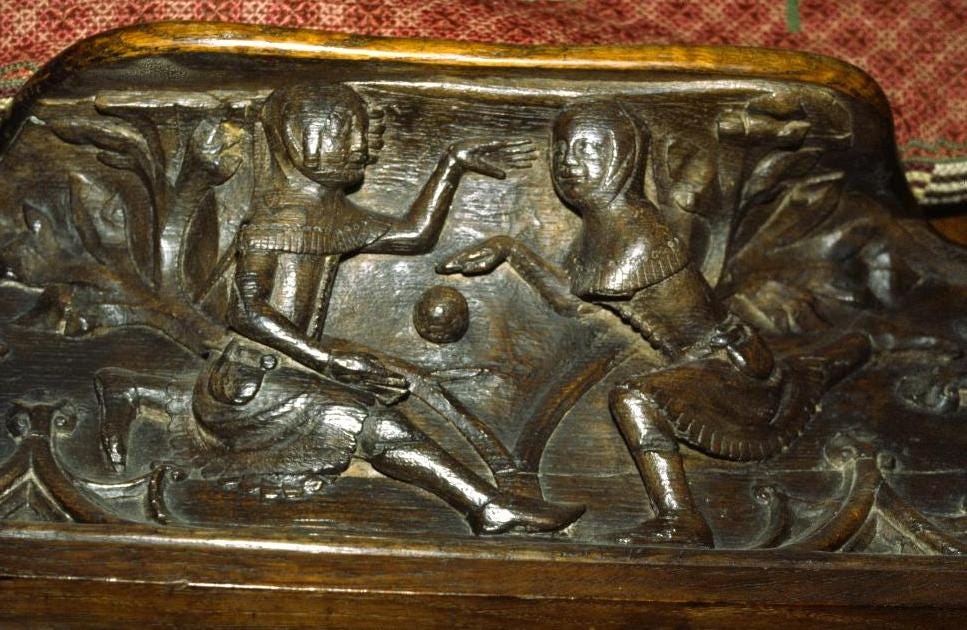
Were these kids throwing the ball to one another like the Romans a thousand or so years earlier? It is hard to be certain, but it seems more likely that they were kicking it around. The earliest robust source for football being a game played, with, well, the feet, comes from a papal dispensation dating from May 1321. It was for Canon William de Spalding from Shouldham in Norfolk, absolving him of blame when one of his mates ran into him during a match and, err, stabbed himself to death in the process:
To William de Spalding, canon of Scoldham [Shouldham] of the order of Sempringham. During the game at ball, as he kicked the ball, a lay friend of his, also called William, ran against him and wounded himself on a sheathed knife9 carried by the canon, so severely that he died within six days. Dispensation is granted, as no blame is attached to William de Spalding, who, feeling deeply the death of his friend, and fearing what might be said by his enemies, has applied to the pope.

Pretty much as soon as the nation became football crazy, steps were taken to ban the beautiful game. Those carefree adolescents spilling out across the streets of London made a hell of a racket, so local merchants persuaded King Edward II to ban the sport in the city on 13th April 1314:
…there is great noise in the city caused by hustling over large balls from which many evils may arise which God forbid; we command and forbid, on behalf of the King, on pain of imprisonment, such game to be used in the city in the future.
Edward III10 issued a broader ban in a proclamation on the 12th June 1365, but his had a more serious intent behind it – people were playing football when they should have been practising their archery:
We, wishing to provide an appropriate remedy for this, order you that in all places in your shire, as well within liberties as without, where you shall deem it expedient, you shall cause to be proclaimed that everyone in the shire, on festival days when he has holiday, shall learn and exercise himself in the art of archery, and use for his games bows and arrows, or crossbows or bolts; forbidding all and every one, on our command, to meddle in any way with throwing stones, wood or iron, handball, football, hockey, cock-fighting, or any other such idle games, under pain of imprisonment.
Not wanting to be left out, King James I of Scotland banned the game as well with his Football Act of 1424:
it is statut and the king forbiddis that na man play at the fut ball under the payne of iiij d. to the lorde of the lande als oft as he beis taintit (be the scheref of the land or his ministeris, gif the lordis will nocht punnysh sic trespassouris).
(It is decreed and the king forbids that any man play football under the pain of 4 d. to the lord of the land as often as he is convicted (by the sheriff of the land or his ministers, if the lords will not punish such trespassers))
Perhaps the most famous version of the game played around these times was mob football (also know as folk football). The rules, such as they were, were pretty simple. Two teams of unlimited players had to get an inflated pig’s bladder (or ball) to their team’s marker. These could be at either end of the town, or, when played between two villages, suitably far apart from each other on neutral territory. You could do so by any means necessary, short of murder, and unsurprisingly these games could get very violent indeed.
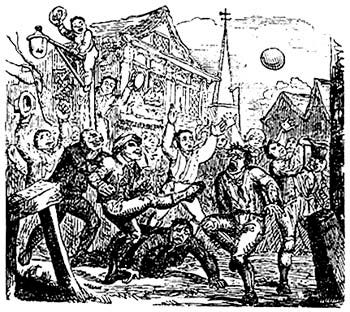
A version of this which continues to this day is the Atherstone Ball Game which claims to have been played pretty much continuously, every Shrove Tuesday, since 1199. The reality is that it is hard to substantiate the origin anything like that far back; nonetheless, their rules are fun:
Stay on Long Street
Don’t kill anyone
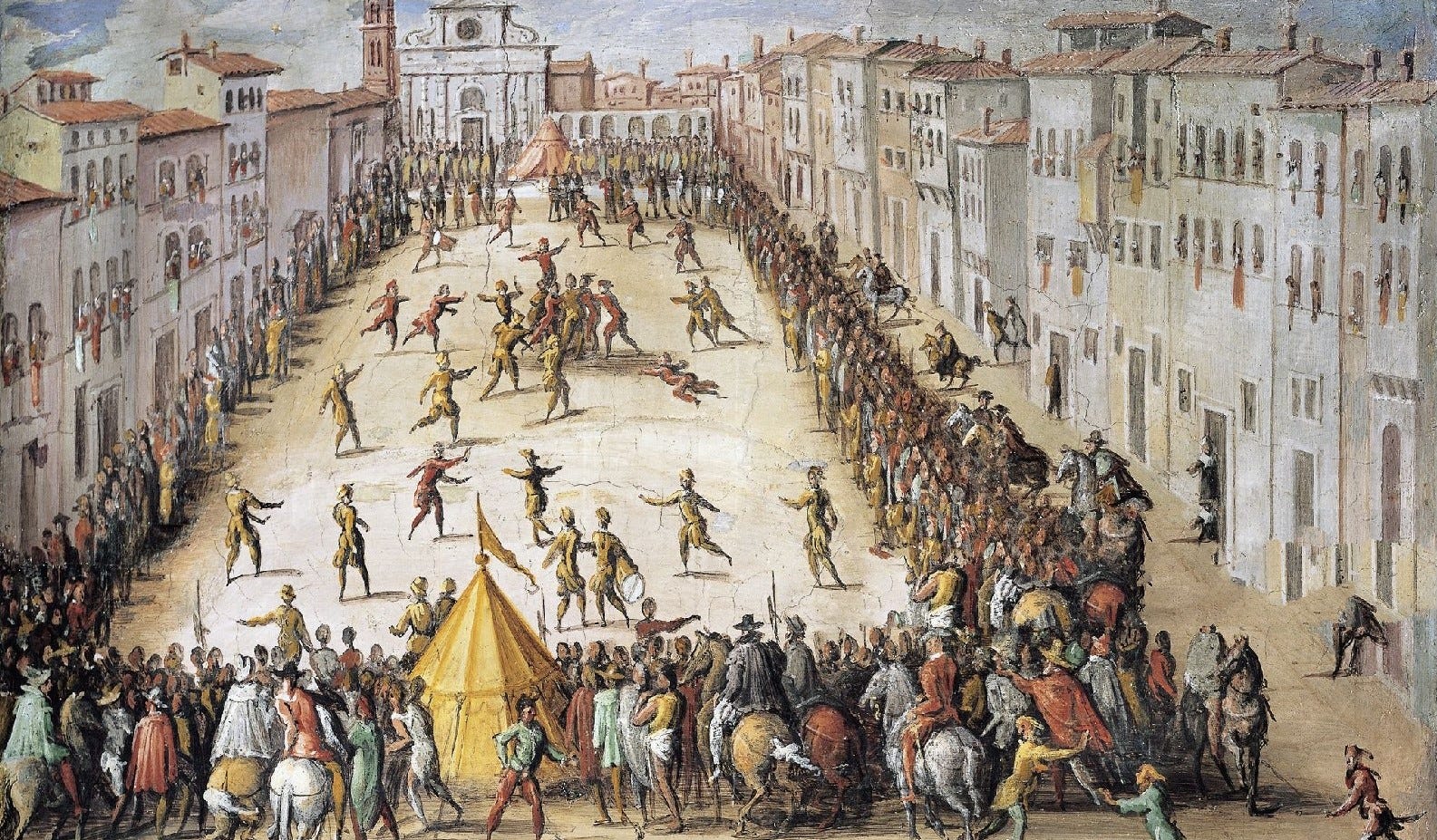
Despite claiming to be the “home” of football Britain was still having somewhat chaotic games whilst Italy had an incredibly detailed rule set for their version of the sport. Florence had the game Calcio storico fiorentino which is thought to have started in Piazza Santa Croce. It became known as the giuoco del calcio fiorentino or simply calcio, which is now the Italian word for “football”. The exact origins of the game are unclear, but it is thought to have possibly arisen out of military training exercises. We know that it was well-established by 1530, as on the 17th of February a game was defiantly played whilst the city was under siege.
We have an incredibly comprehensive set of rules and instruction from Giovanni de’ Bardi’s Discorso sopra 'l giuoco del calcio Fiorentino (1580). An overview of them follows, and whilst lengthy, I think that they are fascinating!
1. The theatre of the game should be a principal city square, suitable for noble women and the people to watch.
2. The field should be fenced: 172 braccia long, 86 braccia wide, and two braccia high.
3. The game is public, played by two sides of young men, on foot and without weapons.
4. The object is to make the inflated ball pass deliberately beyond the opposing end boundary.
5. A successful passage beyond the opponent’s end is a caccia (goal).
6. The side with more cacce wins; falli (fouls) count against the offending side, with the later Capitoli tradition making two falli equal one caccia.
7. After every caccia or fallo, the teams change places.
8. The players number fifty-four: twenty-seven per side.
9. Each side consists of fifteen Innanzi (forwards), five Sconciatori (halfbacks), four Datori innanzi (full backs), and three Datori a dietro (goal keepers).
10. Players should be fit gentlemen, generally eighteen to forty-five, of good reputation and trained in noble exercises.
11. The season runs from early January to March, with Carnival as the most solemn period.
12. The game should be played toward evening and should last only as long as the players can bear the sweat, blows and exertion - roughly one or two hours in Bardi’s phrasing.
13. Dress should be short and free: hose, doublet, cap and thin shoes; in formal games, the two sides wear different liveries.
14. In an ordinary game, two knowledgeable captains choose the sides on the field from the assembled players.11
15. In a liveried game, the sides are chosen privately beforehand, often trialled in two colours, and publicly announced.
16. Six experienced former players sit on a raised seat and judge disputes.
17. A neutral ball-man, dressed in both colours, starts play by striking the ball and keeps spare balls available.
18. The game begins with the ball placed in the centre and the thirty forwards run at it from a circle.
19. The Innanzi must carry the ball softly with their feet, keeping it close and advancing in three squads.
20. Forwards should not hurl the ball; ordinary handling is limited to setting it down to the feet or to special breakaway circumstances.
21. A deliberate throw or hurl of the ball, and deliberate sending of the ball over the ditch-side fence, constitute falli.
22. Forwards should meet blockers with extended arms rather than begin fist-fighting.
23. The Sconciatori must shield the Datori, disrupt enemy forwards, delay rather than simply hold them, and preserve the line’s order.
24. Sconciatori should not usually strike the ball, except in defined circumstances, especially the ditch-side player returning dangerous balls.
25. The Datori innanzi govern the ball by powerful strokes and should not retreat for balls belonging to the rear line.
26. The Datori should not send the ball among the spectators, because that chills the game by stopping play.
27. The Datori a dietro are the last guard and must stand deep enough to move forward to the ball, not so close that they must retreat.
28. When the ball is on a side’s own end fence, the whole side should give common aid, keep the ball low, and stop it being lifted over.
29. When fights break out, the nearest players should separate them, but the rest should not abandon the ball to watch.12
30. Players should not bear grudges after the game; bodily blows received in calcio do not touch honour.13
31. During changes of field, the winning flag should be carried high and spread, the losing flag lowered and wrapped.
32. The flags should not be torn.
33. The highest honour sought through the game is not merely sporting reputation but recognition as men fit for civic and military service.
The game underwent a revival in the 20th century, and is played annually in Florence to this day. In my next piece (which will drop tomorrow, Saturday 18th of July!) I’ll explore how these varied games ultimately resulted in the sport watched today by billions and how perhaps England can claim to be the home of football.
Okay, I watch climbing videos, but that doesn’t quite feel like quite the same thing to me.
Update, England won!
In the mid 90s I briefly worked in a warehouse in Portsmouth, and would study the form of the local team, Portsmouth FC, as though it were an academic subject so that I would have something to chat about with my coworkers.
I honestly can’t remember who they were playing now. Sorry.
I think that I watched an FA cup final sometime in the early 1980s, only because I knew that everyone would be ta’king about it at school on Monday morning.
Such as ‘Aggers’.
It has to be copied in part from the earlier record.
The result of too many drunken orgies, perhaps?
I don’t want to defame a 14th-century canon, but this seems a little sus to me? If the knife was sheathed he must have hit with such force that it pierced the sheath, and then himself? Though perhaps I am being unfair. There is an even earlier, similar, fatality, dating from 1280, at Ulgham in Northumberland: “Henry, son of William de Ellington, while playing at ball at Ulgham on Trinity Sunday with David le Ken and many others, ran against David and received an accidental wound from David’s knife, of which he died on the following Friday.”
Not all kings hated football. Henry VIII ordered a pair of football boots from his Great Wardrobe in 1526. And then attempted to ban the game in 1540.
This gives me flashbacks to being picked last for games at school…
Yes, you have to have a rule about not stopping to watch fights…
Though by all reports the games could be very violent indeed. See previous footnote.
This was an enjoyable history. Do you have any information about how the French game of Soule might have contributed to various forms of football? I'm looking forward to the next installment.