
In my previous piece I explored how artificial light slowly evolved from simple fires, to oil lamps and then to candles. And, well, not every much changed over the course of the first millennium. If you were poor, you were likely to have very little artificial light at all, other than that thrown out by your household fire. You might have burned rushes,1 soaked in animal fat as the next cheapest form of light – but the thing about animal fat was that it could be eaten, as well as burned for light, and many would have chosen to consume, rather than combust, those calories. If you were slightly further up the social strata then you may have tallow candles, again made from animal fat, but these could be both smoky and smelly. The acme of lighting technology at the time was the beeswax candle, but this was strictly the preserve of the wealthy and religious institutions.2
If you were incredibly wealthy, say as wealthy as a king, you could even use candles to measure time. This is, according to Asser’s Life of King Alfred (Vita Ælfredi, written in approximately AD 893), exactly what King Alfred did:
Having pondered these matters for some time, he eventually arrived at a useful and judicious plan. He ordered his chaplains to supply sufficient wax, which he commanded to be weighed against pennies in a balance. When enough wax had been measured out to equal the weight of seventy-two pennies, he ordered his chaplains to make six candles from it, each of equal weight, so that each candle was twelve inches long, with the inches marked along its length.
Having thus devised this method, the six candles burned without fail for twenty-four hours, by day and by night, before the holy relics of many of God’s elect, which always accompanied him wherever he went.
Sometimes, however, the candles could not remain alight for a whole day and night, until the same hour at which they had been lit the preceding evening. For the violence of the winds, which sometimes blew without interruption by day and night through the doors and windows of churches, through partitions and boards, through the numerous cracks in walls and through the thin material of tents, caused them to burn more rapidly than they should and to finish their course before the appointed hour.
He therefore considered how he might prevent such draughts and, having skilfully and wisely devised a plan, ordered a lantern to be beautifully constructed from wood and ox-horn. For white ox-horn, when shaved thin with tools, is no less transparent than a glass vessel.
When this lantern had been wonderfully constructed from wood and horn, as we have said, and a candle placed inside it at night, the candle shone as brightly outside as within, undisturbed by the blasts of wind, because he had also ordered a door of horn to be made for the opening of the lantern.
With this device constructed, the six candles, one after another, burned without interruption for twenty-four hours, neither more nor less. When they were extinguished, others were lit.
As demand for candles grew in the middle ages then their production became big business for the chandlers. Before researching this piece I had assumed that a candlemaker was a candlemaker – you would make candles from tallow for your poorer customers and beeswax for your wealthier ones. No. No. No. There were two distinct trades, the tallow chandlers and the wax chandlers. The tallow chandlers organised their trade first in England, around the year 1300, and gained a royal charter in 1462 whereas their was counterparts started regulating their trade in the 1350s and received their royal charter in 1484. Despite being younger, the wax chandlers were considered to be higher status. In part this was due to their manufacturing operations – beeswax is simply much nicer to melt and form than animal fat – and in part because their customer base constituted the higher echelons of society. You don’t have to take my word for it, here is a diss of tallow candles by Shakespeare in Cymbeline:
Base and unlustrous as the smoky light
That’s fed with stinking tallow; it were fit
That all the plagues of hell should at one time
Encounter such revolt.
These guilds played a vital role in ensuring the quality of their products, as the First Royal Charter of the Tallow Chandlers’ Company describes:
And furthermore, that the same Master and Wardens of the said craft, and their successors, shall have full power and authority for ever to inspect and test, and to undertake and exercise proper scrutiny of whatsoever weights, measures and materials are held, used and employed by any men and practitioners of the same craft within the aforesaid City and suburbs.
So that proper, just and trustworthy weights, measures and materials shall be employed and used in the same craft by all those practising it there; and to inspect all and every other goods and merchandise sold or to be sold, or offered or to be offered for sale, by such men and practitioners of that craft, so that they shall be suitable, good and lawful, without any deception or fraud whatsoever; and duly to correct such defects and deceptions as they shall discover in this regard, and duly to punish, or cause to be punished, all persons offending in this regard, according to their respective faults and offences, under the supervision of the Mayor of our said City of London for the time being.
You might be thinking that if a candle is simply a candle, how could one create a fraudulent one? Well one could lie about the weight of the candle, or even (and yes, apparently this actually happened) use an excessively heavy wick to reduce the amount of wax or tallow in it. For the wax chandlers perhaps the greatest crime was adulterating beeswax with filthy tallow! This is probably what happened in the case of John Donat, an influential Italian-born spice merchant and apothecary who was discovered to have manufactured a fraudulent wax torch. We have a record of the hearing of his case which took place on the second of April 1358:
Friday before Palm Sunday, William Samkyn, Walter le Rede, and John de Notyngham, wax-chandlers, sworn before John de Stodeye, the Mayor, and the Aldermen to inquire whether or not a certain wax torch made in the house of John Donat, a Lombard, was justly made. They say on oath that the torch is falsely made to deceive the people, and to the scandal of the whole City.3 The torch to be forfeited and the said John committed to prison, &c. Thereupon he made fine to the Commonalty for 20s.
The chandlers’ guilds had extraordinary powers to enter premises, inspect products, and if they deemed them defective, destroy them (usually by burning) without recourse to the courts. Their inspectors were usually called “searchers” and they continued their work into the 18th century. These actions only came to an end in 1709 when one Lewis Nicholls, a candle maker in Piccadilly, successfully sued the Tallow Chandlers Company after their searchers entered his premises and destroyed his stock.
Astonishingly4 (and quite brilliantly) both of these institutions still exist to this day. The Worshipful Company of Wax Chandlers maintains commercial links with the modern wax industry, supports beekeeping, funds apprenticeships and promotes bee conservation, and carries out other charitable activities; The Worshipful Company of Tallow Chandlers maintains links with the modern oils, fats, lubricants and candle-making industries and also undertakes charitable and educational activities.
The next significant development of lighting was the creation of illumination by burning gas. It had been known that natural sources of gas could ignite for millennia, and this could occasionally happen without human intervention and continue for long periods of time. In Turkey there is a source of methane called Yanartaş which is believed to have been burning for more than 2,500 years.
The Chinese managed to tap sources of geological gas and put them to practical uses. There is some debate about the age at which they started doing this, possibly as early as the 10th century CE. Certainly by 1637 they were using burning gas to evaporate brine for the production of salt, carried to the desired locations in bamboo pipes. Of course these kinds of technologies only worked when you had a ready source of natural gas venting out of the ground. For it to become a widespread fuel one would have to find a way of manufacturing it. The first person to do so was a Lancashire clergyman, Rev John Clayton (1657-1725), whose experiments with gas began with the investigation of a mysterious ditch:
Having seen a Ditch within two Miles from Wigan in Lancashire, wherein the Water would seemingly burn like Brandy, the Flame of which was so fierce, that several Strangers have boiled Eggs over it; the People thereabouts indeed affirm, that about 30 Years ago it would have boiled a Piece of Beef; and that whereas much Rain formerly made it burn much fiercer, now after Rain it would scarce burn at all. It was after a long-continued Season of Rain that I came to see the Place, and make some Experiments, and found accordingly, that a lighted Paper, though it were waved all over the Ditch, the Water would not take Fire.
I then hired a Person to make a Dam in the Ditch, and fling out the Water, in order to try whether the Steam which arose from the Ditch would then take Fire, but found it would not. I still, however, pursued my Experiment, and made him dig deeper; and when he had dug about the Depth of half a Yard, we found a shelly Coal, and the Candle being then put down into the Hole, the Air catched Fire, and continued burning.
Intrigued he attempted to replicate this effect at home:
I observed that there had formerly been Coal-pits in the same Close of Ground; and I then got some Coal from one of the Pits nearest thereunto, which I distilled in a Retort in an open Fire. At first there came over only Phlegm, afterwards a black Oil, and then likewise a Spirit arose, which I could noways condense, but it forced my Lute, or broke my Glasses. Once, when it had forced the Lute, coming close thereto, in order to try to repair it, I observed that the Spirit which issued out caught Fire at the Flame of the Candle, and continued burning with Violence as it issued out, in a Stream, which I blew out, and lighted again, alternately, for several times.
I then had a Mind to try if I could save any of this Spirit, in order to which I took a turbinated Receiver, and putting a Candle to the Pipe of the Receiver whilst the Spirit arose, I observed that it catched Flame, and continued burning at the End of the Pipe, though you could not discern what fed the Flame: I then blew it out, and lighted it again several times; after which I fixed a Bladder, squeezed and void of Air, to the Pipe of the Receiver. The Oil and Phlegm descended into the Receiver, but the Spirit, still ascending, blew up the Bladder. I then filled a good many Bladders therewith, and might have filled an inconceivable Number more; for the Spirit continued to rise for several Hours, and filled the Bladders almost as fast as a Man could have blown them with his Mouth; and yet the Quantity of Coals I distilled were inconsiderable.
And how did he utilise this great discovery? Err, to perform a party-piece:
I kept this Spirit in the Bladders a considerable time, and endeavour’d several ways to condense it, but in vain. And when I had a Mind to divert Strangers or Friends, I have frequently taken one of these Bladders, and pricking a Hole therein with a Pin, and compressing gently the Bladder near the Flame of a Candle till it once took Fire, it would then continue flaming till all the Spirit was compressed out of the Bladder; which was the more surprising, because no one could discern any Difference in the Appearance between these Bladders and those which are filled with common Air.
Clayton did, however, write up his findings and sent them to the great Robert Boyle in 1688, who did nothing with them. It seems likely that the letter arrived at a point when his health was starting to fail (he died in 1691) and this could have explained his lack of engagement with the discovery. Whatever the cause, the results of Clayton’s work were only published in 1739, long after both men had died. It is interesting (though arguably pointless) to speculate that had Boyle been in fine fettle and championed the fact that such a fuel could be produced both cheaply and easily that the development of the coal gas industry would have begun a century earlier than it actually did.
In 1785 the Dutch-born scientist Jan Pieter Minckelers (1748–1824) discovered that coal gas was lighter than air (he was wanting to inflate balloons) and also that he could burn the stuff to light his lecture theatre, but didn’t take this discovery much further. The person who is generally considered to have invented commercial gas light was the Scottish engineer William Murdoch (1754–1839). Probably in 1792 he started experimenting with heating coal to generate gas and certainly by 1794 he was using the stuff to light his own home – the first domestic residence to be lit by gas. He also created a portable gas lamp, as his friend William Fairbairn recalled:
It was a dark winter’s night and how to reach the house over such bad roads was a question not easily solved. Mr Murdoch, however, fruitful in resource, went to the gasworks where he filled a bladder which he had with him, and, placing it under his arm like a bagpipe, he discharged through the stem of an old tobacco pipe a stream of gas which enabled us to walk in safety to Medlock Bank.
Unlike his predecessors he understood the potential commercial benefit of gas lighting, and strove to exploit it. In 1805 his company began installing gas lamps in the vast Philips and Lee cotton mill in Salford, Manchester, and by 1808 it was almost wholly gaslit. The benefits of this were twofold: gaslight was of a higher quality and steadier than candlelight; and it was materially cheaper. Even allowing for the capital costs of building a gas plant and installing the piping in burners it saved more than 70% of the lighting costs for the building – a sum the equivalent of millions of pounds a year in today’s money.
Murdoch’s approach was to construct individual gas plants for the factories and buildings that needed them, but that was not hugely efficient. The person to turbo-charge the gas industry was a German entrepreneur, Friedrich Albrecht Winzer (1763–1830), better known as Frederick Albert Winsor. He envisaged large gas production plants whose output would be piped to the locations where it was needed. In 1804 he lit London’s Lyceum Theatre to wow potential spectators, and in 1807 he spent £50,000 (a vast sum at the time) lighting Pall-Mall for the birthday celebrations of George the Third. After a lot of lobbying and some financial setbacks his Gas Light and Coke Company was granted a royal charter in 1812.
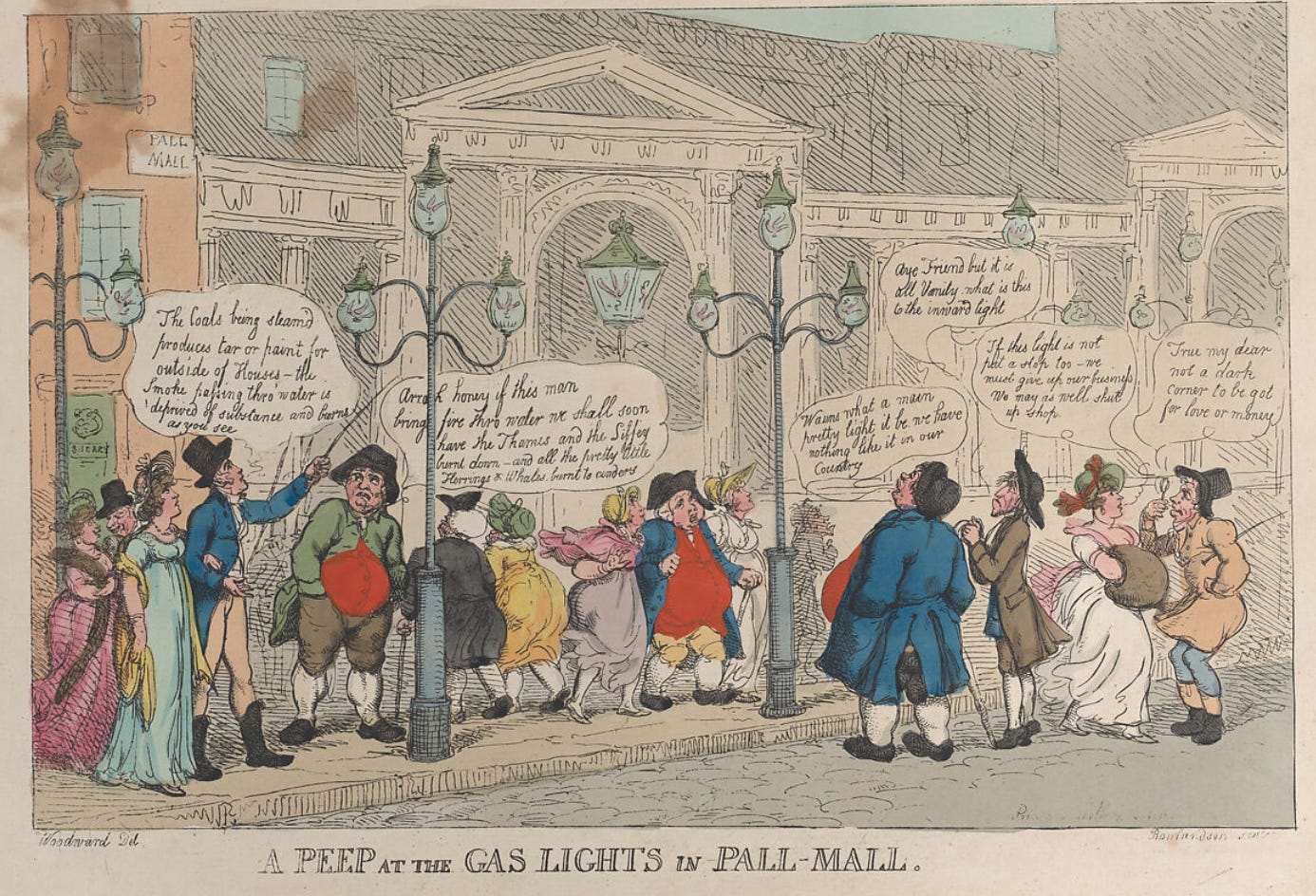
The expansion and take-up of this new technology was akin to the recent AI boom.5 Westminster had public gas lighting by 1813 and cities across the country soon followed suit. In my home town the Oxford Gas Light and Coke Company was incorporated in 1818, establishing gasworks in St Ebbe’s on the northern bank of the Thames (about half a mile from where I am writing these words). By 1819 there was gas lighting on the streets.6 This was an industry in which Britain led the world. By 1826 virtually every major town in the country had a gasworks when New York had only got gas in 1825, and Berlin in 1826. By the 1820s London had around 50,000 gas lamps whereas Paris didn’t begin introducing gaslighting to major public streets until 1829.
This expansion of lighting had a huge societal impact. Prior to its introduction cities would more or less shut down when it got dark, shops would close, people would retreat to their homes. This new technology helped create what we would now term the “night-time economy”. Women in particular felt safer treading the streets at night (and doing so became considered a reasonable activity for a respectable woman). The costs of lighting factories dropped materially. Over the course of the century lighting made its way into domestic homes, again reducing costs and increasing both the abundance and quality of light. A small, but significant, impact was that it became much cheaper and easier to read in the evenings. As is generally the case with innovations, however, these benefits were not initially evenly distributed. The wealthier households got gas lighting first, as did the more well-to-do streets, but by the end of the century gas lighting was all but universal and it has been calculated that on average a person used 86 times the amount of light that they did a century earlier.
But by then a new technology had emerged, one that I will explore in my final piece – electric lighting.
I read a thing online yesterday where someone claimed that the use of rushes as a light source was the origin of “rush hour” and “being in a rush”. That is total, utter bobbins. Rush comes from the Middle English verb rushen, which entered English via Anglo-French russher and Old French ruser (to drive back, repel, or dodge), tracing back to the Latin recusare (to object, refuse, or push back).
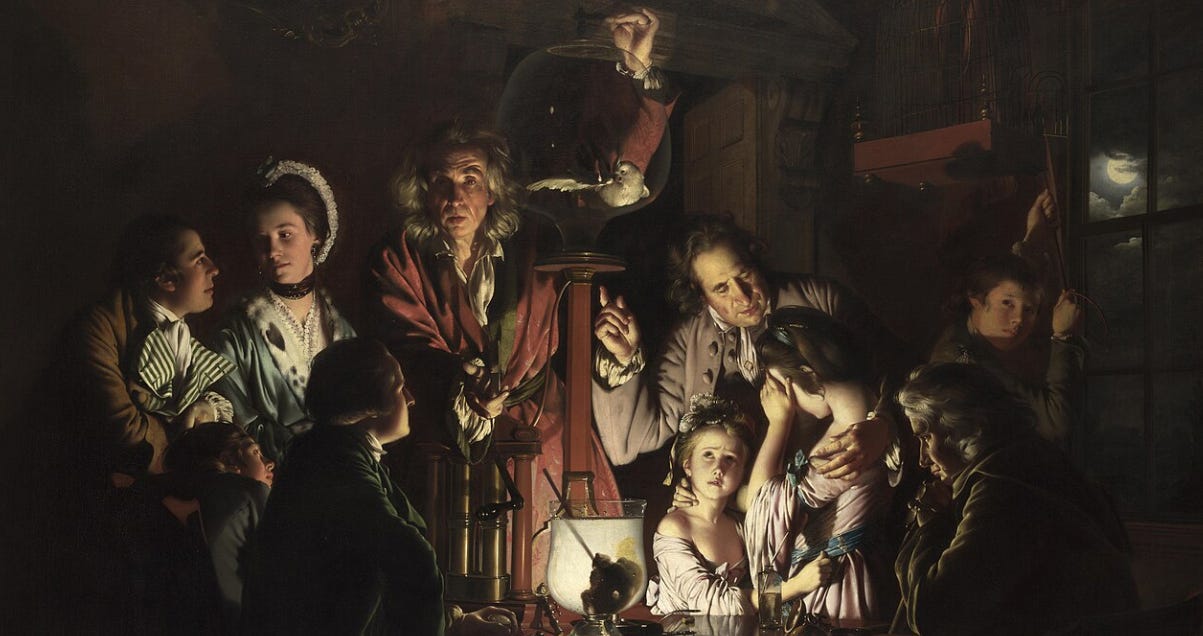
Is this a gratuitous use of Joseph Wright of Derby’s An Experiment on a Bird in the Air Pump (1768)? Maybe, but I bloody love that painting.
To say that the whole city was scandalised feels a bit hyperbolic.
Actually not that astonishingly at all if you know about the longevity and wealth and influence of the London guilds.
It may seem like an obvious trope to suggest this, but I think that it is a reasonable comparison. Incredibly rapid spread, some notable and vast financial failures, considerable cynicism in some quarters, but ultimately society-changing.
How I wish public infrastructure development could take place at such speeds today…