
The clocks went back in the UK a couple of weeks ago, and I had been at the house party of some friends the night it happened. I was thankful for an extra hour of time between what could reasonably be described as a rather late bedtime and the time at which I had to check out of my hotel. It did, however, mean that the subsequent evenings got correspondingly darker, and as I write these words the days will continue to shorten for around another six weeks. This is not my favourite time of the year. I like to be outside. In the light. But at least at home I can have light. Light that is so readily and cheaply obtained that I do not give its acquisition a second’s thought. But that has been very far from the case for the majority of human history, and so this week I will be exploring the history of artificial light.
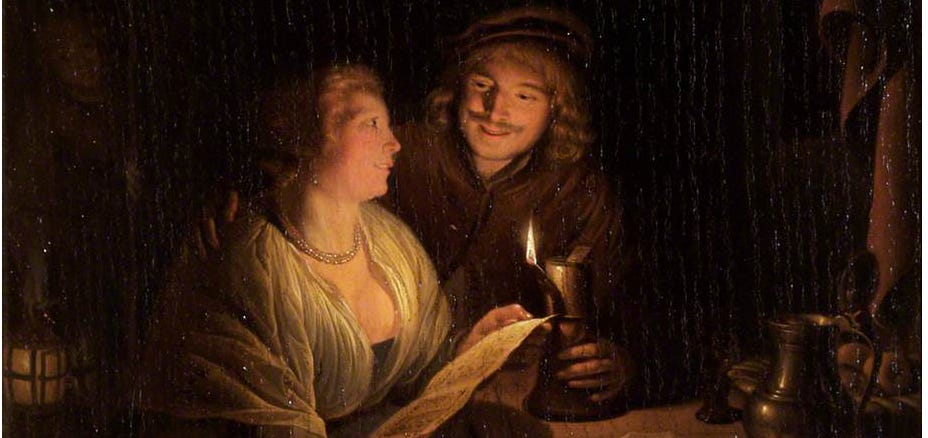
The earliest form of artificial light was, of course, fire, and this predates humanity itself (or rather Homo sapiens). It is tricky to pinpoint exactly when controlled fire – as opposed to natural wildfires – first arose, with some traces suggesting that it could date back more than a million years. Research published this year has proved that fires were burning in the Wonderwerk Cave in South Africa some 30 metres (100 feet) from the entrance – a sufficiently deep distance that they could not have been natural – between 1.07 and 1.79 million years ago. We can therefore be confident that some form of artificial light is more than a million years old. This light would not have been great, would have required constant refuelling, and would likely have been more the by-product of the other benefits fire can offer– heat, cooking, and protection – than the main objective.
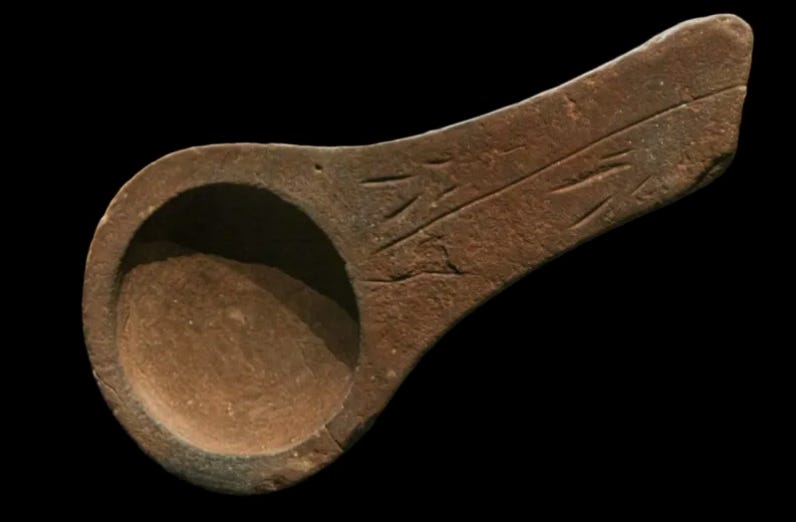
These early fires would have been kindling and scrub and wood. In time animal fat may have been added to provide a brighter, hotter burn. In time the utility of oils and fats alone as a fuel for the creation of light must have become obvious, but quite when is uncertain. Natural depressions in rocks could well have been used, along with a wick made from plant material, of which nothing obviously human-worked remains. The earliest known oil lamps, depressions in stone with traces of animal fat and charring, date back around 40,000 years. Some of the finest examples, more than a hundred, were discovered in the famous Lascaux Caves, where they had been used to illuminate the creation of the incredible cave paintings there. These included a beautiful, spoon-like object carved from red sandstone that dates back between 17,000 and 21,000 years. A point I have reflected upon before in these pieces is the extent to which the past can easily seem ‘other’ to us, but knowing that around a thousand generations ago people were not only making oil lamps, but that they were using them to create art serves as a reminder that peoples separated by thousands of years are perhaps more similar that one might have immediately imagined.
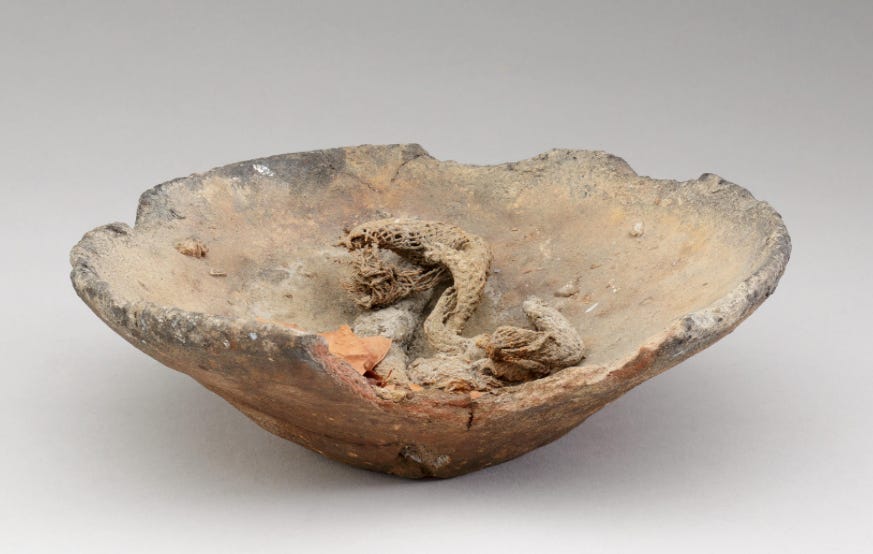
By around 4,000-4,500 years ago considerable numbers of clay oil lamps were being made. Initially these were simply flat saucers, which we filled with oil in which a free-floating wick would be placed and ignited. Examples of these, including remains of the linen wicks, have been found at a number of sites in Egypt.
We have a lovely description of such lamps being used from Herodotus, writing in the 5th century BCE:
At the times when they gather together at the city of Saïs for their sacrifices, on a certain night they all kindle lamps many in number in the open air round about the houses; now the lamps are saucers full of salt and oil mixed, and the wick floats by itself on the surface, and this burns during the whole night; and to the festival is given the name Lychnocaia (the lighting of the lamps). Moreover those of the Egyptians who have not come to this solemn assembly observe the night of the festival and themselves also light lamps all of them, and thus not in Saïs alone are they lighted, but over all Egypt: and as to the reason why light and honour are allotted to this night, about this there is a sacred story told.
On the subject of the Egyptians you may have read that they were the first to invent the candle perhaps as much as 5,000 years ago. These would have been reeds dipped into animal fats, or even beeswax; however, there is not sufficiently robust archaeological evidence to establish this beyond doubt. What they did have was that trope of every Indiana Jones film, burning torches. These would have consisted of linen, most likely wrapped around reeds or sticks, and soaked in animal fats or plant oils. In addition to their use in providing light, they could play a ceremonial role, as described in Spell 137A of the Egyptian Book of the Dead (commonly called the Spell of the Four Torches) dating from around 1,400 BCE:
Spell for four torches for the ceremonies which are carried out for a spirit.
You shall make four basins of clay beaten up with incense and filled with
milk of a white cow; the torches are to be quenched in them
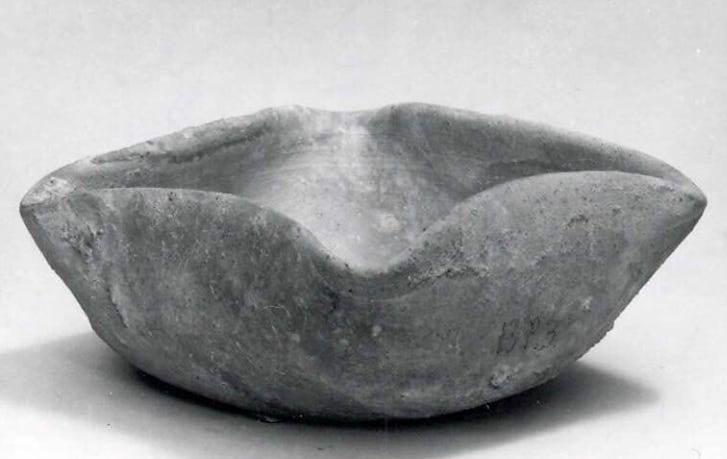
Back to oil lamps. Those early designs were not without their flaws. It was easy to spill an open bowl of oil and the wick could float around or even sink resulting in an unpredictable burn. The solution turned out to be pretty simple: pinch the rim of the clay saucer while it was still soft to create a protruding channel in which the wick could be placed. These pinch-nozzle lamps (sometimes called cocked-hat lamps) date back more than 4,000 years.
These lamps could result in a degree of sploshing when carried, and it was generally not ideal to get inflammable oil on oneself when carrying a naked flame. From around the 7th century BCE the Ancient Greeks began throwing oil lamps on potters’ wheels. Over the centuries that followed the designs evolved, gradually enclosing the top so that only a small hole remained through which the oil would be poured with a separate opening for the wick. These could be carried around much more safely, and the wick would more readily stay in place. They also started applying a black ceramic slip or glaze to the pots, which helped reduce oil seepage through the porous clay.
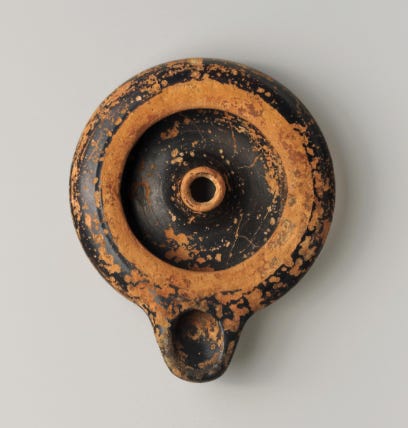
The next development in oil-lamp technology took place early in the 3rd century BCE with the introduction of reusable moulds. There would be one for the top of the lamp and one for the bottom, with the two pieces joined while still soft and then fired. This enabled both the mass-production of lamps and transformed them from being fairly utilitarian items to elaborately decorated things of beauty. The Romans developed the lamp industry even further, with a typical design consisting of a flattened circular oil reservoir, a relatively small filling hole in the top, a protruding nozzle, and often a handle at the back. Its decorated upper surface was known as the discus and could depict scenes involving gladiators, gods, animals, chariot races, and, err, even erotic subjects.
It is hard to know the exact scale of Roman oil lamp production as we don’t have robust data on how long one lasted on average, the number per person and so on. Having said that, it is not unreasonable to estimate that over the approximately five centuries separating the reign of Augustus from the fall of the Western Roman Empire, Roman workshops manufactured something in the region of one to two billion oil lamps. These lamps, as with many other things, were not, however, evenly distributed. We know from finds at Pompeii that larger households could have upwards of 30 lamps. Small apartments and one-room dwellings would, in contrast, have perhaps one or two.
It wasn’t just the number of oil lamps that varied from household to household; the extent to which they were used was too. These lamps burned olive oil, and olive oil cost money. It is hard to get precise numbers, but a not unreasonable estimate would be that to burn a single oil lamp for six hours in Pompeii in 79 CE would have cost around 10% of the daily wage for a worker (or about $20 in today’s terms). These lamps weren’t just expensive to run; they were also pretty crap at producing light. An average Roman oil lamp produced around 3-5 lumens. In comparison, a modern 60 watt equivalent LED bulb produces around 800 lumens, 160+ times more. Or to put it another way, to get the equivalent of six hours of light-bulb light 2,000 years ago one would have to spend thousands of dollars. More opulent properties did not have lamps made out of mere clay, but far grander affairs made from bronze, silver, and even glass, often with multiple wicks, which would consume oil at a far faster rate, quite literally burning money.
The Romans didn’t just have oil lamps to create light, they also had candles but these were generally considered to be somewhat poorer options. We don’t know exactly when the first began to be used, but we have a hint from the play Curculio written by Plautus early in the second century BCE:
PALINURUS: Where am I to suppose you’re going out at this time of night, Phaedromus, dressed up like that and with all this display?
PHAEDROMUS: Wherever Venus and Cupid command and Love directs. Whether it’s midnight or early evening, even if it’s the appointed day for an appearance in court, you must go wherever they command, however unwillingly.
PALINURUS: But really, really—
PHAEDROMUS: You really are becoming a nuisance.
PALINURUS: There’s nothing fine or remarkable about this: you’re acting as your own slave. There you are, all dressed up, carrying your own wax light!
PHAEDROMUS: Am I not to carry something made through the labour of little bees, produced from the sweet honey of my sweet love?
Here we are both told that anyone of decent standing would have a servant to slave to light the streets for them at night, and also that something made of beeswax could be used to provide illumination. It may simply have been a short-burning taper, of the sort that was used to light lamps, but quite possibly it was a candle in its own right.
We have a passage making a similar point, with something that seems certain to be candle, in Juvenal’s Satires early in the second century CE. Bullies and ne’er-do-wells would not have a go at someone with a retinue of servants and a lamp, but they might attack someone who had only a mere candle to light their way:
He keeps clear of the man whose scarlet cloak commands respect, whose long procession of attendants and multitude of flames, together with his bronze lamp, warn people to stand aside. But me, who is usually guided home by the moon, or by the feeble light of a candle whose wick I carefully regulate and husband, he despises.
After the fall of the Western Roman Empire the nature and extent of artificial light would vary depending upon where one lived. In southern Europe, particularly around the Mediterranean, oil lamps were more common due to the more ready availability of olive oil. In the north candles and rushes doped with animal fat were more widely used. For the poor (particularly the poor in rural areas) the reality is that artificial light was a scarce luxury. As noted above, an oil lamp was expensive to run for a manual worker. Beeswax was very pricey. And while animal fats were widely available a person desirous of light had to decide if it was worth burning calories that could otherwise be eaten. For many, as it was with our ancestors a million or more years ago, the primary source of light would have been their household fire.
While we lack sufficient evidence to be certain, it seems highly likely that this lack of light had a material impact upon the daily routines of such peoples as the seasons changed. They would have spent far more time in bed, if not necessarily always asleep. This would have been in part because they lacked the light to carry out practical activities, but also meant that they could conserve energy during the winter when typically food supplies were scarcer. Evidence for this also comes from a 1991 experiment by Thomas Wehr subjected eight volunteers to 14 hours of darkness each day for a period of four weeks. They averaged 11 hours of sleep, compared to 7.7 hours with a shorter darkness schedule.
Being more or less powerless to dispel the dark is difficult to imagine in a society where we can simply conjure light with the flick of a switch. In my next piece I will explore the history of how modern lighting developed.