
(Hello, I’m back! After a little break, I’m returning to write occasional pieces here again, in the original Histories format.)
It is a singular coincidence that the murder was committed during Bank Holiday night, and is almost identical with another murder which was perpetrated near the same spot on the night of the previous Bank Holiday.
Those words were printed in London’s Pall Mall Gazette on 24th August 1888. Given the year, you might well connect them with the serial killer known as Jack the Ripper. But… this was printed a whole week before the first of the five ‘canonical’ murders attributed to him, that of Mary Ann Nichols. Wait, what?
So the murder the report discusses is that of Martha Tabram, aka Turner:
Mr. George Collier, coroner, resumed his inquiry yesterday, at the Working Lads’ Institute, into the circumstances attending the death of a woman, supposed to be Martha Turner, aged thirty five, a hawker, lately living off Commercial road, E., who was discovered early on the morning of Tuesday, the 7th inst., lying dead on the first floor landing of some model dwellings known as George yard buildings, Commercial street, Spitalfields. The woman when found presented a shocking appearance, her body being covered with stab wounds to the number of thirty nine, some of which had been done with a bayonet.
And the previous one is that of Emma Elizabeth Smith – she was attacked in Whitechapel early on the morning of Tuesday 3rd April. Emma actually survived the attack (which was by two or three men rather than one) but then died in hospital the next day. The earliest news story (syndicated across the country) I can find is this:
MURDER IN WHITECHAPEL
A widow named Emma Elizabeth Smith, aged 45, of Spitalfields, was returning home late on Easter Monday, and when in Whitechapel Road, she was set upon and brutally maltreated by some men at present unknown. She was taken to the London Hospital, where she died this morning from the injuries.
I’m certainly not the first to discuss these women in the context of ‘Jack’ – they and another case, Annie Millwood (she was stabbed on 25th February by someone demanding money, survived but then died of natural causes three days before Emma) have often been discussed by ‘Ripperologists’, some saying they were Jack’s victims too, most saying they weren’t. But what interests me here is the history of an idea, the idea of this being a serial killer, as well as the idea of ‘Jack’ (and I certainly don’t intend to add to the endless speculation about who ‘he’ was, nor dwell on the gory details).
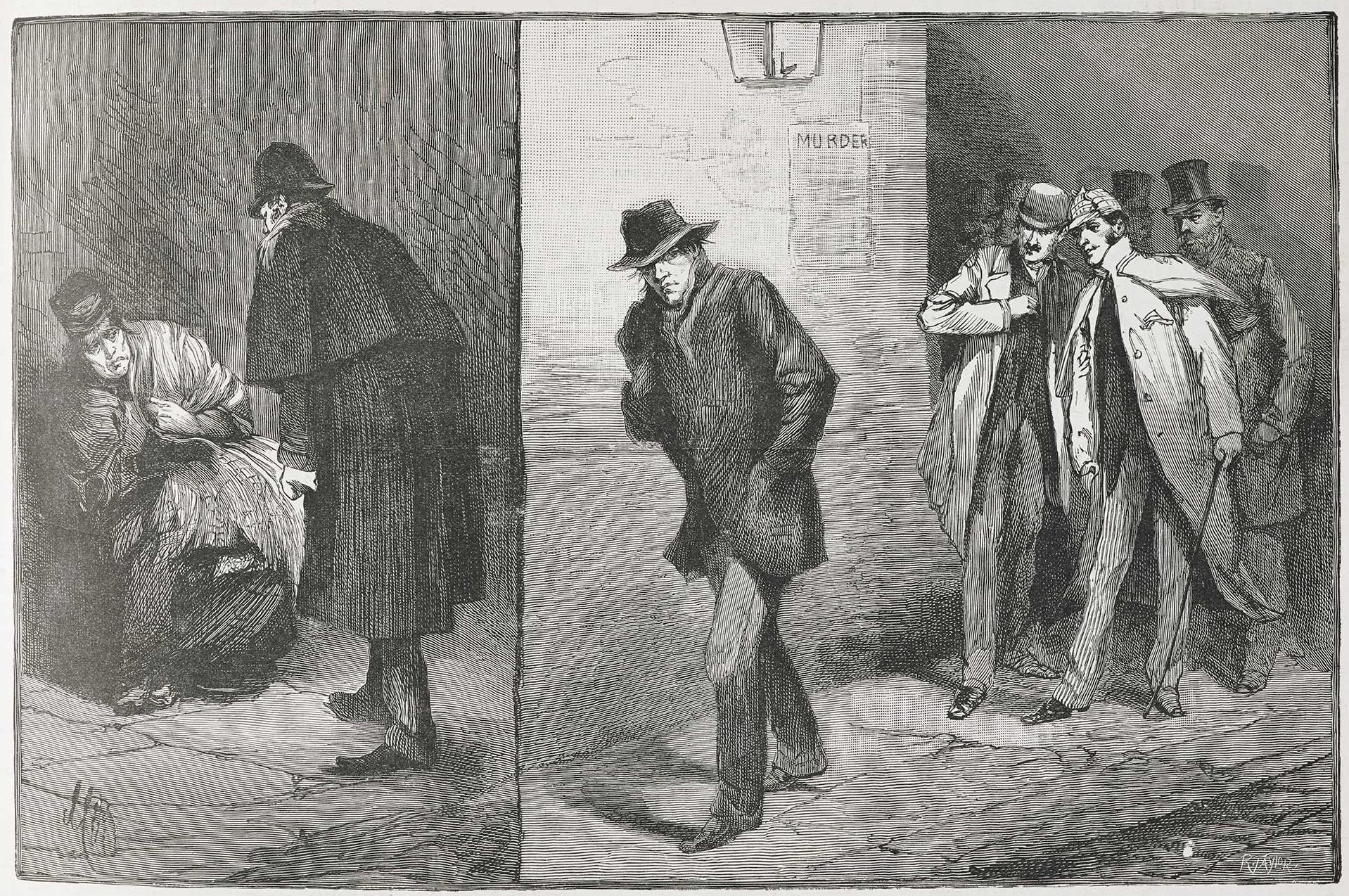
The origin of the name ‘Jack the Ripper’ is well known, the phrase first being used by the author of the infamous ‘Dear Boss’ letter, sent to the Central News Agency of London on 25th September, after the deaths of the first two canonical victims, Mary Ann Nichols and Annie Chapman.1 The letter is widely regarded as a hoax, possibly perpetrated by a journalist.
‘Jack’ of course had a many-centuries-long history of being used to refer to an otherwise unspecified man. The Oxford English Dictionary suggests that ‘ripper’ in this violent context appears to originate with this letter – though a more specialist use of the term for ‘one who rips things’ seems to go back to the 17th century.
As is often the case, though, the slow-moving OED isn’t always right. Here’s a report from the Manchester Courier of 7th February 1887, for example, a whole year before any of the Whitechapel events (and there are earlier examples):
LIVERPOOL HIGH RIPPERS
At the Liverpool Police-court, on Saturday, before Mr. Raffles, stipendiary magistrate, three youths named John Baker, George Baker, and Francis M’Tavey were charged with stabbing several people in Scotland-road, on Friday night.
And indeed the ‘High Rippers’ were well known in the 1880s specifically, as the Liverpool equivalent of Birmingham’s well-known Peaky Blinders. It’s not a wild linguistic leap to connect their activities with the London stabbings (especially for a journalist).
Going back to London in 1888, as well as that report linking Emma Smith and Martha Tabram, on 1st September we have this report from the Evening News a day after Mary Ann Nichols was killed: “The theory that the murder is the work of a lunatic, who is also the perpetrator of the other two murders of women which have occurred in Whitechapel during the last six months, meets with very general acceptance amongst the inhabitants of the district…” (The report goes on to offer its own take: “The more probable theory is that the murder has been committed by one or more of a gang of men…” – and later on references the High Rippers, in fact.)
On the same day, the New York Times was also quick to join the dots: “All three victims have been women of the lowest class; all three murders have taken place in the same district, at about the same hour, and have been characterized by the same inhuman and ghoul-like brutality.” And two days later, the Daily News made even more explicit the hypothesis “that all three sanguinary deeds are by one and the same hand”.2
So what’s my point? Simply that the whole Whitechapel community was very early on primed to envisage the same perpetrator for each new killing, without necessarily looking into all the detailed, varying circumstances of each. People rush to make connections.
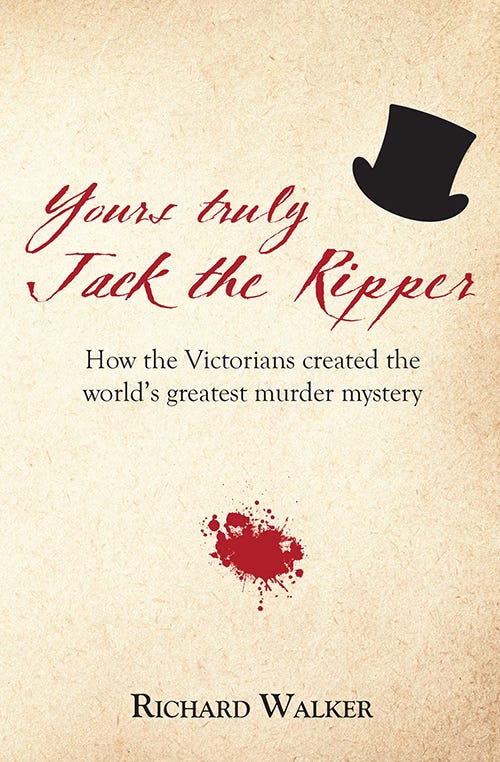
Someone who has studied all this in much more detail than me is Richard Walker, who runs one of London’s best-rated Jack the Ripper tours. And now he has written a book, Yours Truly Jack the Ripper, which draws on his own painstaking research, combined with his experience of the geography of Whitechapel – which turns out to make a big difference to how you might interpret the events. Full disclosure: I published the book for him, and I want you to buy it! It’s refreshing because it’s about the victims (like Hallie Rubenhold’s The Five) as much as the perpetrator, and about the circumstances rather than the wild obsession with identifying ‘Jack’ (though Richard does offer some reasoned arguments on that). What Richard reveals so clearly is that Victorian society – particularly from a mixture of the sensationalist press and cultural prejudice against poor women – in many ways created its own monster.
If that doesn’t convince you to check it out, readers of Histories can get an exclusive 25% off by using the code DYA25 in the checkout here until the end of April:
(Or you can pay full price at Amazon if you insist!)
I’ll be back again soon – and not trying to sell you something :)
No relation, I hope, though I did have Chapman ancestors living in a different part of London at the time.
Fascinating. I'll certainly check this out.