
(In alternate weeks to ‘The History of Things’ I’ll be dropping some other pieces from time to time. There is no real connection between them, other than that they are things that interest me, and I hope that you find them interesting too.)
I was raised in suburban Surrey, in the village of West Byfleet, to be precise. Unless you have passed it on the train you are unlikely to have ever heard of it. It stumbled into being towards the end of the 19th century with the arrival of railway and is perhaps only notable for the fact that it is one of a curious slew of places whose name begins with “W” on that line (Wimbledon, Walton-on-Thames, Weybridge, West Byfleet, Woking, and Worplesdon).
I read avidly as a child, intoxicated by stories of knights and kings and battles. Of intrigue and betrayal. Of fantastical beasts and thrilling adventures. And throughout that childhood there always lay, in the back of my mind, a crushing disappointment in the banality of the place that I called my home. My house was built in the early 1970s, before that the ground had been rough Surrey heath. No knights had ever ridden down my road. No kings had ever feasted here. And certainly the place had never been visited by mythical creatures.
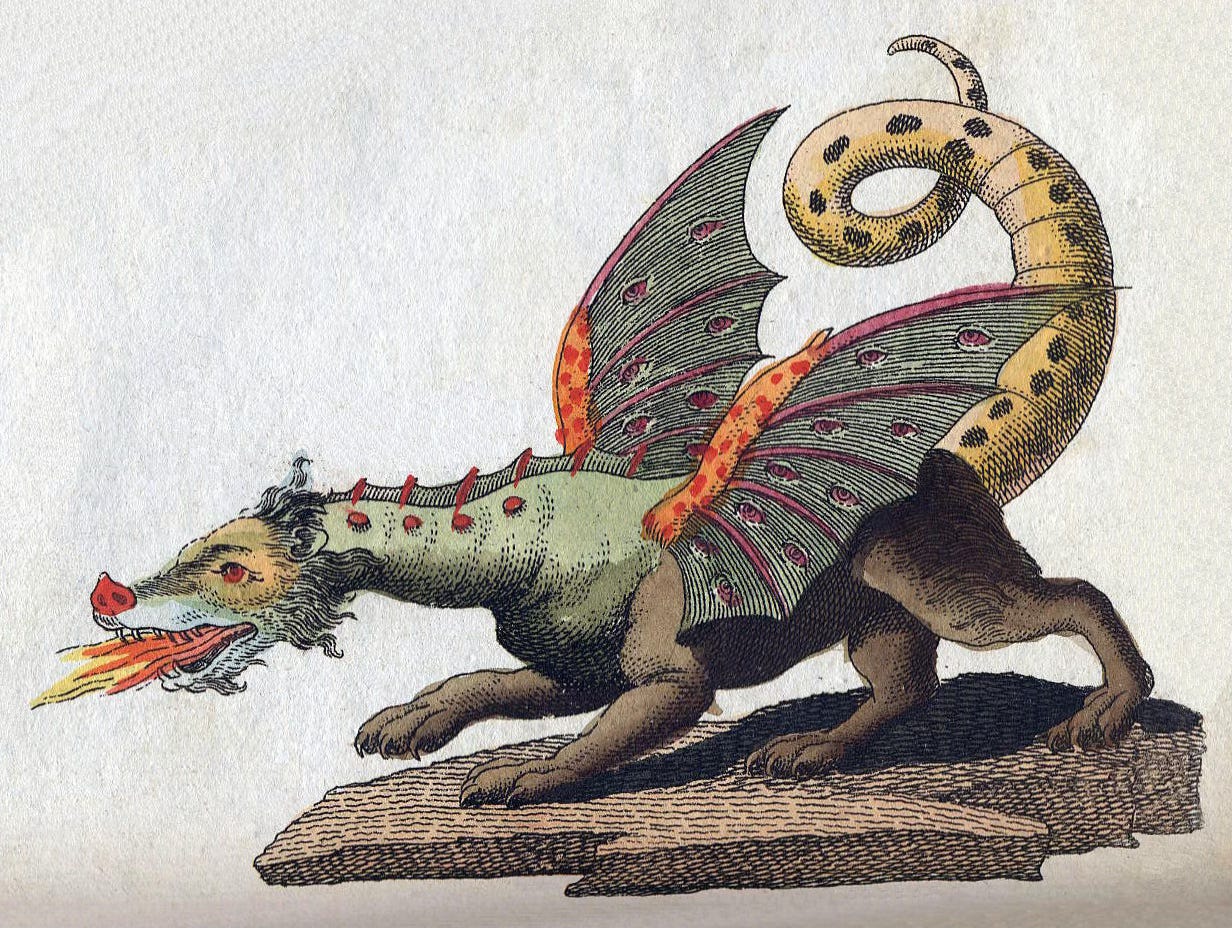
I moved into the house in which I now live 19 years ago and was thrilled to discover that the land beneath and around this otherwise unassuming Victorian terrace was steeped in history. I can only guess at the delight the younger me would have taken from living here, but I can guess pretty well. Unlike so many of my childhood infatuations that ebbed away as I aged, my love of those tales still remains. So today I’ll share some of the stories of my current home. Stories of kings. Stories of conflicts. And things even more incredible, because here be dragons…
I live in Oxford, on Osney Island, a little over a hundred acres bordered by the Thames to the west and south, the Sheepwash Channel to the north, and the Castle Mill Stream to the east.1 The river runs past the end of my road, less than fifty yards from my front door, and when it is in full spate, as it is at the moment, I can hear it churning and boiling as I lie in bed at night. The name probably comes from the Old English for “Osa’s Island” but we have no idea who Osa was, though we do know it has been called “Osney” for over a thousand years. The Thames has shaped the place, both geographically and socially, for centuries, and it plays a crucial role in the first of my stories.
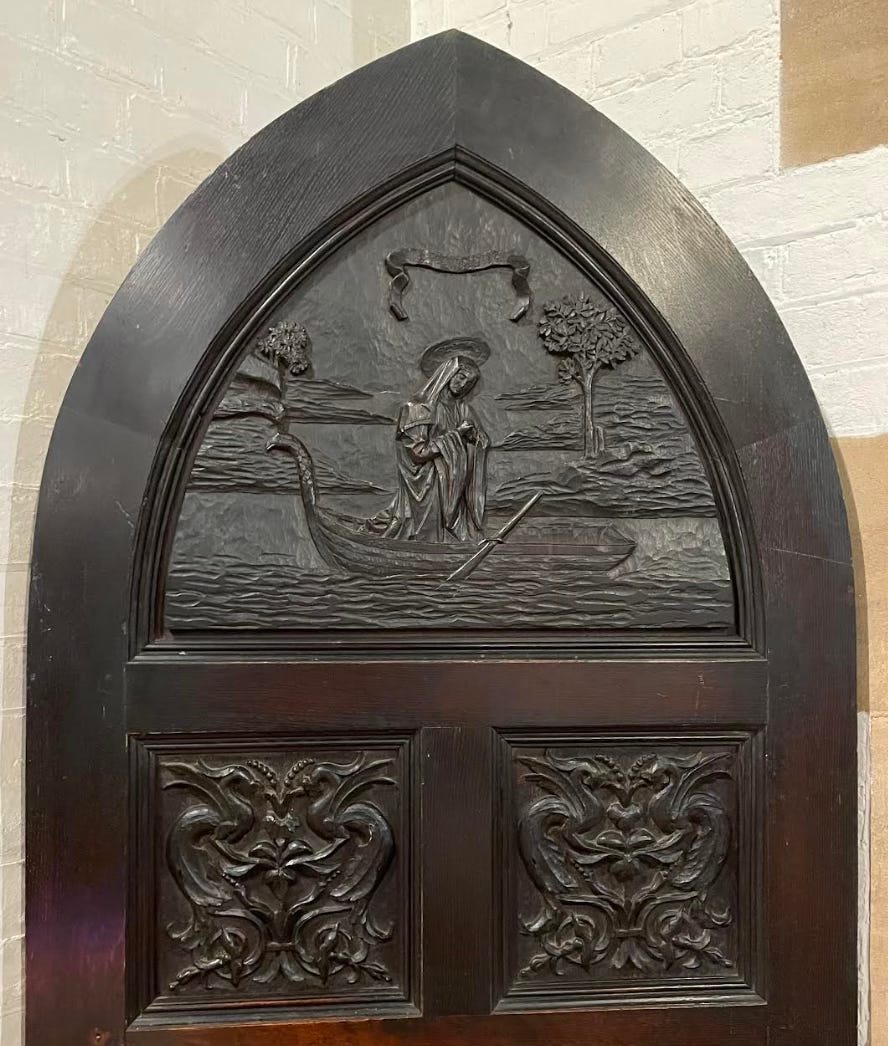
Frithuswith (Better known as “Frideswide”) was born in 650 to King Dida of Eynsham and his wife Safrida. Dida ruled over a chunk of Mercia, including Oxford, and upon the tragically early death of his wife he consecrated an abbey in her memory (somewhere in Oxford, quite possibly on Osney island itself). Frideswide, always a pious child, took holy orders, a vow of chastity, and at the age of 18 was put in charge of the abbey. Then disaster struck, her beloved father died and Algar,2 King of Leicester, took over his lands. Land alone was not enough for him; he also sought to take the virgin Frideswide as his wife. She naturally rejected him, for she was already a bride of Christ, and so he then attempted to take by force what he couldn’t gain by request. Frideswide fled into the wilderness outside Oxford, but struggled to survive in the harsh conditions that she found there. At this point God came to her aid, and provided a magical boat in which she sailed (or rowed, accounts vary) up the river Thames, passing by the end of my road, to Bampton. This scene is vividly captured, carved in wood, on a door which resides in St. Frideswide’s Church a stone’s throw from here. This door was carved by two sisters, pupils of John Ruskin, Rhoda and Violet Liddell. For many years though it was attributed to their more famous sister, Alice, the “original” Alice in Wonderland.
Algar did not take rejection lightly, and demanded that the people of Oxford tell him where his putative bride was to be found. The good citizens of the city refused to tell him anything, and so he stood spitting in rage at their gates, vowing to make them pay for their silence. Luckily, however, God intervened once more and struck him down blind!
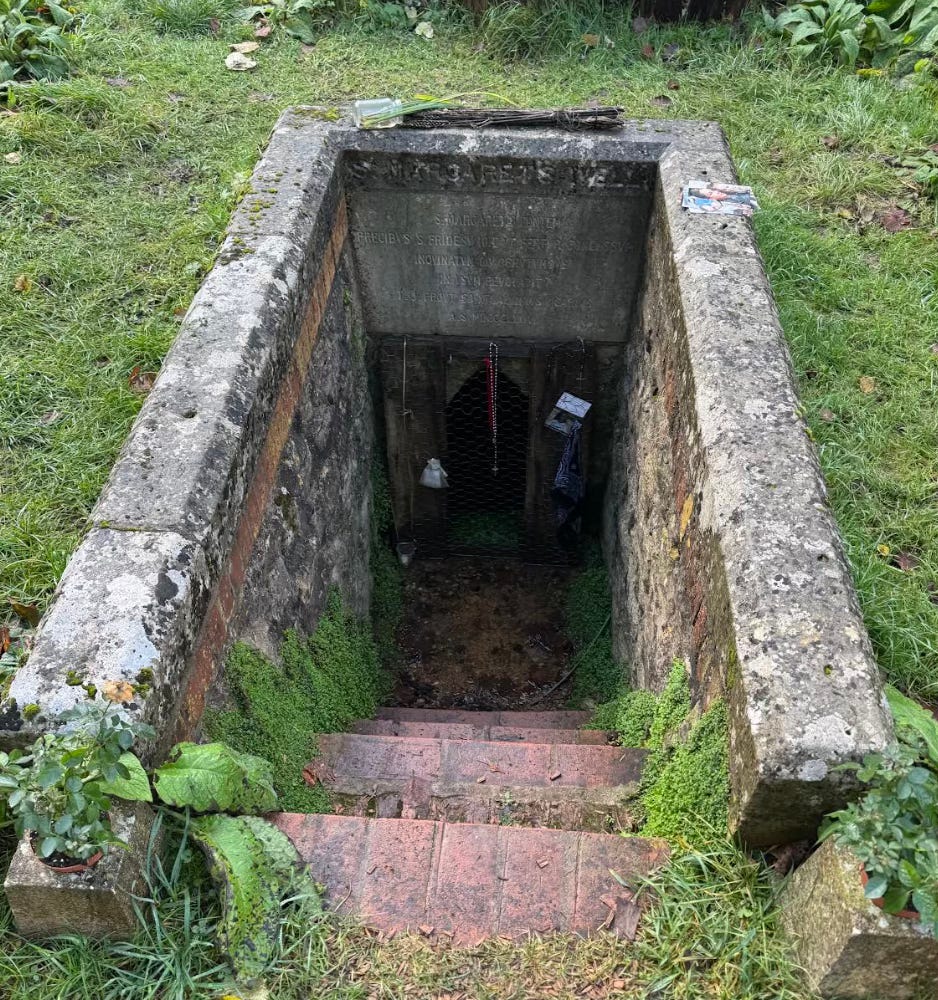
Frideswide, in the meantime, had moved down the river to Binsey, to be closer to Oxford, and hid in the nunnery there. Noticing how long it took the nuns to walk to the river each day to collect water she caused a spring to gush forth from the ground. This not only saved the aching legs of the nuns; it turned out that the water had miraculous healing powers! The well that was constructed above it was thus known as a treacle3 well and yes, it was this very well that inspired Lewis Carroll to have his dormouse claim to have lived in just such a place in Alice in Wonderland. The well remains to this day, albeit with a much later housing.
Algar, meanwhile, repented his actions and sought Frideswide out to beg her forgiveness. This she graciously gave him, and used the water from the well to restore his sight.4 She then returned to Oxford to establish St Frideswide’s Priory before dying in 727. Such were the miracles that were associated with her relics, she was beatified and became the patron saint of Oxford in 1440. Our next story also involves the formation of a religious institution, but one borne out of sexual guilt…
Edith Forne (also known in contemporary records as Eda, and later as Edith FitzForne or Forne’s Edith) was born into an Anglo-Saxon noble family probably in the 1090s. She was the daughter of Forn (or Forne) Sigulfson, a landholder in the north of England. Forn was a Cumbrian lord of probable Norse descent who managed to thrive under Norman rule. The Domesday Book (1086) records him as a king’s thegn with estates in Yorkshire, and during King Henry I’s reign he either acquired or was confirmed in the barony of Greystoke in Cumberland. Edith was clearly a very attractive woman and at some point, possibly when he was on one of his northern expeditions, she caught the eye of King Henry I. Sometime around the year 1120 she became the king’s concubine, and bore him at least one child, Robert FitzEdith (“son of Edith”)5 but the tryst probably only lasted a couple of years before the king tired of her and moved on to someone else. He did, however, set her up with a husband, Robert D’Oilly the Younger, prominent royal official. He was the High Sheriff of Oxfordshire and Constable of Oxford Castle – and notably the nephew of Robert D’Oilly the Elder, a companion of William the Conqueror who had built Oxford Castle in the 1070s.
Edith had wealth and status now but, like Frideswide before her, she was a pious Christian woman. She had been little more than a child when she had been beguiled and seduced by a king, and whilst one may consider this an easily forgivable transgression, she did not forgive herself. The king had been married; she had committed a sin. That she found peace, and indeed happiness, with Robert seems clear, but her guilt remained. So she would take long walks with her ladies in waiting on the water meadows where my house now stands, but let me handover to the great antiquarian, Anthony Wood, writing in the 1660s, to take the story from here:
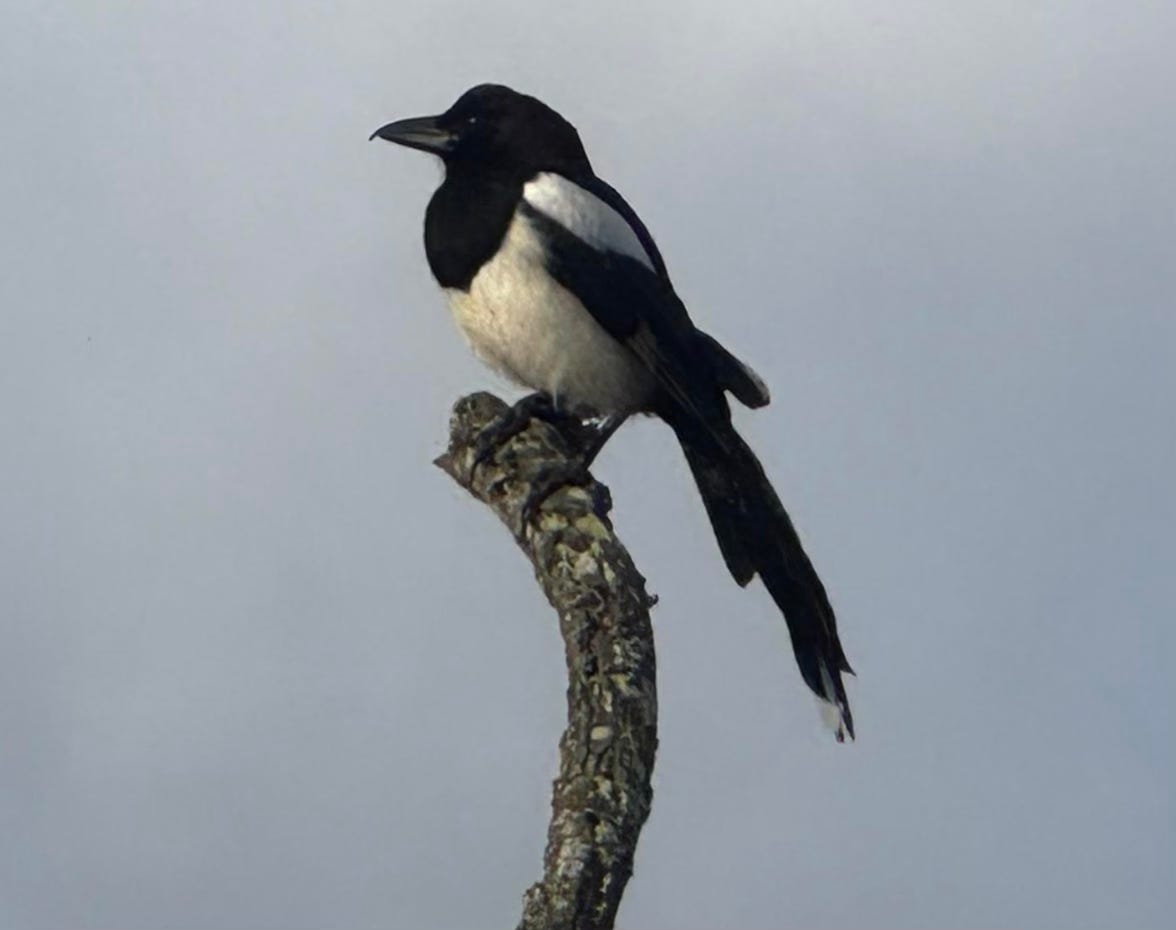
A noble lady of this city called Editha Forne wife of Robert de Oilley, (a woman given to no lesse superstition then credulity)6 to recreate and solace herself therin when she lived at the Castle. Who more particularly, as upon an evening she with her attendance walked by the river’s side, saw a great company of pyes [magpies] gathered together on a tree, making a hideous noise with their chattering. Which she beholding, did with slight notice passe it by for that time; but the next evening walking that way againe with her maidens, (as she did afterwards the third time) found againe the pyes on the same tree, and making the like noise as before, seeming as ’twere to direct their chatterings to her.
Bewildered, and somewhat intimidated, by this corvid cacophony she did what any good Christian woman would – she spoke to her confessor about it. Her confessor, alas, was somewhat lacking in her moral qualities, and decided to use these noisy birds for his own ends:
With which being much perplexed, wondered what the meaning might be; and returning home againe, sent for her confessor who was one Radulphus, a canon of St. Frideswyde’s, and relating all the particulars that had severall times hapned to her in this place, demanded of him what the reason of their chattering might be. He told her he could not directly resolve her at that time; but if she would walke there againe the next day, he would wait upon her and veiw the matter himselfe, and then give her an exact account. That time being come, they all walked the same way; where they found the pyes againe as before and making the like noise. Radulphus, seeing all this, seemed at the present to be amazed; but after mature deliberation told her (upon her often demands for resolution) “O Madam,” the wiliest pye of all, “these are noe pyes, but soe many poore soules in purgatory that doe begge and make all this complaint for succour and relief; and they (knowing you to be pittyfull and one that will have regard of their condition) doe direct their clamours to you, hoping that by your charity you would bestow something both worthy of their relief as also for the welfare of your’s and your posteritye’s soules as your husband’s uncle did in founding the College and Church of St. Georg.” These wordes being finisht, she replied:—“And is it soe indeed? now, de pardieux, if old Robin my husband will concede to my request, I shall doe my best endeavour to be a means to bring these wretched soules to rest.”
Her husband did concede, and, unsurprisingly, Radulphus became the prior to Osney Priory (later Osney Abbey), a position of huge wealth, power and influence.7 The main church was over 300 feet long, comparable to Rievaulx Abbey in Yorkshire, and it remains without a doubt the greatest building Oxford has lost. The Reformation saw it stripped of its titles, and it became little more than an open quarry for people to loot stone from. The back gardens of my street lie over the site of its precincts, and though little remains on the surface of it now, just part of a building, if you dig down a few feet you will find, as I have done, fragments of medieval tile, worked stone, and animal bones.
Edith’s tomb itself did survive for more than a century after the Reformation, and Anthony Wood was able to record it:
[she] was buried on the north side of the high altar with her image of stone, in the habit of a vowes and holding a heart in her right hand, lying upon the tumbe. In the wall of the arch over her tumbe was painted her comming to Ousney, and Radulph waiting upon her (as I have before shewed) and the tree with the chattering pyes8 theron.
Whilst the building has all but vanished, the sounds of it still persist. Its bell was taken and recast as “Great Tom” which I hear every day ringing out from Christ Church College – bronze that was first smelted the best part of a thousand years ago. And then there are the magpies, who visit my garden each day, whose chattering cuts through the morning air, and whom it amuses me to believe are the direct descendants of the ones that Edith heard all those years ago…
Edith and her husband Robert now go on to play a role in my next tale. If you mention the Civil War to someone in the UK then they will probably think about the events of the 17th century – Cromwell, the beheading of King Charles, all of that kind of stuff. Many will not realise that this is not the only civil war the country has experienced; it is simply the most recent one. Between 1138 and 1153 the country was thrown into turmoil by a conflict known as The Anarchy. Edith’s former lover, Henry I, died in 1135 and whilst he had a legion of illegitimate children, the only son he had by his lawful wife, William Adelin, died in 1120 in the White Ship disaster. His desire was to leave this throne to his daughter, the Empress Matilda, but his nephew, Stephen of Blois (better known as King Stephen) had other ideas. He had himself crowned on the 22nd of December 1135 and soon found himself battling rebellious barons, a situation exacerbated by Matilda invading the country from Normandy in 1139.
What followed was a long drawn-out series of skirmishes with the fortune of each side rising and falling. By 1142 Matilda, recently expelled from her base in London, set up her headquarters in Oxford. In addition to being a well-defended city the castle was run by the aforementioned Robert D’Oilly who had personal reasons to be sympathetic to her cause, as Edith was the mother to Matilda’s step-brother. On the 26th of September Stephen’s forces attacked the city, with his forces swimming across the Thames and other waterways. Matilda and her forces were taken by surprise, and those who were not killed or captured in the initial onslaught fell back to Oxford Castle. The complex was too well-defended to fall by force, so Stephen decided to besiege it and starve his enemy out.
By early December things were getting pretty grim in the castle, supplies were running low, and the weather turned bitterly cold – though as it turned out it was the cold that saved Matilda. What follows may sound like something from a fairy-tale, but the broad elements of what happened are true. One night Matilda and a couple of her closest companions lowered themselves out of a window of St George’s Tower (one version has them doing so with a rope made from bed-sheets). Snow lay heavy on the ground, so when they landed they took care to walk backwards, so as not to make it appear that anyone had walked away from the castle, rather towards it. All were clad in white cloaks, camouflaging them against the snow, and so dressed they were able to sneak through the lines of Stephen’s forces, undetected.
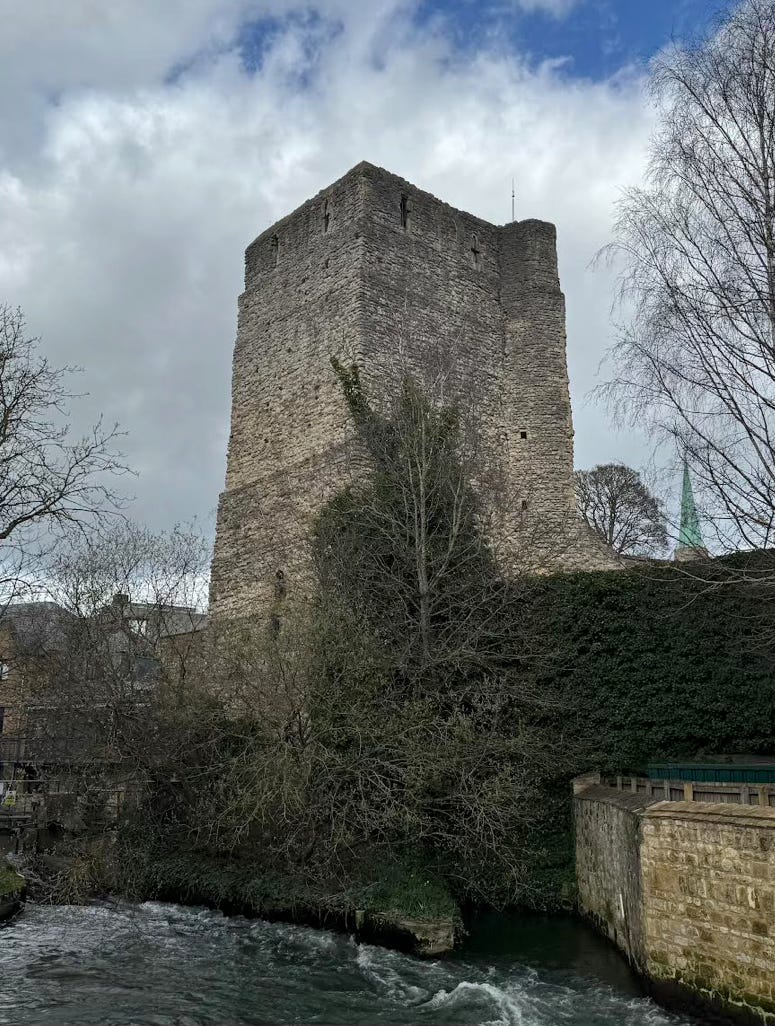
Once past the troops they were able to cross the frozen Thames, and make their way to another loyal stronghold, the castle in Wallingford. Now exactly where they crossed the Thames has been subject conjecture for centuries. I like to image that having escaped from the tower they headed to the west, away from the city and potential discovery. This would have taken them past Osney Abbey which would make sense as this was an institution founded by her ally, Robert, and so the monks there would have likely turned a blind eye. If (and this is obviously a big if) she did so then her route to the river would have taken her past my front door, and she would have crossed the frozen waters at the end of my road!
The castle surrendered the day after her escape, and it appears that loyal Robert was put to death shortly afterwards.9 The war continued for another eleven years and ended with a compromise – Stephen would remain king but upon his death Matilda’s son Henry would then become Henry II.
But what about the dragons that I promised you? Fear not, they are central to my final tale. Long ago, sometime shortly before the Roman invasion of England, the country was plagued by two rambunctious dragons. Lludd, the King of the Britons, decides that he really has to do something about this, but luckily his younger brother, Llevelys, who is the King of France, has had similar dragon issues, so he goes to meet him to ask for his advice. To make sure that they don’t get spotted by the dragons they meet on ships in the middle of the English Channel10 and Llevelys tells Lludd what he needs to do:
When you arrive home, have the length and breadth of the island measured, and where you find the exact centre, have a pit dug. In the pit, place a vat full of the best mead that can be made, and cover the vat with a silk sheet.
The idea is that the dragons will be attracted to the mead, gorge themselves upon it and fall into a drunken stupor. The sheet can be dropped upon them, trapping the beasts, and Lludd can then do with them as he sees fit. The King follows this advice and gets his men to measure the country so as to find its centre. After much careful work this turned out to be Rhydychen, which is the Welsh name for Oxford. The pit is dug, the mead procured, and just as predicted the dragons fall into the trap and are captured! Lludd then locks them in a stone chest and buries them beneath a mountain in Snowdonia (also known as “Eryri”).
But where in Oxford was this pit dug? In his wonderful book The Ancient Paths Graham Robb makes the case that the true centre of Oxford, the omphalos, is in fact Osney. Not necessarily in the sense of it being the pure geographic centre, but rather that it was the confluence of ancient Celtic paths and that as such it had a deep spiritual significance. Were you to trap dragons anywhere in Oxford, then it would be here. And this older sense of importance could well explain why Osney was perhaps where Frideswide’s first Abbey was built, and why Edith Forne’s was definitely constructed here – the place has religious saliency that goes back millennia.
If it was in Osney, then where? Some years ago Andrew (the other half of Histories) and I spent a summer’s afternoon circumnavigating Osney Island with the support of a bottle of wine (not exactly an arduous task). We then set about finding the centre, the place where the dragon pit had been dug. And after some walking and consulting of maps we determined that it was here, on an unremarkable stretch of road near the end of a footbridge over the railway.

Unremarkable or not, I can’t help but think that the nine-year-old me, on being told this story, would have been slack-jawed in wonder at the thought that possibly, a long time ago, there had once been dragons on this spot…
Yes, I am aware that the residents of Osney Town, an adjacent island, refer to it as “Osney Island” but it isn’t.
Also known as Æthelbald of Mercia. which does somewhat throw the myth into question. He didn’t become king until 716, when Frideswide was 66 years old (scarcely the young virgin one might have imagined) and her father would have been dead for decades at that point.
From the Middle English word for remedy ‘triacle’.
In some accounts, at least.
His Wikipedia page has, at various times, had wildly inaccurate dates for his birth (but none is shown at the moment). He was probably born around 1122. Evidence from the royal Pipe Roll of 1130 shows Robert’s lands in Devon were then in the custody of guardians, implying he was still a minor (under 21). And writing in 1142, the Norman abbot-historian Robert of Torigny noted that Robert FitzEdith was “still young and unmarried” at that date.
I think that this is a bit harsh of him…
He was clearly an operator.
I love the fact that her pyes surrounded her even in death.
Probably receiving a career-ending neck injury at the business end of an axe.
Obviously.
Fascinating. Thank you. Although not dragons, I think that area was in the region where the Martians' heat ray was first used.