
[I realise that this is more of a science, rather than a history, piece, but it is something I have been wanting to write about for a while, so I hope you will indulge me. Normal service will return with my next article.]
Space is big. You just won’t believe how vastly, hugely, mind-bogglingly big it is. I mean, you may think it’s a long way down the road to the chemist’s, but that’s just peanuts to space.
Douglas Adams, The Hitchhiker's Guide to the Galaxy
On the 15th of August 1977 Ohio State University’s Big Ear telescope detected a radio signal, arguably the most intriguing one in all of human history. But no one at the time noticed.It wasn’t until a couple of days later when astronomer Jerry R. Ehman was reviewing the data captured during that observation window that it was noticed. He saw the alphanumeric code indicating the signal’s strength on the printout – 6EQUJ5 – and circled it. But this signal was so interesting, so potentially significant, that highlighting it in this way was not enough for him. He wrote a single word next to it to convey his reaction: Wow!
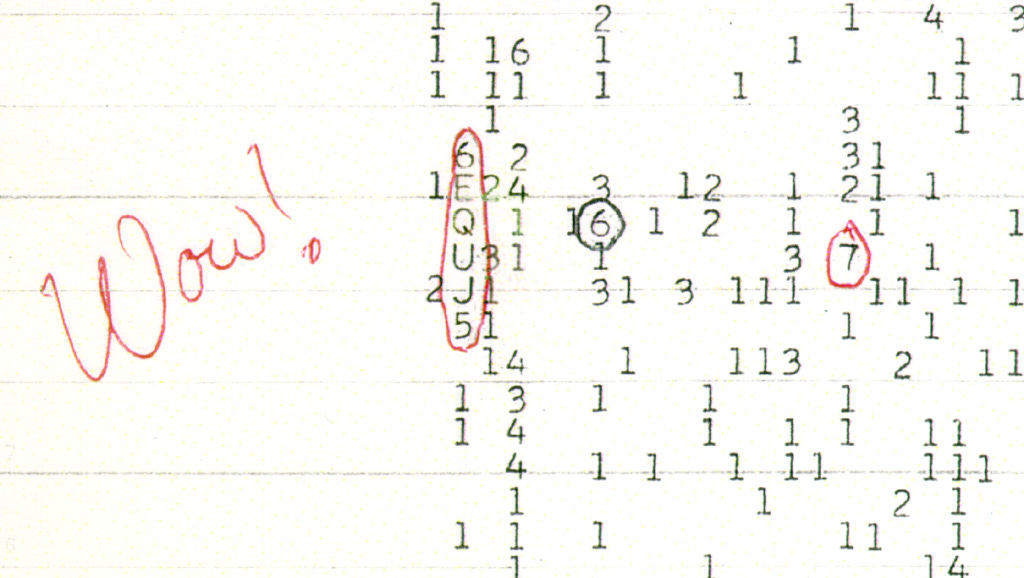
What was so special about 6EQUJ5 that it should elicit such a response? First I’ll need to talk a bit about the Big Ear. The telescope could survey a single point in the sky for 72 seconds. If there was a steady signal transmitting from that point then, as the rotation of the earth swung the receiver through the signal, you would expect to see the power of that signal increase and then diminish as the scope entered the edge of the beam, then faced it full on, then slide out of it the other side. 6EQUJ5 was a record of that signal strength, and it perfectly represented just such a rise and fall. Or as the SETI Institute puts it:
The signal rose and fell as one would expect from a cosmic source fixed on the sky – moving into and out of the telescope beam as the Earth rotated.
SETI stands for “Search for Extraterrestrial Intelligence” – wait, so am I saying that this signal came from aliens? We’ll come on to that. Even more interesting than the power of the signal was its frequency – in 1998 Ehman gave a value for it of 1420.4556±0.005 MHz, which is incredibly close to the 1420.4058 MHz of the hydrogen line. What’s the hydrogen line? It is the radio emission produced when a neutral hydrogen atom undergoes a tiny change in the relative alignment of the proton’s and electron’s spins. It is something that any civilisation sufficiently advanced to create such a signal would know, and had previously been proposed as a plausible “hailing frequency” between different civilisations who know nothing about each other other than the fact that they are able to send or receive just such a signal.
The signal was not perfectly on the hydrogen line, but had the source been moving towards the earth at around 10km/s then the Doppler shift could have explained the variance. As to where the signal came from, the possible location is in Sagittarius (roughly northwest of the globular cluster M55). A 2022 paper identified a particularly interesting sun-like star within the possible beam area some 1,800 light years away, but there is no hard evidence to suggest that this was the origin.
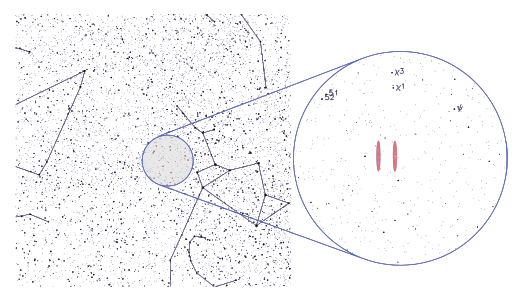

The Big Ear had two feed horns, and having been picked up by one, it should have been picked up by the other some three minutes later (or earlier). But it wasn’t. Also, because of the computer systems at the time, we don’t actually know which of the horns detected it (hence the two possible source locations). Despite repeated attempts, it was never detected again. In a 1994 interview with the Cleveland Plain Dealer Ehman said:
We should have seen it again when we looked for it 50 times. Something suggests it was an Earth-sourced signal that simply got reflected off a piece of space debris.
Oh, so it was simply a signal from Earth bounced off something? That theory has more or less been ruled out now, including by Ehman himself. The consensus is that it came from somewhere in space. As to what might have created it, we will get onto that, but first we need to visit the lunchroom of the Los Alamos National Laboratory in 1950. The physicist Enrico Fermi was sitting with his colleagues Emil Konopinski, Edward Teller, and Herbert York, when he blurted out “But where is everybody?” As Teller later recalled:
The result of his question was general laughter because of the strange fact that, in spite of Fermi’s question coming out of the blue, everybody around the table seemed to understand at once that he was talking about extraterrestrial life.
The question framed what is now called “The Fermi Paradox”, which asks, given the vast number of stars and potentially habitable planets in our observable universe, why is there no clear evidence of extraterrestrial civilisations? A number of explanations have been proposed, and I will share a few of them now:
Life is rare, and intelligent life is exceptionally rare. There simply aren’t any other civilisations even vaguely close to us in astronomical terms. This is often called the “Rare Earth Hypothesis”.
Civilisations screw up before they can cross the stars, or broadcast strongly enough to them. Resources are drained, wars break out, diseases flourish.
The “Zoo hypothesis” – civilisations are aware of us, but are not revealing themselves so as to avoid messing with our development. Think Star Trek first contact principles. Related to that, there are already probes in our solar system, but we just can’t detect them.
The “Dark Forest” hypothesis – civilisations are out there, but they are not travelling, or transmitting, so as not to draw the attention of an even more advanced race which might destroy them.
Interstellar travel is simply much harder than we have previously presumed. This is the one that I am going to focus upon and suggest how it potentially might connect with the Wow! signal.
As a child I loved reading science fiction, and still do today as an adult. So many of these stories are predicated upon the concept that species can cross between the stars that to me, at least, growing up, it seemed that it would be inevitable that a suitable advanced civilisation would be able to do so – and if so, then where is everybody?
I don’t think that now, and the reason all comes down to energy. If you want to accelerate a mass of one tonne to 10% of the speed of light (enough to get you to the nearest star in about 50 years) then you would need to apply around 1.4 gigawatts of propulsive force to it for a decade (and then spend another decade slowing it down). In other words, you would need a propulsion system that has the energy output of a reasonably sized nuclear power station, and sufficient fuel to run it for 20 years, all weighing less than a mid-sized family car. And that would only be sufficient to get the engine to the star, it wouldn’t be carrying any payload, because more mass would require more energy, which would require a more powerful engine, and more fuel.
To say that this way beyond the scope of any technology that we currently possess is something of an understatement. Ah, but what about creating anti-matter drives? In theory such a thing is physically possible but currently wildly technically impossible (let’s not even get into wormholes through space and teleportation). One particularly detailed solution to this challenge was proposed in the 1970s, Project Daedalus. It theorised that a fusion engine on a ship weighing 54,000 tonnes could get a payload of 450 tonnes to Barnard’s star in around 50 years. It would achieve this by creating around 250 deuterium-helium-3 explosions every second for four years and would use magnetic nozzles to point the charged particles created in such a way as to drive the ship.
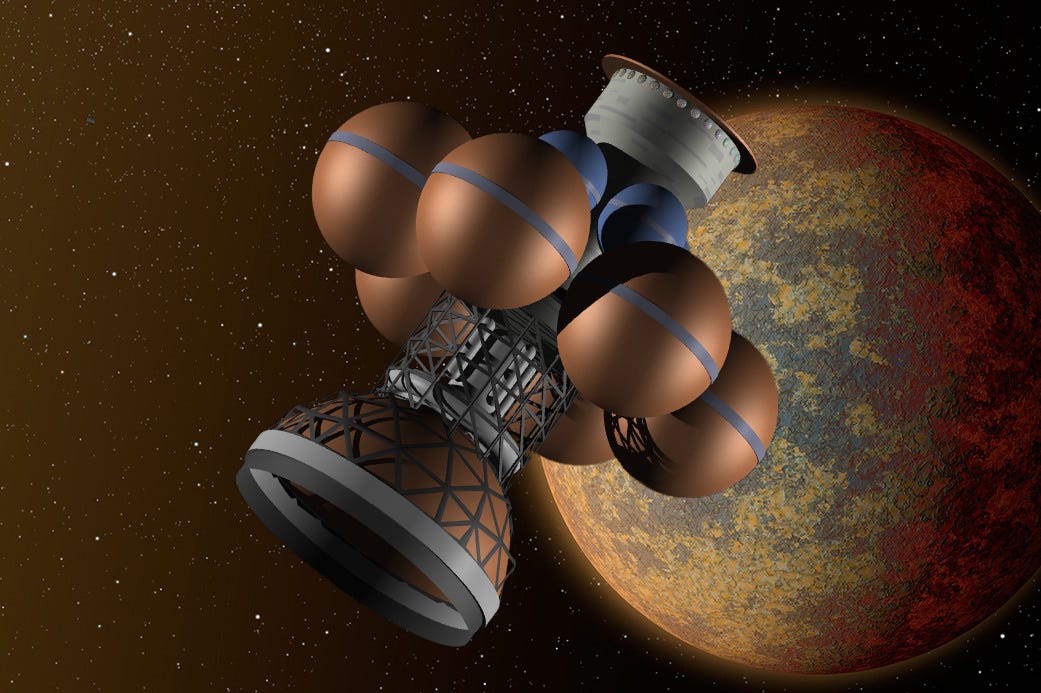

There are some problems with this. We have yet to create wholly net fusion energy (the reaction producing more energy than the whole facility consumes). Then there is the fuel, helium-31 is exceptionally rare on Earth (and, indeed, likely so on all rocky planets). There is a bit more on the moon, but you’d have to mine and process more than 100 trillion tonnes of lunar soil to extract enough for the ship (the original proposal suggested mining it from the atmosphere of Jupiter, which sounds pretty non-trivial to me).
But perhaps you don’t need an engine at all to power your ship? How about you have a solar sail in space, attach a probe to it, and fire a load of lasers at it from Earth and the photons bouncing off the reflective sail quickly accelerate the ship? That is the core concept of Breakthrough Starshot, which proposed accelerating a thousand 1 gramme probes to 20% of the speed of light using just a 4 metre diameter sail. There are a couple of problems with this idea though. To achieve it you’d have to fire 100 gigawatts (roughly the power consumption of a mid-sized country) of lasers at each sail for ten minutes. The sails would have to be essentially perfectly reflective to stop them vaporizing immediately. And if you could overcome all of that then you would have a one gramme probe, which couldn’t slow down on arrival, zipping past the star you are interested in at an incredible speed.
Perhaps I am fixating too much on speed. Maybe aliens would be happy to travel really, really, slowly across the stars, so instead of aiming for 10% of the speed of light, they are happy to settle for 0.1% of it. That would mean that for a close star the voyage time would be perhaps 5,000 years, and it could be that the nearest thing of interest would be 100,000 years away. We have no idea what alien psychology might be like, should it even exist at all, and they may well be happy to consign themselves to such vessels for generations – or freeze themselves or something – but that doesn’t alleviate all of the challenges. Put simply, things break down. The ship would be exposed to cosmic radiation and dust impacts. In the darkest of the void between the stars one cannot rely upon solar; you would need a power supply.2 None of this, again, is physically impossible, just very, very, technically challenging.
Okay, so they don’t send living beings at all, they send small, slow-moving, probes that have that common sci-fi trait, the ability to self-replicate. When self-replicating machines are proposed as a solution to a problem like this I think it useful to consider the following thought experiment. Imagine we have to send an autonomous probe to a pre-Anthropocene Earth and it has one task, to create a single iron nail from the resources of the planet. It would have to map likely landing sites from orbit, find, mine, and process the ore, then smelt it into a nail. This is probably not beyond our current technology level, but materially more challenging than, say, deploying the Mars Rover.
Now repeat that experiment, but this time the probe has to make an iPhone. Instead of sourcing one3 chemical element, you have to get hold of around seventy different ones, and honestly that isn’t the hardest part. You need to make the chips4 for it, which we do on Earth in fab plants that are among the most complex industrial facilities ever built. Hundreds of machines, upwards of a thousand processes, insane levels of precision and purity. But let’s say you can fit all of that on your probe. For it to be self-replicating it now has to be able to build a new fab plant (and so much more besides). And for it to spread to other planets, it then needs to be able to build and launch a new starship. Complexity begets complexity begets complexity begets complexity.5 The notion that such probes could be small is, with our existing understanding of technology, absurd.
None of this suggests that interstellar travel is impossible – rather that it is technically astonishingly challenging, and far beyond our current abilities. Ah, but those are our “current” abilities, look at the astonishing rate of technical progress we have made – surely it is likely that we will find better solutions to these challenges in the future?
While we have seen incredible technical developments over the last century, they have not been evenly distributed. Advancements in computing, robotics, and artificial intelligence have been breathtaking. When it comes to moving physical stuff around well, not so much. A jet engine built in 2025 is perhaps 30% more efficient than one built in 1975. The basic principles behind the internal combustion engines that still power the majority of our vehicles are the same as they were when the first such devices were built more than a hundred and fifty years ago. When it comes to space travel we have got materially better at building rockets that can land themselves and be reused, but the core propulsion technology has changed little in 60 years.6 The SLS rocket, for instance, uses RS-25 engines which use the core design of engines developed for the Space Shuttle in the 1970s.
While scientists and authors alike speculate about possible future advances, perhaps there simply isn’t a technical deus ex machina when it comes to space travel. We haven’t encountered another civilisation not because they don’t exist but because such an event would require so much time, so many resources, and so much risk, that it simply doesn’t make sense to even attempt it.
Now let’s return to the Wow! signal. Assuming that it wasn’t some random signal that somehow bounced off Earth, nor that it is a transmission from an alien civilisation, then what could have caused it? A number theories have been proposed. The most likely explanation is that a cold cloud of hydrogen somewhere in Milky Way might have been stimulated by an intense burst from a magnetar7 or soft gamma repeater8 and this briefly turned it into something like a natural radio laser, and that was the signal detected. Alternatively the signal could have been generated by a cloud of hydrogen enveloping a comet. This was once quite popular, but has now generally considered to be somewhat weak. There are other, generally considered less likely, options as well. None has been conclusively proved to have been the cause of the signal, but probably, one day, one of them (or something wholly new) will finally, if banally, provide the explanation that has been sought for almost fifty years.
But perhaps it won’t.
Perhaps the signal is artificial.9 Perhaps it was created by a civilisation that had reached the same conclusion that I have. That even though there might be other intelligent life-forms in the universe, they would never get to meet them. So instead they decided to dedicate their resources to sending a signal out into the cosmos. A signal that conveyed a single, simple, message:
You are not alone.
Yes, I am aware that you could replace the helium-3 with tritium, but that mostly outputs neutrons which cannot be magnetically guided. Oh, and it has a half-life of 12.3 years.
To produce 10MW of electricity for 100,000 years would need around 1,000 tonnes of uranium, for example.
Actually two, if all you found was iron oxide you would need some carbon as well, but that is pretty easy to get hold of.
Well, couldn’t they just take a store of chips with them and use those? For sure, but at some point those would run out and they would have to make more.
And you still have the problem of stuff breaking down over the courses of the thousands of years that the journeys would require.
Yes, methane is a more energy-dense fuel by mass, but fundamentally our rockets are still just burning stuff to blast off into space. There hasn’t been the orders of magnitude-level improvement that would make interstellar travel even vaguely possible.
A rare type of neutron star with a magnetic field around a trillion times more power than that of the Earth.
They are other rare things, which could be magnetars, that send out sudden bursts of low-energy gamma rays and hard X-rays.
I could have gone into a lot of detail about likely energy requirements for it to have come from a source 1.8k light years. And also why a repeat signal might not been detected (think of the transmission less being like a lighthouse broadcasting across a narrow slice, more like a laser on gimbals at a club transcribing the interior of a sphere with its beam, which takes much more time) but I felt I had already put way too much science into what purports to be a history Substack..
Pretty convincing, sadly😏
It is only a matter of time before someone invents a rocket that travels on a laser beam.
Stay positive