
The other afternoon, returning from a walk, I remembered that I hadn’t yet had lunch, so I picked up a sandwich from Marks and Spencer at Oxford station to eat when I got home. An inconsequential act, buying a sandwich, but one that millions of Britons do each day. That act, as is often the case with me, led me to wonder how this repast became so ubiquitous, so today I will be exploring its history.
Now there is, of course, a famous story about the invention of the sandwich (the one that gave them their name) that many of you will doubtless know. We will get to that in due course, but in the meantime let us go a bit further back in history. You can’t have a sandwich without bread, The earliest breadcrumbs (or more precisely charred pieces of unleavened things like bread) date back between 11,600 and 14,600 years, and were produced by Natufian hunter-gatherers in the Black Desert in what is now Jordan. Far older grinding stones, used to crush down seeds, have also been found with some Australian examples being an astonishing 60,000 years old. It isn’t certain that once crushed into a crude flour that these seeds were baked into breads – they could have been boiled up, for example – but it seems unlikely that at some point someone wouldn’t at least have tried baking up some dough. Which is a long-winded way of saying that bread is incredibly old.
Six thousand years ago bread was a core part of the diet of neolithic Egyptians, but it isn’t until the first century BCE that we get a reference to something that is, if not a sandwich per se, a type of hand-held bread snack. The Babylonian Talmud (albeit compiled several hundred years after the events that it describes) notes how Hillel the Elder would, during Passover, wrap lamb and bitter herbs in soft, flat, unleavened matzah bread – not a sandwich, but something basically the same as a modern wrap.
Around a thousand years later, in the 10th century, Abū Muḥammad al-Muẓaffar ibn Naṣr ibn Sayyār al-Warrāq complied the earliest known Arabic cookbook, and it contains an elaborate recipe for a bazmāward, a type of cooked wrap:
Take meat and pound it finely, as meat is pounded for laqāniq [sausages]. Add a little kidney fat, onion, fresh herbs and rue. Add ground coriander, black pepper, caraway, cumin, spikenard, cloves, nutmeg, ginger and cassia.
Break five raw eggs over the meat, add a little chopped garlic and onion, and pound everything together until thoroughly blended.
Take a soft sheet of ruqāq [very thin flatbread] and spread sheep’s caul fat over as much of its surface as possible. Spread the pounded meat mixture over the caul fat.
Take five hard-boiled eggs, shell them but leave them whole, and arrange them in a row along the meat mixture.
Roll the ruqāq up tightly around its filling. Truss the roll with clean intestines. Fasten it to four sticks of khilāf [willow] with thread so that the roll keeps its shape.
Lower it into the tannūr oven and set it upon a flat tile placed directly over the fire.
When it is cooked, remove it and cut it crosswise into slices; these pieces are the bazmāward. Arrange them on a serving dish and serve them with Nabataean murrī [a salty fermented sauce] or with mustard.
In medieval Europe we find bread being used as trenchers, essentially as plates. Food was served on large pieces of generally stale bread, and over the course of the meal it would soak up the fats and juices and to be eaten at the end of the repast (or, if one were rich, given to the dogs or the poor). I mean, one could argue that this is a form of open sandwich, but I think that this is really stretching the definition. For an early recipe for a true open sandwich we turn to Bartolomeo Scappi (1500–1577) a 16th-century celebrity chef who cooked for a number of Popes. In his 1570 book Opera we have this recipe:
To make crostate, that is, pan ghiotto, with pork jowl or ham
Once the bread has been cut in the manner described above [Take slices of bread baked a day previously, about the thickness of the back of a knife], fry it in butter or in rendered lard. Have ready pork jowl cut into slices, or ham, and fry it in a pan with finely chopped small onions and the tips of sage.
When these have been fried, add a little vinegar and cooked grape must—or sugar—together with pepper and cinnamon, and heat it through briefly.
Have the slices of bread arranged on a dish and moisten them with a little hot fat. Place the pork jowl or ham on top, together with the other ingredients, and serve hot.
The Dutch are famous to this day for their belegde broodje, their open-faced sandwiches, and this too has a storied history. The English naturalist John Ray (1627–1705) has this account of them from 1663:
The common people feed much upon Cabiliau (that is Cod-fish) and pickled Herrings which they know how to cure or prepare better than we do in England. You shall seldom fail [sic] of hung Beef in any Inn you come into, which they cut into thin slices and eat with Bread and Butter, laying the slices upon the Butter.They have four or five sorts of cheese, three they usually bring forth and set before you. (1) Those great round cheeses, coloured red on the outside, commonly in England called Holland cheeses. (2) Cumin-seed cheeses. (3) Green cheese, said to be so coloured with the juice of sheep’s dung.1 This they scrape upon buttered Bread, and so eat.
Okay, so this is all well and good, but these aren’t proper sandwiches consisting of two slices of bread with a filling in between. We now come to the famous origin story of the sandwich, or at least the tale that gave them their name. Those of you who have read a number of these pieces may well now be expecting me to say that this, like many other famous tales of development and discovery, simply didn’t happen. Well, I have a surprise for you if so… this one is actually true! John Montagu, 4th Earl of Sandwich (1718–1792) was a keen gambler, being particularly fond of cards. He didn’t want to waste valuable playing time through leaving the table to eat, nor did he want to get grease upon his cards, so he would request a snack that consisted of a slice of meat between two pieces of bread. Other players soon embraced this delicacy and were said to order “the same as Sandwich!” and the name stuck to this day.
As for when exactly the practice arose, we can’t be certain. We do know that it had properly taken hold by the 1760s because the historian Edward Gibbon (most famous for his The History of the Decline and Fall of the Roman Empire) wrote in his personal journal for the 24th November 1762:
I dined at the Cocoa Tree. That respectable body, of which I have the honour of being a member, affords every evening a sight truly English. Twenty or thirty, perhaps, of the first men in the kingdom, in point of fashion and fortune, supping at little tables covered with a napkin, in the middle of a coffee-room, upon a bit of cold meat, or a Sandwich, and drinking a glass of punch.
The French traveller, Pierre-Jean Grosley, who was in the capital around the same time details the specifics of the origin story in his book A Tour of London published a decade later:
A minister of state passed four and twenty hours at a public gaming-table, so absorpt in play that, during the whole time, he had no subsistence but a bit of beef, between two slices of toasted bread… This new dish grew highly in vogue, during my residence in London: it was called by the name of the minister who invented it.2
There can be no doubt that Sandwich gave his name to the sandwich, but is it also the case that he invented it? Well, he certainly wasn’t the first person to put meat between two slices of bread. Nearly a century earlier we have a description of a fried sandwich in Hannah Woolley’s 1670 book The Queen-like Closet or Rich Cabinet:
Take a rosted Kidney of Veal, cold and minced small, put to it grated bread, Nutmeg, Currans, Sugar and Salt, with some Almonds blanched and beaten with Rosewater, mingle all these together with beaten Eggs and a little Cream, then cut thin slices of white Bread, and lay this Compound between two of them, and so fry them, and strew Sugar on them, and serve them in.
Soon the word sandwich had reached sufficiently common parlance that it was being used in cookery books, such as in 1773’s The Ladies Assistant3 by Charlotte Mason.4

By 1804 we have multiple sandwich recipes in the 1804 book Culina Famulatrix Medicinae5 by Scottish physician Dr. Alexander Hunter (1729–1809) including these:
A Butterham.
TAKE any quantity of butter; work into it some made mustard, and having ready some thin slices of bread from a penny loaf, spread this composition upon them. Over each piece put a thin slice of Gloucester cheese, and upon it spread a layer of buttered mustard, and over that put a thin slice of ham, or meat of any kind. Cover all with a slice of bread buttered as at first. Then press the slices gently down to make them adhere, and with a sharp knife cut the bread neatly into mouthfuls. This is a Dutch Sandwich.A Shrimp Sandwich.
PUT a layer of potted shrimps between two pieces of white bread and butter, and after pressing the Sandwich gently down, cut it with a sharp knife neatly round the edges. It is usual, before closing in, to spread a little made mustard over the meat.
Industrialisation, combined with the spread of the railways results in an explosion in sandwich consumption, as people needed cheap, simple, food that could be eaten on the go. The quality of the catering provided in railway station has been mocked for well over a hundred and fifty years in the UK. None other than friend of Histories Charles Dickens did so in a statical 1867 piece about a fictitious station “Mugby Junction”:
“Mugby Junction” was especially dedicated; and it seems appropriate that the readers of this journal should be introduced to the doughty champions who have grappled with and conquered the peculiar abuses we have so long inveighed against in vain.
The pork and veal-pies, with their bumps of delusive promise, and their little cubes of gristle and bad fat; the scalding infusion satirically called tea; the stale bad buns, with their veneering of furniture polish; the sawdusty sandwiches, so frequently and so energetically condemned; and, more than all, the icy stare from the counter, the insolent ignoring of every customer’s existence, which drives the hungry frantic—all these are doomed.
The men are rapidly teaching the public that better things are possible. Hearing, to our astonishment, that wholesome food, decently served, could now be obtained at certain railway stations.
In 1901 we see the first mention of that American classic, the peanut butter and jelly sandwich. Julia David Chandler claims to have invented it, but it seems highly likely that versions of it were around before then:
For variety, some day try making little sandwiches, or bread fingers, of three very thin layers of bread and two of filling, one of peanut paste, whatever brand you prefer, and currant or crab-apple jelly for the other. The combination is delicious, and, so far as I know, original.
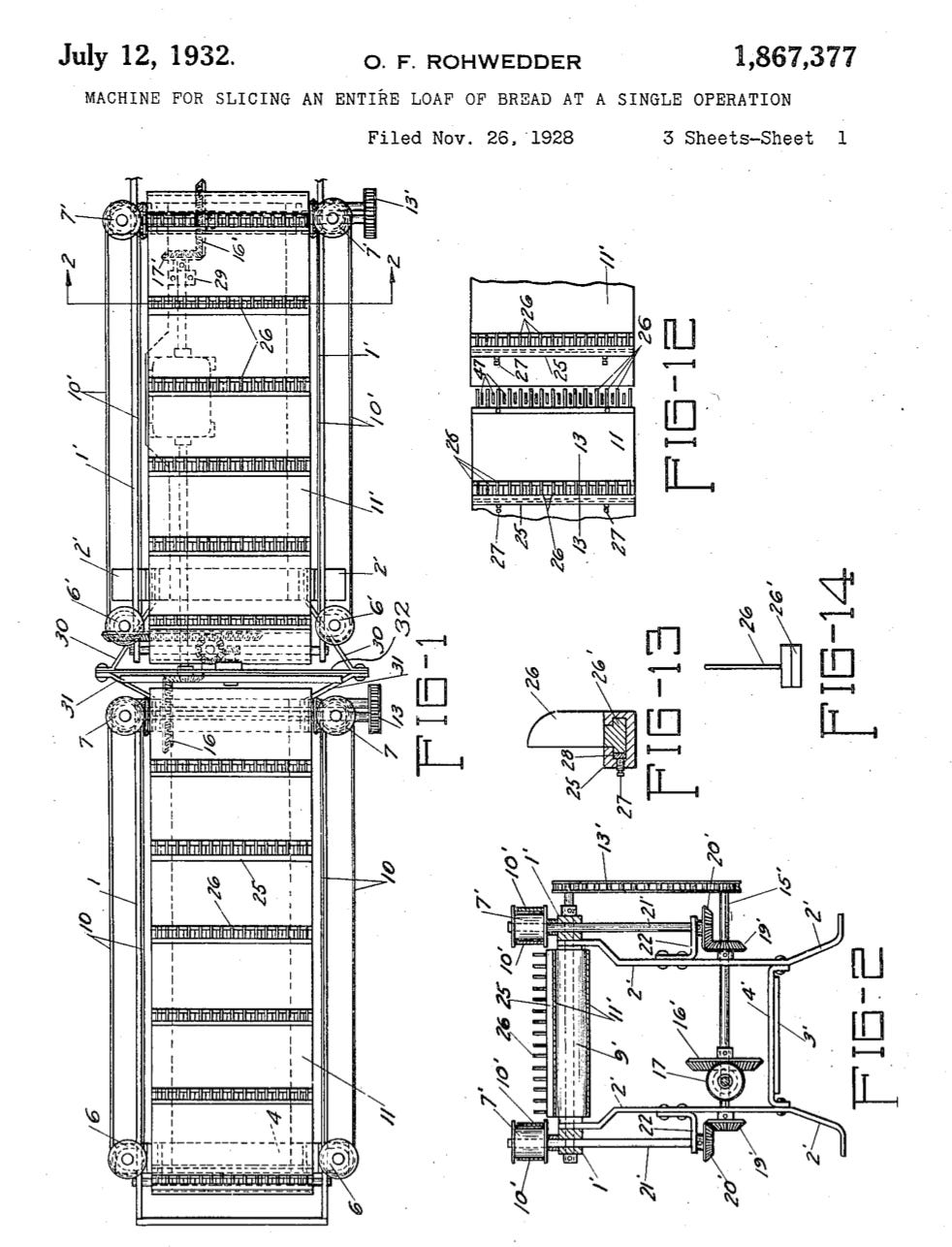
Bread at this time was still being laboriously cut by hand which is why pre-sliced loaves were a game-changer for both commercial and domestic sandwich production. For this we have to thank Otto Frederick Rohwedder (1880–1960) of St. Joseph, Missouri. In 1927 he succeed in making a machine that both sliced and wrapped bread. Unlike everyone that followed him he was unable to claim that his invention was “the best thing since sliced bread”, but I was delighted to discover that he said his achievement was “The greatest forward step in the baking industry since bread was wrapped”!
You may have encountered discussions online, or, indeed, in person, where it is debated exactly what a sandwich is. Is, for instance, a hamburger a sandwich? Is a hotdog? You may therefore be interested to know that in the state of Massachusetts at least there is a formal definition of this food. As case was brought by a Panera Bread franchisee against the shopping mall it was located in claiming that as its tenancy was on the basis that it was the only sandwich shop allowed then a burrito establishment could not be opened nearby. The judge disagreed:
Relying on the dictionary definition requiring two pieces of bread with a filling between them, the court concluded that items like burritos, tacos, and quesadillas made with a single tortilla are not commonly understood to be sandwiches.6
However, that definition is not universally accepted. In New York, for instance, the definition of a sandwich is much broader:
Sandwiches include cold and hot sandwiches of every kind that are prepared and ready to be eaten, whether made on bread, on bagels, on rolls, in pitas, in wraps, or otherwise, and regardless of the filling or number of layers. A sandwich can be as simple as a buttered bagel or roll, or as elaborate as a six-foot, toasted submarine sandwich.
Some examples of taxable sandwiches include:
bagel sandwiches (served buttered or with spreads, or otherwise as a sandwich);
burritos
hamburgers on buns, rolls, etc.;
hot dogs and sausages on buns, rolls, etc.;
open-faced sandwiches;
wraps and pita sandwiches.
Which ever way you define them, sandwiches continue to be wildly popular. In the UK Brits chomp their way through more than ten billion of the things a year (and that is using the narrow “Massachusetts” definition of the dish). I have just contributed to this number, since starting this piece I have eaten another one…
Hard pass from me, I am afraid.
One biographer has suggested that Sandwich actually came up with the dish, for the same reasons, whilst hard at work at his desk in the Admiralty. Which is more laudable, clearly, but just not such a good story.
Or to give it its full title, The Lady’s Assistant for Regulating and Supplying her Table, Being a Complete System of Cookery, Containing One Hundred and Fifty select Bills of Fare, properly disposed for Family Dinners of Five Dishes, to Two Courses of Eleven and Fifteen; With Upwards of Fifty Bills of Fare for Suppers from Five Dishes to Nineteen; and Several Deserts; Including Likewise the fullest and choicest Receipts of various Kinds, with Full Directions For preparing them in the most approved Manner, from which a continual Change may be made as wanted in the several Bills of Fare. Published from the Manuscript Collection of Mrs. Charlotte Mason, a Professed Housekeeper who had upwards of Thirty Years Experience in Families of the first Fashion. Which is a bit of a mouthful.
Probably the earliest known sandwich recipe.
Amusing subtitled Or, Receipts in Cookery: Worthy the Notice of Those Medical Practitioners, who Ride in Their Chariots with a Footman Behind, and who Receive Two-guinea Fees from Their Rich and Luxurious Patients.
Yes, I do realise that this does not resolve the hotdog or hamburger questions, but see later…
Have to say the revamp to 'the greatest thing since sliced bread' rolls off the tongue a lot easier than 'The greatest forward step in the baking industry since bread was wrapped'!
This was a fun read, thank you! I was expecting for the Earl of Sandwich origin story to be debunked (eek, have I just given it away!?)