
A few weeks ago I played Rock, Paper, Scissors with a friend to make some trivial decision that we couldn’t otherwise agree on. The decision was so trivial that I can’t even remember now what it was, but I remember thinking at the time that I had no idea when or how I had learned this simple game, it was something that I have always known how to play – and I suspect that might be true for many of you reading this too. Back home now travelling for a bit I still can’t recall who first taught it to me, and I suspect I never will. So instead I am going to do the next best thing and dig into the history of the game itself.

It turns out that the practice of throwing shapes with your hands to settle disputes or win friendly bets is both much older than I would have imagined and a surprisingly recent arrival in the West. The earliest mention of a game like this can be found in the book written by Xie Zhaozhe (alive around the year 1600) which describes it as being played during the later Han Dynasty (947- 951 CE):1
In the Later Han, when various generals and high ministers gathered at banquets, they played a “hand-gesture command” (shǒushìlìng, 手勢令). Its method was: the palm represented a “tiger’s breastplate”; the finger joints, “pine roots”; the thumb, a “crouching owl”; the index finger, a “hooked halberd”; the middle finger, a “jade pillar”; the ring finger, a “submerged dragon”; the little finger, “surprise troops”; the wrist, the “three Luo”; and the five fingers, “strange peaks.” But I do not know how its rules were actually used. Nowadays, children in the lanes have a game of grabbing the middle finger—could that not preserve its leftover idea? Yet for generals and ministers to do this was already quite improper; and that Shi Hongzhao, because he did not understand it, drew his sword and cursed at others is even more laughable — eventually it opened the way to a calamity of family slaughter. Alas!
Clearly this version is more complex than the three-choice set that exists today, and as noted in the text, we don’t know how it was played. Li Rihua (1565–1635) also recorded a description of something similar in Note of Liuyanzahi (probably compiled around the time of his death in 1635) and makes it clear that this was a popular drinking game:
In common drinking [games], people use their fingers—bending and extending them and ‘contending’ (matching/striking) with each other—this is called huoquan (豁拳), also called huozhitou (豁指頭). It works by watching from a distance how many fingers a person extends or retracts, using hidden tactics and competing for speed. I very much dislike it, because it becomes a gateway, little by little, to changing seats and noisy shouting.
By the 1600s the game had travelled from China to Japan, and this is where the now familiar set of three moves developed (though as we shall see, they have different names in the many iterations of the game). As a group they are called sansukumi-ken (ken of the three who are afraid of one another). From the 18952 book Korean games with notes on the corresponding games of China and Japan by Stewart Culin we find a description of the game we know today:
The same name, Ken, is applied in Japan to a large number of games played by two persons with the hands and fingers. One of the commonest of these games is Ishi Ken, or "Stone ken', usually called Janken, In Ishi Ken the fist is called ishi, "stone”; “the open hand”, kami, "paper," and the extended index finger and thumb, hasami, "scissors" The players extend their hands simultaneously. Stone beats scissors, as scissors will not cut stone. Paper beats stone, as paper will wrap up stone, and scissors beat paper, as scissors cut paper. Janken is often used to decide who shall perform some duty or task. Thus, jinrikisha men play it to determine which is entitled to a passenger. In this case it is customary to cry "one, two, three," which is uttered as a thrice-repeated hissing sound before each decisive movement of the hand.
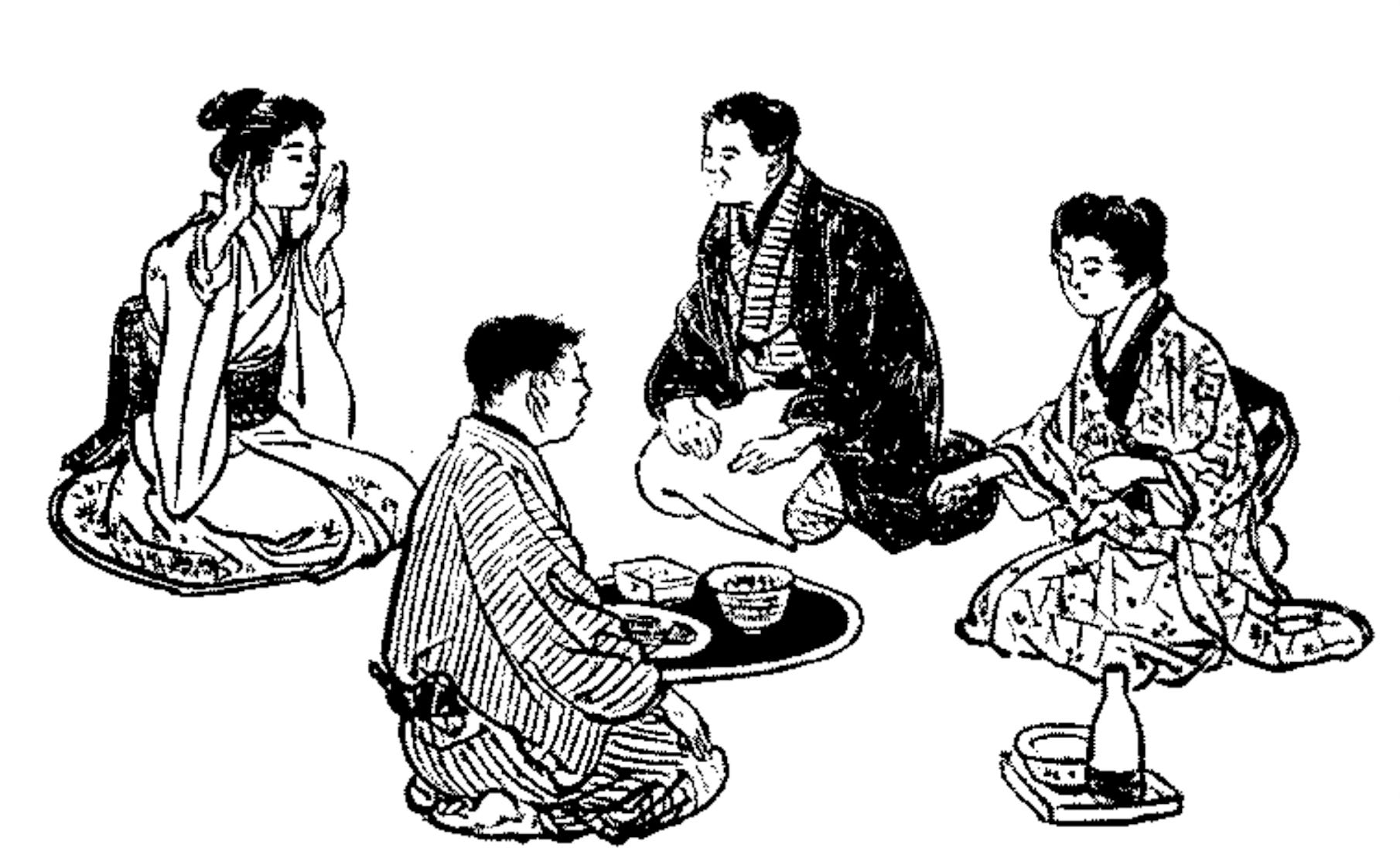
I am a little sad that this is the version I learned, rather than Reptile Ken which Culin goes onto describe:
MushiKen, or " Reptile Ken'' is played like Janken, The thumb is called hebi, "snake”; “the forefinger”, kairu, "frog"; and the little finger, namekuji, "slug." The snake beats the frog, the frog the slug, and the slug the snake.3
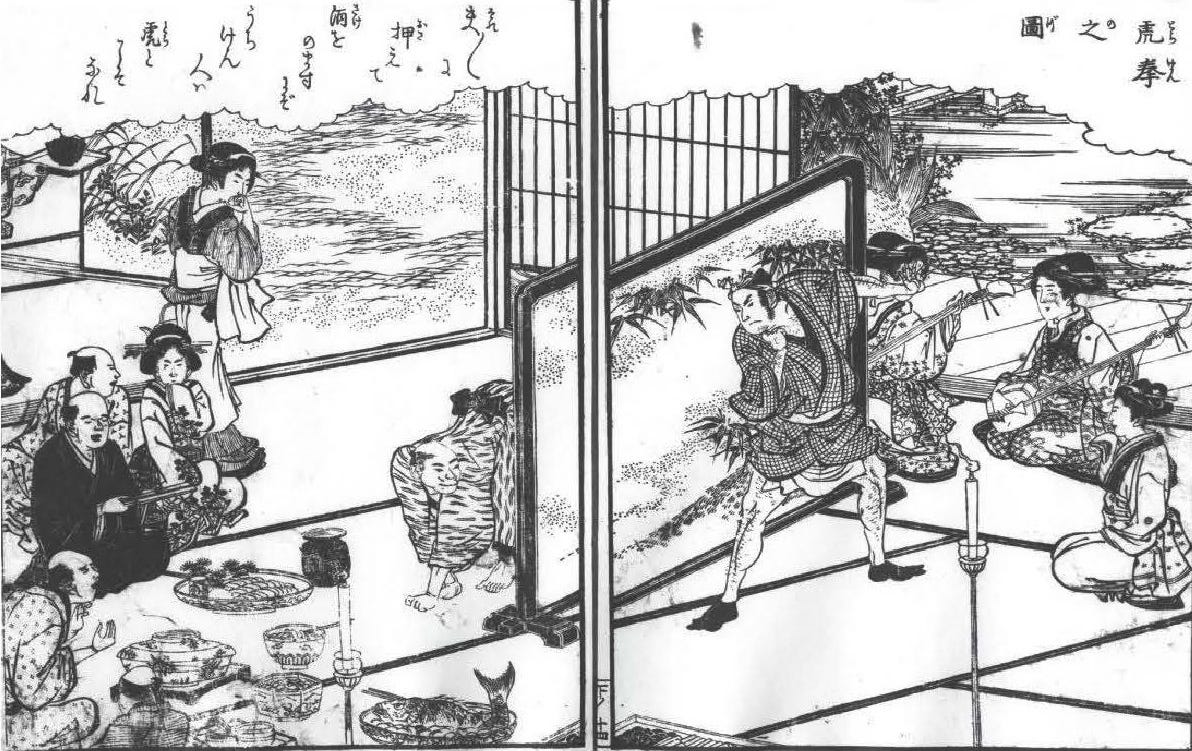
Some versions of the game involved more than just the hands. Tora-ken (Tiger-ken) involves Watonai (a warrior hero popular in early 18th century Japanese theatre) who beats the Tiger, who beat’s Watonai’s mother, who in turn beats Watonai. The standard set of three, but the players would enact their selection using their entire bodies – crouching for the tiger, standing tall as the warrior, and stooping as the aged mother. You may be wondering how readily this could be played, as surely it would take time to adopt the various positions, clueing the selection the player was making? It seems that the answer was that the players would make their choices on either side a screen, which would be pulled away to reveal the outcome as shown in this woodcut of 1809:
If you wanted to do something more than simply decide who buys the next round, or has to down a shot, then there was a more grown-up version of the game that uses both hands as Culin once more explains:
These may be regarded more as play than as serious games. Such is not always the case with the following game of Ken commonly known as Kitsune Ken, or “Fox Ken.” In Kitsune Ken, the two hands slightly bent forward and raised to the ears is called kitsune, “fox”; the two hands placed on the thighs in the respectful posture, shdya, “the headman of a village”; and the extended forefinger, teppo, “gun.”
In this game kitsune beats shdya, because the fox can deceive the man ; the shdya beats teppo, because the gun may not shoot the magistrate, but the teppo beats the kitsune, because the gun kills the fox. There are a great variety of positions in which the hands may be placed to represent the figures in Kitsune Ken, no less than twenty-five4 different attitudes being used for kitsune, and ten, it is said, for shdya,
This wasn’t simply a game, it was a full-on spectator sport:
Kitsune Ken is said to be more properly called To Hachi Ken, after an itinerant quack doctor named To Hachi,5 some two hundred years ago, when the game was very popular. Instruction is regularly given in Hachi Ken by teachers of the game, who are usually schoolmasters. In Tokyo matches are held at places devoted to the game, such as the Kotobuki Tei. The announcement is made by circulars and an admission is charged. Many hundred spectators assemble, and from 70 to 120 contests are held during the day and evening. A structure, shi hon bashira, “four posts,” consisting of a square pavilion, supported by four bamboo posts, is erected for the players. This pavilion is similar, only smaller, to that used in wrestling, and the posts are colored in the same manner – green, red, white, and black – to represent the four seasons.
The players sit opposite to each other at the sides of the pavilion, within which a small narrow table, ken dai, is placed, upon which they rest their elbows. Two umpires, called Gyoji and Mukogyoji, who have fans, gumbai, like those used by umpires in wrestling sit on the other sides. At the corners are four men called Toshiyori, “Elders,” who watch the game. They are usually experts who have retired from contests. They are appealed to when a controversy arises. They are called respectively: Asakusa, Shiba, Kanda, and Kojimachi, Toshiyoti, from the four principal wards of Tokyo, which they are supposed to represent. Small prizes are given, such as inexpensive watches or kimono (coats) to the successful players.
It is hard to say exactly when awareness of the game began to spread from Japan to the West, but it seems likely that the 1910 book Home Life in Tokyo by Jukichi Inouye played a role:
There is a curious diversion called the game of ken, or fists, which, its name notwithstanding, has nothing to do with pugilism. The principle of the game is that there are three positions of the hands or fingers, each one of which beats one and is beaten by the other, of the remaining two. The game is played with one or two hands. That played with both hands is called the fox-ken; its three positions are the putting of the open hands with the palms outward close to the temples in imitation of the fox, the stretching out of the right arm with the hand closed while the left hand is brought to the breast, which represents the huntsman with a gun, and the placing of both hands on the knees to show the staid manners of the village headman. The fox may bewitch the headman as that animal is popularly believed to possess magical powers, but may be killed by the huntsman, who, however, must not shoot the headman; thus, the fox beats the headman, who beats the huntsman, who, in his turn, beats the fox.
The game is played by two persons, who must move their hands with uniform rapidity, for the game is spoilt if either side moves more quickly or slowly than the other. It is a favourite game at convivial parties, especially if one of the parties is a geisha, though it is not so popular now as it used to be. The person who beats the other three times running is declared the winner, and the defeated party has, as forfeit, to drink a cup of sake.6 The stone-ken is played with one hand; in this the closed hand represents a stone, the open hand a piece of paper, and two fingers or a finger and the thumb spread out a pair of scissors; the stone may be wrapped in the paper, but is proof against the scissors, which may, however, cut the paper. This ken is played less often as a game than for deciding in a case where one would toss a coin in England, for tossing up is unknown in Japan.
Certainly by 1916 it was well known enough to get name-checked in The Campfire Girls go Motoring by the wonderfully named Hildegard G. Frey. Here it is called “John Kempo” a phonetic Anglicisation of the standard chant じゃんけんぽん (jankenpon, often rendered jan-ken-pon) — the cry used to start rock–paper–scissors in Japanese.
As there didn’t seem to be much difference between them we played ‘John Kempo’ and the northern route won, two out of three.
Hang on, you7 might be thinking, surely the game came to the USA much earlier, for it is sometimes called Rochambeau? So yes, it is claimed that the even more wonderfully named Jean-Baptiste Donatien de Vimeur, comte de Rochambeau (1725-1807), the French army officer who played a key role in achieving the American victory at the siege of Yorktown played the game and gave his name to it. Specifically it is said that he, George Washington, and Cornwallis (the British commander) used it to determine who would be the last to leave Cornwallis's tent after the signing of the British surrender at Yorktown in 1781. There is, alas, no historical evidence to back this up. The earliest association I can find between his name and the game dates from 1936.
The game is, when you think about it rather odd. The best strategy is to have no strategy at all, to make purely random selections, hard though this might be. That way you can ensure that you don’t provide any clues to your opponent as to what your next move is. In theory a person with sharp eyes, and even sharper reflexes, can guess the shape you are going to make as your hand comes forwards, and rapidly pre-empt it, but really is a form of cheating, I think. And if that approach is allowed, then it turns out that humans can be defeated every single time by, appropriately enough, a Japanese robot with cameras and micro-second reaction times. You can watch a video of it doing just there here!
Yes, I am aware that the Wikipedia page has the dates for the Eastern Han period, around a thousand years earlier. I suspect that this is due to confusion over the terms used to describe the periods.
There is also mention of it in the 1890 book Things Japanese: The Japanese play various games of forfeits, which they call ken, sitting in a little circle and flinging out their fingers, after the manner of the Italian mora. The most popular kind of ken is the kitsune ken, or "fox forfeit," in which various positions of the fingers represent a fox, a man, and a gun. The man can use the gun, the gun can kill the fox, the fox can deceive the man; but the man cannot kill the fox without the gun, nor the fox use the gun against the man. This leads to a number of combinations. Another variety of the game of forfeits is the tomo-se, or "follow me," in which the beaten player has to walk round the room after the conqueror, with something on his back, as if he were the conqueror's baggage coolie. The dance called by foreigners "John Kino" is a less reputable member of the same family of games.
No, I don’t know why the slug beats the snake, it seems pretty counter-intuitive.
25!
Sadly I can’t find out anything about him, he sounds fascinating!
I might be tempted to play to lose…
Or some of you, at least.
Thank you for diving into this fascinating history, Paul! Good to see that you quoted Inouye’s “Home Life in Tokyo.” I have a 1911 edition on my shelves. It is a beautiful book and very well written.
I researched the history of Japanese ken games four years ago and found quite a few photos and several film clips that show how important these games were in Japan. I even visited an organization in Tokyo that has been ranking players like sumo wrestlers since the 1800s.
You can read what I discovered in the link. The article features quite a few rare photos and woodblock prints, including a modern sumo-like ranking list of tōhachiken that I received from the Tokyo organization. Several images are from my own collection and are rather difficult to find.
https://oldphotosjapan.substack.com/p/1910s-headman-hunter-fox