
In my last piece I explored the development of ball games from Ancient Greece and China up to the late middle ages. In England there were games called football that were little more than barely organised riots, but nothing akin to a formal, rules-based sport. In Florence the situation was different, there was a highly codified form of football with 54 players on the pitch,1 but that isn’t the game we play today. So how and why did the familiar 11-a-side format develop, and how did it become a global phenomenon?
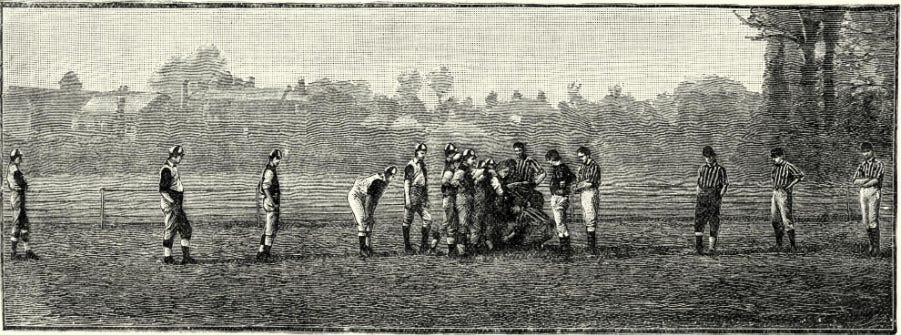
We need to begin with the games being played in English public schools in the middle of the 19th century. For non-British readers it is worth noting that the world “public” here does not mean state-operated and open to all. These schools were – and are – the antitheses of such establishments: all-male boarding schools that charge significant fees for the privilege of attendance. On the pitches of these schools a variety of games called “football” were being played and in time they began to codify their rules. The earliest surviving “school code” were the Rugby School laws, approved on the 28th of August 1845. The game they describe is, unsurprisingly, very different to football and, err, very much like rugby. The earliest surviving rules for Eton College’s Field Game date from just two years later, and include the crucial clause “Hands may only be used to stop the ball”. They also had an offside rule (which they called “sneaking”)2 in order to prevent attackers simply hanging around their opponent’s goal waiting for a ball to be kicked their way.
Schools including Harrow, Westminster, and Shrewsbury similarly had their own versions of the game, and in concert these educational establishments did much to form the institutional nature of the sports They made football games regular events where matches were attached to the school calendar rather than confined to an occasional festival. With boys representing houses, forms or schools, they encouraged fixed sides, with collective tactics and enduring loyalties. And they also debated, agreed, and recorded, codes for the game and then old boys took their rules to universities, military units, churches, businesses and adult clubs.
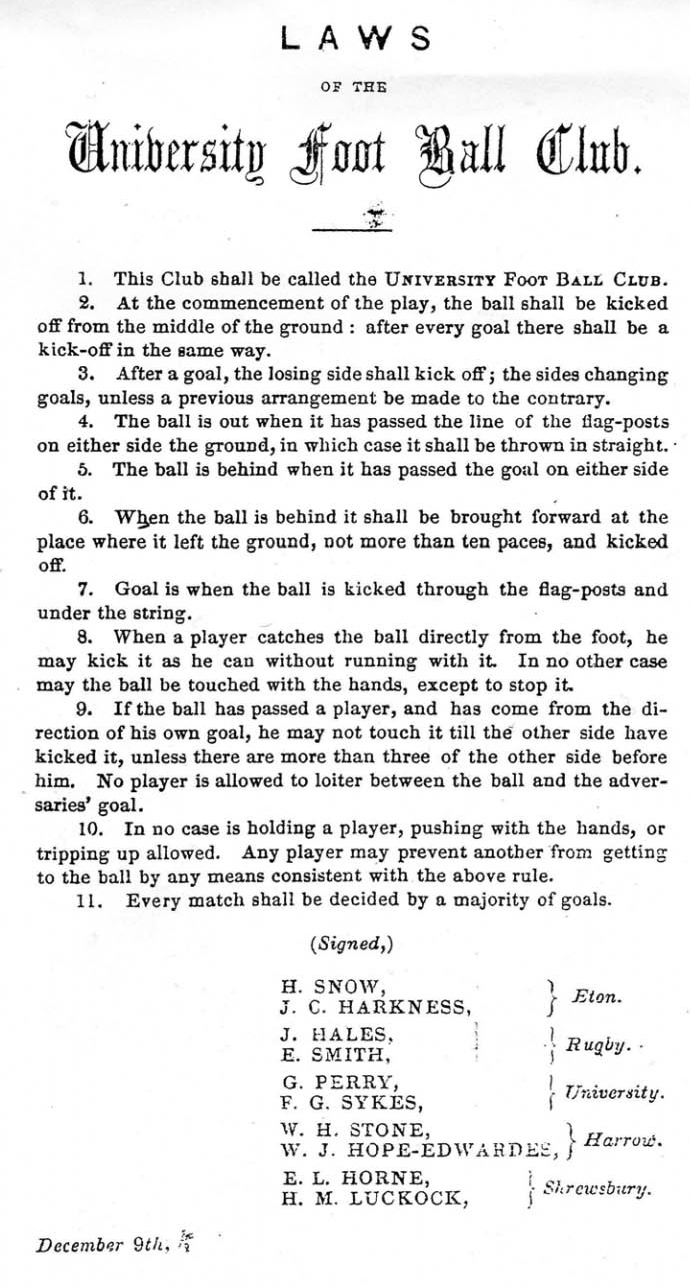
There was, however, a problem. It still wasn’t easy for the schools to play against each other because the sides would be familiar with different sets of rules. What was needed was a melting pot to blend all of the variations together, and it turned out that Cambridge University was just the place for this to happen. Old boys of the various schools wanted to play football, and they needed a unified set of rules to do so, and these rules were created. The earliest surviving set dates from 1856, but it drew upon, now lost, codes from earlier decades:
Football wasn’t just the preserve of public school boys though, versions of the game were being played by factory workers and miners and railwaymen across the country. In 1855 in Sheffield the members of the local cricket club started having informal kick-abouts and enjoyed them so much that two members, Nathaniel Creswick and Willian Prest decided to set up a dedicated football club. The first meeting of Sheffield Football Club (the oldest, continuously operating independent football club in the world) took place on the 24th of October 1857 and it was clear that a codified set of rules was needed to govern their play. These were drawn up by Creswick and Prest and approved at the club’s AGM on the 21st of October 1858:
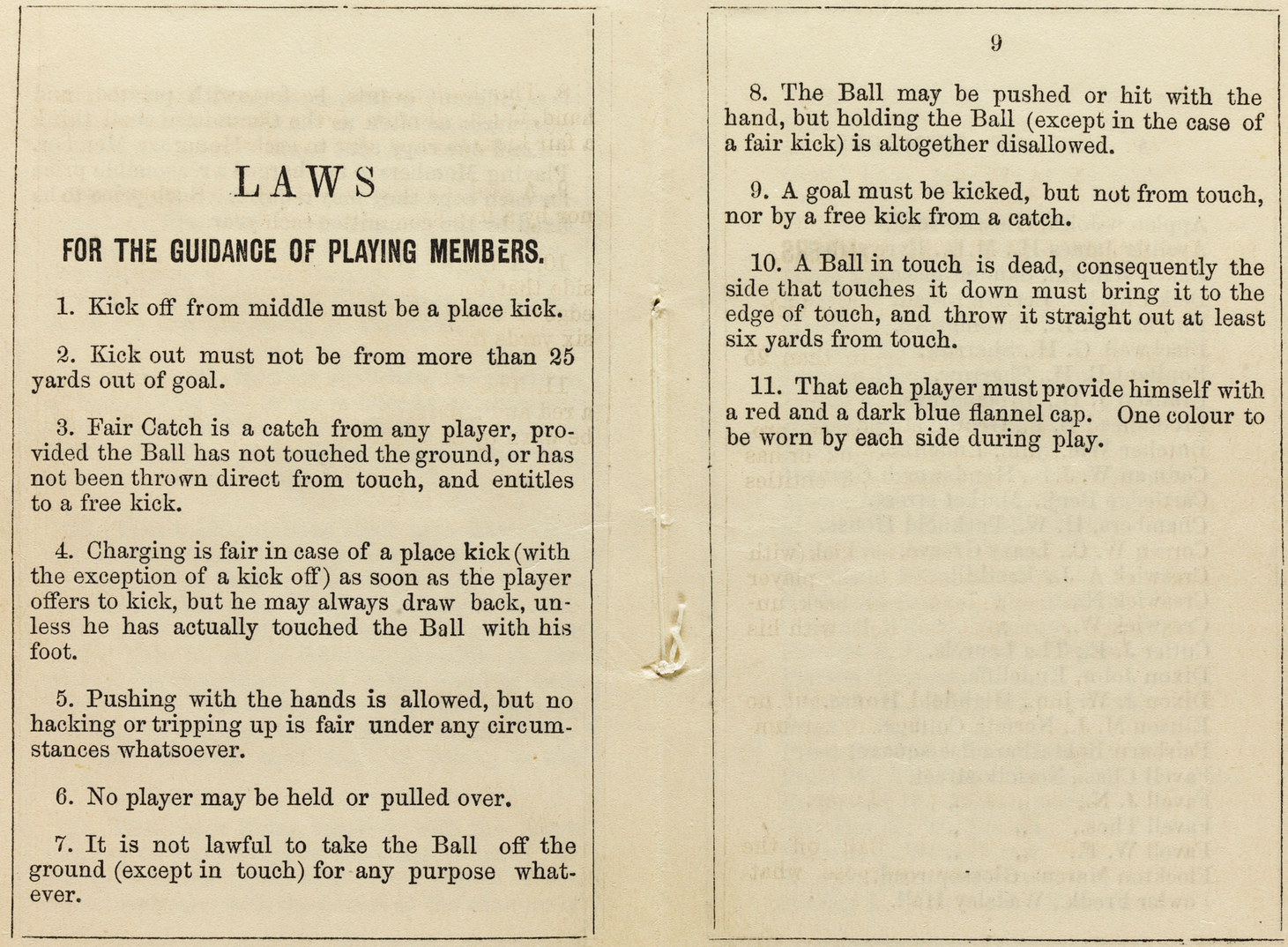
As you can see, this allowed for some handling of the ball and had no offside rule but they proved popular, and other teams soon adopted them. At the code’s height in 1877 there were 27 clubs making up the Sheffield Football association. This was not, however, the only game in town. Okay, it was the only game in Sheffield, but you get what I mean. Many clubs had sprung up in London as well and they too needed an agreed set of rules by which to play. Ebenezer Cobb Morley, captain of Barnes Football Club, argued that football needed an institution comparable to the Marylebone Cricket Club and in 1863 he wrote to the sporting press proposing just such a governing body. Representatives of London and suburban clubs met at the Freemasons’ Tavern in Great Queen Street on 26 October 1863 and formed the Football Association. Its stated objective was “establishing a definite code of rules for the regulation of the game”.3
It turned out that this wasn’t that straightforward. Rival factions debated whether “hacking” (deliberately kicking an opponent in the shins) and the use of hands should be allowed over the course of six meetings. The final laws were approved on the 8th of December 1863 and were as follows:
THE LAWS OF FOOTBALL
Drawn up by the London Association
LAWS
1. The maximum length of the ground shall be 200 yards, the maximum breadth shall be 100 yards, the length and breadth shall be marked off with flags; and the goals shall be defined by two upright posts, 8 yards apart, without any tape or bar across them.4
2. The winner of the toss shall have the choice of goals. The game shall be commenced by a place kick from the centre of the ground by the side losing the toss, the other side shall not approach within 10 yards of the ball until it is kicked off.
3. After a goal is won the losing side shall kick off and the goals shall be changed.
4. A goal shall be won when the ball passes between the goal posts or over the space between the goal posts, at whatever height, not being thrown, knocked on, or carried.
5. When the ball is in touch the first player who touches it shall throw it from the point on the boundary line where it left the ground, in a direction at right angles with the boundary line, and it shall not be in play until it has touched the ground.
6. When a player has kicked the ball any one of the same side who is nearer to the opponent’s goal line is out of play, and may not touch the ball himself, nor in any way whatever prevent any other player from doing so, until the ball has been played; but no player is out of play when the ball is kicked from behind the goal line.
7. In case the ball goes behind the goal line, if a player on the side to whom the goal belongs first touches the ball, one of his side shall be entitled to a free kick from the goal line, at the point opposite the place where the ball shall be touched.
If a player of the opposite side first touches the ball, one of his side shall be entitled to a free kick, but at the goal only, from a point 15 yards from the goal line opposite the place where the ball is touched.
The opposing side shall stand behind their goal line until he has had his kick.
8. If a player makes a fair catch, he shall be entitled to a free kick, provided he claims it by making a mark with his heel at once; and in order to take such a kick he may go back as far as he pleases, and no player on the opposite side shall advance beyond his mark until he has kicked.
9. No player shall carry the ball.
10. Neither tripping nor hacking shall be allowed, and no player shall use his hands to hold or push an adversary.
11. A player shall not throw the ball or pass it to another.
12. No player shall take the ball from the ground with his hands while it is in play, under any pretence whatever.
13. No player shall wear projecting nails, iron plates, or gutta-percha on the soles or heels of his boots.
Hang on a second, didn’t I just say that the peak of the Sheffield Code was in 1877, some 14 years later? Does that mean that both football codes were operating at the same time? Yes, and not just these two, there were others, most notably in Scotland. This obviously caused problems when teams from the different associations faced each other. Whose code should they follow, or should they follow an amalgamation of the two?
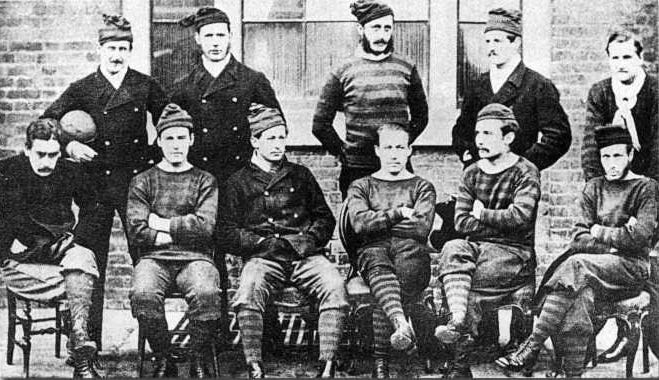
Despite these challenges the first Football Association Challenge Cup, better known as the FA Cup today, took place in the 1871–2 season, using the FA code, and it remains the oldest association football competition the world. The final took place on the 16th March 1872 where the Wanders beat the Royal Engineers 1:0.
I will spare you too much detail, but eventually a unified code combining parts of the Sheffield, FA codes with input from the Scottish club Clydesdale, was agreed, as reported in the Sheffield and Rotherham Independent on the 24th April 1877:
A meeting of the Sheffield Football Association was held last evening at the Imperial Hotel, Castle street; Mr. Dickinson presiding. Mr. W. Peirce Dix, hon. secretary, rendered a report of his recent visit to the London Association meeting in the metropolis, and described the views which guided those present in arriving at the resolution submitted by the Clydesdale Club, and supported by the Sheffield Association. He referred to the excellent speech made by Mr. Alcock in support of the proposal, and said the result was highly gratifying to the Sheffield Association. It was then formally resolved, on the motion of Mr. W. E. Clegg, seconded by Mr. Skinner, that the Sheffield Association accept the Clydesdale amendment and the London Rules.
So we have got to the point where Britain has a single agreed set of football rules, but how then did these get propagated around the world and the game be adopted with such global fervour? In the last quarter of the 19th century, Britain (and its empire) accounted for around a quarter of the world’s GDP, and a similar share of its manufacturing output. British companies and British people were scattered across the globe building railways, running mines, and setting up a host of trading and manufacturing operations. And where they went, they took (often quite literally) football with them. They were also the first and only nation to have a codified, published, set of rules that could be distributed.5
Let’s start by looking at Brazil. For sure people had been kicking balls around there for a while, but the development of the formal game can be traced back to one Charles William Miller (1874-1953).6 He was born in São Paulo to a Scottish railway engineer father and a Brazilian mother of English descent. Educated in England, where he excelled at sports, he returned to the country of his birth in 1894 bringing along two footballs, a pump, some boots, and a set of rules from the Hampshire Football Association. On the 14th April 1895 he arranged the game that is seen as the symbolic beginning of organised football in Brazil. Teams representing employees of the São Paulo Railway Company and the São Paulo Gas Company played under association rules with Miller appearing for the railway side (which won 4–2). Miller went on to form the São Paulo Athletic Club, the first club in the country, and the first football league that survives to this day as Campeonato Paulista Série A1, the top-flight of Brazilian football.
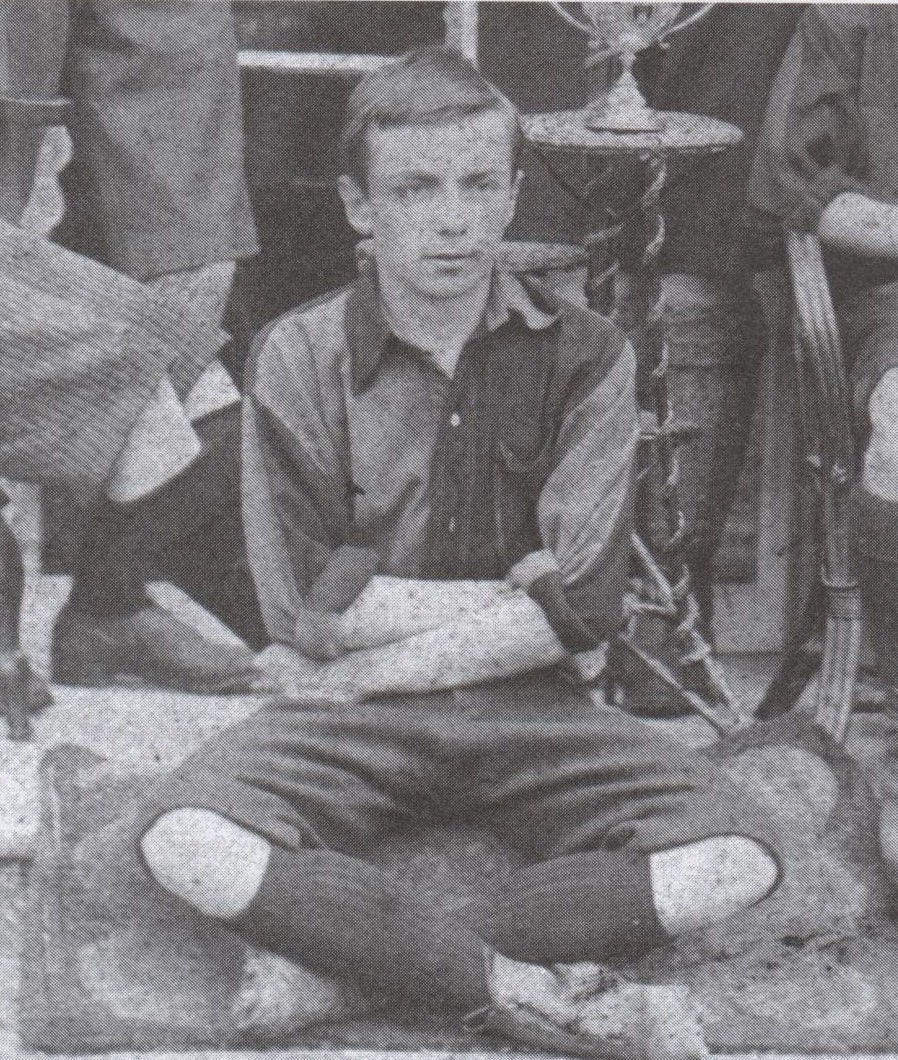
In northern Italy, particularly in the cities of Turin, Genoa, and Milan British sailors and merchants introduced their version of the rules of the beautiful game. Edoardo Bosio, a Turin businessman working in textiles encountered the game in Nottingham and in 1887 founded the Torino Football and Cricket Club – the first association football club in the country. A few years later, on the 7th of September 1893 a group of British ex-pats founded Genoa Cricket and Athletic Club which competes in the top-flight of Italian football today as Genoa CFC. And then there is one of the most famous of all Italian teams, AC Milan. Have you ever wondered why the English name of the city is used, rather than the Italian Milano? Well, that is because it was founded by a bunch of Brits and Italians as the Milan Football and Cricket Club.7
The rise of football in Germany turned to be a little bit more challenging. The country prided itself on its physical-culture tradition of Turnen (organised gymnastics). This was seen to promote bodily discipline, collective order, patriotism, and national regeneration. Gymnastic societies – Turnvereine – performed regulated exercises, often in synchronised groups and under formal instruction. Football, however was seen to provoke competition, violence, and individual initiative. The detractors of the game used terms such as Fußlümmelei, approximately “football loutishness”, and referred to the game as an englische Krankheit – an “English disease”. Rules and kit made their way into the country though, usually in the hands of returning German teachers. Arguably the first game of Association Football in the country tool place in Lüneburg in August of 1875, at the Johanneum school, organised by teacher Wilhelm Görges and the Australian-born Richard Ernest Newell Twopenny.8
Now let’s turn to the winners of the first World Cup, in 1930, Uruguay. The country had strong commercial connections to Britain in railways, banking, meat packing, and other industries and as they did everywhere else the ex-pats set up their own sports and social clubs. The Montevideo Cricket Club9 was established in 1861 and whilst cricket was its principal purpose, its members also experimented with rugby and different forms of football. The club records a football match against the crew of a visiting vessel in 1878, while the first generally recognised match between two established Uruguayan clubs was played in 1881, between them and the Montevideo Rowing Club. The person who is considered to be the “Father of Uruguayan Football” comes on the scene a little later, and was the Anglo-Scot William Leslie Poole (1866-1931). He started working as a teacher in the English High School in 1885 an enthusiastically taught the game to his charges. One of them, Henry Candid Lichtenberger founded the first Uruguayan10 football team on 2 June 1886, the Club Albion which plays at to this day at the country’s highest levels. Poole, amongst other things, was the president of the nascent Uruguayan Association Football League (founded 1900) and played for the country itself.
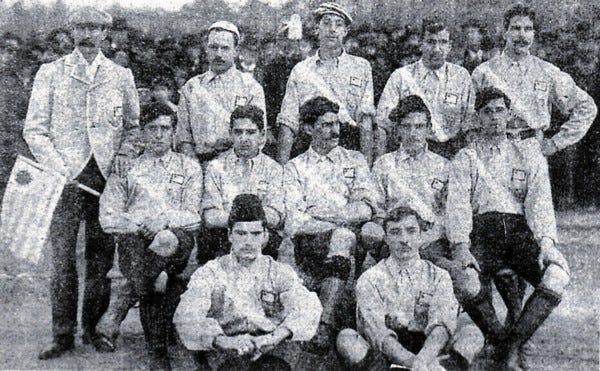
All around the world you will find the echos of the British influence recorded in the names of teams. Wanders, Juniors, Albion, Old Boys and so on. I could write half a dozen more posts delving into the stories behind these, but I will end by considering one final country, Argentina, with whom it is fair to say England has a bit of football history. In seven hours time, as I write this, we will face them in the World Cup Semi Final, but were we responsible for introducing the sport to arguably our greatest nemesis? Obviously yes.
The generally accepted starting point for the official form of the game took place on the 9th May 1867 when two Yorkshire-born members of the British ex-pat community in Buenos Aires, Thomas Hogg and his brother James, convened a meeting to form the “Buenos Ayres Football Club”, with matches to be played at the ground of the local cricket club. An inaugural match was originally intended for 25th May, but bad weather caused its postponement and it was eventually played on 20th June 1867. Only sixteen players could be assembled, so the sides consisted of eight men each rather than eleven. They were distinguished by coloured caps – one side red, the other white – rather than by complete uniforms. The match lasted approximately two hours, and Hogg’s side reportedly won 4–0.
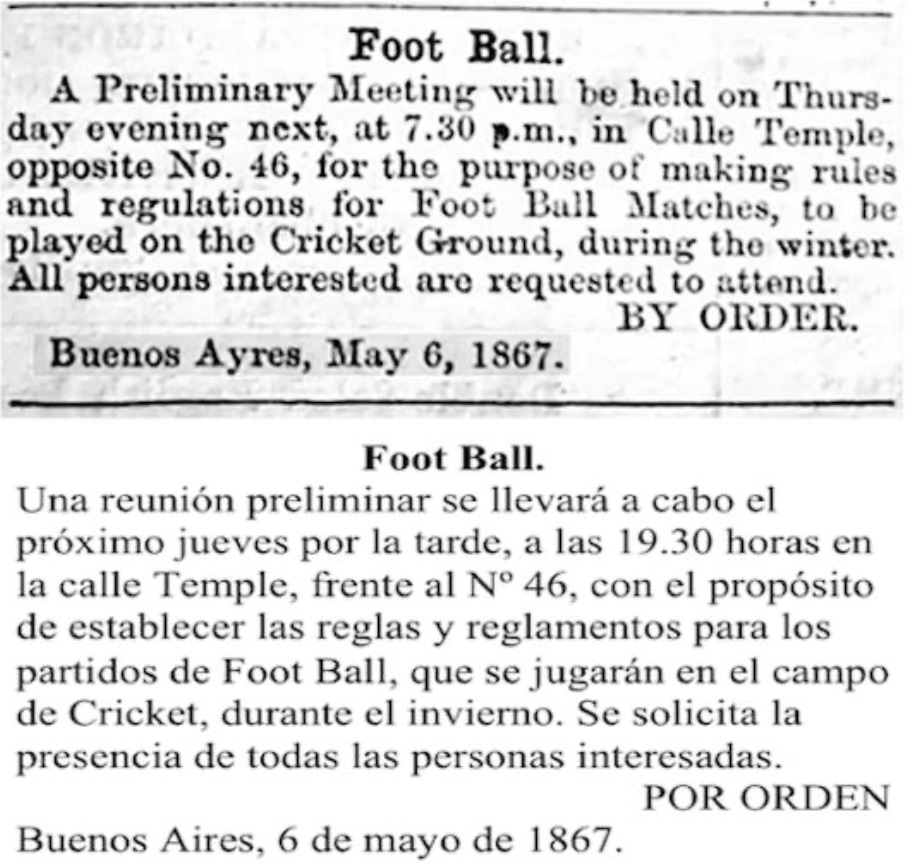
Thomas Hogg was somewhat pessimistic about the enthusiasm for the game, as this statement attributed to him attests:
This game will take a long time to spread even among British residents, but I intend to persist, because I consider it the best, easiest and cheapest pastime for middle-class youth, as well as for the common people.
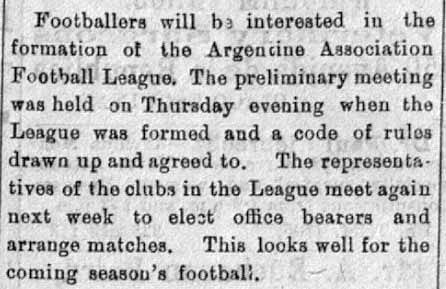
Hogg was not wrong, the sport continued to be played, for sure, but didn’t really take off until the arrival of the Scottish educator Alexander Watson Hutton who established the Buenos Aires English High School in 1884. This soon became a nursery for football, and the boys who learned there took the game with them as they moved into the world of work. In 1893 Hutton helped establish the Argentine Association Football, the predecessor of the current Argentine Football Association.11 Lest you doubt the extent to which the British helped create the opponent that England will face tonight, a notice telling people about the formation of the body that today runs the national team was published in English:
Before I started researching this piece I have to admit that I would cringe slightly at the whole “football’s coming home” thing.12 Not because of its (till now, at least) misplaced optimism, but rather than it smacked a little of embarrassing jingoism. Was England really the “home” of football? Clearly not alone, as Scotland played a pivotal rule in formalisation and internationalisation of the game that is played today, but it is hard to deny that had it not been for Britain both codifying rules and and spreading the game around the world then things would be very different today.13 Perhaps another country would have created their own code, and popularised it, but more likely it seems multiple codes would have arisen, and no ready winner would have been emerged. Things may have coalesced in time, but it is difficult to believe that the sport would be followed – and played – at quite the same scale that it is today.
Will football “come home” this year? I don’t think so, England has to beat Argentina and then Spain, and the odds look to be against them. Obviously I could re-edit this piece once that I know the result, to create the illusion of foresight, but I promise that I won’t!
I have to say that this sounds way more fun than 22 players.
I love the idea of it being called “the sneaking rule” as opposed to “the offside rule”.
Ignoring the fact that such a code had already been created in Sheffield some five years earlier.
Yes, there was no single, set, size for the pitch!
Okay, I know that the Melbourne Rules were first written in May 1859, which led to the modern game of Australian rules football.
Some say that Thomas Donohoe, another Scot, brought over a football in 1894 and arranged the first formal game, but let’s not get into that now.
It is a shame that the Italians (and indeed, the South Americans) didn’t embrace cricket with the same enthusiasm that they did football, as it could be a much more widely-played sport today as a result.
What a brilliant name!
Despite its name it was also the first rugby club founded outside of the UK.
As opposed to ex-pat.
And earlier league had been set up in 1891 but faltered.
For non-British readers, this written about, chanted, and sung to excess whenever England plays in an international competition.
Things were also helped by British teams touring internationally and playing against local sides.